From Kandy to Jaffna: Inside Palitha Bandara's Online Bookstore, Book Bank
An author of astronomy books, a self-taught website builder and an independent bookseller, Palitha Bandara is trying to make books easier to find across Sri Lanka. But running an online bookstore presents challenges that customers rarely see.
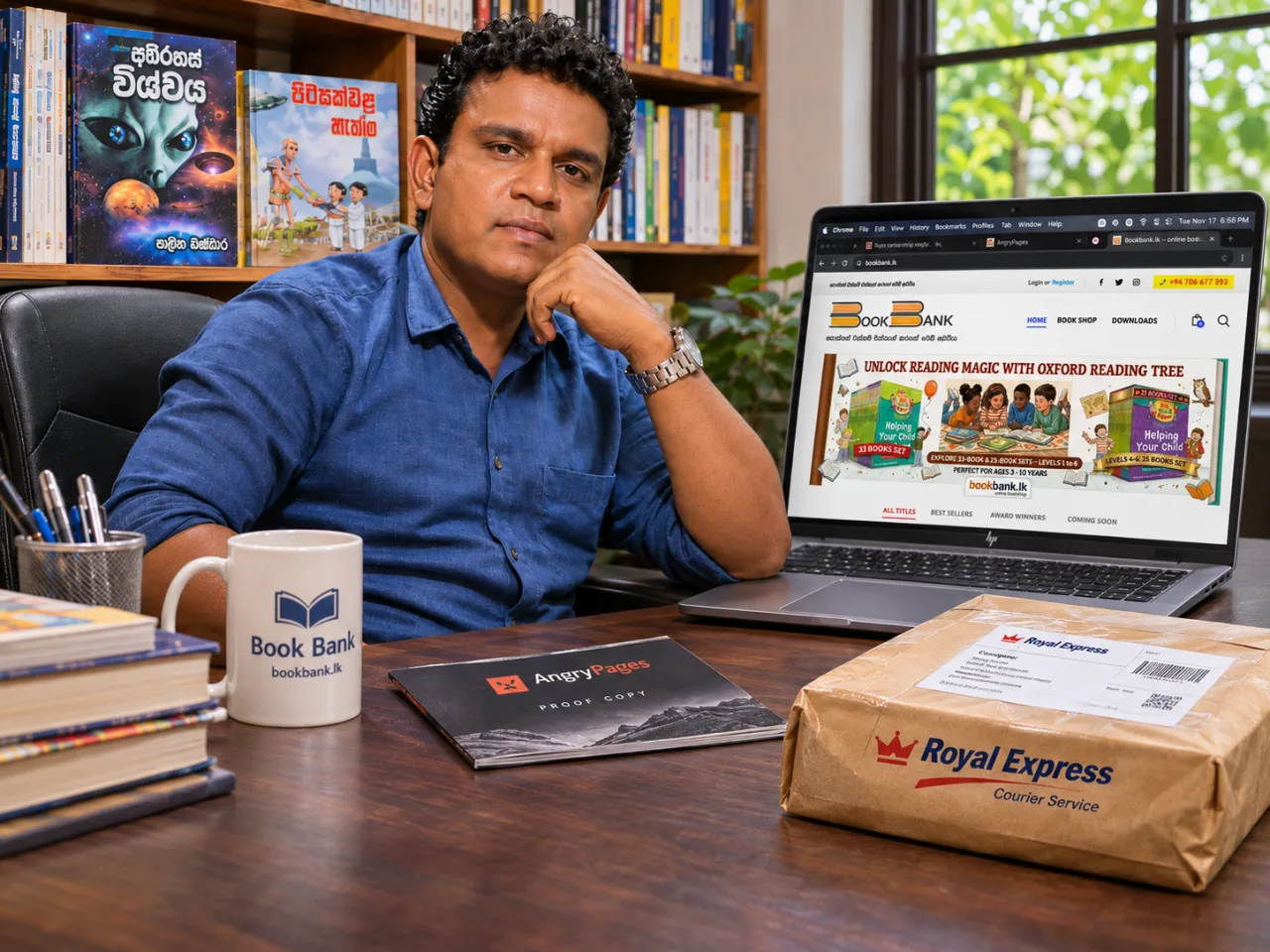
A customer in Jaffna orders a book. The bookseller is in Kandy. Somewhere between the two, a printed book needs to be located, packaged and delivered, often for a relatively small profit.
For Palitha Bandara, the entrepreneur behind Book Bank, this is an ordinary part of running an online bookstore in Sri Lanka.
Bandara doesn't operate a conventional walk-in bookshop. Instead, he manages his business online, maintains selected physical inventory and works with suppliers and couriers to fulfil orders.
In telephone conversations with AngryPages, he described supplying customers in places including Jaffna, Hambantota and Ampara. Some deliveries, he said, have reached customers the following day, although this should not be understood as a guaranteed delivery time.
What makes Bandara's story interesting isn't simply that he sells books online. It's that he is also an author who has written about astronomy, and a website builder who developed much of his own digital business.
The author behind the bookstore
AngryPages asked Bandara what inspired him to become a bookseller.
"Book Bank was started out of my passion for books and my belief that reading can transform people's lives," he explained in his written interview.
For him, reading is not merely a commercial activity. He described books as sources of knowledge, imagination, inspiration and personal growth.
That interest has also led him into writing.
During our conversations, Bandara discussed several books he has written, including works on astronomy. He has promised to share a digital copy of one of those books with AngryPages.
His experience as an author gives him a perspective that a conventional retailer may not have. He understands that books begin with somebody's effort to communicate an idea, not merely with an item appearing in a catalogue.
But his interests extend beyond writing.
Bandara also built his own online storefront using WordPress and WooCommerce, seeking assistance from programmers when technical problems arise. He has since begun developing a second venture, eBook Nexa, focused on digital publications.
The result is a business in which its owner handles several distinct jobs: bookseller, author, website administrator and stock manager.
What happens after someone orders a book?
One of the more revealing parts of our conversation concerned inventory.
Bandara doesn't purchase every title advertised on his website in advance.
He explained that he keeps selected educational books in stock, including English-medium Advanced Level materials. Other titles may be sourced from suppliers after an order arrives.
For example, he described obtaining certain Buddhist publications through nearby sellers in Kandy rather than maintaining substantial quantities of every title himself.
This approach reduces the amount of money tied up in unsold books. It also means that availability can depend on suppliers, not just the bookstore's own stock.
For customers, that distinction matters.
Someone ordering an examination guide may need a particular edition before a school deadline. Another customer looking for an imported novel may care more about the edition, price and delivery cost.
Checking these details before ordering can prevent disappointment, particularly when a title needs to be sourced.
Bandara's experience also illustrates a wider challenge for independent booksellers: a large catalogue is useful only if the business can reliably obtain and deliver what customers order.
Why physical books remain important
When AngryPages asked which three categories he would recommend, Bandara chose Buddhist publications, children's books and eBooks.
The selection reveals two sides of his business.
Buddhist books, children's literature and educational publications serve established reading needs. Digital books represent a different opportunity, one that doesn't require physical storage or courier delivery.
Book Bank also offers English novels, imported titles and school examination resources.
Bandara told AngryPages that local publications can produce relatively narrow margins, while competition among importers is placing pressure on returns from imported books as well.
Holding inventory carries its own risks. A book that remains unsold still represents money that has already been spent.
These pressures help explain why Bandara is interested in digital publishing.
But the economics of an eBook are not the same as demand for one.
Bandara acknowledged that his digital sales in Sri Lanka have been relatively modest. Selling a downloadable product removes printing and delivery requirements, but it doesn't automatically create customers.
That is an important distinction for publishers considering a move from print to digital.
Can a Sri Lankan bookseller reach international readers?
Alongside Book Bank, Bandara is developing eBook Nexa, a separate digital-book venture.
He told AngryPages that he hopes to reach readers in the United States and United Kingdom, while continuing to serve customers in Sri Lanka.
Digital distribution could make that possible without the cost of shipping individual books overseas. However, international sales also bring practical questions about payment processing, customer access, copyright permissions and competition.
Those are challenges that Bandara is still working through.
For authors and publishers, a bookseller with both physical and digital capabilities could provide more than one route to customers. The commercial arrangements, distribution rights and responsibilities would still need to be agreed upon for each title.
Bandara's ambition is therefore understandable, but success will depend on more than opening another website.
It will depend on finding books that readers genuinely want, selling them at workable prices and making the purchasing experience reliable.
What should readers know about Book Bank?
For readers considering an order, Book Bank is primarily an online bookstore rather than a conventional retail shop.
Its catalogue includes local and imported publications, educational titles, children's books, Buddhist books and digital editions.
Physical orders are handled through a delivery network. Customers buying a time-sensitive title should confirm availability, the required edition and the expected delivery date. For eBooks, it's worth checking the download format and access conditions before purchasing.
Asked about his longer-term plans, Bandara said he wants to expand the selection of English novels, children's titles, educational publications and international books, while improving customer service and delivery.
He also hopes to make his books accessible to readers beyond Sri Lanka.
There are no guarantees that every part of that ambition will be realised. Independent bookselling is competitive, and Bandara is operating in a market where both customers and merchants are sensitive to price.
But there is something distinctive about a bookseller who writes his own books, manages his website and personally deals with the practical problems of getting orders to readers.
Bandara's business is not a story about technology replacing traditional bookselling. It is a story about one bookseller using technology to extend what he can do.
And behind the website remains the same motivation he described at the beginning of our interview: a belief that reading can change lives.
Book Bank: bookbank.lk
eBook Nexa: ebooknexa.com
Reporting note: This article draws on telephone conversations between Lehan Edirisinghe and Palitha Bandara, supplemented by Bandara's written interview responses in November 2026. Quotations are drawn from his written responses. Business operations and future plans are reported from his account and are not independently audited.
Disclosure: AngryPages and Book Bank have discussed possible book-distribution arrangements. No completed partnership is implied by this article.