Good Night, Laundry: The Thirty-Second Question That Saves the Day
Sharanga Senanayake’s funniest workplace stories expose a serious management mistake: assuming an instruction has been understood because it has been delivered.
A hotel laundry has been taught how to answer the telephone. Before noon, good morning. After noon, good afternoon. After four, good evening.
Then somebody calls around midnight.
“Good night, Laundry. How may I help you?”
In The Corporate Ball Game, Sharanga Senanayake remembers the laughter that followed. A staff member had learned the shape of the instruction without quite grasping its purpose. The greeting sounded polite. It also sounded like the end of the conversation.
It is a small hotel story with a much larger audience. Anyone who has sent a clear email and received the wrong result knows the territory.
The missing step is what comes back
Managers often judge communication by what they have said. The instruction was specific. The explanation was given. The meeting happened. What else could anyone want?
Evidence of understanding would be a useful addition.
Sharanga’s story makes the gap visible without a management diagram. The employee can produce a plausible phrase, but the meaning has shifted. Remembering the words has not quite produced the intended behaviour.
A second hotel anecdote raises the stakes. A chairman asks for a wake-up call at five in the morning. The receptionist records the room but omits the time. Rather than ask the chairman again, he consults the driver, who plans to rise at three to prepare the car and himself.
The receptionist supplies the missing link through an assumption. If they are travelling together, perhaps they should wake together. The chairman receives his call two hours early.
The driver has answered a question about his own arrangements. He has not changed the chairman’s instruction.
A sensible answer to the wrong question
That distinction makes the second story especially useful. The receptionist has not simply forgotten to act. He has taken action to resolve uncertainty, but he has gone to a source that cannot establish the fact he needs.
A missing detail has become somebody else’s timetable, then a confident decision.
The same pattern can appear in an ordinary office. A colleague knows when they need their portion of a project. That does not necessarily establish the client’s deadline. A person knows their own access permissions. That does not determine another person’s authority to approve a payment.
These are applications of the lesson, rather than events Sharanga claims to have witnessed. The practical question is the same: does the person being consulted actually know, or have the authority to settle, the missing detail?
Sharanga’s conclusion is direct: “If an important detail is missing, clarify it.”
Close the loop without making a ceremony of it
The Agency for Healthcare Research and Quality describes a check-back as a closed-loop communication technique. The recipient acknowledges and repeats the information; the original sender confirms that it has been understood accurately. Its published guidance concerns healthcare teams, not evidence about these hotel incidents. The mechanism nevertheless offers a useful comparison. AHRQ, Check-Back
In a workplace, the idea need not become a performance of managerial seriousness. For a consequential instruction, ask the recipient to confirm the action, time and person responsible. Correct any mismatch while both people are still available.
For training, ask what someone would do in a slightly different situation. The midnight greeting is exactly such a test: does the employee understand the purpose well enough to adapt?
Not every conversation needs this treatment. Routine exchanges can remain routine. The question is where misunderstanding would create rework, cost or harm—and whether a brief confirmation would prevent it.
Humour that leaves something useful behind
Sharanga writes from years in finance, auditing and corporate life. His collection moves through hotels, offices, travel and the awkward moments people would often prefer to forget.
The appeal is not that every remembered exchange supplies a universal rule. It is that a recognizable human mistake can make an abstract lesson memorable. The sleepy greeting stays with us. So does the chairman being woken too early.
There is generosity in learning from the joke before becoming the next person inside it. A manager can make uncertainty easier to disclose. An employee can ask for the missing fact rather than manufacture one. Both can check that the intended action survived the conversation.
The extra question may take thirty seconds. The wrong wake-up call lasts considerably longer in everybody’s memory.
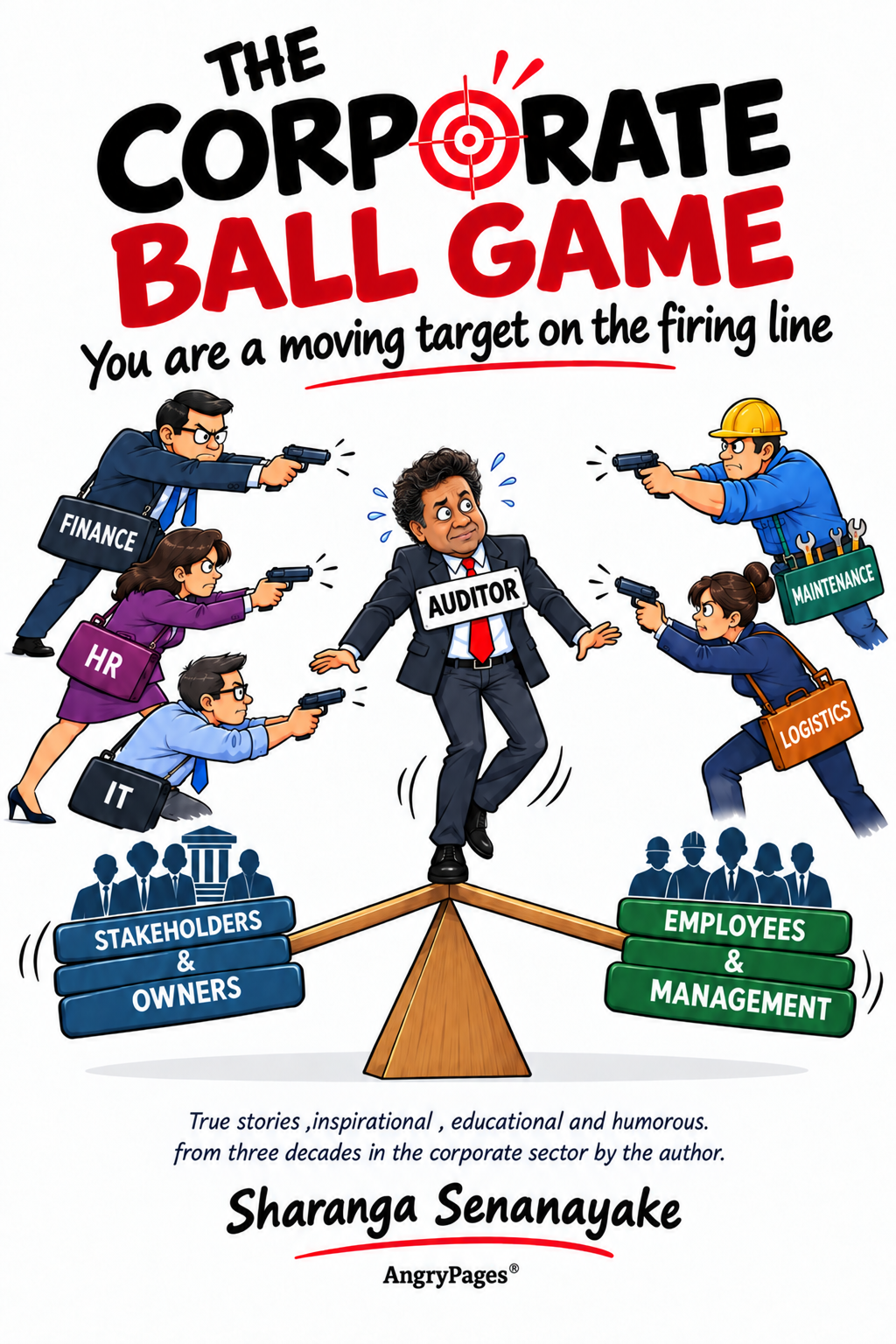
Explore The Corporate Ball Game, Sharanga Senanayake’s collection of firsthand corporate stories. Available for $6.50, with a free opening preview.
References
- Sharanga Senanayake, The Corporate Ball Game. “Good Night Laundry” and “Take Instructions from Me or the Driver?” are the source anecdotes; dialogue is presented as remembered in the book.
- Agency for Healthcare Research and Quality, “Tool: Check-Back (or Repeat-Back)”. Accessed 3 November 2026. Supplies the communication technique, not independent confirmation of the anecdotes.