The Succession Test: Can the Work Continue Without You?
Preparing another officer to take over gave Hemasiri Wijayagunawardane room to learn—and left the squadron stronger.
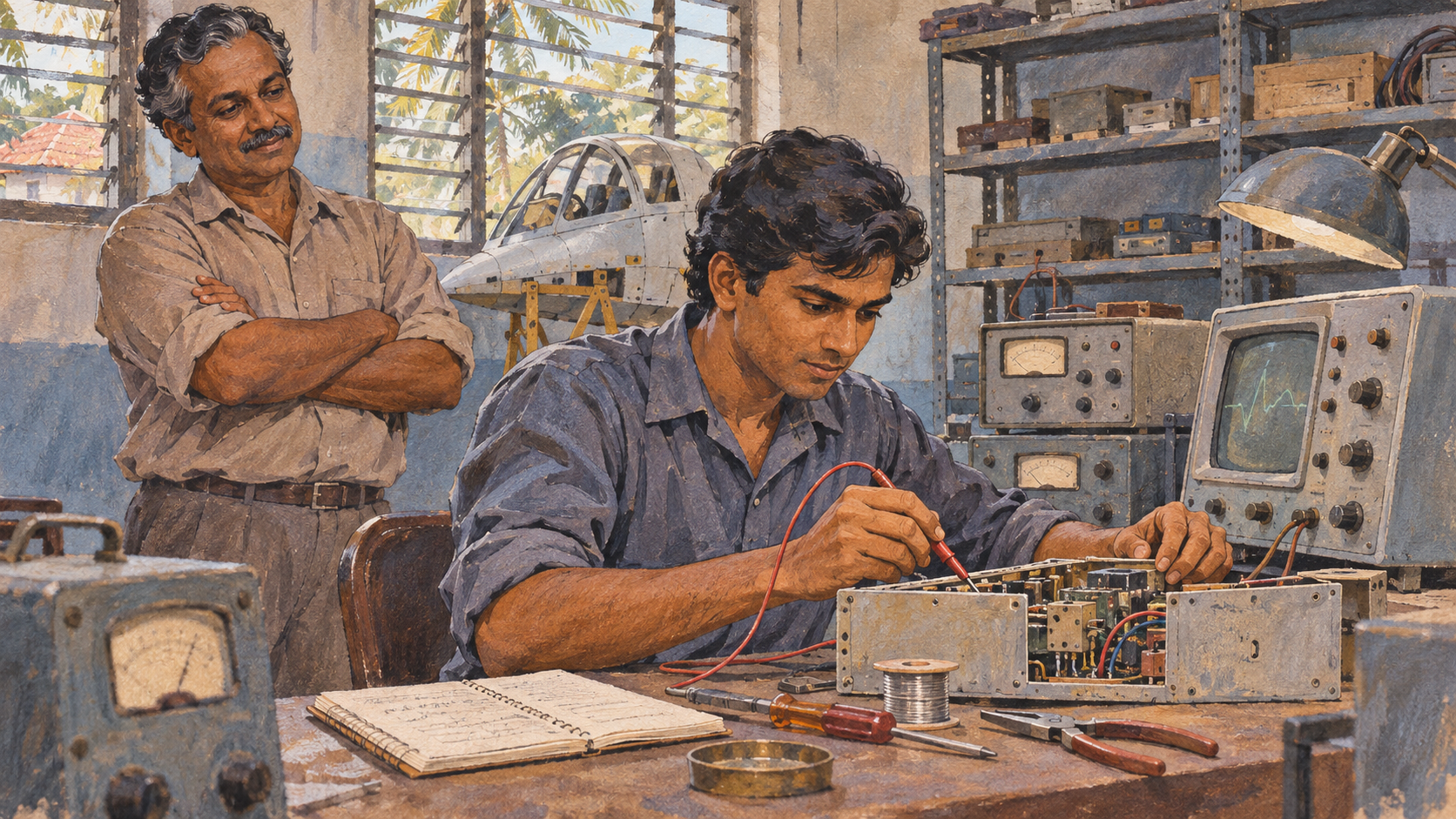
AI-generated conceptual illustration of mentoring; people and equipment are not documentary depictions.
The course was available. The nomination had arrived. Hemasiri Wijayagunawardane could pursue advanced electronics training in India—provided somebody was ready to take over his work.
His squadron needed continuity. An officer’s opportunity to develop could not leave the avionics section unable to function.
In Dust to Sky, the problem is resolved through a colleague who has already shared a training opportunity. That earlier investment in another person now makes a new departure possible.
Hemasiri writes: “Training someone to replace a boss is not always easy.”
The sentence is brief. The account that surrounds it gives the work behind it.
Succession began before it became urgent
The officer brought back to prepare for the role had trained with Hemasiri in Israel. He already possessed relevant second-line maintenance experience.
The preparation therefore began with something more substantial than a job title and a hurried explanation. There was shared technical ground on which to build.
Earlier in the memoir, when asked to recommend technicians for overseas training, Hemasiri chose two experienced colleagues who had worked beside him on F-7 modifications. He remembered what they had contributed, including work that could not be fully represented in a personnel file.
That is a separate training decision, but it belongs to the same pattern: opportunities expand the competence of the group when the people doing the work can share in them.
A course becomes more than one individual’s credential if its learning returns to colleagues and changes what the team can do.
Handing over meant allowing him to manage
The crucial passage describes responsibility moving in stages:
“I gradually handed responsibilities over to him and, eventually, allowed him to manage the avionics section almost completely without my involvement.”
There is a distinction between explaining a job and letting another person exercise it. The first can happen while the expert continues making every consequential decision. The second requires the expert to give the learner room.
Hemasiri reports that the officer performed well and that the Commanding Officer was satisfied. He could leave for the course.
We should not manufacture a formal assessment framework around that recollection. The memoir does not provide one. It does, however, identify a meaningful test: the colleague was actually managing the section with very little involvement from the person he would replace.
The evidence of readiness came from doing the work.
Knowledge continuity is everyday work
NASA’s guide for supervisors treats knowledge transfer as part of technical work, rather than something to begin only when departure is imminent. It recommends mentoring, cross-training, accessible documentation and planned overlap with a successor. It also asks leaders to notice where critical knowledge belongs to only one person. These are institutional practices, not findings from a controlled experiment. NASA, Knowledge Continuity: A Guide for Supervisors, pp. 2–4
That guidance gives the memoir episode a useful present-day comparison. A handover is easier when others have already had access to the work. A folder prepared on the final afternoon cannot supply months of shared experience.
The guide does not independently confirm events in Hemasiri’s squadron. It helps explain why the method he remembers—prior exposure followed by increasing responsibility—is worth a manager’s attention.
Making room for somebody else also made room for him
Being depended upon can feel like professional security. It can also limit movement. A person becomes so central that studying, taking leave or moving to another role creates a crisis.
In this episode, preparing a successor serves both the organization and the individual. The squadron keeps its capability. Hemasiri gains room to develop his own.
A manager reading it could begin with three questions: who can perform the essential work in my absence, what have they already been allowed to practise, and where do I still answer every difficult question myself?
These are questions drawn from the account, not a claim that one arrangement suits every workplace. Necessary competence, supervision and safety requirements still determine what can be delegated and when.
The deeper satisfaction in Hemasiri’s story is that another officer becomes capable of carrying responsibility. The achievement continues without its original holder at the centre.
A career can leave behind completed assignments and certificates. It can also leave behind people able to do more than they could before.
That second legacy is visible when the work continues—and somebody else has the confidence to lead it.
Selected excerpts from Dust to Sky are reproduced with Hemasiri Wijayagunawardane’s permission. The full memoir traces the shared learning, technical work and friendships behind this handover.
References
- Hemasiri Wijayagunawardane, Dust to Sky. “Between Duty and Dreams,” with earlier training context from “From China Bay to Tel Aviv” and “Kfirs in Operation.” Primary memoir evidence for preparation and delegation.
- NASA, Knowledge Continuity: A Guide for Supervisors, pp. 2–4. Undated guide, accessed 3 November 2026. Practical guidance on retaining knowledge through staff transitions; not independent verification of the memoir.