Why I Am Watching Vijay From Sri Lanka

Why I Am Watching Vijay From Sri Lanka

Why I Am Watching Vijay From Sri Lanka

Why I Am Watching Vijay From Sri Lanka

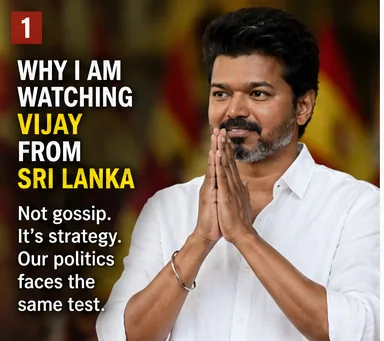
I am not watching Vijay’s rise as a distant Tamil Nadu story.

I am watching it from Sri Lanka because it feels close.

We know this kind of politics. We know the pull of a familiar face. We know what happens when people get tired of the old parties and begin looking for someone who feels new, clean, strong, and outside the usual room.

Vijay matters because he is not only a film star entering politics.

He is a test.

Can a person who carries feeling become a person who carries a state?

That is the question.

Sri Lanka should watch carefully because we have made the same mistake many times. We fall in love with the entrance. We enjoy the fall of the old villain. We celebrate the new face.

Then comes the hard part.

Prices. Jobs. schools. hospitals. debt. courts. police. corruption. promises. files. delays. anger.

The crowd can cheer a hero.

A country needs more than that.

Why I Am Watching Vijay From Sri Lanka (2/12)

Why I Am Watching Vijay From Sri Lanka (2/12)

People Vote For A Break

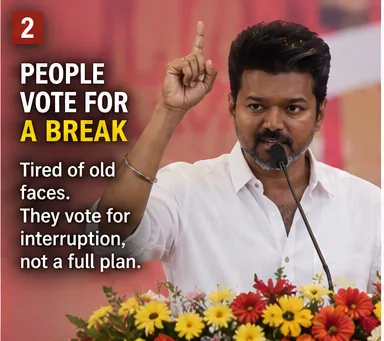
Voters do not always vote for a full plan.

Sometimes they vote for a break.

They vote because the old faces have become unbearable. They vote because the usual speeches sound dead. They vote because the same parties keep asking for trust after wasting it.

That is not stupidity.

That is how people behave when politics has disappointed them for too long.

Vijay gave voters a break from the old room. He gave them a face they already knew. He gave them a story they could understand. He gave them the feeling that something could move again.

Sri Lanka knows this feeling too.

We have seen voters turn to strongmen, reformers, rebels, technocrats, outsiders, insiders pretending to be outsiders, and anyone who looked like a door out of the old mess.

The first lesson is simple:

A tired country will vote for interruption.

But interruption is only the opening scene.

It is not the whole film.

Why I Am Watching Vijay From Sri Lanka (3/12)

Why I Am Watching Vijay From Sri Lanka (3/12)

Do Not Laugh At Cinema Politics

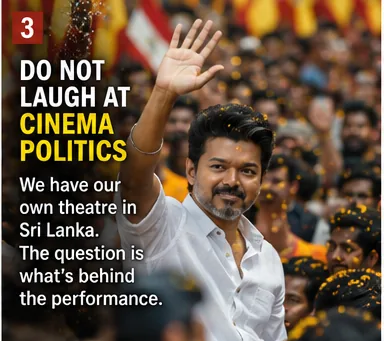
Sri Lankans should not laugh at Tamil Nadu’s cinema politics.

We have our own theatre.

We have flags, songs, war memories, religious robes, family names, village stages, television speeches, strongman poses, funeral politics, and saviour stories.

Cinema is only one kind of theatre.

Politics everywhere uses performance. The question is not whether a leader performs. All leaders perform.

The question is whether there is anything solid behind the performance.

A poster can make people look.

A speech can make people clap.

A song can make people cry.

A film hero can make people hope.

But none of that fixes a broken school. None of that pays a debt. None of that makes a corrupt office honest. None of that brings down the price of food.

The image can open the door.

The work begins after that.

Why I Am Watching Vijay From Sri Lanka (4/12)

Why I Am Watching Vijay From Sri Lanka (4/12)

The Fan Club Is Not A Government

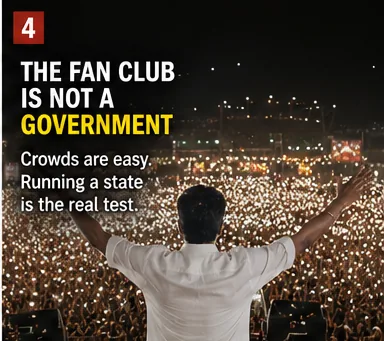
A fan club can move fast.

It can fill a street. It can defend the leader online. It can spread a clip. It can make a man look unstoppable.

But a fan club is not a government.

Government is slower. It is heavier. It is less exciting.

Government is files, budgets, officers, laws, contracts, courts, tenders, taxes, schools, hospitals, buses, police stations, angry voters and promises that come due.

That is where the hero meets the wall.

In a film, the hero knows who the villain is.

In government, the villain may be delay. Or debt. Or bad data. Or a lazy department. Or a corrupt ally. Or a promise made too easily.

That is why Vijay’s real test is not whether people love him.

They already do.

The test is whether love can be turned into work.

That is much harder.

Why I Am Watching Vijay From Sri Lanka (5/12)

Why I Am Watching Vijay From Sri Lanka (5/12)

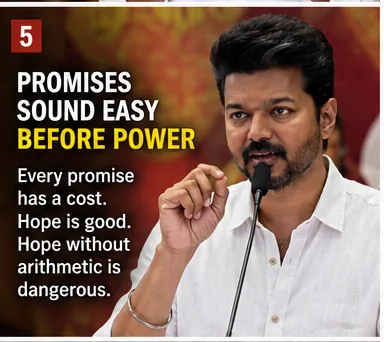
Promises Sound Easy Before Power

Promises are beautiful before power.

Help for women. Help for graduates. Cheaper gas. Loans. Jobs. Clean government. New industries. A better future for young people.

Who would not want these things?

The problem is not that people ask for help. People need help. Families need relief. Young people need work. Women carry the household economy in ways politics often ignores.

The problem is that every promise has a cost.

Someone has to pay.

Someone has to deliver.

Someone has to stop theft.

Someone has to decide who gets help first.

Someone has to explain what cannot be done yet.

That is where many leaders fail. They speak like poets during the campaign and count like cowards after victory.

Sri Lanka knows this very well.

We have heard promises without price tags.

We have paid for them later.

Hope is good.

Hope without arithmetic is dangerous.

Why I Am Watching Vijay From Sri Lanka (6/12)

Why I Am Watching Vijay From Sri Lanka (6/12)

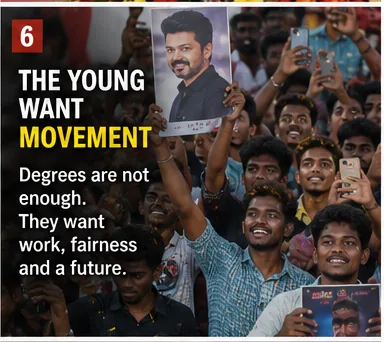
The Young Want Movement

Vijay’s appeal is not only about poor people wanting welfare.

It is also about young people wanting movement.

A degree is not enough if there is no decent job. A phone is not freedom if the future still feels blocked. Education is not dignity if the only choices are waiting, leaving, or begging someone with power.

Young voters want to feel that life can move.

They want work. They want fairness. They want less corruption. They want a state that does not waste their time. They want leaders who speak to the world they live in, not only the world their parents endured.

Sri Lanka should listen to this part most closely.

Our young people are also tired of waiting. Many are not asking for luxury. They are asking for a reason to stay.

That is why new leaders can rise quickly.

When old politics cannot offer movement, people look for a new face that can.

But a face is not a future.

A future has to be built.

Why I Am Watching Vijay From Sri Lanka (7/12)

Why I Am Watching Vijay From Sri Lanka (7/12)

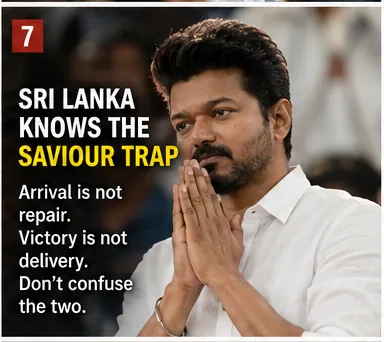
Sri Lanka Knows The Saviour Trap

Sri Lanka knows the saviour trap.

We have seen leaders arrive as rescuers. We have seen people place discipline, justice, honesty, strength, patriotism or kindness onto one person.

For a while, it feels good.

The old order looks frightened. The crowd feels alive. The country feels as if it has turned a page.

But a page is not a system.

A new leader can punish the old mood. That does not mean he can build a better one.

A new face can look clean. That does not mean the offices under him become clean.

A leader can speak for ordinary people. That does not mean ordinary people will see results.

This is the trap.

We confuse arrival with repair.

We confuse victory with delivery.

We confuse the fall of the old villain with the birth of a working country.

That is why Vijay’s story matters to us.

It reminds Sri Lanka to ask harder questions earlier.

Why I Am Watching Vijay From Sri Lanka (8/12)

Why I Am Watching Vijay From Sri Lanka (8/12)

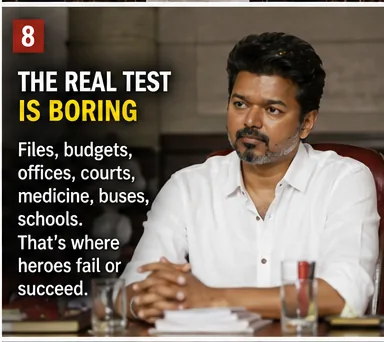
The Real Test Is Boring

The real test of Vijay will not be the rally.

It will be the boring things.

Can he choose good people?

Can he control his own side?

Can he say no to bad friends?

Can he keep promises without damaging the state?

Can he handle criticism without calling everyone an enemy?

Can he make offices work?

Can he keep young voters hopeful after the first year?

Can he turn public love into public service?

That is where politics becomes real.

Crowds are easy to admire. Systems are harder to build.

A country is kept alive by boring things done well: medicine arriving, buses running, schools opening, police behaving, courts moving, money being counted, contracts being watched, and citizens feeling that the rules are not only for the weak.

The hero must learn the boring work.

Or the hero becomes another memory.

Why I Am Watching Vijay From Sri Lanka (9/12)

Why I Am Watching Vijay From Sri Lanka (9/12)

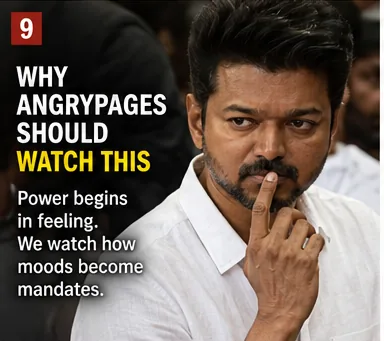
Why AngryPages Should Watch This

This is the kind of story AngryPages should hold.

Not because it is about one election.

Because it teaches something about power.

Power does not begin only in parliament. It begins in feeling. It begins in memory. It begins in songs, faces, anger, jokes, films, promises, wounds and hope.

By the time people vote, the story has already been forming inside them.

That is why AngryPages matters.

We are not only watching leaders. We are watching how people come to believe. We are watching how a public mood is made. We are watching how private frustration becomes a political wave.

Vijay’s rise is useful because it shows that politics is not cold.

It is human.

People do not only want a policy paper. They want a reason to believe the room can change.

But belief is not enough.

The best political question is still simple:

What will change in real life?

Why I Am Watching Vijay From Sri Lanka (10/12)

Why I Am Watching Vijay From Sri Lanka (10/12)

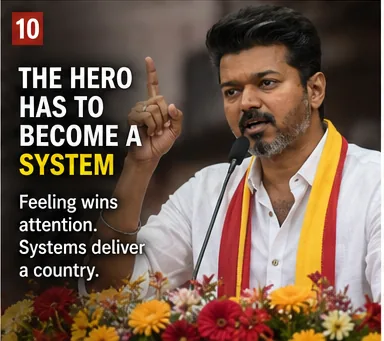
The Hero Has To Become A System

The line I keep coming back to is this:

The hero has to become a system.

A hero can gather feeling.

A system has to deliver.

A hero can make people believe.

A system has to make life work.

A hero can speak against corruption.

A system has to make corruption harder.

A hero can promise jobs.

A system has to create the conditions for jobs.

A hero can stand with ordinary people.

A system has to make food, fuel, school, medicine, transport, courts and work more bearable.

That is why I am watching Vijay from Sri Lanka.

Not as a fan.

Not as a hater.

As someone trying to understand what happens when a public mood becomes power.

The trailer is over.

The crowd has become the public.

Now the hero has to govern.

Why I Am Watching Vijay From Sri Lanka (11/12)

Why I Am Watching Vijay From Sri Lanka (11/12)

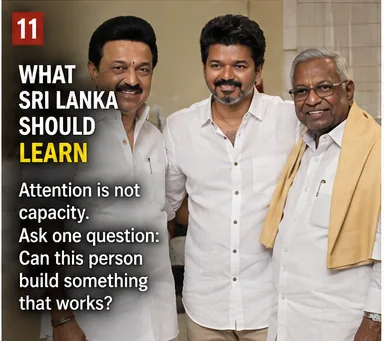
What Sri Lanka Should Learn

Sri Lanka should not ask only whether Vijay succeeds or fails.

We should ask what his rise teaches us.

It teaches us that voters still want emotional leadership.

It teaches us that old parties can look permanent until the public finds a new vessel.

It teaches us that culture can move politics faster than official speeches.

It teaches us that young voters may choose freshness before detail.

It teaches us that welfare promises still matter when daily life feels insecure.

It teaches us that anti-corruption language still has power when people believe the old system protects itself.

But it also teaches the danger.

Attention is not capacity.

A crowd is not a government.

A mood is not a plan.

A new face is not a new state.

Sri Lanka will face this again. New people will rise. New slogans will come. New platforms will appear. Some will be useful. Some will be empty.

The public should ask one question:

Can this person build something that works?

Why I Am Watching Vijay From Sri Lanka (12/12)

Why I Am Watching Vijay From Sri Lanka (12/12)

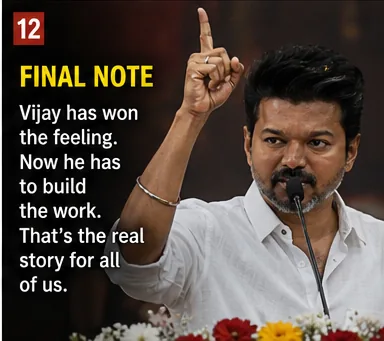
Final Note

I do not see Vijay’s rise as a small Tamil Nadu story.

I see it as part of a larger pattern around us.

People are tired of stale rooms. They want fresh faces. They want a break. They want leaders who feel closer to real life. They want someone to punish arrogance and open a door.

That desire is understandable.

But the next stage is harder.

After the victory speech, there is the file.

After the crowd, there is the budget.

After the slogan, there is the department.

After the hero image, there is the institution.

That is where the story becomes serious.

For Sri Lanka, the lesson is not that cinema politics is silly.

The lesson is that all politics has theatre.

The real question is whether the theatre can produce a working state.

If not, the public wakes from one dream into another disappointment.

Vijay has won the feeling.

Now he has to build the work.