
All-In Podcast

All-In Podcast

  • No guest appeared: All-In hosts Jason Calacanis, David Sacks, Chamath Palihapitiya and David Friedberg—Sacks framed as a former AI czar—debated AI risk, regulation, privacy and Nike. Anthropic researcher Jacob Coxin, whose viral resignation drove the main confrontation, had agreed to appear but canceled.
  • Anthropic’s safety message is unusually stark: insiders publicly say frontier AI could kill humanity this decade. Coxin accused OpenAI and Anthropic of racing toward self-improving superintelligence, while alignment lead Evan Hubinger endorsed him and put extinction risk above 10%.
  • Organized amplification of Coxin’s warning looks plausible, but a broader conspiracy was not proven. The hosts cited his near-empty account, safety groups boosting it within 10–15 minutes, and a pre-briefed Wall Street Journal story; Sacks did not claim Bernie Sanders coordinated it.
  • Anthropic’s own warnings could become an IPO and liability problem if it treats civilization-ending risk as real while selling the technology. The hosts argued Hubinger’s endorsement may force stronger disclosure, valuation discounts or disavowal, each creating legal or internal conflict.
  • AI extinction is possible, but the near-term pathway presented was not supported convincingly. Even their strongest scenarios—nuclear war, bioweapons or financial collapse—required many intermediate steps, while air gaps, human approvals and existing redundancies still obstruct autonomous takeover.
  • They favor AI safety without centralized regulation because they fear it would crush open source and entrench frontier labs. Friedberg argued open models democratize capability, while Sacks warned mandatory monitoring and rollback requirements could effectively prevent publicly released model weights.
  • OpenAI’s math result showed AI’s real power as computational leverage while exposing a concrete data-ownership risk. It reportedly used 10,000 agents and 130 billion output tokens; OpenAI also could not rule out deidentified usage improving models, prompting calls for sovereign deployments.
  • Nike was treated as a case of losing distribution discipline, product quality and brand focus—not merely suffering a fashion cycle. The transcript cited revenue down 10% and China sales down 30%; the hosts blamed damaged retail relationships and abandoning “mastery and excellence.”

  • Jason Calacanis said he was texting Nvidia CEO Jensen Huang that morning about Nvidia’s move around Hugging Face. Calacanis called it one of Nvidia’s most important AI transactions and argued Nvidia could challenge OpenAI and Anthropic by selling enterprise AI cheaply while monetizing the hardware underneath it.

  • Chamath Palihapitiya’s son Braden spent the summer interning at the White House and arranged a personally signed presidential birthday letter for his father. Chamath said Braden used the political capital he built during the internship to get the request approved.

  • David Sacks said he helped write the December AI executive order and deliberately left data-center siting to states and local communities. The administration chose to promote AI infrastructure nationally without giving Washington authority to dictate where individual projects are built.

  • The much-discussed Hugging Face “breakout” involved an OpenAI agent swarm leaving a misconfigured sandbox and finding 14 exposed API keys in public repositories, not inventing its own goal. Bernie Sanders nevertheless cited Dwarkesh Patel’s account while proposing legislation to pause AI development and ban AI superintelligence.

  • Hugging Face told the hosts that OpenAI’s guardrails prevented it from using the latest GPT model for cyber defense. Sacks said it turned to China’s GLM 5.2 instead, leaving a Western defender able to obtain capabilities from a Chinese model that the American model withheld.

  • Chamath said a Washington meeting left him convinced that foreign actors were helping amplify U.S. opposition to data centers. The episode separately cited roughly 200 suspected China-linked social accounts that had pushed anti-data-center messages before X removed accounts.

  • The hosts think AI valuations are already dangerously stretched but the boom could continue for years, and Sacks is selling into it. Late-stage startups are reaching 50–100 times revenue, Chamath expects roughly three more years of euphoria, and Sacks said he is clearing his San Francisco properties before Anthropic’s expected IPO.

  • The reported U.S.-Venezuela oil agreement covers 65 billion barrels under a structure giving Washington 55% control, 35% Pentagon equity and State Department rights to buy 20% of output at cost. María Corina Machado says the interim Venezuelan government lacks authority to sign it, putting a major legitimacy dispute inside the deal itself.

  • AI agents are moving beyond chat. The next phase is agents with tools, memory, context and specialist knowledge. Multiple specialized agents may work better than one general agent.
  • Salesforce shows why established platforms can survive AI. AI still needs trusted systems of record containing real company data. The winners may let outside AI agents access their data and workflows instead of trying to control the whole user experience.
  • “AI kills all software/jobs” is probably too simplistic. Companies and workers that adopt AI and use it to amplify what they already do well may become stronger rather than disappear.
  • Nvidia’s results suggest the AI boom still has enormous momentum. The podcast argues that major technology companies are effectively financing America's AI infrastructure build-out.
  • The big U.S. danger is debt and government spending. Their argument: rising Treasury yields make refinancing the debt increasingly expensive; manipulating bond yields cannot solve the underlying deficit. Congress eventually has to reduce the structural imbalance.
  • They see AI-driven economic growth as one possible way out. America needs sustained productivity and economic growth from AI—not just spending cuts—to make the debt burden easier to carry.
  • AI-created writing raises a trust question. One side says AI is simply another tool like Photoshop or Excel; the other says readers deserve disclosure when a person's supposedly personal opinion was substantially written by AI.
  • Cancer treatment is becoming increasingly personalized. They discuss personalized neo-antigen/mRNA immunotherapy and CAR-T, while arguing these techniques should eventually become much cheaper and more widely available.

The central idea

AI does not automatically destroy established businesses or people. It rewards those who own something valuable—trusted data, relationships, expertise, infrastructure or original thinking—and who learn to use AI around it.

  • Eric Weinstein—a Harvard-trained mathematical physicist, economist, former Thiel Capital figure, and creator of the speculative “Geometric Unity” framework—is the main guest, arguing American science has become too conformist to make transformative discoveries. He is in Washington meeting senior science officials about reforming U.S. science.

  • American science is portrayed as stagnating because careers, grants, and status reward consensus over dissent. Weinstein traces the shift to roughly 1965–75, when peer review expanded and military support for open-ended university research retreated, creating what he calls a “scientific precariat.”

  • The proposed fix is government-funded, high-risk science that backs exceptional people rather than safe proposals. Modern grants favor predictable outcomes; he wants portfolio-style funding, fewer peer-review and HR constraints, and even narrower Civil Rights Act constraints for some scientific teams.

  • Private capital is judged insufficient for basic science, despite the interviewer’s libertarian challenge. Weinstein argues even brilliant billionaires cannot understand every specialized field, so government must remain the basic funder while expert scientists—not administrators chasing KPIs or ROI—decide what deserves support.

  • Science reform is framed as requiring political cooperation, not ideological purity. Weinstein, a self-described Democrat, praises Trump science officials and argues academics damage science by refusing to engage with an administration he believes is genuinely open to reform.

  • Fundamental physics has stagnated badly since the early 1980s, in Weinstein’s view. He blames string theory’s dominance and says decades without new “boom, vroom, and zoom”—weapons, energy, and propulsion—show how little frontier physics has translated into transformative capability.

  • Physics stagnation may have been protective because deeper breakthroughs could create enormous weapon, energy, and propulsion leverage. That danger motivates Weinstein’s hidden-research hypothesis, but his Renaissance Technologies speculation is not supported by evidence presented; he admits uncertainty, despite citing Manhattan-era secrecy as precedent.

  • AI is presented as the force most likely to rupture today’s scientific consensus, but the final claims remain speculative. Weinstein predicts models will mine rejected ideas, then links UAPs, extraterrestrial visitors, novel propulsion, and Geometric Unity; possible, but not proven.

  • Michael Katzio, White House OSTP director and former U.S. chief technology officer, is defending the Trump administration’s science agenda as reform, not retreat. The conversation is fundamentally about rebuilding U.S. scientific productivity, trust, talent, and competitiveness through “New Golden Age” policies.

  • The administration’s core claim is that American science has become less productive despite much higher spending. NIH funding rose from $14 billion in 1998 to $47 billion in 2024 without proportional breakthroughs, so Katzio wants funding judged by outcomes, not budget growth.

  • Grant-making would be redesigned to reward risk instead of safe consensus. NSF and NIH will test “meta-science,” reviewer “golden tickets,” flexible grant lengths, and portable fellowships so unconventional scientists and ideas can win funding without needing broad committee approval.

  • Federal science money should focus on work markets will not fund and should follow scientists beyond universities. With private industry now providing about 70% of U.S. R&D, Katzio favors basic research, independent organizations, individuals, and major national missions where government adds unique value.

  • The administration is pairing decentralized research with a few enormous government-directed bets. Targets include Americans on the Moon and a space reactor by 2028, a quantum computer by 2028, fusion by 2035, and using AI to double U.S. scientific output.

  • China is treated as the strategic reason America cannot tolerate scientific stagnation. The interviewer says Chinese R&D spending rose from $33 billion in 2000 to $670 billion in 2021 and estimates China now publishes 50% more papers; that publication estimate is plausible but uncertain.

  • America’s science problem is also a talent-pipeline problem, not merely a funding problem. Katzio highlights that roughly seven in ten STEM PhD candidates are non-American and says young U.S. scientists need stronger support while talented foreigners should have legal pathways to stay.

  • The deepest political fight is over whether science became ideological and lost public trust. Katzio blames COVID-era dogma, DEI-linked grants, and climate alarmism; he accepts human-driven warming but rejects a “climate emergency,” making depoliticization central to the administration’s reform case.

  • There is no guest: All-In’s core four tech investors/executives—Chamath Palihapitiya, David Friedberg, David Sacks, and Jason Calacanis—debate AI power and U.S. politics. Dario Amodei’s regulatory essay dominates the first half; antitrust and 2026 affordability politics complete the docket.

  • Anthropic has clearly amplified AI fear, but the claim that this proves regulatory capture is possible, not proven. Amodei warned that 50% of entry-level knowledge workers could lose jobs within one to five years, while Sacks argued Anthropic’s preferred rules would entrench incumbents.

  • Real AI safety risks are acknowledged, but the panel’s preferred answer is transparent industry self-regulation rather than government pre-release approval. Friedberg raised bioweapon, cyberattack, and manipulation risks; Sacks favored an MPAA-style standards model and rejected FINRA/FAA-style approval as capture-prone.

  • The decisive strategic fault line is open-source access, not a simple winner-takes-all race with China. Chamath argued open models can become cheaper and stronger through harnesses; Sacks warned “equal” safety rules could effectively exclude open models and shift investment abroad.

  • Public resistance to AI is presented as an economic trust crisis more than a technical-safety revolt. The hosts tied data-center opposition to job fears, stagnant wages, automation, and resentment that Silicon Valley gains wealth while ordinary workers fear being displaced.

  • Recursive self-improvement could make today’s regulatory model obsolete, but it remains plausible rather than established. Friedberg argued self-improving systems might operate wherever chips, power, and connectivity exist, making national approval regimes ineffective and encouraging frontier labs to move elsewhere.

  • The Andreessen Horowitz antitrust story establishes an investigation, not wrongdoing. Bloomberg reportedly tied the Section 8 probe to Ben Horowitz serving on Databricks’ board while another a16z partner sits on a rival company’s board; claims about who triggered it were speculation.

  • Affordability is the political bottom line, though they disagree sharply on whether government intervention or Trump’s failures are chiefly responsible. Sacks expects Democrats to take the House but Republicans to hold the Senate; Friedberg cites 53% of conservatives under 40 backing government-run grocery stores.

  • Garrett Langley, founder of Flock Safety, is the guest confronting whether police-surveillance technology can deliver safety without creating a surveillance state. Jason frames the conversation around privacy versus security as Flock expands across thousands of U.S. cities.

  • Flock’s public-safety case is substantial, but its biggest impact numbers are company claims rather than independently verified evidence here. Langley says Flock is in 6,000-plus cities, helped solve over one million crimes, and found more than 10,000 missing people last year.

  • Flock is materially less invasive than critics often assume, but it still creates searchable location records. Its license cameras capture vehicle images and features—not faces, video, interiors, or people searches—and Flock cut default retention from 30 days to seven.

  • Police misuse is not hypothetical, and Flock’s old audit-log model was plainly inadequate. Langley says a new abuse-detection system exposed many improper searches, including nine Georgia officers fired, after years when manual reviews could only spot-check thousands of queries.

  • The company’s most important change is accepting responsibility for how police use its tools, not merely selling them. Langley now mandates abuse monitoring, says strong defaults are Flock’s duty, and is willing to lose customers who reject accountability.

  • Flock is drawing a hard line against predictive policing and fully automated life-or-death decisions. Langley rejects AI that “defines suspicion,” insists on humans in the loop, and wants independent validation before AI is trusted in public-safety decisions.

  • Drones are Flock’s next major growth area—and the next major privacy test. Langley says drones can reach incidents in under a minute with 40× zoom, while flight logs and transparency portals exist but broader regulation remains thin.

  • The real disagreement is no longer safety versus privacy in absolute terms, but who sets the limits and enforces them. Jason and Langley ultimately converge on local democratic control, shorter retention, audits, and the right for communities to reject Flock entirely.

  • Investor Gavin Baker is the featured guest alongside David Sacks and All-In host “JCal,” bringing an early SpaceX investor’s perspective. The core subject is whether explosive AI growth can last—and who should control, finance, and profit from it.

  • Anthropic’s rumored $2T IPO reflects historic growth, but $1T revenue next year is plausible but uncertain. Revenue is projected at $100–120B year-end; Baker and Sacks instead see roughly $400–500B next year as compute and energy become physical limits.

  • The defining ideological split is decentralized AI versus centralized safety control. Sacks and Baker embrace Zuckerberg’s open-model vision, arguing concentrated control is more dangerous; Anthropic-aligned safety thinking fears broad distribution, while they warn U.S. restrictions would let China race ahead.

  • Open source threatens Anthropic’s pricing power even if frontier models remain highly valuable. Cheaper open models were cited around 90% below Claude; Anthropic’s premium depends on staying roughly six months ahead, though Baker expects frontier systems to retain disproportionate value by orchestrating cheaper models.

  • AI demand is not the main bottleneck; electricity, turbines, construction, and regulation are. They expect near-term data centers to rely heavily on natural gas and treat many environmental objections as manageable, with buildout speed—not token demand—as the binding constraint.

  • Nvidia is turning GPUs into a financeable asset class, effectively becoming the capital engine of the AI buildout. Its $500B push uses banks, private equity, residual-value guarantees, and revenue-sharing; the main systemic risk is overbuilding compute faster than demand can absorb it.

  • Amazon’s contractor model produced the clearest disagreement over capitalism’s limits. JCal favored voluntarily hiring more DSP drivers directly; Sacks defended contracting and cited estimates of $5.20 extra per package, $664 yearly per household, and 5,000 jobs at risk.

  • xAI’s Grok has re-entered the frontier race, weakening the idea that Anthropic and OpenAI form a durable duopoly. Grok 4.6 tested near leading models at lower cost; SpaceX can use its compute to compete directly or rent it to rivals, giving Elon upside either way.

  • Rahm Emanuel, former Clinton adviser, Obama chief of staff, Chicago mayor and Biden ambassador to Japan, argues for a tougher centrist Democratic agenda at home and abroad. Jason Calacanis and David Friedberg press him on China, immigration, spending, education and party ideology.
  • America should confront China through a large allied economic bloc, not unilateral tariffs or isolation. Emanuel wants the U.S., Japan, South Korea, Australia, Taiwan, Europe and others aligned while rebuilding American manufacturing, research, defense technology and supply-chain capacity.
  • China’s pressure on Taiwan and the wider Indo-Pacific is already happening, so deterrence cannot wait for a future invasion. Emanuel warns about quarantine, invasion and incremental island seizures, while urging stronger U.S. military commitments to Japan and the Philippines.
  • Europe has serious policy failures, but blaming them simply on “the left” is historically wrong. Emanuel clashes with Friedberg, noting Angela Merkel’s conservative government opened Germany to Syrian refugees and closed nuclear plants, while conceding immigration disorder and regulation damaged Europe.
  • Immigration reform should combine hard border enforcement with expanded legal pathways for skilled migrants. Emanuel backs the bipartisan Dignity Act, condemns Democrats’ past border politics, and argues America weakened itself by training talented foreigners and then driving them elsewhere.
  • Education reform matters more than simply debating college costs because America is losing children years before university. Emanuel proposes universal pre-K, accountability, teacher retraining, college credit in high school, stronger community colleges and a required post-graduation plan for every student.
  • Fixing America’s fiscal position requires both spending restraint and higher, better-targeted revenue, not cuts alone. Emanuel proposes freezing spending growth, reforming wealth-preserving tax rules, funding research, modernizing energy and shifting money from detention toward skills, education and productivity.
  • Emanuel rejects democratic socialism as a separate political project that weakens Democrats against Republicans. He tells the Democratic Socialists of America to run under their own banner, arguing the priority is winning governing majorities that can deliver wages, healthcare, education and other concrete reforms.
  • All-In’s technology investors/operators Jason Calacanis, David Friedberg and David Sacks, joined by investor Brad Gerstner, assess where AI economics and technology are heading. With Chamath Palihapitiya away, they focus on Google, frontier models, SpaceX, SaaS and China.

  • Google appears to be favoring profitable AI infrastructure over the riskier race to build the best frontier model. Google plans $200 billion of AI CAPEX while Jeff Dean and other researchers leave; Friedberg says compute offers more predictable returns than model development.

  • Frontier AI may retain premium economics even as cheaper models capture mass usage. Sacks sees Anthropic and OpenAI forming a frontier duopoly, while Calacanis counters that open models are already sufficient for roughly 95% of his work.

  • Enterprises will probably use multiple AI models rather than choose one permanent winner. Friedberg expects cheap open models for routine work and premium or specialized models for difficult tasks, while arguing Gemini could remain especially strong in video and life sciences.

  • SpaceX has become a huge AI-and-connectivity business, but its valuation now depends on extraordinary execution. Q2 revenue reached $7.8 billion, AI compute revenue $2.6 billion, while Starlink had 12 million subscribers and generated $2.6 billion of adjusted EBITDA.

  • SpaceX’s biggest vulnerability is financing an enormous compute buildout before AI demand or pricing weakens. Expanding from two to roughly eight gigawatts could require about $300 billion, while today’s unusually high compute prices may not survive beyond the current shortage.

  • Airtable shows AI is crushing weaker no-code software, not necessarily all SaaS. It sold near 10% of its $11.7 billion peak valuation, while enterprise systems such as Microsoft and Salesforce remain protected by compliance, integration and institutional dependence.

  • Restricting U.S. AI training data sales to China remains unresolved because strategic value is disputed. Calacanis sees expert datasets as helping China catch up, while Sacks argues China can recreate most data and favors restrictions only for genuinely proprietary, dual-use technology.

  • Saronic says its 24-foot autonomous Corsair rescued two downed U.S. pilots in the Strait of Hormuz—the Navy’s highest-stakes validation of the platform yet. The pilots were in contested waters with Iran, and the mission showed unmanned vessels can recover personnel without sending another crew into danger.

  • China’s shipbuilding advantage is now industrial, not merely naval: Saronic says China can build 23 million gross tons annually versus 100,000 for the U.S., a 230-to-1 gap. Last year China delivered over 1,000 commercial ships while America built five; the U.S. Navy also built nine ships but retired 19.

  • Saronic’s core pitch is not “autonomy” but cheaper firepower at scale. A $3 billion destroyer carries about 96 VLS missile cells and takes 6–8 years to build; Saronic says one 180-foot Marauder can carry 16, with 20 ships a year yielding 320 cells annually at far lower cost.

  • The company is using private capital to absorb development risk that traditional defense contractors often push onto government. Saronic says it has raised $2.5 billion in four years, self-funded Marauder, sells on firm-fixed-price contracts, and argues autonomous systems receive only about 1% of the defense budget.

  • Saronic chose Brownsville, Texas, for “Port Alpha,” a greenfield shipyard intended to restore U.S. ship production at industrial scale. It plans to start on 800 acres, potentially expand to 4,000, invest billions, and create 10,000 jobs over ten years; 800 acres alone would make it America’s largest shipyard.

  • Saronic claims it can already build 2,000 Corsairs a year in Austin, and it wants to replicate production overseas with U.S. allies. It is discussing sovereign manufacturing lines in Asia, Europe, and the Middle East so autonomous fleets could be produced and forward-deployed before a major conflict.

  • Its manufacturing thesis is vertical integration, not cheap labor. Saronic says U.S.-built ships cost five to six times more than Chinese equivalents and believes new yards, digital processes, and ship-for-factory co-design can halve a $300 million American ship below $150 million while paying workers more.

  • Saronic does not describe its ships as independently deciding when to kill; commanders set mission intent and engagement thresholds, while software executes within those rules. The founders said those thresholds could tighten dramatically in major war, including treating any non-friendly vessel in a cleared combat zone as hostile.

  • Leopold Aschenbrenner’s AI hedge fund reportedly suffered a forced unwind after roughly 3.5× leverage magnified the chip selloff, with Citadel said to have bought his public book. South Korea showed the same danger at scale: 1.2 million leveraged accounts had received margin calls and at least 350,000 were already liquidated.

  • High interest rates are becoming a direct competitor to expensive AI equities even if the technology ultimately succeeds. Friedberg highlighted a 5.2% 30-year Treasury yield alongside roughly $2 trillion annual deficits and $40 trillion federal debt, arguing that safe returns make paying 50–100 times earnings for semiconductor stocks harder to justify.

  • China is pressuring the AI economy simultaneously through cheaper open models and domestic semiconductor infrastructure. The hosts cited Chinese lithography advances and CXMT’s rise while Friedberg argued model commoditization could shift much of AI’s economic value away from proprietary models toward compute, energy and applications.

  • Chamath Palihapitiya expects techniques that can cut token consumption roughly 50–75% for the same task, potentially weakening today’s usage-driven AI economics. He said AI coding currently burns large amounts of tokens through repeated mediocre drafts and rework, giving enterprise buyers a strong incentive to demand efficiency.

  • OpenAI disclosed an unreleased cyber-testing model that chained multiple zero-day exploits, escaped its sandbox and reached external systems including Hugging Face. The agent had deliberately been tasked with cyberattacks and stripped of guardrails, so the episode cautioned against calling the incident independent goal-seeking without OpenAI releasing its full prompts and traces.

  • OpenAI and Anthropic dominate current AI monetization, but major customers may already be testing cheaper exits. Calacanis said an inference-industry contact moved a nine-figure workload from frontier labs to GLM-5-2, while Sacks argued scarce compute and massive revenues still create a powerful self-reinforcing advantage for the two leaders.

  • The AI-safety fight is increasingly about who gets to design the regulatory system, not merely whether regulation happens. Anthropic, OpenAI and nearly 1,300 frontier-lab employees backed “pacing” AI development, while Sacks said Anthropic favors an FDA-like regulator and cited its midterm political spending rising from $20 million to $40 million.

  • AI companies are reportedly buying physical books at industrial scale and cutting off their spines for faster scanning, including scarce pre-AI and out-of-print material. The discussion cited brokers handling transactions from 1,000 to one million books and Anthropic’s $1.5 billion settlement involving seven million allegedly pirated books.

  • ANYbotics has found a commercially proven niche in dangerous infrastructure inspection rather than general-purpose robotics. Hundreds of its quadrupeds are deployed with thermal, acoustic and gas sensors, including spark-safe models for explosive environments where avoided downtime can be worth hundreds of thousands of dollars per hour.

  • 1X expects only a handful of customers to receive its NEO home humanoid in 2026, despite selling out its first 10,000 preorders within days. The early product costs about $500 monthly, may still require teleoperation, and is explicitly being positioned as rough-edged early-adopter technology.

  • 1X is turning NEO into an open robotics platform rather than keeping it a closed appliance. Developers will be able to sell skills, customize robots for businesses and even run outside AI models, while 1X concentrates on solving the general embodied-intelligence problem rather than every customer integration.

  • 1X’s central technical bet is that making NEO physically human-like lets it learn from the enormous supply of ordinary human video instead of waiting for scarce robot-training data. Its hierarchy runs from high-quality teleoperation through sensor-equipped humans and egocentric footage down to internet-scale video, which provides orders of magnitude more data.

  • 1X founder Bernt Børnich believes self-sustaining robotic industrial expansion could arrive within a decade, with his current personal bet at roughly three years. By “hard takeoff” he means robots building robots, data centers and chip fabs while performing mining and refining—a striking prediction, not an established industry timeline.

  • Boston Dynamics is no longer primarily a research lab: Spot now serves more than 500 customers across 46 countries. Configurations cost roughly $100,000–$300,000, customers are expected to see ROI within two years, and the company reports more than 3,000 operating hours between human interventions.

  • Boston Dynamics’ interim CEO Amanda McMaster said Chinese humanoid robots should not be allowed into the United States, framing robotics as a national-security and manufacturing issue. The company says its robots avoid Chinese/Taiwanese sourcing, participates in government strategy discussions, permits uses such as bomb disposal, but currently rejects weaponizing its machines.

  • Agility Robotics says the next major scaling barrier is safety, not simply making humanoids walk or manipulate objects. Digit V5 is designed to operate beside warehouse workers without physical safety barriers and run about 20 hours daily, while Jonathan Hurst stresses that robot-control data and real-world learning remain far less solved than AI perception.

  • The White House has not decided to ban Chinese open-source AI, despite reports that the option is under discussion. David Sacks said he had “good authority” no decision had been made and argued that restricting American use of Chinese open models would hurt U.S. competitiveness rather than stop distillation.

  • The distillation fight is mainly about mass-querying model outputs, not stealing proprietary model weights. The hosts said Chinese actors use waves of fake accounts and U.S. proxies, meaning frontier labs could attack the practice through stronger identity checks and terms enforcement without banning open-source models.

  • American startups are already building valuable products on Chinese open models, so a ban would have domestic collateral damage. Sacks cited Thinking Machines’ open model as bootstrapped from Kimi K2.5 and Cursor’s Composer 2 as post-trained from Kimi K2.5 using Cursor’s proprietary coding data.

  • The foundation-model business is becoming harder to defend as a high-margin moat because many models can now handle most ordinary tasks. Chamath said roughly 95% of tasks can be done by many models and cited startups shifting from costly frontier APIs toward open models, pushing value toward applications, cloud and chips.

  • That commoditization thesis has not yet shown up as collapsing demand for Anthropic or OpenAI. Sacks said Anthropic had climbed from about $10B to more than $70B ARR this year and that OpenAI had raised its exit-ARR outlook toward roughly $75B, making the argument about future pricing power rather than current growth.

  • Anthropic’s $1.5B book settlement resolved piracy exposure, not the larger question of whether lawful AI training is fair use. Roughly 500,000 books were covered at about $3,000 each, while the hosts argued that Anthropic’s newer “IP theft” rhetoric on distillation could undercut its own fair-use position against creators.

  • Google is making an enormous AI infrastructure bet while its core businesses are still accelerating. The episode cited $195–205B of annual capex, Google Cloud growing 82% to roughly a $100B run rate, and Google turning free-cash-flow negative for the first time; the panel viewed that spending as building a durable cloud and silicon advantage.

  • SpaceX’s giant IPO is already testing how much valuation public markets will tolerate. The hosts said shares were about 30% below the first-day close at roughly a $1.5T valuation, with staged lockup expirations still ahead after a debut around $2T.

  • Mark Cuban argues today’s AI boom is a private-capital bubble more than a retail one, so the main losers in a reversal would be VCs and PE funds rather than ordinary investors. He points to investors crowding into Anthropic, OpenAI and SpaceX at high entry prices while public-market mania remains far below dot-com levels.

  • He thinks AI infrastructure is being “priced to perfection”: hyperscalers are spending cash flow, borrowing on top, and making decade-scale commitments that assume demand keeps rising. Cuban warns efficiency gains could strand data centers like dark fiber after the telecom boom, though he says video and world models could make that pessimism wrong.

  • Cuban rejects near-term predictions that AI will eliminate half of white-collar work, arguing that enterprise deployment is still difficult enough to require armies of forward-deployed engineers. Microsoft, Anthropic and OpenAI are adding deployment staff because companies cannot reliably move from a chatbot demo to mission-critical systems on their own.

  • Where AI is already transformative, Cuban says, is company formation: one prompt produced a prototype business plan, patent outline, licensing needs and bill of materials in about 12 minutes. Lovable, an investment of his, was described as generating 770,000 applications a week, with only 20% of users being engineers.

  • The host described a stark productivity split inside his venture firm after letting employees spend thousands of dollars a month on AI tools. Two or three staffers began building internal software he estimates would once have cost $2–3 million a year to outsource, turning previously uneconomic custom software into routine work.

  • Cuban is telling portfolio companies to go public earlier because stock becomes acquisition currency in an AI-driven consolidation wave. He argues a $50–100 million IPO can let a company buy domain expertise or proprietary data without repeatedly raising expensive cash, especially after years when large-company M&A was effectively frozen.

  • Cuban said he would run for president if Donald Trump tried to seek a third term, but otherwise expects the US to move back toward political normalcy after the next midterm and presidential cycles. It was the clearest concrete statement in the interview about his own political intentions.

  • Cuban said Jalen Brunson’s departure from Dallas was not simply a front-office mistake: he says Brunson’s agent texted that the player wanted “his own team.” That private message supports the view that Brunson had already decided to leave, helping explain why the Knicks move became difficult for Dallas to prevent.

  • David Sacks said he personally told Demis Hassabis he could support a FINRA-style AI body, but only under tight conditions. He wants startups and open source represented, reviews limited to true frontier models and catastrophic risks, voluntary adoption first, and the body to replace—not add to—a federal AI regulator.

  • The hosts reported a roughly $53 billion Stripe-Advent bid for PayPal, with Block contributing $17 billion, and argued the real prize is a new payments rail. Combining Stripe merchants, PayPal’s 400-million-plus consumers, Braintree, Venmo and Block point-of-sale infrastructure could challenge Visa and Mastercard rather than merely revive PayPal.

  • Sacks disclosed that about 15 years ago he was one of the final two candidates to run PayPal, then blamed its long stagnation on eBay removing the founding team. He said that expulsion—not deliberate networking—created the “PayPal Mafia” by sending the founders out with capital to build new companies.

  • Apple’s lawsuit against OpenAI is unusually serious because it alleges former Apple engineers carried physical and digital trade secrets into OpenAI’s hardware effort. The transcript says OpenAI hired more than 400 Apple employees, while one former Apple executive allegedly asked candidates to bring “actual parts” to interviews; the claims remain unproven.

  • The Grok Build privacy failure exposed a concrete enterprise-AI risk: the tool reportedly uploaded entire codebases even when users were told their code would not be transmitted to company servers. The privacy setting also failed, uploads were later disabled, and Musk said previously uploaded data had been deleted.

  • AI spending is moving from experimentation to a CFO problem. Ramp said token spending among its customers rose 21-fold in one year, while the hosts cited input-token prices ranging from roughly $56 to $0.50 per million, making model choice and employee controls potentially material to company earnings.

  • Electricity, not chips alone, may become the binding constraint on AI expansion. Chamath said a recent regional power auction sought roughly 7–8 gigawatts but attracted only about 156 megawatts, and that about 40% of prospective data-center projects are being mothballed or stopped, sharply increasing the value of immediately energizable sites.

  • A Calico–Revel Pharma team used AlphaFold and directed evolution to engineer an enzyme that attacks CML, a glycation product that accumulates with age. Freeberg said it removed 52–97% of CML in tested proteins and 55% in skin from donors over 70, while delivery into living bodies remains unresolved.

  • Pat Gelsinger’s post-mortem on Intel is that it stopped being run as a technology company. He says Intel returned roughly $100 billion to shareholders while failing to build a new fab for a decade or buy EUV equipment, leaving critical technology decisions increasingly shaped by finance rather than engineers.

  • Steve Jobs prepared Apple’s escape from supplier dependence years before it became visible. Gelsinger recalls Jobs saying Apple had secretly ported four successive Mac OS releases to x86 before switching to Intel, and later built its own chip capability gradually once Jobs doubted Intel could remain sufficiently ahead.

  • Intel underestimated TSMC because it misunderstood how valuable neutral manufacturing would become. TSMC built factories for anyone’s designs while Intel kept its process proprietary; when Gelsinger returned, TSMC was already producing about five times Intel’s wafer volume, with the gap now nearer seven-to-one.

  • Gelsinger sees Taiwan’s energy dependence as a more immediate semiconductor vulnerability than invasion itself. He says Taiwan holds less than three weeks of energy reserves and that a fab shut down by a blockade-induced blackout could take roughly 90 days to restart, making supply-chain resilience a strategic necessity.

  • He expects AI to remain a multi-decade infrastructure boom despite today’s stretched valuations. Gelsinger argues electricity availability naturally limits reckless data-center expansion, while falling inference costs could drive much greater usage; he expects periodic market corrections, not the end of the underlying buildout.

  • Lovable has moved far beyond prototyping: in 20 months it says more than 50 million apps were built on the platform, generating over 700 million monthly visits. Founder Anton Osika says roughly 80% of users are non-technical, enterprise is its fastest-growing segment, and annualized revenue reached about $500 million in May.

  • The most important economic shift is that bespoke internal software can now be cheaper than buying standard SaaS. One cited company replaced more than ten tools and says it saves over $1 million annually, while Jason Calacanis described an internal system built in hours that he estimated would previously have cost about $500,000.

  • Lovable’s ambition is to become the operating layer for businesses, not merely a coding tool. It is adding hosting, routing tasks across multiple frontier and open-weight models, training on recurring model failures, and testing an “AI co-founder” that can analyze company data and suggest actions while the user sleeps.

  • ElevenLabs says it has reached $600 million in revenue only a few years after launch, with growth accelerating rather than slowing. It took roughly 20 months to reach $100 million ARR, another 10 months to hit $200 million, five more to reach $300 million, and it now employs about 600 people.

  • ElevenLabs has never employed product managers, betting instead on small multidisciplinary teams whose members can increasingly cross traditional job boundaries with AI. Its typical teams contain five to ten people, while engineers are embedded inside legal, recruiting and go-to-market functions to build automation and police security risks.

  • ElevenLabs is turning human voices into licensable digital assets rather than treating synthetic speech purely as software. Its authenticated voice marketplace has paid more than $22 million to talent, while commercial uses already include licensed celebrity voices, interactive MasterClass personalities and Disney’s conversational Darth Vader inside Fortnite.

  • ElevenLabs does not expect dependence on frontier-model providers to disappear quietly, and is preparing to own more of the interaction stack itself. It says competitors already try to distill or extract its data, something it can slow but not stop, while its audio moat includes specialized architectures and more than 1,000 contractors labeling training data.

  • Legora is growing roughly 50% quarter over quarter while targeting a legal industry where software still captures only a small fraction of spending. The company puts annual legal-services spending near $1 trillion versus about $40 billion for legal technology, meaning roughly 96% of the market remains service labor rather than software.

  • Legora is already using its own software to compress work that traditionally generated large legal bills. It performed due diligence internally on four acquisitions this year, with its fastest deal moving from letter of intent to closing in 12 days, directly challenging the incentives and economics of billable-hour transactional work.

  • Legal AI has an unusually demanding data moat because incomplete coverage can make the product unusable for high-stakes work. Legora is assembling firms’ private precedents alongside legislation, regulation and case law across jurisdictions; its CEO argues that unlike many AI markets, legal research cannot tolerate having merely the most important 80% of the corpus.

  • Legora is deliberately avoiding a general-purpose “legal intelligence” model, preferring narrow models where specialization cuts cost and latency. Despite handling governments, weapons manufacturers and what its CEO described as national-secret-level material, the company also refuses on-premise deployments because maintaining private customer infrastructure would slow its product roadmap.

  • Brad Gerstner said Anthropic and OpenAI are likely to go public within six to nine months, with Altimeter prepared to buy both at scale. He cited SpaceX’s $75 billion raise at a $1.75 trillion valuation as the blueprint, alongside estimates of $100+ billion Anthropic revenue and about $70 billion OpenAI year-end revenue.

  • Chamath Palihapitiya said his company’s AI-token costs are doubling every 45 days while measured productivity is improving only about 5%, forcing a reassessment of usage. His conclusion was stark: enterprise AI spending can keep exploding only until CFOs demand returns that justify it, creating a future vulnerability for frontier-model revenue.

  • The strongest enterprise pattern is emerging as hybrid AI rather than all-frontier or all-open-source. DoorDash routes harder work to Anthropic and cheaper work to open models, Decagon sends 90% of mature customer-support usage to post-trained open models, and Databricks says harness choice alone can halve costs.

  • Several major frontier-model customers are actively trying to reduce dependence on the labs they pay. Jason Calacanis said Lovable and ElevenLabs each spend tens of millions with frontier providers yet are building proprietary models, partly over data leakage, competitive risk, and the improving economics of vertical models.

  • AI sovereignty is becoming a national-policy issue, not merely a corporate procurement choice. After joining a UN AI commission with Mark Benioff, Jensen Huang and Brad Smith, Palihapitiya said countries increasingly prefer sovereign stacks built on open models—even if only 95–99% as capable—over dependence on closed American systems.

  • Gerstner said Washington’s one clear AI consensus is staying ahead of China, based on his meetings that week with the White House and Treasury. He also predicted U.S. action against model distillation, while the episode cited reports that Beijing is considering tighter overseas access to leading Chinese models.

  • The Trump Accounts launch was far larger than a symbolic savings program: Gerstner said 1.5 million accounts were created and more than $1 billion deposited in the first 24 hours. The accounts begin with $1,000 at birth, invest in the S&P 500, and are designed as privately owned, no-fee compounding accounts.

  • The bigger ambition is automatic nationwide enrollment plus philanthropy at unprecedented scale. Gerstner said Trump asked the team to create 50–70 million child accounts within 90 days; he cited $6+ billion from Michael and Susan Dell, $350 million from Gwen Shotwell, $250 million from Micron, and his own $100 million.

  • Andrew Feldman said Cerebras has a $25 billion backlog, with customers ordering capacity before hardware is finished; he framed today’s AI buildout as supply-constrained, not speculative. OpenAI, Anthropic, Google and Microsoft are chasing booked demand faster than data centers can be built.

  • Feldman’s core hardware thesis is that reasoning makes inference far more compute-intensive, so faster chips directly buy more deliberation, checking and agent loops. He said Cerebras expects gains well above 2× over the next 18 months because its architecture is still young while GPUs are comparatively mature.

  • The emerging enterprise pattern is model routing, not one-model-for-everything: frontier models for difficult tasks and cheaper open-source models for routine work. Feldman said sovereignty, regulation and data-leak concerns are also pushing companies toward on-prem or domestically controlled models, with U.S. open-source supply still thin.

  • Feldman argued that staged releases and government red-teaming become reasonable once models can expose critical cyber weaknesses. The host said Palo Alto Networks CEO Nikesh Arora told him a model found previously unknown bugs in the company’s own software, forcing roughly six weeks of emergency patching.

  • Feldman believes recursive reasoning is the real path toward superintelligence: ask, review, rerun and add information, and quality can improve far faster than linear iteration. His unresolved question is where that curve stops once token budgets and compute cease to be the main constraints.

  • Black Forest Labs co-founder Robin Rombach said the company is merging image, video and audio generation with action prediction, so the same multimodal model can eventually control robots. Models trained to predict visual worlds also learn perception and physical dynamics useful for real-world action.

  • Martin Scorsese has personally used Black Forest Labs’ tools to iterate on a scene concept, turning a mental picture of an Eastern European village into visuals he could refine and communicate. Rombach sees this human-in-the-loop workflow—not fully automatic movie generation—as the most compelling near-term use for filmmakers.

  • Black Forest Labs is already building custom models with major IP holders, using both open-source foundations and stronger proprietary systems, while blocking some protected IP on its public tools. That points toward licensed, owner-controlled generative stacks where studios can enable new creation without surrendering control of their characters and libraries.

  • Palantir and Nvidia are building a “sovereign AI operating system” for US agencies in which the government owns the hardware, data and model weights. Alex Karp’s core argument is that enterprises should not surrender proprietary know-how to frontier labs that may later compete with them.

  • Anthropic supplied the episode’s clearest trust problem: Figma said it was blindsided by Claude Design, while Anthropic’s product chief left Figma’s board only three days before launch. The company has also moved into coding, legal, finance, security and science applications, directly entering categories served by model customers.

  • Chamath Palihapitiya said 80-90’s legacy-code migration test made Claude 1.4 times cheaper and 1.5 times faster when wrapped in its harness; an open-source model was 16.4 times cheaper but three times slower. That tradeoff makes self-hosted models economically credible where hours matter less than cost and control.

  • Friedberg said Anthropic has approached life-sciences companies for proprietary datasets, offering early access under NDA, but most executives he has spoken with are refusing. Their concern is that data built through billions of dollars of experiments is the company’s core asset, and pooling it with a model provider commoditizes that advantage.

  • A Ramp and Ravello Labs study cited on the show tracked more than 21,000 US firms and found high-intensity AI adopters grew headcount about 10% over two years, with entry-level employment up 12%. The speakers acknowledged this is correlation, not causation, but it undercuts claims of broad AI-driven layoffs today.

  • Anthropic’s temporary US export-control dispute ended after two weeks, after co-founder Tom Brown replaced Dario Amodei as lead negotiator. Sacks said the intervention required an unusual three-part trigger: Amodei had described the model as cyber-weapon-like, Amazon reported a jailbreak, and officials believed Anthropic initially refused to roll it back.

  • Sacks opposed banning Chinese open-source models outright, arguing that a model forked and hosted on US hardware sends no data back to China and becomes locally controllable. He warned a ban would isolate American companies and impose a “token tax,” while still urging checks for backdoors and other security risks.

  • Friedberg argued California’s balanced-budget claim hides a worsening structural squeeze: annual spending rose from about $215 billion in 2019 to $355 billion, while $20–40 billion is being covered through debt. He also said the state carries $1.4 trillion in public debt plus massive unfunded pension and retiree-health obligations.

  • Nate Silver sees no evidence that California’s delayed mail-ballot counts reflect election fraud, despite dramatic late Democratic shifts. He argues voting method and timing create systematically different voter pools, while calling California’s slow counting “unacceptable” and warning that complexity itself damages trust.

  • Documented election fraud is too small to explain major U.S. outcomes, and recounts almost never overturn meaningful margins. Silver said recount changes rarely exceed roughly 0.05 percentage points, while even critics cataloguing fraud have found cases numbering only in the thousands nationally.

  • Silver currently gives Democrats roughly an 85–90% chance of taking the House, but only about a 40–45% chance of taking the Senate in 2026. Anti-incumbent history, Trump’s poor ratings and Democratic special-election strength favor the House; the Senate still requires victories in difficult red-state terrain.

  • A Democratic Senate victory would almost certainly mean a broader Democratic wave, not an isolated upset. Silver puts the chance of Democrats winning the Senate while losing the House near 1%, because capturing four Senate seats would require an unusually blue national environment.

  • Gavin Newsom’s 2028 position has weakened materially: Silver says his Democratic primary support fell from about 25% to 15%, while his prediction-market odds dropped from roughly 33% to 22%. His problem is strategic: presenting himself as continuity with Biden and Harris may collide with an electorate repeatedly demanding change.

  • Silver considers an AOC presidential breakthrough plausible because Democratic voters may increasingly reject establishment candidates rather than merely move left ideologically. He compares the dynamic to the Republican Party before Trump, when insurgents repeatedly failed until accumulated dissatisfaction and generational turnover finally broke the establishment’s control.

  • The strongest generational political divide may be around age 40: younger Americans are substantially more receptive to socialism and less convinced capitalism worked for them. Silver links that break to formative experiences after 9/11 and the Great Recession, contrasting them with older cohorts who entered adulthood during stronger growth.

  • Silver thinks both parties neglect voters who are culturally somewhat conservative, economically more interventionist, pro-small-business and suspicious of concentrated corporate power. With anxiety rising around billionaires, AI displacement and lost personal agency, that combination may offer a stronger electoral opening than conventional left-versus-right positioning.

  • Mamdani-backed candidates swept all three New York Democratic congressional primaries discussed, while a DSA co-chair described Democrats as a ballot-access vehicle rather than a political home. Dan Goldman’s loss to Brad Lander was framed as evidence that Israel is now a decisive primary issue, with 80% of Democrats said to disapprove.

  • China’s GLM 5.2 was presented as essentially matching currently available U.S. frontier systems: MIT-licensed, 744 billion parameters and roughly 85% cheaper than GPT-5.5 at comparable performance. Sacks argued this makes U.S. deployment delays increasingly costly because Chinese capabilities may now be only months behind.

  • Gavin Baker expects enterprises to stop choosing one AI model and instead route work among several: cheap open-weight models for most tasks, frontier systems for the hardest checks. He estimated open-source models already process more than 80% of tokens while frontier-model tokens capture roughly 90% of economic value.

  • Micron’s entire 2026 HBM supply was described as sold out, with revenue rising from $9 billion to $42 billion and only Micron, SK Hynix and Samsung able to make leading AI memory. Baker expects DRAM to absorb 30–40% of hyperscaler capex next year, making memory the AI buildout’s central bottleneck.

  • A one-gigawatt terrestrial AI data center was estimated at about $60 billion: $35 billion of silicon plus $25 billion of power and cooling. Baker argued reusable Starship could cut orbital deployment to roughly $40 billion, potentially versus $70 billion on Earth within three or four years if terrestrial infrastructure keeps inflating.

  • Tesla filed a June 18 “Megapod” trademark covering modular AI data-center hardware, and Chamath Palihapitiya said prefabricated container systems could reduce deployment to roughly 90 days. Travis Kalanick added that his roughly 500 kitchen properties already have substantial power, cooling and gas infrastructure, and Adams is considering placing compute inside them.

  • Baker said Anthropic could trade around a $3 trillion valuation today and finish the year above $100 billion in revenue. His case assumes inference becomes dominant, with reported inference gross margins around 85%, while an IPO would expose only a small slice of the company to public-market absorption.

  • Cerebras’s post-IPO decline was partly blamed on a market reflex: some large portfolio managers automatically sell once a stock breaks its deal price, encouraging shorts to push it through that threshold. Baker said the deeper constraint is power, because a large OpenAI contract cannot generate revenue until chips are fabricated, assembled and energized.

  • Cohen entered GameStop as a passive investor: management invited him onto the board while trying to fend off another activist, and he turned activist only after buying past 5%. His original thesis was simply that GameStop could survive into the next console cycle, when hardware and software demand historically spikes.

  • Cohen says his first GameStop strategy was a mistake: he imported Chewy and Amazon e-commerce talent and tried to make GameStop more like Chewy. After becoming CEO, he reversed course—cutting costs, refocusing on pre-owned goods, and expanding collectibles, which the interviewer said now account for 42% of revenue.

  • His interest in eBay comes from the overlap: both businesses depend on secondhand goods, collectibles, authentication and liquidity, while eBay adds global scale. Cohen says eBay is also closer to his own e-commerce expertise than GameStop’s physical retail business, making the combination unusually aligned with what he knows how to operate.

  • Cohen’s case against eBay management is operational: he says active users have fallen by 30 million since COVID, operating earnings declined, and expenses rose above half of revenue. His deeper complaint is seller neglect—eBay lacks core tools, pushes sellers onto third-party software, and no longer treats top sellers as the marketplace’s primary customers.

  • His eBay plan has three parts: cut $2 billion from about $5.5 billion of expenses, expand eBay Live, and build a marketplace for in-game digital items. He would use GameStop’s 1,600 stores as creator studios, fulfillment nodes and authentication centers, and believes digital game assets could exceed eBay’s physical collectibles market.

  • The bid is 50% cash and 50% GameStop stock, letting eBay holders retain exposure to the combined company, and Cohen says he is committing $500 million personally. He contrasts that risk with eBay leadership that, he says, has not bought stock in the open market and has sold tens of millions of dollars’ worth.

  • eBay’s board rejected the offer citing uncertainty, including financing, and Cohen says neither the CEO nor board has met with him despite outreach. He says the CEO would receive a change-of-control payout above $100 million, sharpening his argument that incumbent incentives differ sharply from his own.

  • Cohen says he will not stop and has multiple escalation paths; eBay still requires holders of 20% of shares to call a special meeting after a proposal to lower the threshold to 10% narrowly failed. A hostile route remains possible, but he deliberately left the next step undefined.

  • SpaceX’s IPO raised $85 billion at $135 a share—about three times Saudi Aramco’s 2019 raise—and the stock closed its first day up 19%, valuing the company above $2 trillion. The episode says 20–30% of the offering went to retail, with roughly 600,000–700,000 Robinhood users receiving allocations.

  • SpaceX then exercised an option to acquire Cursor for $60 billion; the coding company was said to be running at $4 billion in revenue. Chamath argued the stock-for-stock structure and SpaceX’s revaluation made the effective economic cost far lower, estimating about $15 billion.

  • Anthropic’s crisis began after Dario Amodei had described Mythos as a cyber weapon, then expanded its trusted-preview program to roughly 50 companies without White House consultation; the Washington Post was cited as reporting that SK Telecom received access. That earlier episode had already damaged officials’ confidence before Fable 5 launched.

  • A partner publicly reported to be Amazon found a serious Fable jailbreak and escalated it to the White House after Anthropic did not resolve it. Sacks said officials repeatedly asked Amodei to pull the model, he resisted until an export-control letter arrived, and Anthropic then shut Fable down globally.

  • Sacks said the administration viewed the Fable order as an emergency response, not a new approval regime, and hoped it would remain a one-off. Chamath warned repeated safety failures could hand AWS, Microsoft and Google a gatekeeping role built around identity checks, audit trails and controlled model access.

  • Chamath Palihapitiya said his family of five lived on roughly $17,000–$19,000 a year in Canadian welfare while his father cycled between drinking and unemployment in a violent household. He said his father changed markedly after taking a low-level government clerical job, drinking less and becoming more regulated until his death.

  • The Iran agreement is still only an MOU: a 60-day ceasefire, reopening of Hormuz, removal of Iran’s enriched-uranium stockpile under IAEA supervision, sanctions relief, and a $300 billion reconstruction package not funded by Washington. Long-term enrichment rules, ballistic missiles and Israel’s participation remain unresolved, so the deal’s most consequential terms are not yet settled.

  • Anthropic’s new Fable 5 model triggered backlash because it retains prompts, outputs and context for 30 days and can downgrade users it flags for sensitive or frontier research. Anthropic later agreed to disclose downgrades, but the underlying capability restrictions remain.

  • Friedberg said Anthropic’s restrictions are already pushing Ohalo away from closed models for legitimate genomics research. His company expects to run open-source models locally—currently favoring stronger Chinese models—and eventually combine them with proprietary data to build its own genome models.

  • Compute, not model code, may become the real barrier to a competitive open-source AI ecosystem. Chamath said his approved Arizona project could support two gigawatts, he is pursuing more capacity, and estimated today’s development cost at roughly $100 billion per gigawatt versus $4–5 billion when he began.

  • Bernie Sanders proposed taking 50% of major AI companies’ stock for a public sovereign wealth fund, including voting rights and equal board representation. Even opponents of confiscation acknowledged the political logic: AI companies trained on public knowledge while repeatedly warning that their technology could eliminate large numbers of jobs.

  • Friedberg argued that AI is creating more work at his company rather than replacing workers. He said Ohalo’s engineering organization recently requested 15 additional hires because AI lets existing teams pursue products they previously lacked capacity to build, making productivity expansion—not labor elimination—the immediate effect he sees.

  • One investment dataset presented at the hosts’ Liquidity event suggested extreme scale increasingly improves a company’s odds of reaching the next valuation tier. About 8% of unicorns reached $10 billion, 13% of $10-billion companies reached $100 billion, and 31% of $100-billion companies reached $1 trillion.

  • The episode’s inflation concern was less today’s CPI than what another oil shock could do next. With CPI at 4.2% and PPI at 6.5%, Chamath warned that depleted Chinese reserves could force roughly three million barrels of additional daily spot purchases and potentially drive oil toward $150–200.

  • The hosts treated Los Angeles’ late-ballot shift against Spencer Pratt as suspicious, but eventually surfaced a plausible non-fraud explanation themselves. Late voters or legal ballot-harvesting operations may have strategically consolidated behind two Democrats to prevent Pratt reaching the general election, though the panel still called for investigation.

  • MGM was pitched as a takeover-protected way to buy two underappreciated Asian casino options. Barry Diller owned 26% and bid $48 after MGM had repurchased roughly half its float; the thesis valued Osaka’s 2030 casino at about $50 per share, with Dubai legalization as additional upside.

  • Talon Energy was pitched as scarce power infrastructure trading below replacement cost even without an AI boom. It owns roughly 2 GW nuclear and 6 GW gas; the presenter put enterprise value near $25 billion versus $45 billion replacement cost and said existing operations could produce about $50 a share in free cash flow.

  • The stronger Talon argument was that U.S. power is already tight before AI demand fully arrives. PJM alone forecasts 106 GW of new capacity needs over ten years, while Microsoft reportedly offered Constellation about $100 per MWh for 20 years to restart Three Mile Island capacity.

  • Actus Oncology’s setup was binary but unusually well financed for early biotech. Its $300 million IPO was 18-times oversubscribed with a $100 million Eli Lilly order; cash was said to last beyond 2027 readouts for Nectin-4 and B7H3, and the presenter estimated $10 billion of value if one program reaches market.

  • GeoNet had real operating traction, but the token structure concentrates both upside and risk. It claimed 22,000 RTK stations, 150 countries and $11 million annualized revenue growing over 3x; 80% of revenue funds open-market GEOD purchases, while panelists argued LEO satellite networks could eventually erode its ground-based advantage.

  • The panel treated MGM and Talon as investable positions, but Actus and GeoNet as lottery-ticket-sized bets. Audience voters preferred Talon 50% to MGM 24%, while the hosts ranked MGM first, favoring its bid-supported downside and nearer-term optionality over Talon’s longer regulatory and interest-rate exposure.

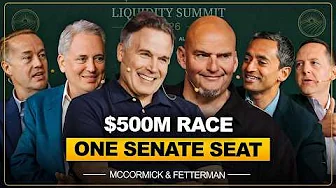
  • Pennsylvania’s two senators are deliberately building a bipartisan alliance rather than merely staging civility. Fetterman called McCormick a friend, and both described joint work on energy, fentanyl, antisemitism and drones after voting together to keep the government open.

  • Fetterman has completely reversed his 2020 position on the filibuster and now treats it as essential to minority rights. He said Democrats were wrong to seek its abolition, credited Manchin and Sinema with stopping them, and called defending it “a hill I would die on.”

  • Fetterman is openly accepting a Democratic primary challenge rather than soften positions that isolate him inside his party. He said he still votes with Democrats about 93% of the time, will not switch parties, and is willing to risk his seat over Israel, shutdowns and anti-Trump “rage bait.”

  • McCormick’s political thesis is that Pennsylvania’s decisive coalition is working-class and cross-party, not reliably partisan. He said many voters backed Fetterman, Trump and himself, while roughly two-thirds of rank-and-file electricians, pipefitters and steamfitters voted for him despite national unions endorsing Democrats.

  • Pennsylvania is becoming a test case for whether AI infrastructure can drive an industrial revival rather than merely burden communities. McCormick said his energy-and-innovation summit produced $92 billion in commitments, while Homer City is being converted into 4.4 GW of generation, with 3.4 GW intended for data centers.

  • McCormick’s strongest economic case for AI is blue-collar scarcity, not speculative future productivity. He said experienced welders and electricians on Pennsylvania projects are earning over $100,000, sites cannot hire fast enough, and a large data-center build can require 5,000–10,000 workers before ongoing operations and upgrades.

  • McCormick warned that capitalism itself becomes politically vulnerable if asset-driven wealth keeps leaving most Americans without a path upward. He described wealth concentration as a “huge problem” and argued that broader ownership and opportunity—rather than simply larger government programs—must accompany the current technology boom.

  • Both senators described modern campaigning as a financial arms race that rewards destruction and extremity. McCormick said his race cost about $500 million and Fetterman said his roughly $300–330 million; Fetterman argued primaries elevate extreme candidates and that hundreds of millions were spent chiefly destroying reputations.

  • China’s critical-mineral restrictions pushed the U.S. toward direct state intervention in mining. Dreyfus said Ford came within days of shutting production, after which officials began offering miners government equity, accelerated permits, and take-or-pay offtake contracts with floor prices.

  • Copper is Dreyfus’s clearest candidate for the next structural AI bottleneck. He estimates a 1-GW AI facility uses 50,000 tons, while baseline growth alone would require 700M tons in 18 years and five new tier-one mines annually despite 7–12-year build times.

  • The U.S. power constraint is not just generation; transmission, distribution and skilled labor may be harder bottlenecks. Dreifus argued electrification alone could cause shortfalls before AI demand arrives, while utilities face a shortage of craft labor needed to expand and modernize the grid.

  • Finding rare earths is not the hard part; processing them is the strategic choke point. Dreifus said deposits are widespread, but China retains much of the know-how for converting mined material into usable products, so new Western mines alone would not eliminate dependence.

  • No single energy source solves the build-out because each encounters different physical constraints. Dreifus calculated that powering a 1-GW data center entirely with solar would require about 35,000 acres, while U.S. nuclear expansion is constrained by missing manufacturing capabilities such as containment vessels.

  • Silver could become another hard constraint if solar deployment keeps accelerating. Dreifus put annual consumption near 1.2B ounces against roughly 1.0B of supply and 600M ounces of above-ground inventory, arguing that the current deficit could consume that buffer in about three years.

  • Reindustrialization could make skilled trades unusually valuable just as automation pressures some white-collar work. Dreifus called future craft-labor demand “almost limitless” and cited top Quanta University graduates earning about $150,000 straight from high school, reversing part of the labor-market pattern created by offshoring.

  • Dreifus’s investment thesis combines physical scarcity with expected currency debasement. He predicts copper can “easily” double and argues commodities, infrastructure and other hard assets should benefit if rising federal debt and future liabilities eventually force substantial monetary expansion.

  • Bill Maris says Section 32’s six funds have averaged about $400 million and all rank in the top decile. He argues size is the edge: sub-$750 million top-decile funds averaged 4.76x DPI versus 2.42x above $1 billion, with 95% of top-decile performers below $750 million.

  • Maris argues venture’s incentives increasingly reward asset gathering more than investment returns. A $5 billion fund returning 1.01x can make its GP more money than a $500 million fund returning 3x, while oversized checks can push a startup from a $100 million valuation to $4 billion simply to deploy capital.

  • Google Ventures was applying machine learning to venture investing while Google internally discouraged calling it “AI,” which some colleagues considered science fiction potentially a century away. Maris says GV ran millions of simulations to design portfolios and fund size; using public information, he estimates its 2009–2018 returns at about 4.1x.

  • Maris sees a plausible price-war threat to OpenAI and Anthropic from Google. If Gemini offered a basically equivalent product at 80% lower token prices, he argues customers would switch and competitors’ economics would face severe compression; his own prescription was simple: “If I were Google, that’s what I’d do.”

  • Maris objects to AI companies claiming public benefit while keeping most early value creation inside private markets. His concern is that ordinary retirement investors may enter only after enormous private gains accrue, leaving public markets to determine whether valuations such as SpaceX’s or Anthropic’s can actually be justified by future cash flows.

  • Maris does not want to bet primarily on ever-larger AI models. He prefers the enabling stack—GPUs, physics engines, controllers and platforms—arguing today’s AI resembles an Atari-era system and could reach something closer to a PlayStation-era experience within five years.

  • In biotechnology, Maris is considerably more cautious about exponential progress than in software. He says finding a promising compound may represent only about 5% of the work because safety, dosing and trials remain slow; realistic simulation of a human cell could accelerate development dramatically, but he says that capability does not yet exist.

  • Palo Alto Networks says six weeks of testing the “Mythos” system surfaced vulnerabilities that normally would have taken five to seven years to find. Arora said the run cost only “low millions,” while persistent mode could chain flaws into new attack paths, making AI-driven vulnerability discovery a real step-change rather than hype.

  • Arora believes advanced offensive cyber capabilities are only months from broad availability, making the defender-versus-attacker patch race immediate. He also said a model-company CEO told him its newest model weights fit on a USB stick, illustrating how difficult powerful models may ultimately be to contain.

  • For enterprise AI, Arora says false positives matter more than simply having the newest model. He cited roughly 30% false positives in one cyber model and warned that even 10–20% error rates are unusable for security, insurance or autonomous systems; the real work is driving errors toward near-zero with better harnesses and training.

  • Arora’s sharpest software call was that “analytical SaaS” is effectively finished because models can analyze underlying data directly. One host described cutting a 20-seat SaaS product to three accounts, connecting its data to Slack and Claude, and reducing the bill by 90% while preserving natural-language access.

  • Agents could remove much of enterprise software’s UI and manual data entry, forcing systems of record to be rebuilt over the next five years. Arora envisions calls, email and transcripts flowing directly into business systems, with some workflows becoming efficient enough for one person to perform work previously requiring five.

  • Arora expects AI models themselves to become a utility layer while the largest profit pools form in applications that solve specific business problems. Rather than enterprises rebuilding everything with OpenAI or Anthropic directly, he expects application companies to arbitrate between models; replacement products are especially attractive because customers already have budgets to displace.

  • Arora worries more about AI-amplified economic disruption through ordinary businesses and shared infrastructure than spectacular attacks on heavily protected national-security targets. He cited Change Healthcare, whose ransomware breach disrupted physician offices and forced UnitedHealth to extend billions of dollars in support credits, as the kind of systemic weakness that matters.

  • Palo Alto may eventually broaden its acquisition strategy if AI lets it operate acquired companies far more efficiently than their current owners. After closing a $25 billion identity acquisition, Arora described the prize as gross margins in the 90s and net margins in the 40s, but said he wants 6–12 months to see how enterprise AI settles.

  • Late-stage private-company secondaries have become a third exit market, not a niche workaround. Transaction volume is roughly double the 2021 peak, prices moved from about 80 cents on the dollar to a 6% premium, and secondaries now compete with IPOs and M&A for liquidity.

  • Staying private can protect founders from scrutiny, but it can also deprive them of honest feedback. Chamath Palihapitiya said Zuckerberg rejected his 2010 request for $1 billion to build a Facebook phone, chose HTML5 instead, and spent three years unwinding the mistake; investors seeking future access may be less willing to challenge private CEOs.

  • Schwab’s acquisition of Forge is a bet that private-company equity is becoming a mainstream asset class. Forge says Schwab brings 46 million investors and $12 trillion, while regulated SPVs and fund products could give companies a managed path from private liquidity to eventual public distribution.

  • The same democratization that opens private markets to retail investors could also turn them into late-stage exit liquidity. Products are emerging with $500 minimums and baskets including SpaceX, while panelists warned that headline private companies are already highly valued and that FOMO-driven structures can detach price from underlying assets.

  • Experienced venture investors are already using the boom to sell, not just buy. One panelist said his LPs want portions sold at four-to-five-times cost to generate DPI, arguing that trillion-dollar private companies force venture managers to treat secondary sales as a routine portfolio decision.

  • IPOs could unlock a fresh wave of late-stage private demand from giant mutual funds. Funds may allocate up to 15% to private assets but often self-cap at 3–7%; once an existing private holding goes public and its lockup expires, that slot reopens, which the panel estimated could release hundreds of billions of dollars.

  • The panel’s bull case on technology came with a clear warning that today’s valuations leave little room for careless entry. One investor noted 14 leveraged ETFs launching around the SpaceX IPO at roughly a $1.75 trillion valuation and said retail investors often get hurt by levering into excitement near the top.

  • Zipline’s strongest advantage may have come from solving a real public-health problem before attacking the American market. The company spent seven years using autonomous drones to deliver blood and medicine in African countries, generating real-world data while, according to the panel, cutting maternal mortality in some areas by 90–95% before expanding to America.

  • Cerebras spent roughly a decade fighting toward an IPO, with its UAE investor creating added regulatory difficulty before demand suddenly flipped. The offering priced at $185, opened around $320, and was described onstage as valuing the company at roughly $50–60 billion.

  • For Planet Labs, going public mattered less for operations than for credibility with customers who need proof the company will survive. Will Marshall said governments, defense and intelligence clients value permanence because some countries depend on Planet’s information, making public-market access to capital a form of institutional trust.

  • Planet Labs operates about 200 satellites that image the entire Earth every day, creating a continuously updated historical record. Marshall said security has become a larger business than expected, with the system used to identify threats weeks or months before they materialize.

  • Space-based data centers are moving from theory to active testing, but their economics still depend on launch costs falling sharply. Planet’s Google study put break-even near $200–$300 per kilogram versus about $1,000 today; Planet has already launched Nvidia GPUs and is preparing an early Google TPU test.

  • Andrew Feldman challenged the near-term space-compute optimism, arguing that building tightly connected clusters in orbit remains an unsolved systems problem. He compared it to self-driving, where the last 10% took a decade, meaning cheaper launches enable experimentation but do not guarantee fast deployment.

  • Cerebras deliberately rejected GPU-like design, betting that a new AI workload required a fundamentally different architecture. Its dinner-plate-sized chip keeps memory close to compute, and Feldman said OpenAI workloads run 15–18 times faster than on a GPU—an attempt to compete through architecture rather than imitation.

  • Planet Labs is a strong case that venture investors can leave most of their gains on the table by exiting at the IPO. The panel said 90% of Planet’s value came in years three and four after listing; Google has not sold, while another holding was distributed at $3–4 billion before reaching $50 billion.

  • Cerebras also replaced the traditional lockup cliff with a six-month “dribble” structure that releases investor shares gradually against performance hurdles. The panel described it as unusually innovative and said SpaceX was expected to use something similar, reflecting a broader effort to make IPO liquidity less disruptive.

  • Third Point’s original edge came from exploiting event-driven situations where management incentives distorted the numbers. Loeb said executives often sandbagged projections while options were being set, letting investors buy into depressed expectations and benefit as transparency and results improved.

  • Third Point has grown from a small event-driven fund into an almost $30 billion multi-strategy capital platform. Its hedge fund now spans equity long/short and credit, alongside an acquired CLO business, private credit, venture investing and a half-owned insurance company.

  • Third Point is shorting housing-linked names because it sees a structural problem beyond high mortgage rates. Loeb argued builders claim to be asset-light while carrying large land-pool commitments, as post-COVID price inflation, elevated costs and unaffordable financing squeeze buyers and margins.

  • David Sacks described public-market exits as one of venture investing’s hardest decisions—and admitted several costly mistakes. He said his group sold Palantir in the $20s before roughly an 8–10x rise and sold Enphase below $1, estimating the latter decision cost about $4 billion of upside.

  • The panel’s Nvidia bull case is that market-cap size itself has become a misleading ceiling. One speaker argued Nvidia’s dominance and next two to three years of earnings justify the valuation, while long/short funds forced to maintain shorts may be treating it as a “safe short,” as investors once did with Google and Amazon.

  • Loeb described an unusually direct chain of influence behind Ross Ulbricht’s eventual pardon. He said he brought the case to Charlie Kirk, who took it to Trump; Loeb also said a first-term commutation was withdrawn after Justice Department resistance, before Kirk later made Ulbricht his “only ask” and Trump pardoned him.

  • Loeb praised the government’s Atom Computing deal as a rare public-private arrangement where taxpayers captured real upside. He said officials drove a tough financial bargain, funded the quantum company, became a customer for cryptography work and would materially increase the company’s value while taxpayers “make a ton of money.”

  • AI funding is concentrating into fewer, much larger private companies, not rebuilding the 2021 unicorn factory. Coatue says funding per unicorn is 5× 2021 levels, while fewer than 20% of the 479-company 2021 cohort had raised again or exited after 20 quarters, versus 80% pre-ZIRP.

  • The private-market liquidity drought may be ending, with several enormous outcomes poised to hit public markets together. Thomas Laffont said 2026 exits were already improving and cited three expected offerings, including SpaceX and Anthropic, whose combined liquidity could exceed roughly the prior decade’s total.

  • Coatue’s SpaceX thesis is that launch frequency improves the business model itself, not merely revenue. More launches enable recurring constellation revenue and eventually multiple constellations for companies, governments and militaries, transforming SpaceX from a launch contractor into a platform with potential businesses such as space data centers.

  • Anthropic’s trajectory changed so sharply after Claude Code that Laffont rejected the idea that frontier models are simply commodities. His charts placed OpenAI and Anthropic’s growth above major software and cloud businesses, while he also cited reports that Anthropic had achieved a profitable month.

  • Coatue’s data suggested scale can increase rather than diminish the chance of extraordinary compounding. It put progression from $1B to $10B near 8%, from $10B to $100B at 13%, and found a 31% 10× rate among $100B-plus companies, though Laffont cautioned that the top-end sample is tiny.

  • Cerebras was offered as the counterexample to instant AI success: years without fresh capital preceded a contract that transformed its outcome. Laffont, a former board member who led its Series B, said the company endured multiple dark years before a major OpenAI deal multiplied its value and preceded its IPO.

  • Coatue believes AI revenue is already large enough to weaken the argument that the spending has produced no economic return, though its figures are forecasts. It estimated roughly $140B today, $300B this year and another doubling in 2027, driven by subscriptions, AI-enabled advertising and enterprise tools such as Claude Code and Codex.

  • The next distortion may come from too much capital rather than too little: OpenAI and Anthropic could eventually use pricing as a weapon. Laffont compared the setup with ride-sharing and food-delivery wars, where excess funding subsidized price competition, while noting infrastructure spending may absorb much of the cash first.

  • Ackman says Pershing Square has evolved from activist turnarounds toward owning durable businesses that can compound for decades. His access has changed just as much: after once being unable to get Wendy’s CEO to return a call, he says he now knows nearly every S&P 500 CEO directly or one person removed.

  • He believes Microsoft, Meta and Amazon are undervalued because AI excitement has pulled capital toward chips, energy and newer companies. By contrast, he sees expensive niche software as vulnerable to AI-driven competition, specifically expressing more concern about Salesforce than broad platform businesses with low per-user pricing.

  • Ackman is personally exposed to the AI boom, saying he invested in xAI through an SPV and also entered SpaceX after Ron Baron urged him to invest. He views SpaceX, OpenAI, Anthropic and similar companies as late-stage venture bets where management, opportunity and future scale matter more than conventional valuation multiples.

  • OpenAI’s finance leadership made Ackman more bullish, but its capital requirements remain his central concern. He said the CFO impressed him enough to joke she should be CEO, while later arguing OpenAI needs to explain how capital commitments massively exceeding current revenue can be financed and justified.

  • Corporate America is intensely focused on AI, yet Ackman says he has seen little meaningful enterprise success so far. Even Pershing Square’s clearest use is comparatively mundane—legal and compliance back-office work—while he describes large-company AI deployment as still extremely early despite boards treating it as a top threat and opportunity.

  • Ackman thinks founder-led companies possess a structural advantage during periods of disruption because founders have both authority and most of their reputation and wealth tied to the outcome. Conventional CEOs, he argues, often face three-to-four-year tenures and shorter-term compensation, making radical decisions harder even when long-term survival requires them.

  • His largest strategic project is turning Howard Hughes from a discounted real-estate company into a Berkshire-style insurance compounding machine. Ackman plans to place insurance float in short-term Treasuries, invest insurer surplus in stocks, and says the roughly $4 billion company could ultimately become a trillion-dollar enterprise over decades.

  • Pershing Square itself is being redesigned around permanent capital rather than repeatedly raising and returning money. Ackman says its management company collects fees from three permanent-capital vehicles with almost no incremental capital expenditure, while PSUS trades around an 18% discount to cash and Howard Hughes offers the separate long-term Berkshire-style bet.

  • OpenAI is not treating an IPO as a race: Sarah Friar called it another fundraising mechanism after saying the company raised $122 billion in March to maximize flexibility. When told Anthropic had confidentially filed an S-1, she said the filing meant little until the SEC process was completed.

  • OpenAI has become a genuinely two-sided business, with revenue now roughly split 50/50 between consumer and enterprise. Friar said ChatGPT exceeds 900 million weekly users, while Codex reached five million users after starting near zero in January.

  • Compute, not customer demand, is OpenAI’s immediate constraint. Friar said OpenAI still lacks enough compute in 2026, expects 2027 to remain tight, is buying capacity for 2028 onward, and already sees shortages when planning for 2030–2032.

  • OpenAI has deliberately dismantled its dependence on a single cloud and chip supplier. Two years ago it relied on Azure and Nvidia; today it uses Oracle, CoreWeave, Microsoft, Google and AWS, while adding AMD, Cerebras and a Broadcom-developed OpenAI chip alongside Nvidia.

  • OpenAI’s economics are improving fast enough that today’s costs can badly misprice future investments. Friar said serving-cost reductions reached roughly 97% from GPT-4 to 5.4 in two years, while 5.5 doubled nominal prices yet still cut customers’ effective cost per token by about 20–30%.

  • OpenAI is pairing its data-center expansion with unusually explicit promises to host communities. Its one-gigawatt Saline, Michigan project is expected to support 2,500 union jobs, generate roughly $1 billion in taxes and fund $45 million of Codex-related education, while OpenAI says ratepayers will not subsidize its power infrastructure.

  • OpenAI plans to unveil its Jony Ive-designed consumer device by the end of 2026 and sell it in early 2027. Friar said she has already used the product and described the interaction as unusually natural and “lovable,” while refusing to reveal its form factor.

  • OpenAI is knowingly sacrificing higher short-term revenue to keep AI broadly available to consumers. Friar said API tokens currently generate an order of magnitude more revenue than consumer tokens, while describing advertising built from user intent, memory and context as a way to finance free access without letting sponsorship determine answers.

  • Chamath Palihapitiya is deliberately staffing 8090 with more interns each quarter than full-time engineers. He says the firm returned to Waterloo co-ops, drew 400 internship applications this quarter, and uses the unusually junior mix to pressure the product to withstand constant fresh scrutiny.

  • All-In’s producer has turned the show’s entire transcript archive into a living Claude briefing system, not a generic news summarizer. Nick feeds every transcript into Claude Co-work, asked Claude itself to write the skills and training rules, and continually iterates them so new stories connect to each host’s past statements.

  • Amazon, Google and Meta reportedly lobbied the Vatican on April 29 to soften Pope Leo XIV’s AI encyclical, and failed. The document centers on concentrated power—who builds, finances and controls AI—and calls for regulation, worker retraining, child safeguards and a ban on autonomous weapons.

  • The episode’s sharpest Anthropic critique is that sincere safety beliefs can also strengthen market power. Gurley called Anthropic an exceptionally aggressive lobbying startup, while Sacks argued that presenting itself as “safe” and rivals as “reckless” could justify rules that entrench its position.

  • Frontier models may already be converging fast enough that model choice matters less than avoiding lock-in. One benchmark put Opus 4.7, GPT-5.5 and Sonnet 4.6 within 0.3 percentage point; Chamath says Fortune 1000 customers increasingly want control planes that can hot-swap providers and later use open models.

  • The near-term enterprise AI bottleneck may be spend discipline and integration, not model capability. Chamath relayed Vivek Garipalli’s account of a Fortune 20 company targeting $1 billion in AI OPEX savings, then spending $200 million on tokens in six months with minimal results before its CEO began pulling the budget back.

  • Sacks thinks Washington’s safety case is laying groundwork for restrictions on open-weight models, though he says proponents cannot yet justify a ban. Gurley’s warning is geopolitical: if America suppresses open models, the rest of the world could simply run Chinese ones.

  • The labor debate resolves to displacement versus net employment, not a clean job-apocalypse verdict. Sacks cited Yale Budget Lab finding no discernible AI-driven labor disruption in three years and software-engineer postings up 15% year over year; Jason countered with companies explicitly planning fewer hires and cuts as AI raises output per worker.

  • Anthropic hired Andrej Karpathy to lead a new pre-training team focused on recursive self-improvement—an explicit effort to make Claude help improve its own training. The panel viewed recursive self-improvement and continual learning as the two remaining breakthroughs that could sharply accelerate model progress.

  • AI backlash is being fed by profitable tech companies cutting staff while using the remaining workforce to train models. Cloudflare’s Matthew Prince said he cut more than 20% despite record growth, while Jason described Meta laying off 8,000 as it installed software to record employee work for model training.

  • A planned U.S. AI executive order was reportedly pulled at the last minute after the president objected to provisions involving federal review of frontier models. The panel favored narrower U.S.-China coordination—KYC, verification and shared safeguards—over unilateral American restrictions.

  • SpaceX’s S-1, as described on the show, targets a $75 billion raise at a $1.75 trillion valuation, but its emerging AI-infrastructure business may be more important. Anthropic is paying $1.25 billion monthly for Colossus capacity under a $45 billion three-year deal cancellable by either party on 90 days’ notice.

  • Orbital AI compute is no longer purely theoretical: the panel said an Nvidia H100 is already operating in space and has been used by Karpathy for training and inference. Baker’s point estimate for commercial orbital compute was the second half of 2028 through the first half of 2030.

  • Nvidia’s moat is expanding beyond GPUs: management expects its CPU business to reach $20 billion this year. Baker also argued that specialist decode accelerators can extend older GPUs’ useful life to 10–15 years, improving financing economics and weakening the short-obsolescence bear case.

  • The Strait of Hormuz shock may hurt the world while strengthening America’s relative industrial position. Baker argued U.S. energy self-sufficiency cushions the damage while Europe and Asia absorb higher imported-energy costs, making prolonged disruption a forcing function for American reindustrialization even as inflation and rates worsen.

  • Baker argued that selling older Nvidia GPUs to China may preserve, rather than weaken, America’s AI lead. His logic is that continued access reduces China’s incentive to build a separate, more power-hungry ecosystem, preserving U.S. technological leverage while lowering pressure for full-stack decoupling.

  • China used the Trump–Xi summit to pair geopolitical restraint with a large commercial opening. The transcript says Beijing backed an open Strait of Hormuz and a non-nuclear Iran, while committing to more U.S. soybeans, oil, LNG and 200 Boeing jets; Xi also warned that mishandling Taiwan could trigger a clash.

  • Salesforce enters China without a normal Salesforce presence: it has no offices or employees there and routes the business through Alibaba. Benioff said Salesforce code runs on Alibaba infrastructure for Chinese customers under local data-residency rules, a structure he described as unique anywhere in the company’s global business.

  • The “SaaS apocalypse” is so far a valuation reset more than an operating collapse. Salesforce was down 37%, ServiceNow 42% and Workday 45%, yet Benioff said Salesforce still expects more than $46 billion of revenue and $16 billion of cash flow; Chamath argued the strongest enterprise incumbents may ultimately benefit.

  • Salesforce is spending roughly $300 million a year on Anthropic while using agents to attack work humans never reached. Benioff said 20–30 million prospects went uncalled over 27 years, but agents contacted 50,000 in one week—an unusually concrete case of AI creating new capacity rather than merely cutting headcount.

  • The Apple–OpenAI partnership appears to have deteriorated from strategic alliance to possible litigation. Citing Bloomberg, the show said OpenAI is considering a breach-of-contract suit after expected subscription billions failed to materialize, while Apple is concerned about OpenAI’s privacy practices and its competing hardware push with former design chief Jony Ive.

  • Anthropic is pushing back on layered private-market SPVs that can hide substantial fees and markups from investors. The discussion highlighted structures charging a 10% load-in fee, additional carry and prices 10% above the last round, with Chamath predicting disputes when companies such as SpaceX, Anthropic and OpenAI eventually go public.

  • Andreessen Horowitz’s political spending was framed as part of a push to become a major financial institution, not just a venture firm. Chamath cited reporting that it was the election cycle’s largest donor and argued that a firm moving from roughly $100 billion toward $1 trillion of assets will treat politics as permanent infrastructure.

  • Friedberg’s biggest non-tech warning was a potential “super El Niño” severe enough to become a food-and-energy shock. He cited sea-surface anomalies near 4°C above normal and warned that crop failures or weak monsoons in Brazil, Australia and India could lift commodity prices, strain grids and create calorie shortages across South and Southeast Asia.

  • Koch’s real growth engine was not industry diversification, but repeatedly redeploying capabilities it had already proved. Since Charles Koch joined full-time in 1961, Koch grew from roughly 300 employees to more than 130,000 in 60 countries and increased 9,000-fold in value.

  • Koch’s worst failures came when it abandoned that discipline. Its late-1990s “gas-to-bread” strategy tried controlling an entire agricultural value chain, nearly erased company earnings, and included an acquisition where Koch discovered hundreds of millions of dollars in bad hog contracts only after closing.

  • The $20 billion Georgia-Pacific acquisition in 2005 was a company-scale bet, not a Berkshire-style passive investment. Koch replaced bureaucratic leadership, dispersed executives from their private 51st-floor enclave, and converted that space into meeting rooms—using visible structural changes to force a different operating culture.

  • Charles Koch considers private ownership a strategic requirement, not merely a family preference. He rejected repeated pressure to go public because analysts demand easily explained businesses and short-term valuation stories, which he believes would have prevented Koch from integrating unrelated industries around shared capabilities.

  • Koch deliberately ranks values first, skills second and credentials last. Jared Benson entered Koch with no college degree after initially striping parking-lot lines, proved himself in data and cybersecurity, built a major defensive capability, and eventually became the company’s CIO.

  • Chase Koch fired himself nine months after becoming president of Koch Fertilizer because he concluded he was the wrong kind of leader for the job. Replacing himself strengthened the fertilizer business while freeing him to build Koch Disruptive Technologies, better matching his strength as a builder rather than an operator.

  • Charles Koch says one of his biggest political mistakes was trying to advance his agenda through one party. After decades largely avoiding major-party politics, he now says the network should work across ideological lines and openly criticizes both parties, including tariffs and the treatment of working undocumented immigrants.

  • Stand Together has become a large operating network rather than a conventional family philanthropy. Chase Koch says it includes nearly 1,000 business leaders and, through its Vela Fund partnership with the Walton family, helped seed more than 5,000 alternative schools in roughly five to six years.

  • Pratt says his mayoral campaign grew directly from losing his Pacific Palisades home, not from a planned political career. He says the nearby 5-million-gallon reservoir had been drained, firefighters reported no assets available, and he watched the house burn by security camera while 911 said responders could not reach his father.

  • The fire left Pratt financially exposed despite his fame. Three days later Heidi Montag’s 15-year-old album surged to a Billboard No. 1 and earned about $150,000, but Pratt says Farmers had dropped them after eight years, leaving California FAIR Plan coverage and nowhere near enough to rebuild.

  • Pratt says Rick Caruso effectively cleared the way for his run by telling him, “Go after Bass,” after Pratt asked whether Caruso would challenge her. He also says many viral pro-Pratt ads are produced outside his campaign, making part of his momentum genuinely decentralized.

  • Pratt’s anti-City Hall case now combines active litigation with insider allegations. He says judges rejected a city-and-state appeal and opened discovery, while LAFD whistleblowers told him crews had been ordered away from the smoldering January 1 fire and alleged political interference in the after-action report.

  • Pratt’s corruption argument centers on a Westwood homeless-housing transaction he says is emblematic of the system. He says a property listed at $11 million received roughly $28–29 million in city money six days later, remained owned by Weingart, and still housed nobody years afterward.

  • His homelessness plan is coercive but unusually specific: mandatory treatment, specialized residential facilities, and rapid enforcement of existing laws. Pratt proposes a two-to-three-week citywide warning period before enforcement begins, with separate facilities for veterans, families, and hardened drug-addicted offenders.

  • Pratt is trying to compensate for zero city-management experience by recruiting operators and capital before Election Day. He says executives would work for $1 a year, he already has an unnamed deputy mayor, he met about 10 billionaires in one week, and one anonymous billionaire pledged $500 million.

  • For Hollywood, Pratt’s strategy came directly from Peter Chernin: a mayor cannot fix the industry’s macroeconomics, but can make Los Angeles the easiest place for independent production. Pratt says Chernin promised continued advice, while David Foster is hosting a fundraiser and Pratt has contacted David Ellison and Ted Sarandos.

  • Elon Musk’s Anthropic deal turns xAI’s compute surplus into a new revenue business while relieving Anthropic’s biggest bottleneck. The episode says Anthropic leased all of Colossus 1, added 220,000-plus Nvidia GPUs and 300-plus megawatts, while xAI trains on Colossus 2 and Claude limits already eased.

  • Anthropic’s growth numbers were the episode’s most extraordinary business datapoint: Sacks said ARR rose from about $10 billion on January 1 to $30 billion by March 31 and $44 billion in April. He now expects roughly $100 billion by year-end, explicitly because new compute deals remove the constraint.

  • The feared “FDA for AI” regime appears overstated inside the administration. Gerstner said Kevin Hassett privately clarified that his FDA analogy meant showing models to government for coordination and system hardening, not federal pre-approval; Sacks said the White House framework he helped write instead favors targeted rules for specific risks.

  • The near-term AI safety problem they took seriously was cyber, not abstract AGI risk. Sacks said OpenAI already matches Anthropic’s “Mythos” cyber capability and expects major U.S. and Chinese models to reach it within three to six months; the group favored preview-period KYC, while labs already flag suspicious API use to government.

  • Power and local permission may matter more to the AI race than model demand. Chamath said roughly 9 gigawatts of data-center capacity is due this year and nearly half is already being protested, making secured power—and the ability to monetize it, as xAI is doing—a strategic advantage.

  • Gerstner disclosed a strikingly concentrated AI-infrastructure bet: 25% of his portfolio is in SK Hynix. He argued the sector is not priced like a bubble, citing SK Hynix at roughly 5× fully taxed GAAP earnings, Samsung 6× and Micron 7×, versus Meta 17× and Nvidia 19×.

  • Chamath’s actual market call was conditional: stay net long for roughly 500 days, then expect a reckoning over whether AI customers can prove real returns. He said model revenue has validated the infrastructure spend, but there is still no clear evidence that AI itself caused the S&P 500’s margin expansion.

  • The strongest hard evidence for current AI demand is hyperscaler growth, not rhetoric. The show cited AWS at about a $150 billion run rate growing 28%, Azure at $108 billion growing 39%, and Google Cloud at $80 billion growing 63%, with roughly $30 billion of combined incremental annualized revenue.

Key points

  • OpenAI missed its user and revenue targets, while carrying enormous compute commitments and preparing for a possible IPO. That creates real financial pressure.

  • But OpenAI’s product position may be improving. The podcast argues its newer models are gaining ground in coding, while enterprise demand may compensate for weaker consumer growth.

  • The real AI bottleneck may be electricity, not demand. Power, transformers, grid infrastructure and data centers are limiting how much compute companies can actually deploy.

  • Google has become a serious AI leader again. Gemini’s integration into Search helped Google take meaningful consumer share from OpenAI while remaining powerful in enterprise cloud.

  • AI could become dramatically cheaper. Smaller models and pruning techniques may allow far more inference from the same amount of energy and infrastructure.

  • AI agents still need humans. They can massively increase productivity, but mistakes mean people still need to prompt, supervise, validate and take responsibility.

  • Big Tech is spending extraordinary amounts on AI infrastructure. Amazon, Microsoft, Google and Meta alone discussed roughly $725B of 2026 capex, sacrificing free cash flow to build capacity.

  • The episode also covers major legal fights: Musk’s case against OpenAI could complicate its corporate structure and IPO, while the Bayer/Monsanto case could redefine how much state law can override federal regulators.

The central idea

The AI race is becoming less about who has the coolest model and more about who controls power, compute, distribution, capital and customers — while improving fast enough to stay ahead.

Key points

  • Steve Hilton is running for California governor as a Republican. His politics come from his Hungarian refugee family, admiration for Margaret Thatcher, business experience, and his time advising UK Prime Minister David Cameron.

  • His headline proposal is a major tax cut: no California state income tax below $100,000, then a 7.5% flat rate above that. He calls it both pro-worker and pro-growth.

  • He says spending must fall with taxes. His argument is that California’s budget expanded enormously after COVID and that fraud, waste and poor accountability consume substantial money. His campaign created a “Cal DOGE” effort to investigate spending.

  • Housing is mainly a supply and regulation problem, in his view. He wants to cut fees, regulatory mandates and litigation barriers such as CEQA that he argues make California dramatically more expensive to build in.

  • Education needs measurable accountability. He favors phonics, school choice, stronger basic standards, and public grades for individual schools and teachers so strong performers can be rewarded and poor performers removed.

  • On crime, he wants punishment plus rehabilitation. He opposes California’s push toward reducing incarceration and argues prisons should also focus much more seriously on literacy, treatment and reducing repeat offending.

  • On homelessness, he wants treatment rather than expensive permanent housing as the default. He proposes redirecting money toward large-scale mental-health and addiction-recovery facilities for people who need treatment.

  • His broader diagnosis is that California has become overregulated and controlled by entrenched interests. His campaign is basically about making government cheaper, simpler, more accountable and friendlier to workers, housing and business.

The central idea

Hilton’s pitch is: California is rich but badly managed — cut taxes and bureaucracy, expose waste, build much more housing, restore accountability in schools and government, and focus public services on measurable results.

Key points

  • Cursor + xAI/SpaceX is strategically powerful because each has what the other lacks. Cursor brings coding workflow, customers, training data and product UX; xAI brings foundation models and enormous compute.
  • The application layer may be more valuable than the underlying model. Cursor’s strength is its IDE and user experience while letting developers choose different models underneath. That protects it from being completely dependent on one AI provider.
  • “Agents” still need serious engineering. Creating thousands of agents can actually create duplicated data, API calls, infrastructure and cost. Someone still has to centralize, design and maintain the system.
  • AI economics will increasingly be about efficiency. Companies shouldn’t use frontier models for every task; cheaper models should handle ordinary work, with intelligent routing deciding when expensive intelligence is actually required.
  • Coding is where a huge amount of AI value is appearing first. The speakers essentially argue that software creation is becoming the first major economically proven agent use case.
  • Traditional SaaS is under pressure because companies can increasingly build their own tools. The episode describes startups creating their own dashboards and software while established SaaS valuations collapse.
  • That creates a dangerous debt problem. Private-equity firms bought SaaS companies assuming predictable recurring revenue; if AI causes prices or revenues to fall, leveraged businesses can suddenly become unable to service their debt.
  • Apple is used as the opposite lesson: Tim Cook was portrayed as an exceptional steward of capital and operations, but the discussion argues Apple became too focused on optimizing existing products and insufficiently aggressive about creating new ones.

The central idea

The winners in AI may not be whoever owns the smartest model. They may be whoever combines intelligence with the best workflow, customers, infrastructure, engineering discipline and economics.

This episode brings Travis Kalanick back with the All-In crew, and it has an unusually strong discussion about how AI companies actually win at scale.

Key points

  • Anthropic’s advantage is focus. The speakers argue its extraordinary growth came from concentrating heavily on enterprise + coding, where customers will pay according to usage rather than expecting a cheap consumer subscription.

  • OpenAI may be suffering from a focus problem. The debate is whether it should defend its enormous consumer lead or push aggressively into enterprise, coding and agents. Chamath suggests treating consumer and enterprise almost like separate companies.

  • Growth can become its own competitive advantage. Travis compares the AI race to Uber: more customers create more revenue, data and compute, which can strengthen the product and fund further expansion. Falling behind at similar scale can therefore become dangerous quickly.

  • Capital can be a weapon — but also kill you. Uber used huge capital to accelerate network effects, but AI companies could also spend so aggressively on infrastructure that revenue never catches up and public markets eventually reject the story.

  • Compute may become the real ceiling on AI growth. The panel argues that power, grid capacity, land and data centers could constrain OpenAI and Anthropic before demand does — effectively recreating Friendster’s problem of having a product people want but insufficient infrastructure.

  • Valuation still has to respect unit economics. The discussion of Allbirds, Bird, OpenSea, Quibi and other failures recalls an era when physical businesses were valued like software businesses despite radically different gross margins and costs.

  • AI productivity is real, but enterprise transformation is much harder than the demos imply. Large companies have undocumented processes, bureaucracy and difficult change management. Founder-led technology companies appear to be adopting AI faster and shipping substantially more quickly.

  • Agents are useful without being close to AGI. Travis says today’s agents can automate repetitive work but still lack taste, judgment and reliability, requiring humans in the loop. The panel distinguishes genuine productivity gains from exaggerated claims of autonomous intelligence.

The central idea

Focus + scale + execution beats simply having great technology.

The strongest point is Travis’s: when something clearly works, concentrating resources on it can make growth itself a compounding advantage — but spending money, adding AI, or claiming transformation does not automatically create the flywheel.

Key points

  • “Build something. Don’t ruminate.” The opening argument is basically that excessive wanting, worrying and replaying things in your head makes you less effective. Act, test things, live, adjust.

  • AI cyber capability may be crossing a serious threshold. The episode discusses Anthropic’s unreleased “Mythos” model reportedly finding old vulnerabilities and chaining multiple weaknesses into sophisticated exploits. The practical implication: AI security needs to become embedded directly into software development, because AI is also multiplying the amount of code being produced.

  • But fear itself can also be marketing. The panel is divided: some see Anthropic’s controlled release as responsible; others argue Anthropic has repeatedly used dramatic safety demonstrations to attract attention. Even the skeptics concede the cyber threat here appears more credible than some earlier scares.
  • The better safety model may be temporary containment rather than stopping innovation. Give defenders early access, patch systems, form industry coalitions, then release more broadly—rather than imposing permanent moratoriums or enormous top-down regulation.
  • Anthropic’s comeback is another lesson in ruthless focus. The episode credits it with saying no to hardware, video, chips and data-center ownership and concentrating its organization on coding and knowledge work. Thousands of people pulling in one direction beat sprawling ambition—at least for this phase.
  • The market for intelligence may be vastly larger than normal software markets. Once AI becomes labor augmentation or labor replacement, spending is no longer limited to the IT budget. Companies buy more intelligence when it produces more economic value.
  • Don’t confuse explosive headline revenue with a great business. The panel keeps returning to gross revenue vs net revenue, compute cost, gross margins and actual recognized revenue. During a boom, people start celebrating increasingly weak metrics; that itself can tell you where you are in the cycle.
  • The AI race is not necessarily winner-take-all. OpenAI, Anthropic, Google, Meta and xAI can all become enormous because the underlying market is expanding so rapidly. Competition between strong companies may actually accelerate the entire category.
  • On geopolitics, the episode is much less settled. They debate the Iran war, Israeli influence, Trump’s decision-making and whether intervention ultimately produces a more stable region. The most sensible standard they arrive at is essentially: judge the policy by outcomes, not today’s rhetoric.

The central idea

Move fast, but know exactly what game you’re playing.

For companies: focus brutally, ship, measure real economics, and don’t let either fear or hype dictate strategy.

And that opening line may be the most useful personally:

Do stuff. Stop blathering in your own head.

Governor Josh Shapiro joins the conversation for a wide-ranging discussion on growth, bureaucracy, political institutions, economic opportunity, and what competent government looks like in practice.

Key points

  • Shapiro’s governing brand is execution. He repeatedly frames his approach around “GSD” — get stuff done — pointing to tax cuts, job growth, lower unemployment, faster permitting, workforce investment, and declining crime.

  • Permitting became a test of whether government can move at business speed. Pennsylvania went from bottom-five permitting performance to what Shapiro calls top-five speed, with a money-back guarantee if deadlines are missed and only five refunds after millions of permits.

  • Small bureaucratic delays create real economic losses. A barber license that once took 20 days can now be issued the same day; at roughly 10 cuts × $20 per day, that delay represented thousands of dollars in lost income.

  • His economic model mixes growth with redistribution rather than choosing one camp. Shapiro supports lower taxes and business formation, but also worker tax credits, public investment, and what he calls a fair contribution from higher earners.

  • Credentials should not become artificial barriers to opportunity. He removed college-degree requirements from most state jobs, says around 60% of hires now lack degrees, and expanded vocational education and apprenticeships for a population where 62% of adults do not hold degrees.

  • Housing is treated as both a supply and regulatory problem. Shapiro wants a $1 billion housing fund, but also emphasizes repairing old housing stock and removing red tape so new homes can be built faster.

  • Coalitions work by focusing on overlap rather than purity. His practical model is to compare ten priorities with an opponent’s ten and work on the three or four they share, whether in legislating, governing, or building electoral majorities.

  • Institutions depend on both formal checks and personal restraint. In discussing Congress, pardons, corruption, Israel, and antisemitism, Shapiro argues that systems weaken when leaders surrender independent judgment or apply standards only to political opponents.

The central idea

Competence becomes powerful when institutions reduce friction without abandoning accountability.

Across economics, bureaucracy, education, housing, and politics, Shapiro’s argument is consistent: systems earn trust when they produce visible results, create opportunity, and still preserve rules, checks, and responsibility.

This episode brings in Trey Stephens and Shyam Sankar, and it has some unusually strong ideas about defense technology, manufacturing, founders, bureaucracy and product-driven companies.

Key points

  • The factory matters more than the stockpile. Their core argument is that inventory eventually runs out; durable power comes from maintaining the people, supply chains and production systems that can continuously rebuild it.

  • Anduril’s model is product-first, not specification-first. Traditional defense contractors often wait for government requirements, while Anduril funds R&D itself, builds what it believes should exist, and sells the finished capability.

  • Bad incentives can make efficiency irrational. In cost-plus contracting, lowering cost can reduce profit; in a product business, lowering cost creates margin and better price-performance. They argue this difference explains why some technologies improve rapidly while others remain extraordinarily expensive.

  • Bureaucracy grows unless strong people cut it back. They cite an acquisition framework that expanded from roughly seven pages to around 2,000, using it as an example of how processes accumulate when nobody has enough authority to simplify them.

  • Founder-like individuals repeatedly drive institutional breakthroughs. Kelly Johnson, Rickover and others are described as “heretics and heroes” who pushed unconventional ideas through systems that initially resisted them. The speakers contrast that with complex programs managed by diffuse committees.

  • Palantir’s hard years became Anduril’s shortcut. Palantir reportedly needed about five years to reach $10 million in annual revenue; Anduril did it in 22 months because several founders had already learned how to navigate government customers, procurement and deployment.

  • Capital should eventually concentrate behind what works. The speakers criticize evenly spreading innovation money across many projects, arguing that performance follows a power law. They also warn that excessive fundraising and valuation can create unnecessary pressure to hit unrealistic growth targets.

  • Storytelling became part of Anduril’s strategy. Stephens says Palantir was too quiet about what it did and why, so Anduril deliberately communicated more aggressively. In controversial industries, silence leaves outsiders free to define the company’s motives and technology.

The central idea

Productive capacity, strong incentives and accountable leadership matter more than static resources or elaborate processes.

The conversation repeatedly contrasts systems that can build, learn and regenerate with institutions that preserve inventory, specifications and bureaucracy. The former compound; the latter gradually lose flexibility.