October 27, 2025
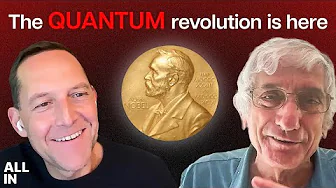
Nobel Prize in Physics Winner: The Quantum Leap That Changed Everything - John Martinis
-
Martinis’s Nobel-winning graduate work showed that a macroscopic electrical circuit could behave quantum mechanically, not just individual atoms. Published in 1985–86, the experiment observed discrete energy levels and tunneling; its deeper importance emerged decades later when the same physics became a basis for superconducting qubits.
-
Richard Feynman’s talk on using quantum mechanics for computation changed Martinis’s career direction near the end of his thesis. Martinis watched Feynman get mobbed afterward and concluded the problem was deep, practical and worth a lifetime; he later went all-in on quantum computing.
-
Martinis left academia for Google because building a quantum computer required a stable team and resources universities could not easily sustain. Google supplied the money; in 2019 his group’s 53-qubit experiment produced a result far harder to emulate classically, though Martinis stresses it had no practical use.
-
Today’s superconducting machines are experimentally capable but still nowhere near general-purpose usefulness. Martinis puts current systems around 50–100 controllable qubits, while noise limits operations and error correction could push a machine capable of solving genuinely hard problems toward roughly one million qubits.
-
Martinis’s company is betting that quantum computing’s decisive bottleneck is manufacturing, not a sudden AI breakthrough. It is pursuing modern 300-mm semiconductor fabrication with industry partners; Martinis says AI may help modeling and error decoding, but clean hardware and precise control remain fundamental.
-
His commercial target is useful large-scale quantum computing in roughly eight to ten years, but he openly acknowledges that “ten years” has been predicted for years. His case for optimism rests on solving manufacturing bottlenecks so successful designs can scale rapidly rather than merely adding qubits incrementally.
-
Martinis thinks China is technically close enough that published results may understate how competitive it already is. Chinese teams reproduced Google’s supremacy work and appeared near parity soon after newer Google results; his concern that China may delay publication until Western disclosure is explicitly a worry, not an established fact.
-
The Nobel was not a complete surprise: Martinis had known for years that he and collaborators were being considered through Nobel symposiums. After several disappointing award mornings he stopped expecting it; this year his wife took the 3 a.m. call, let him sleep until 5:30, and reporters arrived at 6.