
The Diary Of A CEO
...

February 20, 2025

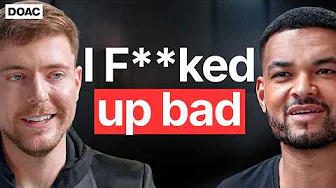
MrBeast: If You Want To Be Liked, Don't Help People & I Lost Tens Of Millions On Beast Games!

  • MrBeast personally lost tens of millions of dollars producing Beast Games. The show cost over $100 million, including more than $20 million in prizes and sets costing $15 million and $14 million for its first two episodes; he deliberately prioritized making an exceptional first season over profitability.

  • Beast Games became Amazon's biggest unscripted show and helped open streaming opportunities for other YouTubers. Jimmy said two creators secured streaming deals following its success, while the show continued attracting over 700,000 new viewers daily; production required approximately 1,000 cameras, 150 editors, and customized Adobe software.

  • Jimmy wants Feastables to prove that a billion-dollar chocolate business can operate profitably without child labor. He cited 1.5 million children working on West African cocoa farms and farmers earning under $1 daily; after encountering suppliers unwilling to offer child-labor-free cocoa, he set a goal of helping one million children escape exploitation.

  • Jimmy secretly installed GoPros inside Walmart stores to investigate why Feastables chocolate bars kept breaking. The recordings exposed defective display boxes that collapsed when customers removed products, a problem his employees had downplayed; he was spending approximately $100,000 weekly inspecting 5,000 stores before fixing the packaging.

  • Despite being a billionaire on paper, Jimmy said he had less than $1 million in his personal bank account. Feastables generated nine-figure annual revenue, but he reinvests earnings, pays himself only enough to cover expenses, and has rejected offers approaching $1 billion for his YouTube business.

  • Jimmy's determination to succeed began with his family's bankruptcy in 2008 and his mother's struggle to raise two children while working two jobs. Her annual salary was approximately $40,000, equivalent to one of his later YouTube sponsorships; he eventually supported her financially after years of conflict over his unconventional career.

  • Jimmy admitted he had been unhappy more often than happy that year and believes his success comes at a substantial personal cost. Crohn's disease, frequent illness, sleep deprivation, and relentless filming intensify the pressure; he increasingly prefers building businesses but cannot delegate being the face of his YouTube channel.

  • Jimmy believes helping people publicly attracts more hostility than displaying personal wealth. His projects restoring eyesight and providing clean water have attracted accusations of exploitation, while luxury purchases by other influencers receive praise; he estimates having read more than 5,000 messages telling him to kill himself.
...

November 14, 2024

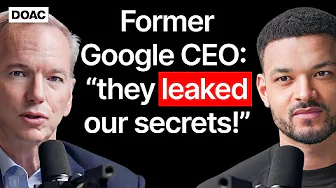
Ex Google CEO: AI Can Create Deadly Viruses! If We See This, We Must Turn Off AI! - Eric Schmidt

  • Google's 70/20/10 investment rule helped turn small experiments into enormous profits. Schmidt said Google devoted 70% of its effort to core operations, 20% to adjacent businesses and 10% to experiments; an early Google Brain team of 10–15 people generated an estimated $10–40 billion in additional profits over a decade.

“so that pays for a lot of failures” — Eric Schmidt

  • Google discovered that YouTube was outperforming its own video service despite having far fewer resources. General counsel David Drummond urged Schmidt to examine the startup, which moved faster because it was not constrained by Google's established procedures, including those involving intellectual property.

“they really work quicker even though we had an incumbent” — Schmidt

  • OpenAI achieved its ChatGPT breakthrough by improving Transformer-based models with human feedback, surprising even its own developers. Schmidt said Google had invented the Transformer architecture, but OpenAI's reinforcement learning from human feedback helped turn the technology into a remarkably effective product that was released while the company focused on GPT-4.

“they didn't really understand how good it was they just turned it on” — Schmidt

  • Google's once-confidential weekly meetings became unsustainable when employees began leaking internal discussions. Schmidt recalled a presentation being transmitted to a reporter while it was still underway, forcing executives to stop the meeting and marking the breakdown of Google's original informal culture.

“someone was leaking the presentation live to a reporter” — Schmidt

  • Schmidt warned that unreleased AI models could reportedly discover previously unknown cybersecurity vulnerabilities as effectively as human specialists. He also identified biological weapons as a concern and compared the possible future security of frontier AI facilities with the armed protection surrounding nuclear materials.

“there's evidence that the raw models these are the ones that have not been released can do what are called Day Zero attacks as well or better than humans” — Schmidt

  • Schmidt identified three warning signs that should prompt humans to shut down advanced AI systems. These are uncontrolled self-improvement, systems developing successor models faster than safety evaluations can occur, and AI agents inventing languages that their human operators cannot understand.

“that's a good time to pull the plug” — Schmidt

  • Despite his warnings about AI, Schmidt's greatest fear is that humanity will adopt the technology too slowly. He considers AI assistants for teachers and doctors relatively achievable advances that could bring personalized education and better medical treatment to people worldwide.

“my actual fear is we're not going to adopt it fast enough to solve the problems that affect everybody” — Schmidt

  • Henry Kissinger completed the final chapter of Genesis during the last week of his life. Schmidt said Kissinger's interest in AI began after hearing DeepMind's Demis Hassabis speak about a decade earlier, and that he wanted their book to help humanity navigate the next 50 years.

“he finished the last chapter in his last week of life in his deathbed” — Schmidt