The Diary Of A CEO

The Diary Of A CEO

Watch Facts Elle's

Facts

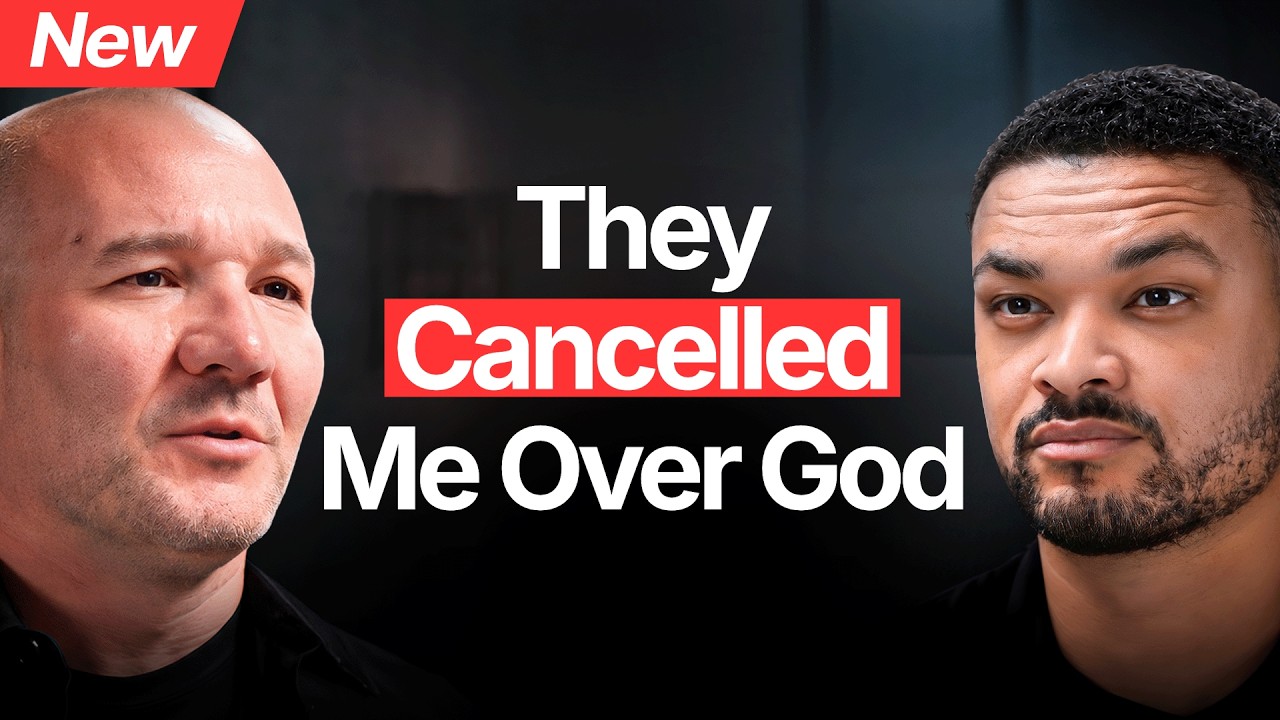
Shawn Ryan: There's A Battle For Your Soul, It's Happening Right Now

- Sean Ryan came close to interviewing Kamala Harris before the 2024 election, but her campaign withdrew at the last minute. Her team objected to proposed questions, and Ryan even offered to let them choose the topics; Donald Trump, by contrast, accepted an interview without editorial restrictions.

- Ryan supported Trump's election but now believes the president has abandoned his promises and is damaging American interests. He sees no favorable outcome from the Iran conflict and says former military colleagues believe American forces are serving Israel's interests, although he admits he cannot establish Trump's actual motives.

- Ryan suspects powerful interests manipulate podcasts through planted guests and carefully cultivated relationships, but acknowledges having no proof. He has declined White House and other prestigious invitations to avoid appearing politically captured and suspects some guests use lengthy interviews to insert a single message designed to become a viral clip.

- Ryan refused to release a COVID-19 vaccine interview after detecting a potentially misleading distinction in the guest's central allegation. The guest claimed vaccines had been patented before the pandemic but repeatedly referred to earlier SARS vaccines rather than COVID-19 vaccines; Ryan feared viewers could make medical decisions based on unreliable information.

- After leaving CIA contracting, Ryan immersed himself in Medellín's drug networks, describing it as perhaps the most dangerous period of his life. He used cocaine heavily and pursued relationships with dealers for excitement, then fled Colombia within 12 hours after a trusted doorman warned that police were monitoring his apartment.

- Ryan credits his first ibogaine treatment with helping him abandon alcohol and medication use, but his second psychedelic retreat left him convinced he had experienced hell. During a 5-MeO-DMT session, he experienced approximately 90 minutes of overwhelming terror; he subsequently underwent at least five Catholic exorcism sessions, with priests describing his condition as oppression rather than possession.

- Ryan plans to replace much of his political programming with a multiyear series examining every book of the Bible, despite already losing advertising revenue. A longstanding life-insurance advertiser cancelled its relationship over faith-based content shortly after discussing an expanded partnership; Ryan says he will continue the project regardless of commercial consequences.

- Ryan intends to reduce his podcast schedule from two episodes weekly to one so he can spend more time with his family and build businesses he believes in. His latest venture, Glacier, combines a VPN, secure DNS, and disposable telephone numbers; he says the pressure of running a major podcast has made him regret moments of his children's lives he cannot recover.

Gathered content

Shawn Ryan: There's A Battle For Your Soul, It's Happening Right Now

- Sean Ryan joined the U.S. Navy at approximately 17 and spent five and a half years in the service. He entered the Navy SEAL training pipeline and later served in Haiti, Afghanistan, and Iraq before becoming a CIA contractor, entrepreneur, and host of one of the world's largest podcasts.

- Ryan spent approximately nine months completing Basic Underwater Demolition/SEAL training (BUD/S), rather than the usual six months. He was rolled back during training, extending the time required to complete the course.

- Becoming an operational Navy SEAL requires several years of training. Ryan described BUD/S, jump school, SEAL Qualification Training, earning the SEAL Trident, and approximately another 18 months to two years of team training before deployment.

- SEAL training prepares operators for missions across sea, air, and land. Ryan described training in diving, parachuting, demolition, marksmanship, close-quarters combat, sniper operations, small-unit tactics, and warfare in desert, jungle, and winter environments. He compared the SEALs with Britain's SAS and SBS.

- Ryan's first significant exposure to conflict was in Haiti in 2004, following the removal of President Jean-Bertrand Aristide. He encountered extreme poverty, sewage flowing through streets, escaped prisoners, floating bodies, bullet-riddled buildings, and burning vehicles.

- Haiti changed Ryan's understanding of poverty and disorder. He said it was the first time he had witnessed poverty on that scale, although he later encountered more intense combat environments.

- Ryan deployed to Afghanistan shortly after Operation Red Wings in 2005. He described the June 28 operation as the largest loss of Navy SEAL personnel in the unit's history at that time.

- Ryan recounted Operation Red Wings as a surveillance mission compromised by a goat herder. According to his account, the herder revealed the position of a SEAL element observing a suspected terrorist, leading to an ambush, helicopter losses, and a single survivor among the original team.

- Ryan arrived in Afghanistan around late September or early October 2005. His unit conducted operations against suspected targets, but most produced little intelligence or operational success. They captured a small number of prisoners and returned home earlier than expected.

- Ryan became dissatisfied with the limited combat opportunities in Afghanistan. He had expected frequent direct-action missions, sniper operations, and close-quarters engagements but found that opportunities were relatively infrequent.

- Ryan subsequently served in Iraq while his original platoon returned home. The experience came toward the end of his military career and coincided with his decision to leave the Navy.

- In Iraq, Ryan's platoon leadership arranged for SEAL operators to work alongside conventional military units suffering roadside-bomb and suicide-bomb attacks. The objective was to help those units identify and pursue the people responsible.

- Ryan trained conventional forces in surveillance and tactical mission planning. Instruction included establishing sniper positions, organizing teams, shooting, insertion and extraction procedures, and executing coordinated operations.

- Ryan claimed that these combined operations regularly eliminated suspected insurgents within 24 hours of deployment. After an operation, his team would move on to support another conventional unit.

- Military service substantially increased Ryan's confidence, ambition, and tolerance for pressure. He said SEAL training demonstrated that people could accomplish far more than they ordinarily believed possible.

- Ryan also identified serious psychological costs associated with special operations. He described becoming attached to adrenaline, dangerous environments, and a military culture that included heavy drinking and fighting.

- Ryan's transition into civilian life began with an unsuccessful real-estate career. He had read Donald Trump's How to Get Rich, which inspired him to pursue entrepreneurship, but his initial attempt failed.

- Ryan moved from real estate into government security contracting. He began with a smaller State Department assignment, obtained CIA-related work through Blackwater, moved to another contracting company, and eventually worked directly for the CIA without an intermediary.

- Ryan's podcast became a major media business following his military and intelligence-contracting careers. During the interview, he reported approximately 150 million to 200 million monthly views.

- Ryan said his podcast ranked third on Spotify at the time of the conversation and had previously reached number one on YouTube. Steven Bartlett also remarked that Ryan's program had attracted more American views that week than Joe Rogan's.

- Ryan suspects intelligence organizations and political interests attempt to influence major podcasts, although he acknowledged having no proof of a coordinated operation. He believes hosts, guests, and other influencers may be deliberately cultivated or positioned to shape public opinion.

- Ryan regards Donald Trump's successful use of podcasts during the presidential election as evidence of the medium's political power. He argued that Trump's campaign recognized the influence of podcast audiences and used appearances strategically.

- Ryan believes political access can compromise an influencer without requiring money or an explicit agreement. Public appearances alongside powerful politicians can make a creator appear politically aligned, restricting their ability to remain independent.

- Ryan identified the public presentation of Epstein-related binders as an example of political association becoming reputational capture. He argued that influencers photographed participating in the event became publicly associated with the administration, regardless of their private intentions.

- Ryan has rejected invitations to political and high-profile social events because he fears being used to demonstrate allegiance. He mentioned invitations involving the White House, football games, and other occasions where photographs could portray him as part of a political inner circle.

- Ryan also expressed concern about invitations involving prestigious presidential access, including Air Force One and Marine One. He argued that extraordinary access can tempt media figures into relationships that compromise their future independence.

- Ryan believes political association creates a long-term ceiling on a creator's independence. Once audiences see a journalist or podcaster as belonging to a particular political camp, decisions made by that camp can damage the creator's credibility.

- Ryan suspects some podcast guests are deliberately promoted despite having little distinctive expertise or personal achievement. He pointed to relatively unknown commentators who suddenly appear across major programs and generate exceptional audiences by discussing current events.

- Ryan described how a single sentence inside a lengthy podcast could serve an influence operation. A guest might participate in a three-to-five-hour interview primarily to insert one statement that can later be clipped, distributed, and amplified.

- Ryan considers viral clips particularly useful for influencing political narratives. He suggested that a strategically placed statement can be separated from the broader conversation and circulated to audiences who never hear the full interview.

- Ryan has become suspicious of guests who make geopolitical predictions and later contact him to highlight their accuracy. He cited guests discussing Ukraine, Israel, Iran, and other conflicts who subsequently reminded him that they had predicted a development.

- Ryan questioned how certain guests remembered specific remarks made during his interviews when they appeared on dozens of podcasts. He described situations involving guests participating in approximately 50 interviews over two months and later recalling a particular prediction from his show.

- Bartlett said his understanding of intelligence operations changed after interviewing people familiar with espionage. He had previously dismissed many such accounts as conspiracy theories but came to recognize that clandestine influence operations were plausible.

- Bartlett described intelligence operatives maintaining apparently ordinary civilian identities. He referred to people living in cities such as New York with families, businesses, and jobs while allegedly receiving covert financial support from foreign governments.

- Bartlett suggested that an intelligence organization could deliberately create a successful podcast guest. A strong initial appearance could generate enormous attention, after which other podcasts would invite the same person and spread the intended message.

- Bartlett argued that one successful podcast appearance can potentially generate 100 million views. He also raised the possibility that organized traffic promotion could manufacture the appearance of exceptional public interest.

- Ryan suspects intelligence operatives may work inside major technology platforms without the companies' knowledge. He suggested that apparent employees at YouTube, Meta, or TikTok could have undisclosed intelligence roles. He offered no direct evidence identifying such employees.

- Ryan questioned why his podcast was absent from YouTube's popular-podcast listings despite its reported audience. He connected the anomaly, speculatively, to controversial discussions about terrorism earlier in the program's history.

- Ryan stopped short of claiming he could prove YouTube had shadowbanned his program. He emphasized that YouTube had been a valuable commercial partner and said he remained satisfied with the relationship despite finding the ranking discrepancy strange.

- Bartlett suggested that human editorial decisions may influence which podcasts appear in platform recommendations. The discussion distinguished potential manual selection from the broader allegation of intelligence interference.

- The speakers discussed Annie Jacobsen's expression "speculative narratives" as an alternative to "conspiracy theories." They considered the phrase useful for discussing uncertain claims without immediately dismissing them or treating them as established facts.

- Ryan supported Donald Trump's presidential candidacy but said he did not believe he had issued a formal endorsement. He wanted Trump to win while maintaining that his show was open to politicians from different parties.

- Ryan attempted to interview Kamala Harris before the presidential election. His team held discussions with her campaign and began developing an interview outline, but negotiations ultimately failed.

- Harris's campaign objected to several proposed interview subjects. Ryan said he offered to let the campaign select the topics and agreed to construct the interview around its preferences, but the campaign withdrew shortly before the proposed appearance.

- Ryan regretted that Harris did not appear before the election. He believed the interview would have allowed audiences to compare the candidates but doubted it would have changed the election result.

- Donald Trump's appearance on Ryan's podcast came without restrictions on interview topics. Ryan said Trump's team imposed no editorial guidelines.

- Ryan also interviewed Robert F. Kennedy Jr. while Kennedy was running as an independent presidential candidate. He cited this as further evidence that he had sought conversations across the political field.

- Bartlett interviewed Kamala Harris after she lost the election and reported that she imposed no topic restrictions. He suggested that Harris's circumstances had changed and that she might no longer have been working with the same campaign team.

- Bartlett found Harris considerably more candid and relaxed after the election. He said she spoke critically about Joe Biden's treatment of her, used profanity, and abandoned much of the polished presentation associated with campaign appearances.

- Bartlett believed voters would have benefited from seeing this less-controlled version of Harris before the election. He viewed her unsuccessful negotiations with Ryan as a missed opportunity for the Democratic campaign.

- Ryan's opinion of Trump deteriorated significantly after the election. He said Trump had departed from his campaign promises and that he was dissatisfied with the administration's direction.

- Both speakers expressed serious doubts about the American military confrontation with Iran. Bartlett said he could not identify a convincing path toward a favorable outcome, while Ryan said he saw no positive outcome for the United States.

- Ryan said former military colleagues believed American forces were serving another country's interests in the Iran conflict. He identified Israel as the country he thought had the greatest interest in American involvement.

- Bartlett contrasted Ryan's assessment with JD Vance's description of America as the senior partner in its relationship with Israel. Ryan said the situation did not appear consistent with that description.

- Ryan rejected the stated nuclear-weapons rationale for the Iran conflict but did not claim to know Trump's actual motive. He emphasized that any alternative explanation would be speculation.

- Ryan expressed disillusionment with both major American political parties. He increasingly saw Democrats and Republicans as behaving similarly and said numerous politicians he had interviewed had lied to him and his audience.

- Ryan raised the possibility that the United States could lose its position as the world's dominant superpower. He cited China's development, America's energy infrastructure problems, the petrodollar, and deteriorating international relationships as possible contributing factors.

- Ryan viewed China's energy and nuclear-power development as a strategic advantage. He contrasted China's expansion with American political arguments over nuclear energy and the future of the national power grid.

- Ryan identified instability in American policy toward Canada as an example of damaging international relationships. He referred to the Biden administration's rejection of the Keystone pipeline and subsequent American pressure on Canada as its trade relationships evolved.

- Ryan argued that Canada had been encouraged to develop alternatives after American energy-policy decisions changed. He criticized the subsequent use of tariffs against Canada, although he could not recall the exact rates and mentioned figures ranging from approximately 25% to 100%.

- Ryan believes unpredictable American trade policy makes the United States a less reliable commercial partner. He argued that businesses cannot plan confidently when successive administrations reverse major decisions and then penalize trading partners for adapting.

- Ryan accused American political leaders of damaging relationships with numerous allies while treating Israel differently. He acknowledged that the United States bears substantial financial and military responsibilities internationally but argued that these contributions do not eliminate the need for dependable allies.

- Bartlett argued that great powers can weaken their authority by behaving like bullies. He suggested that insulting allied governments or threatening their sovereignty can appear more like insecurity than strength.

- Bartlett cited Trump's remarks about Canada becoming an American state as an example of rhetoric that could alienate allies. He argued that such behavior might encourage other countries to strengthen relationships among themselves rather than rely on Washington.

- Bartlett suggested European governments were reconsidering their security arrangements in response to American conduct and the Iran conflict. He believed European leaders could pursue greater collective independence from American leadership.

- Both speakers considered China's relatively restrained public posture strategically advantageous. Ryan suggested that Beijing could benefit from watching the United States undermine its own alliances without needing to confront it directly.

- Ryan wants to examine what happened to Britain when the United States emerged as the leading global power after World War II. He proposed interviewing a historian to understand the practical effects of losing superpower status.

- Ryan questioned whether American decline would necessarily produce the catastrophic outcomes often predicted. He acknowledged possible financial instability and currency problems but wanted to investigate whether such a transition might also have benefits.

- Ryan speculated that diminished American global dominance could reduce political funding from powerful interests and force politicians to focus on domestic problems. He presented this as a possible consequence rather than an established outcome.

- Ryan proposed a documentary project called "50 States in 50 Days." The idea is to visit impoverished communities in every American state, document their living conditions, and confront political leaders with the conditions experienced by their constituents.

- The proposed project would emphasize the contrast between domestic poverty and American spending overseas. Ryan mentioned New York, New Jersey, Wisconsin, California, Alabama, Mississippi, and Florida while describing the intended national journey.

- Ryan wants the documentary to hold senators, representatives, and governors publicly accountable for poverty in their jurisdictions. He would use filmed evidence of neglected communities to challenge officials about their priorities.

- Ryan is unlikely to participate heavily in the 2028 presidential election under current circumstances. He said he saw no particularly strong candidates and was more interested in the possibility of a credible third-party movement.

- Ryan discussed a former podcast guest identified as Blair Skoro, who reportedly worked as a CIA intelligence asset. Ryan said Skoro had been recruited from prison to infiltrate extremist networks, including networks associated in his account with the Muslim Brotherhood.

- According to Ryan, Skoro was an American with origins in an Eastern European country. Ryan said Skoro gained access to terrorist organizations holding substantial weapons caches.

- Ryan described Skoro's alleged intelligence work as arranging weapons transactions that allowed caches to be redirected into CIA custody. These details were presented as Skoro's account of his former activities, not independently established facts.

- Ryan said his team had received an email indicating that U.S. Immigration and Customs Enforcement had detained Skoro. He understood that deportation was being considered but acknowledged that he did not know the full circumstances.

- Ryan said Skoro feared he would be killed if deported. Ryan expressed concern that an individual who had genuinely assisted American intelligence operations might face removal to a dangerous environment.

- Ryan became suspicious when Skoro unexpectedly introduced a claim about Russians bringing nuclear weapons into the United States. The subject appeared disconnected from the interview's focus on terrorism, infiltration, and weapons trafficking.

- Ryan challenged Skoro during the interview about whether he had been sent specifically to introduce that allegation. He believed the abrupt statement resembled the kind of isolated message that could be inserted into a lengthy interview to influence public discussion.

- Ryan did not conclude that Skoro was deliberately spreading intelligence-directed propaganda. He stressed that he could not establish whether Skoro was acting on instructions, but the exchange illustrated why he scrutinizes unexpected geopolitical claims.

- Ryan has declined to publish a small number of completed podcast interviews because he doubted their reliability. He said he was willing to explore controversial subjects but did not want to knowingly distribute false information to millions of viewers.

- One unpublished interview concerned an allegation that COVID-19 vaccines had been patented before the pandemic. Ryan initially found the guest convincing but later noticed that the guest repeatedly substituted references to earlier SARS vaccines when discussing supposed pre-pandemic patents.

- Ryan concluded that the distinction between SARS-related vaccines and COVID-19 vaccines might undermine the guest's central allegation. He considered the shifting terminology sufficiently suspicious to withhold the episode rather than risk publishing misleading medical claims.

- Ryan's decision was influenced by the possibility that viewers might make consequential medical decisions based on the interview. He believed his audience trusted him and did not want someone choosing whether to receive a vaccine based on potentially unreliable information.

- Ryan disclosed that he received a COVID-19 vaccine but later regretted taking it. His personal position did not change his decision to suppress the questionable interview.

- Ryan terminated another interview because the guest could not explain what the World Economic Forum actually was. The guest presented himself as an expert but could not identify the organization's basic structure before moving into conspiracy allegations.

- Ryan also rejected a recent interview with a woman who claimed to have worked for the CIA. When questioned about intelligence work, she repeatedly invoked classification restrictions and concentrated almost entirely on polygraph examinations.

- Ryan considered the former-CIA guest's narrow focus on polygraphs a credibility problem. He questioned whether she had researched an accessible subject to appear knowledgeable and ended the interview without releasing it.

- Ryan acknowledged that his podcast has published mistakes and misinformation. He distinguished unintentional errors from knowingly distributing doubtful claims for audience growth and said he had publicly corrected mistakes.

- Ryan moved to Colombia at approximately 34 after finishing his intelligence-contracting career. He initially stayed in Cartagena before settling in Medellín, where he spent approximately two years.

- Ryan became involved with Colombian drug networks, although he distinguished his activities from personally dealing drugs. He said his primary interest was identifying dealers, discovering their relationships, and inserting himself into their networks.

- Ryan described the Colombian period as an extension of his addiction to danger and adrenaline. Ordinary American civilian life felt intolerably dull after years of military and intelligence work.

- Ryan had also become frustrated with civilians offering opinions about wars they had never experienced. He went to Colombia partly because he wanted to escape English-speaking environments and conversations about his military service.

- Ryan found more excitement in understanding drug-network hierarchies than in actual drug transactions. He approached the activity as a dangerous game involving access, relationships, and the challenge of reaching influential figures.

- Ryan described his Colombian activities as potentially the most dangerous of his life. He said he placed little value on his own survival, although he did not consider himself suicidal.

- Ryan admitted that he contemplated dying in Colombia if the excitement eventually disappeared. His account demonstrated how far his search for stimulation had moved beyond ordinary risk-taking.

- Ryan used cocaine heavily in Colombia and sometimes remained intoxicated for three to five consecutive days. His account included repeated drug binges, heavy drinking, and increasingly reckless behavior.

- Ryan regularly entered a Medellín neighborhood he called Barrio Antioquia to explore its drug networks. He described it as an area with police checkpoints, serious security risks, and access to inexpensive cocaine.

- During one cocaine binge, Ryan visited a bridge he called Puente de los Locos with several women and a large amount of cash. He threw money into the air to observe the reaction of people living around the bridge.

- Hundreds of people reportedly rushed toward the scattered money, nearly trapping Ryan and his companions. They eventually escaped in a vehicle, an incident Ryan later recognized as extraordinarily reckless.

- Ryan systematically cultivated relationships with the doormen and security staff at his Medellín penthouse building. He recognized that they controlled access to the property and could warn him about suspicious visitors.

- Ryan maintained the loyalty of building employees through gifts and payments. He said he provided cash tips, food, clothes, alcohol, and cocaine, making these employees part of his personal information network.

- A trusted building employee named Freddy warned Ryan that Colombian police were investigating him. Ryan initially accused Freddy of fabricating the story to obtain more money or favors.

- Freddy said police had requested Ryan's passport information and details about his identity, background, and associates. Ryan became convinced the warning was genuine when Freddy mentioned police photographs of the cash-throwing incident at the bridge.

- Freddy also reported that investigators had planted a listening device in a light fixture outside Ryan's apartment. According to the warning, police had established an observation position in a building across the street.

- Ryan responded by removing cocaine and other potentially incriminating material from his apartment. He also attempted to identify the alleged surveillance position across the street.

- Ryan used surveillance-detection techniques learned from his security career to assess whether he was being followed. He visited multiple internet cafés along a route designed to expose surveillance but did not detect anyone following him.

- Ryan purchased tickets to multiple destinations and left Colombia within approximately 12 hours of receiving the warning. He said he never returned to the country.

- The police scare did not immediately end Ryan's addiction or attraction to dangerous environments. He reduced his activities but continued traveling to places where he could find similar excitement.

- Ryan subsequently visited Panama, Costa Rica, and Honduras. He specifically traveled to San Pedro Sula because of its reputation at the time as one of the world's most dangerous cities.

- Ryan's cocaine use had previously caused severe fears about his physical condition. He described swollen ankles, circulation concerns, and experiences in which the surrounding world seemed unnaturally slow despite his stimulant use.

- During one frightening episode in Colombia, Ryan called his mother on Mother's Day because he believed he might die. He was concerned that he was experiencing a cocaine overdose and wanted to speak to her while he still could.

- A major turning point came when Ryan tried to help his best friend overcome an opioid addiction. His friend was leaving security contracting and struggling with substance dependence.

- Ryan recognized that helping his friend required changing his own behavior. He made his friend's recovery a personal mission and began reducing his own substance use to set an example.

- Ryan said they initially made meaningful progress, but his friend eventually died as a consequence of addiction. The loss formed part of his later understanding of substance abuse and recovery.

- Ryan began psychotherapy partly because he wanted his friend to see him taking recovery seriously. He also recognized that he needed help himself.

- Therapy initially challenged Ryan's pride and self-image. He had few civilian friends in Florida, while many of his former colleagues remained involved in military or intelligence operations, leaving him socially isolated.

- Ryan found therapy valuable because explaining problems aloud helped him understand them. He appreciated having someone relatively impartial ask questions and hold him accountable.

- Bartlett disclosed that he had spent approximately a year working in the psychedelic mental-health industry. The work occurred between his earlier entrepreneurial career and the development of his podcast.

- Bartlett had encountered ibogaine as a possible treatment for addiction. He said he had been told of cases involving dramatic improvements after a single supervised treatment, although those accounts were not established as general treatment outcomes during the conversation.

- Ryan underwent ibogaine treatment twice, with sharply different experiences. He characterized the first as profoundly beneficial and the second as terrifying and spiritually transformative.

- Ryan's first ibogaine treatment occurred after his podcast had become successful and while his son was approximately six months old. He sought treatment primarily because his intense focus on business prevented him from being emotionally present with his wife and child.

- Ryan described constant pressure to evaluate business opportunities and make decisions. He worried about missing important opportunities, which kept his attention fixed on work even when he was with his family.

- Before his first ibogaine treatment, Ryan had already stopped using cocaine and largely abandoned heavy drinking. He said he was still intermittently using prescription sleeping medication and had also used Adderall.

- Ryan credited his first ibogaine experience with helping him stop drinking and discontinue sleeping medication and Adderall. He described these changes as unusually effortless and said he became more capable of being present with his family.

- Ryan reported more than four years without alcohol by the time of the interview. He also said he no longer used sleeping pills, Adderall, or other substances he regarded as personal vices.

- Ryan returned for a second ibogaine experience approximately three months before the interview. Unlike the first treatment, the second preceded an intense episode of fear and a series of disturbing experiences that he continued to interpret spiritually.

- Ryan described taking ibogaine in pill form and associated the substance with traditions originating in Gabon, Africa. At the treatment facility, participants also underwent a separate 5-MeO-DMT experience the following day.

- Ryan had experimented with several psychedelics beyond ibogaine. He reported taking psilocybin and 5-MeO-DMT on several occasions and had previously regarded these experiences as useful.

- Ryan believed earlier psychedelic experiences had helped him examine complex business decisions. He said they sometimes made relationships, motivations, and possible consequences appear exceptionally clear.

- Ryan also reported using psychedelic experiences to reflect on family relationships and friendships. He interpreted the resulting insights as meaningful, although the conversation did not establish that his perceptions of other people's motivations were objectively correct.

- Ryan had long believed psychedelics might expose people to spiritual experiences they do not fully understand. Even before the frightening second treatment, he said he approached the substances with caution and prayed before taking them.

- Ryan's growing commitment to Christianity influenced how he prepared for psychedelic experiences. As his religious beliefs strengthened, he increasingly incorporated prayer into the experiences themselves.

- Ryan described his second psychedelic episode as an encounter with what he believed was hell. He said the most disturbing portion occurred during the 5-MeO-DMT experience rather than the earlier ibogaine treatment.

- Ryan's experience of hell did not involve fire or recognizable visual imagery. He described complete emptiness, an overwhelming sense of abandonment, and what he perceived as the absence of God and Christ.

- Ryan reported experiencing the greatest fear and anxiety of his life during the episode. He said the experience lasted approximately 90 minutes but felt eternal.

- Ryan described the experience as more real than ordinary waking life. He believed its emotional intensity exceeded anything he had encountered during military operations, drug use, or other dangerous periods.

- Ryan said his body underwent extreme involuntary contortions during the experience. He interpreted the movements as resembling an exorcism and felt as though something inside him was trying to escape or resisting removal.

- A Marine veteran accompanying Ryan reportedly witnessed the unusual movements. Ryan said the veteran came to investigate after hearing disturbing sounds and later told him he had never seen a human body move that way.

- Ryan withdrew socially for several weeks after the experience. He largely limited communication to his wife, a trusted spiritual mentor, and Catholic priests.

- Ryan believes psychedelics may expose people to a spiritual realm in which they become unusually vulnerable. He interpreted his terrifying experience as a warning that altered states can have consequences beyond their perceived therapeutic benefits.

- Ryan questioned whether the supposed spiritual veil separating ordinary life from other realms exists for human protection. He argued that people should consider the possibility that unrestricted access to such experiences is undesirable.

- Ryan did not claim he could prove that psychedelics caused all the subsequent disturbances in his life. He described the treatment as the apparent trigger but acknowledged uncertainty about the underlying cause.

- Ryan criticized parts of the psychedelic community for reacting negatively when he discussed harmful experiences. He argued that advocates often welcome positive accounts while resisting testimony about frightening or potentially damaging outcomes.

- Ryan's experiences prompted him to reconsider the balance between possible psychedelic benefits and risks. He remained willing to acknowledge what he believed the first treatment had accomplished while warning that his second experience was profoundly different.

- Ryan reported persistent nightmares, unusual coincidences, and events he interpreted as supernatural during the following three months. He described the period as dark and frightening, although he also said the fear had gradually become more manageable.

- Ryan's recurring nightmares frequently involved the destruction of his family or religious relationships. He said they could be so vivid that he needed time after waking to recognize they had been dreams.

- Ryan returned to Catholicism after years away from the Church. He had grown up Catholic but later distanced himself from the faith, and he now believed Catholic spiritual traditions offered guidance for understanding his experiences.

- Ryan sought assistance from two Catholic priests who also became spiritual mentors. He said they had performed several exorcisms and prescribed regular prayers.

- Ryan described undergoing at least five exorcism-related sessions. He said the process was continuing and that he remained uncertain about what the experiences meant or how long the treatment would last.

- Ryan distinguished between possession and oppression using explanations he received from priests. He described possession as involving a loss of control over one's mind or body, while oppression involves disturbing external circumstances despite retaining personal control.

- Although Ryan initially entertained the possibility of possession, he later said the priests considered his condition oppression rather than possession. Their assessment reflected a religious interpretation, not an independently established diagnosis.

- Ryan described exorcism as a structured sequence of prayers, sometimes delivered in Latin and sometimes in English. He said priests monitored reactions to particular prayers to help determine what they believed was occurring.

- Ryan's spiritual advisers prescribed a prayer routine at approximately 6 a.m., noon, and 6 p.m. He followed this regimen while continuing to seek religious guidance.

- Ryan recounted a disturbing dream involving a Catholic bishop he had been considering interviewing. In the dream, the bishop sent him sexually suggestive messages, leaving Ryan feeling disgusted and temporarily hostile toward the Church.

- Ryan emphasized that the encounter with the bishop occurred entirely in a dream. He had never met the bishop, and the dream was not an allegation about the real person's conduct.

- While staying with his in-laws in Maine, Ryan said a picture frame suddenly fell from the wall during his morning prayers. He associated the incident with his recent nightmare because it occurred while he was reciting a prayer to Saint Michael.

- Ryan attended Mass shortly afterward with a trusted associate whom he called Hendo. He described Hendo as someone who helped protect his family and had become a close friend and spiritual mentor.

- Ryan reported an immediate physical reaction after receiving Holy Communion. He said his face became intensely hot and red, while Hendo observed pronounced veins in his forehead.

- Ryan interpreted the Communion reaction as part of a sequence of disturbing events occurring within a short period. He emphasized the proximity of the nightmare, picture-frame incident, and physical reaction, although the conversation did not establish a supernatural cause.

- Ryan said unusual incidents seemed to arrive in clusters rather than occurring at regular intervals. He reported periods without disturbances followed by several apparently related events in quick succession.

- Ryan's wife, Katie, has supported him throughout his spiritual difficulties. He said she attended some sessions, witnessed certain events, and remained closely involved despite the emotional strain.

- Ryan worried about the effect of exorcisms and spiritual disturbances on his wife and children. He questioned how his wife felt sleeping beside him, whether she feared his condition, and whether the experiences would eventually end.

- Ryan received messages from other military veterans after publicly discussing his psychedelic experiences. He said SEALs, Special Forces personnel, Delta operators, and other influential military figures reported having undergone similar frightening experiences.

- Ryan interpreted these responses as evidence that he was not alone in reporting such experiences. He believed many veterans had remained silent until someone with a major public platform described his experience openly.

- Ryan said the disturbances had strengthened both his and his wife's Christian faith. Despite describing the period as frightening, he believed it had brought them closer to Christ.

- Bartlett described his own religious position as agnostic but increasingly curious. He grew up in a strongly Christian household before questioning religion in his late teens.

- Bartlett had previously been attracted to the New Atheist movement and read writers such as Richard Dawkins. He later moved away from argumentative atheism and became more receptive to questions about spirituality.

- Bartlett credited podcast interviews with increasing his interest in religion. He said conversations with religious thinkers and scientists had made him reluctant to dismiss the possibility of a reality beyond conventional scientific understanding.

- Bartlett distinguished his openness to spirituality from adherence to a particular religious doctrine. He mentioned Christian apologist Wes Huff as someone capable of articulating a defined theological position, something Bartlett said he could not yet do.

- Ryan said religious conversations with unexpected podcast guests had helped revive his own Christian faith. He described the guests' personal journeys as planting the seeds of his renewed religious commitment.

- Ryan reported being baptized at Easter around 2024, although he was uncertain of the year. He presented the event as an important milestone in his renewed religious life.

- Ryan referenced conversations involving Andrew Huberman as examples of prominent guests discussing faith publicly. He believed the growing visibility of such discussions was meaningful.

- Ryan said he was undergoing a major spiritual transformation and had discussed it publicly with Tucker Carlson in July. He acknowledged that audiences might find his experiences difficult to believe.

- Ryan believes his large audience creates a responsibility to ask difficult questions about religion and spirituality. He said his access to prominent guests allows him to explore subjects that ordinary listeners rarely have the opportunity to discuss directly.

- Ryan wants to move his podcast away from routine political interviews and toward a long-term examination of Christianity. His disillusionment with politicians has reduced his enthusiasm for political programming.

- Ryan plans to produce a series examining every book of the Bible. He expects the project to take several years and intends to use conversations with knowledgeable religious figures to understand the text.

- Ryan admitted that he had read approximately half the Bible but believed he understood only 5% to 10% of what he had read. He presented his lack of theological expertise as a reason to ask questions rather than pretend to possess answers.

- Ryan began pursuing the Bible series with Cardinal Raymond Burke, a senior Catholic Church figure. He associated strange events occurring before that interview with his belief that the project carried spiritual significance.

- Ryan interpreted the timing of disturbances before Cardinal Burke's appearance as a possible sign of spiritual opposition. He understood the experience as part of what he called a battle between good and evil.

- Ryan said he believed a spiritual struggle over his soul was underway. He described prayer and exorcism as efforts to overcome what his advisers considered oppression.

- Ryan did not know when the spiritual difficulties would end. He said his advisers had told him the resolution would become apparent when it occurred.

- Ryan's increased religious focus has already caused a commercial loss. He described a longstanding advertiser that cancelled its relationship after learning the podcast would feature more faith-based content.

- The advertiser was a life-insurance company, making its decision especially frustrating to Ryan. He argued that an audience focused on religion and family should be commercially relevant to a company selling financial protection for spouses and children.

- Ryan said the company had recently discussed deepening its advertising relationship before deciding to cancel. The reversal made the lost partnership more consequential than a routine advertising rejection.

- Ryan interpreted the cancellation as pressure to reduce religious content. He connected it to his broader perception of opposition to his new direction, although the advertiser's stated reason was its policy against advertising on faith-based material.

- Ryan decided that advertising revenue should not determine whether he continues the Bible series. He reasoned that financial success would be meaningless if it required abandoning something he now considered spiritually important.

- Bartlett compared Ryan's decision with career-defining sacrifices made by successful performers. He cited Jimmy Carr leaving a secure professional career to pursue comedy and Derren Brown spending years developing his performance skills.

- Bartlett argued that successful people often make important decisions against their immediate financial interests. He believed such decisions can produce better long-term outcomes when they reflect a person's genuine ambitions and convictions.

- Bartlett acknowledged facing similar choices when selecting podcast guests. Featuring a celebrity might produce short-term audience growth while gradually pulling his program away from the type of work he wants to create.

- Ryan agreed that commercial success can become a trap when it forces a creator to follow the crowd. Both speakers preferred building businesses that remained consistent with their personal interests rather than pursuing every available audience or revenue opportunity.

- Ryan identified intellectual independence as one of his podcast's central goals. He wants listeners to feel comfortable asking difficult questions and resisting pressure to adopt a political or social group's complete set of beliefs.

- Ryan said he maintains relationships across political divisions. He mentioned Cenk Uygur and Tucker Carlson as friends despite their differing political positions, presenting these relationships as examples of his willingness to engage with opposing views.

- Ryan believes public figures should acknowledge mistakes rather than protect themselves through political loyalty. He said he had corrected misinformation on his own show and wanted to demonstrate that admitting error does not necessarily destroy credibility.

- Ryan hopes his willingness to discuss controversial subjects encourages others to speak more openly. He argued that people frequently exaggerate the likely consequences of questioning established narratives or expressing unpopular views.

- Ryan's definition of a successful life has shifted toward creating memories with his wife and children. He no longer views financial achievement as sufficient compensation for lost family time.

- Ryan said both he and Bartlett had achieved financial comfort, but money could not purchase peace or happiness. He acknowledged that wealth removes certain financial pressures while creating other forms of stress.

- Ryan came from a family without significant wealth and now considers emotional fulfillment more important than accumulating additional money. He believes peace must be developed through relationships, purposeful work, and personal choices.

- Ryan remains highly committed to work but wants to become more selective about opportunities. He advocates concentrating on a small number of strategically important projects rather than accepting every potentially profitable deal.

- Ryan argued that rejecting an attractive opportunity can be the correct business decision. A deal may be financially sound while still being wrong for an entrepreneur's priorities, time, or long-term direction.

- Bartlett said he and his fiancée hoped to have children in the future. He recognized that his current ability to devote substantial time to business might change once he became a father.

- Ryan encouraged Bartlett to build aggressively before having children. He argued that the period before parenthood can offer unusual freedom to pursue ambitious business projects.

- Ryan warned Bartlett that an absorbing business can seriously damage family relationships. He said the pace of childhood becomes emotionally difficult to comprehend once a parent witnesses how quickly children grow.

- Ryan described feeling guilty about not always giving his children his full attention. Although he considered himself close to them, he believed their relationship could be stronger.

- Ryan explained that podcasting operates as an almost continuous business. Guest availability, changing schedules, sudden audience opportunities, and urgent production decisions demand attention even outside formal working hours.

- Ryan said young children can recognize when a parent is physically present but mentally occupied. He used the example of sitting with a two-year-old playing with toy trains while his mind remained focused on business.

- Ryan became visibly emotional discussing the speed at which his son was growing up. He emphasized that parents have only one opportunity to experience their children's early years.

- Ryan worried that prolonged absence could weaken a parent's unique place in a child's life. He said children need genuine attention rather than merely having a parent physically nearby.

- Ryan acknowledged that his attachment to business makes family balance an ongoing struggle. Even traveling for interviews had become increasingly difficult because it meant leaving his children at home.

- Bartlett offered a different perspective based on his own working-class upbringing. He said his parents' absence while working also taught him important lessons about determination, responsibility, and perseverance.

- Bartlett remembered his mother working relentlessly in a small corner shop. At one point, she slept on a bag of rice in the back of the shop while trying to provide for her family.

- Bartlett credited his mother's example with shaping his ability to endure hardship and pursue ambitious goals. He believed watching her work taught lessons that direct instruction could not have conveyed.

- Bartlett nevertheless acknowledged that his parents' working hours affected their closeness. He saw the arrangement as a trade-off that produced important benefits alongside personal costs.

- Ryan distinguished working out of financial necessity from continuing to prioritize business after achieving financial abundance. He argued that parents who already have sufficient resources face a different decision about sacrificing family time.

- Ryan concluded that entrepreneurs should seek a smaller number of high-value opportunities that justify the personal cost. He emphasized selecting projects that make sense financially, emotionally, and strategically.

- Ryan introduced Glacier as an example of a business that matched his interests and solved a problem he personally experienced. He said he had rejected numerous other opportunities before finding the idea.

- Glacier is a mobile privacy and digital-security application. Ryan described its main features as a virtual private network, secure DNS, and disposable telephone numbers.

- Ryan positioned Glacier as an effort to simplify personal digital security for ordinary smartphone users. He argued that existing applications routinely collect user information and transmit it to companies and data brokers.

- Ryan considered secure DNS one of Glacier's most important features. He said it was intended to block connections involved in tracking and extracting data from mobile devices, although the conversation did not establish its effectiveness across all forms of data collection.

- Glacier also provides disposable telephone numbers that users can revoke. Ryan described giving a temporary number to someone, deleting it if the recipient abuses access, and obtaining another number.

- Ryan regarded the VPN as useful but less distinctive than the secure DNS and disposable-number functions. He believed those features addressed more immediate privacy problems for everyday users.

- Ryan connected Glacier's purpose with national-security concerns about commercially available location and behavioral data. He argued that information collected for advertising could expose military personnel and other sensitive targets.

- Ryan referred to a discussion with Byron Tau about a possible Iranian attack on an American military base. According to Ryan, Tau suspected attackers might have purchased commercially available data to help identify or track personnel. The theory was presented as a concern, not an established explanation of the attack.

- Ryan intends to reduce his podcast production schedule from two episodes a week to one. He said the existing workload, particularly international travel and guest commitments, was becoming too demanding for his family.

- Ryan does not intend to abandon podcasting or entrepreneurship. He wants to preserve the podcast while creating businesses that solve practical problems and provide a meaningful creative outlet.

- Ryan said entrepreneurship satisfies his desire to solve problems through unconventional thinking. He enjoys identifying alternative approaches when an initial business strategy fails.

- Ryan credited his military and intelligence-contracting experience with teaching persistence and creative problem-solving. He said operators learn to identify multiple routes toward a goal and work backward from the desired outcome.

- Ryan believes persistence becomes more effective when combined with continuous learning. Failed approaches should improve an entrepreneur's understanding rather than automatically end the pursuit of a goal.

- Bartlett disclosed that he had invested in Ketone-IQ and become a co-owner. He mentioned the financial relationship during a commercial segment promoting the company's products.

- The interview ended with Ryan defining love through personal sacrifice. Asked what love meant to him, he replied, "Love is what you're willing to die for."

- Ryan identified his family as the people he would be willing to die for. His answer reinforced the priority he had increasingly placed on his wife and children throughout the conversation.

Read Facts →
...

Facts

The Man Who Calls BS On AI: They’re LYING About AI, 2027 Is When It All Breaks! | Ed Zitron

  • Much of Big Tech’s AI revenue reportedly comes from laboratories it also finances. Zitron says OpenAI accounted for $24.1 billion of Microsoft’s $34.33 billion in fiscal 2026 AI revenue, while Microsoft spent $115 billion on capital investment.

  • Nvidia helps create demand for its own chips by financing customers. Zitron cites Nvidia investing in GPU renter CoreWeave and signing a $1.3 billion agreement to rent equipment back, giving CoreWeave a major contract to show lenders.

  • Flat-rate AI subscriptions can conceal extraordinarily expensive usage. Zitron cites estimates valuing maximum usage of a $200 ChatGPT plan at $14,000 in equivalent API tokens, while Uber reportedly exhausted its annual token budget in three months; token prices are not providers’ actual costs.

  • Proposed data centers would require far more paying AI demand than exists today. Citing Sightline Climate’s 190-gigawatt development pipeline, Zitron estimates that full deployment would require $1.6 trillion–$3 trillion in annual revenue, versus less than $130 billion in current demand.

  • Widespread AI adoption has not established equally widespread productivity gains. Zitron cites an OpenAI study finding no correlation between token usage and revenue per employee, while the interviewer describes real savings for his fiancée’s small business and administrative automation.

  • Google managers reportedly pushed to increase search activity despite concerns about answer quality. Zitron recounts a 2019 dispute involving search chief Ben Gomes and advertising executive Prabhakar Raghavan; his claim that Google subsequently relaxed spam protections remains unproven.

  • Zitron predicts OpenAI could face a financing crisis in 2027 instead of achieving a trillion-dollar IPO. He says it raised $122 billion in 2026 at an $865 billion valuation but may need at least $100 billion annually, making fresh investment or a successful stock-market listing crucial.

  • An OpenAI funding failure could reverberate across technology stocks and infrastructure finance. Zitron points to Oracle’s proposed $300 billion, five-year OpenAI deal and SoftBank’s roughly $100 billion paper stake; in a severe contraction, he predicts Nvidia’s revenue could fall 50–70%.

Gathered content

The Man Who Calls BS On AI: They’re LYING About AI, 2027 Is When It All Breaks! | Ed Zitron

  • Ed Zitron believes the generative AI industry is fundamentally misleading the public. He argues that companies have presented large language models as intelligent, autonomous technology capable of transforming civilization while exaggerating their capabilities, reliability, economic value, and financial prospects.

  • Zitron's criticism comes from roughly 16 years working in technology public relations. He describes himself as a technology enthusiast rather than an opponent of innovation. His objection is to powerful companies making extraordinary promises without providing evidence that their products can deliver.

  • He distinguishes generative AI from other forms of artificial intelligence. Large language models generate text, images, code, and other content, whereas technologies behind protein folding, autonomous vehicles, and robotics can operate through different systems. He argues that generative AI companies exploit the broader term “AI” to take credit for breakthroughs unrelated to their products.

  • The central financial concern is that AI investment vastly exceeds demonstrated demand. Zitron claims the industry has already spent more than $1 trillion on infrastructure and is contemplating another trillion dollars, while the resulting commercial revenue remains comparatively small and heavily subsidized.

  • OpenAI and Anthropic are central to what Zitron calls a circular financing system. He says roughly 70% of the AI revenue attributed to major cloud providers comes from these two companies, which depend on financing from many of the same technology companies selling them computing services.

  • Amazon, Google, Microsoft, and Nvidia are simultaneously investors, suppliers, and beneficiaries of AI spending. Zitron cites Amazon providing $50 billion to OpenAI and $5 billion to Anthropic, alongside Google's $10 billion investment in Anthropic. His argument is that financial support flows back to investors through purchases of computing infrastructure and cloud services.

  • Wall Street's expectations depend heavily on continued spending by OpenAI and Anthropic. Zitron says analysts project more than $400 billion in revenue from these two customers over approximately three and a half years, contributing substantially to expected cloud growth of roughly 30%.

  • The dependence on two unprofitable customers makes projected cloud growth vulnerable. If OpenAI or Anthropic cannot raise sufficient capital, Zitron argues that Microsoft, Amazon, Google, and their infrastructure partners could lose a significant source of anticipated growth.

  • Major technology companies do not adequately disclose their generative AI revenue, according to Zitron. He believes their unwillingness to provide straightforward figures is particularly troubling because they repeatedly describe AI as the most important technological development in decades.

  • Annualized revenue run rates can create a misleading impression of actual sales. Zitron explains that companies sometimes multiply one month's revenue by 12 or use another extrapolation without clearly defining the calculation. Such figures are not necessarily equivalent to revenue already earned.

  • Zitron treats undisclosed AI revenue as a warning sign rather than a neutral omission. He argues that publicly traded companies have strong incentives to advertise successful investments, making their reluctance to publish precise AI financial results significant.

  • Microsoft's reported AI revenue illustrates the scale of the dependence. Zitron cites Bloomberg figures indicating approximately $34.33 billion in Microsoft's fiscal 2026 AI revenue, of which about $24.1 billion came from OpenAI, leaving roughly $10 billion from other customers.

  • Microsoft's infrastructure spending is much larger than its reported AI revenue. Zitron contrasts approximately $115 billion in capital expenditure during fiscal 2026 with plans to spend roughly $175 billion the following year. He considers the gap difficult to justify through existing AI demand.

  • Nvidia's enormous GPU sales are another part of the imbalance. Zitron cites approximately $215.9 billion in its latest fiscal-year revenue, largely from GPUs, while estimating that AI revenue outside OpenAI and Anthropic amounts to only about $22 billion.

  • Growth in existing technology businesses has been mistaken for proof that AI investments are paying off. Zitron says Microsoft's software business, Google's advertising operations, Amazon's commerce and advertising businesses, and Meta's advertising systems have continued generating revenue through conventional business improvements and pricing changes.

  • Amazon's growing advertising business is an example of revenue growth that should not automatically be attributed to generative AI. Zitron argues that investors and commentators often connect successful earnings announcements to AI spending without distinguishing the underlying sources of revenue.

  • Zitron believes rising stock prices have substituted for evidence of economic success. Investors see major companies spending heavily on GPUs and assume the executives must know something valuable, even when the companies have not demonstrated corresponding returns.

  • He does not believe AI companies necessarily intended to build unprofitable businesses. His explanation is that executives probably expected improving models, cheaper chips, and stronger customer demand eventually to produce sustainable economics.

  • Zitron argues the industry should have reconsidered its strategy in 2024. He cites OpenAI losing more than $5 billion that year as an early warning that the technology's economics were not improving quickly enough.

  • The continued investment nevertheless benefited technology valuations. Zitron believes heavy GPU purchases helped raise expectations and share prices for Nvidia, Microsoft, and other technology companies, creating incentives to continue spending even without convincing returns.

  • The interviewer argues that investing before profitability is normal for transformative technologies. He cites the internet, automobiles, and disruptive innovations that initially appeared expensive, unreliable, and economically inferior to existing alternatives.

  • Zitron rejects the assumption that generative AI will follow the same improvement curve. He argues that previous technologies becoming cheaper and more capable does not establish that large language models will achieve comparable gains.

  • Nvidia's CUDA software helped make modern AI development possible. Zitron describes CUDA as an established system for running computations on GPUs that developed over many years before the current generative AI boom.

  • Moore's law does not guarantee equivalent improvements in GPU-based AI economics. Zitron argues that projections based on steadily improving computing power cannot simply be transferred to the costs of training and operating large language models.

  • AI infrastructure requires concentrated amounts of electricity, hardware, and capital. Zitron explains that advanced AI GPUs consume substantial power, use high-bandwidth memory, and must be deployed in clusters containing thousands or hundreds of thousands of chips.

  • OpenAI and Oracle's Stargate project in Abilene, Texas, is his principal infrastructure example. He describes a planned 1.2-gigawatt facility with eight buildings containing approximately 50,000 Nvidia GB200 GPUs each, illustrating the extraordinary concentration of computing resources.

  • Building AI infrastructure increasingly involves borrowing rather than simply using existing corporate cash. Zitron argues that companies are committing billions to facilities whose future profitability depends on demand that has not yet been demonstrated.

  • The cost of serving AI customers continues even when models produce incorrect answers. Customers using token-based services pay for computational work regardless of whether the output is useful, accurate, or requires extensive correction.

  • AI pricing is based partly on tokens, approximately three-quarters of a word on average. Providers charge for input tokens supplied by users and output tokens generated by models, including tokens consumed during internal reasoning processes.

  • Flat-rate subscriptions conceal the underlying economics of AI usage. Users may pay $20 or $200 monthly without understanding how much computation their activity consumes, while providers impose usage limits that are not always transparent.

  • Zitron cites SemiAnalysis estimates showing how much usage subscriptions can permit. According to his account, a $200 ChatGPT plan could provide up to $14,000 in token usage at comparable API prices, an Anthropic plan up to $8,000, and a $20 subscription approximately $400. These are comparisons with token pricing, not disclosed provider production costs.

  • Zitron cites a $20.9 billion annual loss for OpenAI. He argues that subsidizing intensive users helps explain why rapidly growing adoption has not translated into sustainable profitability.

  • Actual operating losses per user remain unclear. Zitron acknowledges that companies do not disclose sufficient information to calculate precise customer-level subsidies and that API-equivalent token values should not be mistaken for exact production expenses.

  • Enterprise pricing has exposed resistance to the real cost of AI. Zitron says OpenAI began moving larger business customers, including organizations with more than approximately 150 employees, toward usage-based charges around March 2026.

  • Uber reportedly consumed its annual AI token budget in three months. Zitron presents this as evidence that companies enthusiastic about AI productivity can become much more cautious when computational usage produces a direct and substantial bill.

  • The interviewer accepts that AI companies may be subsidizing heavy users but questions whether this is temporary. He suggests providers could be buying market share in anticipation of future cost reductions, just as earlier technology companies operated at losses during expansion.

  • Zitron says there is insufficient evidence that inference costs are falling fast enough. He argues that providers are increasingly spending more to deliver more capable models, while GPU rental businesses and inference operators themselves struggle to establish attractive profits.

  • AI providers face difficult capacity-planning economics. Purchasing too much GPU capacity leaves expensive hardware underused, while purchasing too little causes slowdowns, unavailable services, and dissatisfied customers.

  • AI errors can become especially expensive in software development. A model may examine a codebase, alter files, introduce defects, or create security vulnerabilities while still consuming paid computational resources.

  • The interviewer presents rapid consumer adoption as strong evidence of value. He cites ChatGPT reaching 100 million users in approximately 60 days, compared with nine months for TikTok and two and a half years for Instagram.

  • The interviewer also cites widespread organizational use. His research indicates that approximately 88% of organizations regularly use AI in at least one business function, while roughly 95% of employees at his company use AI tools daily.

  • Zitron accepts that generative AI is widely used but disputes what adoption proves. He argues that usage figures cannot independently establish economic value when products are heavily subsidized and promoted everywhere.

  • Generative AI has been integrated into products people already use. Zitron points to Gemini in Google's products, Copilot in Microsoft Word, and Amazon's Rufus shopping assistant as examples of users encountering AI without necessarily seeking it out.

  • He calls this an unusually aggressive, partly non-consensual deployment of technology. He argues that users are simultaneously exposed to AI features and warned that refusing to adopt them will damage their careers or competitiveness.

  • AI search can be useful without being reliably accurate. Zitron acknowledges that conversational systems sometimes handle broad or exploratory queries better than conventional search, particularly when users are unsure how to describe the information they seek.

  • He finds generative search considerably less dependable for precise facts. Broadly finding a possible source or subject is different from accurately identifying specific dates, figures, quotations, or relationships.

  • The interviewer offers his fiancée's business as evidence of practical transformation. As a solo entrepreneur whose first language is not English, she uses AI to write business copy and generate images that previously required paid graphic-design assistance.

  • Zitron challenges whether such benefits justify the actual cost of computation. He says a stronger economic case would exist if customers remained satisfied while paying transparent usage-based prices rather than subsidized subscriptions.

  • AI has accelerated the production of low-quality internet content. Zitron argues that search-engine optimization already encouraged websites to publish material designed to rank rather than genuinely help readers, and generative AI has made that practice cheaper and easier to scale.

  • He does not believe AI invented the internet's content-quality problem. Search incentives and mass-produced low-value articles existed long before ChatGPT; AI has mainly increased the speed and volume at which such material can be created.

  • The interviewer argues AI should be compared with real human alternatives rather than perfection. For writing, research, and other routine work, humans also make mistakes, require payment, and take time, so a sufficiently reliable AI system may still offer a better trade-off.

  • The interviewer cites substantial improvements in simple-task reliability. He references a Vectara hallucination benchmark showing error rates falling from approximately 21.8% to around 0.7% among leading models over several years.

  • Zitron questions whether narrowly defined benchmarks represent real-world reliability. He argues that systems can become better at particular tests without becoming equally trustworthy across complex, unfamiliar, or consequential tasks.

  • A task-duration benchmark also prompted disagreement. Zitron describes models completing approximately hour-long tasks with success rates around 50%, questioning whether such results justify claims of dependable autonomous work.

  • The interviewer says his personal experience of hallucinations has improved dramatically. He recalls early ChatGPT frequently providing obviously incorrect answers but says he now encounters fewer blatant factual errors in ordinary use.

  • Zitron gives a specific example of a financial hallucination. While analyzing historical stock performance using Bloomberg's AI-assisted tools, he noticed a Microsoft share-price figure of $575 that he believed was incorrect.

  • Bloomberg's AskB remains a tool Zitron finds useful. It converts natural-language financial requests into Bloomberg Query Language and executes them against recognizable data sources, saving users from manually writing specialized queries.

  • Even AI tools connected to professional financial databases require verification, according to Zitron. He says he checks figures repeatedly because errors that are harmless in casual research can become serious in financial modeling, medical transcription, or investment decisions.

  • More detailed AI-generated reports create more opportunities for inaccuracies. Zitron argues that a long report can appear authoritative while concealing numerous smaller mistakes that readers must individually identify.

  • AI-generated coding mistakes can accumulate as developers become less vigilant. He describes the danger of programmers accepting increasingly large amounts of generated code without understanding the underlying behavior or thoroughly checking changes.

  • The discussion distinguishes producing more code from producing better software. The interviewer proposes measuring AI productivity through software shipped; Zitron replies that more output has little value if products become less reliable, maintainable, or secure.

  • Zitron believes contemporary software quality is declining across major technology companies. He cites frustrations with Google, Meta, Microsoft, GitHub, Amazon, and Apple's interfaces, although he acknowledges that proving a direct industry-wide connection to AI-assisted coding is difficult.

  • GitHub outages and instability are presented as a particular warning sign. Zitron argues that a growing volume of AI-generated code is increasing pressure on development infrastructure and contributing to software-quality problems.

  • The interviewer cites research suggesting software outages have increased alongside AI-assisted coding. He describes two possible mechanisms: generated code introducing more defects and expanding automated workloads placing additional strain on infrastructure.

  • Zitron claims Amazon Web Services experienced multiple outages connected to AI coding tools. He acknowledges that wider claims about technology becoming less stable need stronger systematic evidence than individual examples.

  • Open-source projects are facing an influx of poorly understood AI-generated contributions. Zitron says people with limited programming knowledge can now produce substantial code changes, sometimes without understanding the resulting systems.

  • AI assistance may encourage developers to neglect essential skills. The speakers agree that successful earlier outputs can make users less likely to inspect subsequent work, allowing mistakes to accumulate unnoticed.

  • Zitron regards human learning as fundamentally different from model context retrieval. A junior engineer or intern develops judgment through experience, relationships, workplace circumstances, and feedback, whereas an LLM primarily operates on information supplied through prompts, files, and other inputs.

  • The interviewer argues that customers care about useful outcomes rather than how intelligence is produced. If Claude can remember a dog's name or retrieve an accurate revenue figure from uploaded documents, he considers that function valuable regardless of whether it resembles human memory.

  • Zitron argues that recalling stored information is not equivalent to understanding a person. He says retrieving names, historical conversations, or work documents does not reproduce the emotional awareness and lived experience that shape human judgment.

  • Zitron uses his editor Matt Hughes to illustrate what AI cannot easily replace. Hughes, a Liverpool-based technology journalist and editor, contributes accumulated knowledge, research judgment, criticism, shared learning, and a trusted working relationship.

  • Zitron describes collaborating with Hughes on extensive research involving asset managers such as Blackstone. They exchanged findings and criticisms while producing approximately 11,000 words of writing, a process he values partly because both participants learned through the work.

  • Zitron says sophisticated AI research systems often produce generic reports. Having tried higher-end LLM research setups used by financial firms, he argues that their outputs tend to repeat widely available observations rather than contribute distinctive insight.

  • The interviewer separates the benefits of collaboration from the benefits of completing a task. He accepts that human research provides learning and connection but maintains that users sometimes need only an accurate final answer.

  • Zitron recommends deterministic systems for important business figures. Rather than asking an LLM to reconstruct revenue from assorted documents, he believes organizations should maintain dependable calculations and verifiable records.

  • Trust in human collaborators comes partly from demonstrated performance and shared context. The interviewer suggests consistent delivery can also make AI systems trustworthy, while Zitron emphasizes that relationships allow deeper understanding and correction.

  • The first iPhone becomes a major point of disagreement about disruptive innovation. Zitron remembers its value being immediately apparent when he demonstrated it to people using conventional mobile phones.

  • The interviewer cites Steve Ballmer's famously dismissive reaction to the iPhone. Microsoft's then-CEO mocked its approximately $500 price and lack of physical keyboard while praising cheaper alternatives, illustrating how experienced executives can underestimate new technologies.

  • Zitron argues the iPhone demonstrated concrete benefits without requiring elaborate theoretical promises. Features such as its interface, mobile browsing, and eventually the App Store could be experienced directly rather than justified through hypothetical future capabilities.

  • Goldman Sachs analyst Jim Covello's 2024 skepticism supports Zitron's position. Zitron references Covello's argument that technologies such as smaller wireless components provided a recognizable development path toward smartphones, whereas comparable evidence for the promised future of generative AI is missing.

  • Zitron says he would be considerably more receptive to honestly marketed experimental language-model software. His objection is not to researching expensive and imperfect generative systems, but to presenting them as autonomous intelligence ready to transform employment and society.

  • Microsoft's early Bing chatbot controversy illustrates the industry's promotional behavior. Zitron recalls journalist Kevin Roose reporting disturbing chatbot interactions and Microsoft CTO Kevin Scott treating the episode as remarkable rather than simply acknowledging unreliable software output.

  • The interviewer argues that technological bubbles can still produce lasting innovations. He points to the dot-com crash, after which many speculative companies failed while successful internet businesses went on to transform commerce and communication.

  • Historical internet skeptics made predictions that proved badly wrong. The interviewer cites economist Paul Krugman's comparison of the internet's economic impact to the fax machine and Clifford Stoll's dismissal of online shopping and digital information replacing established institutions.

  • Zitron notes that some early internet criticism was nevertheless valid. He considers warnings about misinformation, poor information quality, and the limitations of online education more credible than predictions that the internet would have little economic effect.

  • The dot-com bubble included a major overinvestment in fiber-optic networks. Zitron says infrastructure investors expected internet traffic to double roughly every 90 days when actual growth was considerably slower, creating large quantities of unused dark fiber.

  • Zitron considers the residual value of fiber networks different from today's specialized AI infrastructure. Fiber could eventually support many forms of growing internet traffic, whereas he argues that current GPU facilities are more dependent on expensive, specific generative AI workloads.

  • AI data centers retain substantial operating costs even if construction has already been paid for. Zitron emphasizes ongoing electricity, equipment, and maintenance expenses, arguing that future demand alone will not necessarily make the facilities economically attractive.

  • He does not accept advertised GPU efficiency improvements as proof of lower total AI costs. Nvidia's newer systems may perform more computations per unit of power, but Zitron says companies have not demonstrated sufficiently dramatic reductions in real customer operating expenses.

  • Robotics and scientific computing also require powerful hardware, but the needs are different. The interviewer cites DeepMind's AlphaFold, autonomous-driving simulations, genomic research, and climate modeling as examples of valuable AI applications that rely on substantial computing infrastructure.

  • Zitron acknowledges that scientific and autonomous-driving systems use GPUs and high-performance computing. His argument is that these applications existed before the generative AI boom and should not automatically justify the construction of enormous facilities intended primarily for LLM training and inference.

  • A household cleaning robot illustrates the distinction between training and operation. Zitron describes owning a Matic cleaning robot and notes that, although substantial computing may help develop such systems, the robot does not require the same ongoing data-center inference expenses as a cloud-hosted language model.

  • Planned data-center capacity could require vastly more demand than currently exists. Zitron cites a Sightline Climate estimate of approximately 190 gigawatts of planned capacity and offers a rough calculation suggesting $1.6 trillion–$3 trillion in annual demand would be needed to justify such infrastructure.

  • He contrasts those projections with what he describes as less than $130 billion in current annual AI demand. The resulting gap is central to his belief that infrastructure development is being driven by speculation rather than customers already willing to pay.

  • Conventional data centers should not be treated as equivalent to GPU-heavy generative AI facilities. Zitron distinguishes relatively efficient CPU-based hosting, networking, and content-delivery services from enormous clusters designed for intensive AI training and inference.

  • Zitron claims the two leading AI laboratories raised approximately $217 billion during 2026. He argues that this illustrates how much outside capital is required to sustain the industry's apparent growth.

  • Google's deteriorating search experience is partly a business-incentive problem, in Zitron's account. He recounts a 2019 internal “Code Yellow” involving concerns about declining search-query numbers and pressure to increase engagement.

  • Google search leader Ben Gomes reportedly opposed pursuing more queries at the expense of useful answers. Zitron says Gomes recognized that making people search repeatedly could increase advertising opportunities while reducing the quality of the product.

  • Google engineers also raised concerns about these incentives. Zitron mentions Shashi Thakur and the desire to alert Sundar Pichai to the potential conflict between higher query volumes and genuinely helpful search results.

  • Prabhakar Raghavan is central to Zitron's explanation of Google's search changes. He says Raghavan, previously responsible for advertising, pushed for query growth and later took over search leadership around 2020.

  • Zitron suspects Google subsequently weakened spam suppression to increase search activity. He explicitly acknowledges that he cannot prove this causal claim, although he believes changes observed by SEO professionals support his interpretation.

  • The popularity of adding “Reddit” to Google searches is evidence of dissatisfaction, in Zitron's view. He believes users increasingly seek firsthand discussions because ordinary search results have become crowded with commercially optimized, low-quality material.

  • Google's AI-generated answers may keep more users inside Google's own products. Zitron argues that placing AI responses above traditional search results allows Google to answer queries without sending as much traffic to external websites.

  • The interviewer correctly separates Google's search-business decisions from AI-assisted coding. Zitron concedes that managerial decisions harming search quality do not themselves prove that generated code is responsible for worsening software reliability.

  • Uber CEO Dara Khosrowshahi's expectations for autonomous transport prompt a separate discussion of employment. The interviewer says Khosrowshahi anticipates a future in which Uber vehicles no longer require human drivers, potentially affecting one of the world's largest occupational categories.

  • Zitron argues that executives have strong incentives to exaggerate potential labor savings. A driverless fleet would be highly attractive to Uber's business, but that commercial incentive does not establish when such technology will be capable of widespread deployment.

  • Zitron considers Waymo genuinely interesting and potentially useful. His objection is to treating autonomous driving as already solved or assuming that successful limited deployments establish readiness for every environment.

  • Rare driving situations remain a major technical challenge. Zitron cites heavy rain, unexpected pedestrian behavior, and unusual visual conditions as examples of edge cases that become more significant when vehicles operate at scale.

  • Waymo's gradual deployment is something Zitron approves of. He supports limited operating areas, controlled rollouts, human oversight, and careful validation rather than releasing autonomous vehicles everywhere before their weaknesses are understood.

  • He recounts seeing autonomous vehicles become immobilized in ordinary traffic situations. Zitron describes Zoox vehicles blocking an exit in Las Vegas and a Waymo stopping outside a San Francisco hotel, causing other vehicles to queue behind it.

  • The interviewer cites substantial safety improvements for autonomous vehicles. His figures include approximately 2.1 police-reported crashes per million miles versus 4.68 for human drivers, around 80–81% fewer injury-causing crashes, and additional measures showing lower overall and single-vehicle crash involvement.

  • Zitron questions whether autonomous-driving comparisons use equivalent conditions and populations. Human-driving statistics cover vastly more years and environments, while autonomous services operate in selected locations with restrictions and supervision.

  • Autonomous vehicles could cause significant economic disruption even if they improve safety. Zitron recognizes that widespread automation may eventually affect taxi drivers and related employment, but does not consider that outcome imminent.

  • The possibility of autonomous driving does not establish that generative AI will replace white-collar work. Zitron repeatedly insists that the technologies, economic models, and evidence must be evaluated separately.

  • Zitron sees little convincing economic evidence of widespread white-collar job replacement by generative AI. He distinguishes individual tasks being automated from entire professions disappearing or measurable economy-wide productivity gains appearing.

  • He questions whose experiences are being used to promote AI in legal work. Zitron says he frequently hears senior partners praise AI but seldom hears comparable enthusiasm from the associates who perform research, prepare filings, and handle the profession's routine technical work.

  • OpenAI reportedly found no correlation between token spending and revenue per employee. Zitron cites a company study suggesting that businesses consuming more AI tokens were not necessarily generating more revenue per worker.

  • Zitron also references OpenAI research acknowledging persistent hallucination problems. He regards the company's occasional publication of unflattering technical findings as more credible than its broader promotional claims.

  • Some contract and creative work is already experiencing substitution. Zitron identifies art direction, transcription, translation, and other lower-cost services as areas where employers may replace people with AI outputs.

  • He argues that much of this substitution reflects employers seeking cheaper labor rather than technological excellence. Businesses willing to accept poor-quality AI output might otherwise have outsourced the same work to lower-cost providers.

  • The interviewer points out that even partial task automation can change employment. He suggests that, as with elevator operators and other historical jobs, technology can remove monotonous work without necessarily replacing every human occupation.

  • An Oxford Economics finding about young workers becomes another disputed example. Zitron says reports linking weaker youth employment to AI relied on a limited correlation in the study without sufficient evidence of causation or a clearly established magnitude.

  • Zitron believes AI-related professional pressure can distort workplace reporting. He references situations where employees feel compelled to claim productivity improvements or attribute ordinary work to AI because managers expect enthusiastic adoption.

  • This creates what he describes as AI-related groupthink in corporate decision-making. Employees may report success to avoid professional consequences, leaving executives with an inflated impression of how much value AI actually delivers.

  • Zitron believes many senior managers are less familiar with difficult execution work than the employees they supervise. He suggests that people whose jobs involve meetings, correspondence, and presentations can overestimate AI's usefulness after seeing it perform those narrower tasks.

  • Agentic AI is still based on large language models, according to Zitron. He describes agents as models connected through software instructions, tools, screenshots, memory files, and other mechanisms rather than independent intelligence.

  • The interviewer gives a concrete example of useful agentic automation. His chief of staff previously organized and triaged communications, while automated systems now perform parts of that work, allowing the employee to focus on other responsibilities.

  • Zitron accepts that such automation can be useful but disputes its revolutionary significance. He argues that organizing email or running scripts is not enough to justify trillion-dollar investment or promises of broadly autonomous labor.

  • Python and conventional programming contribute much of the practical utility attributed to AI agents. Zitron notes that scraping websites, downloading information, and executing repeatable tasks were already possible through established software.

  • Generative AI became accessible more quickly than the internet partly because it did not require new household infrastructure. Zitron contrasts opening an AI website in an existing browser with the historical challenge of installing telephone lines, modems, and internet connections.

  • The interviewer identifies human taste and judgment as increasingly valuable when AI content becomes abundant. His argument is that easily generated text, images, and code become commodities, while original experiences and distinctive thinking remain scarce.

  • AI-generated LinkedIn content illustrates the risk of making communication indistinguishable. The interviewer suggests that posts created by the same widely available tools lose individuality, making authentic personal perspectives more valuable.

  • Zitron agrees that AI makes ordinary tasks easier while potentially making difficult tasks harder. He cites software engineer Carl Brown's observation that generated shortcuts can become obstacles when complex work requires deep understanding and repair.

  • Zitron rarely uses generative AI for his professional work. Although he has tested financial modeling, research, coding, and other applications, he prefers direct access to source material and conventional tools when accuracy matters.

  • Technical troubleshooting is an exception he openly endorses. He describes submitting diagnostic logs from Synergy, software connecting the mouse and keyboard across his MacBook and Windows computer, and receiving helpful explanations of configuration problems.

  • He also used Claude to investigate a broken Minecraft modification for his child. The tool offered assistance, but he says the process still took about half an hour and involved repeated incorrect suggestions.

  • Zitron considers troubleshooting one of generative AI's strongest practical applications. His position is that interpreting logs or suggesting repairs can be genuinely helpful without proving that the entire technology industry needs restructuring around LLMs.

  • He increasingly struggles with Google's AI-heavy search presentation. Zitron says he sometimes uses Bing because he prefers reaching original websites rather than navigating AI summaries and generated responses.

  • The interviewer sees AI research agents as increasingly capable of performing elaborate preparation work. He describes systems researching a podcast guest, examining past interviews, combining internal records with online information, and generating a lengthy briefing before an interview.

  • Zitron regards such workflows as improvements on existing retrieval and summarization capabilities. He argues that their greater speed and convenience do not necessarily represent fundamentally new kinds of intelligence.

  • The interviewer believes AI systems have demonstrably improved in coding, text, images, video, research, and administrative tasks. He argues that continuing this trajectory could eventually produce capabilities that replace more human work.

  • Zitron concedes that LLMs have improved, particularly in coding. He does not dispute every capability gain; his disagreement concerns whether incremental improvement can produce the autonomy, reliability, and economics promised by industry leaders.

  • He believes large language models are already encountering diminishing returns. More data and computing power continue improving benchmark performance, but he argues these methods face structural limits that increasingly expensive training cannot overcome.

  • Researcher Gary Marcus is cited as an earlier advocate of this limitation. Zitron references Marcus's warnings from around 2022 that scaling language models would not automatically solve deeper problems of reasoning and autonomy.

  • Zitron argues that truly autonomous AI may require different architectures. He refers to approaches such as neuro-symbolic systems that add structured reasoning or other mechanisms rather than relying exclusively on larger language-model training runs.

  • The interviewer sees photorealistic video generation as evidence of substantial progress. He references systems such as Seedance that can create increasingly convincing footage resembling material captured by cameras.

  • Zitron distinguishes generating impressive clips from producing an actual film. A professional production requires continuity, lighting, composition, performances, coordination, and many human decisions that cannot be reduced to generating isolated scenes.

  • He considers demonstrations of AI-generated films particularly vulnerable to exaggeration. Zitron mentions a project described as having screened at Cannes when, according to him, it screened in the city during the festival period rather than being part of the Cannes Film Festival.

  • Zitron cites OpenAI shutting down Sora as part of his argument about video generation's economics and limitations. He acknowledges that some API functionality may have remained available, while questioning whether expensive short-form generation can become a sustainable film-production business.

  • The interviewer argues that technology often advances exponentially rather than linearly. He believes unexpectedly large future improvements could occur through better models, specialized hardware, new techniques, and falling computational costs.

  • Zitron says the available technical and financial evidence does not support assuming exponential progress will continue. He points to repeated generations of Google's TPUs, Nvidia accelerators, and other hardware development that have not produced the dramatic reductions in cost or increases in reliability he considers necessary.

  • The interviewer expects future consumer devices to become substantially more intelligent. He suggests that AI infrastructure will support increasingly capable cameras, computers, and other physical products.

  • Zitron accepts that devices may become smarter but rejects a necessary connection to present GPU megaprojects. He argues that improvements in embedded electronics and specialized AI do not automatically create demand for enormous cloud-based LLM facilities.

  • Meta's reported improvement in content understanding becomes a test case for economic value. The interviewer cites Mark Zuckerberg describing AI systems that better interpret posted content and recommend it to interested users, allegedly improving retention by approximately 15 basis points.

  • Fifteen basis points represents a 0.15-percentage-point improvement. The interviewer argues that a small improvement can be financially meaningful across Meta's enormous audience, while Zitron questions whether it justifies the scale of AI infrastructure spending.

  • Zitron demands financial attribution rather than isolated performance metrics. He argues that Meta should disclose the actual incremental revenue or profit generated by its AI investments rather than relying on small changes in engagement measurements.

  • Meta's approximately $14 billion investment in Scale AI and Alexandr Wang is cited as another expensive commitment. Zitron questions whether the company can demonstrate an adequate financial return from these investments.

  • The metaverse, NFTs, and cryptocurrency are used as examples of speculative technology enthusiasm. The speakers agree that companies and investors can spend enormous amounts chasing visions that ultimately fail to justify their valuations.

  • Zitron believes the current AI boom is larger because it is closely tied to public technology stocks. Investors can speculate directly on enormous established corporations and Nvidia, giving AI enthusiasm much greater influence over financial markets than narrower technology fads.

  • Post-pandemic financial conditions contributed to earlier technology speculation. Zitron discusses abundant liquidity, low interest rates, strong 2021 corporate earnings, and the subsequent slowdown that left technology companies seeking new growth narratives.

  • His “Rotcom Bubble” theory is that major technology companies are running out of extraordinary growth opportunities. Their mature businesses remain valuable, but investors continue expecting unusually rapid expansion.

  • AI spending supplied a new growth narrative when conventional businesses began maturing. According to Zitron, buying GPUs and announcing large infrastructure projects allowed companies to present themselves as leaders in another potentially enormous market.

  • The interviewer offers a scarcity analogy to explain irrational investment. If people stranded on an island discovered a banana tree, they might stampede toward it because it represented a rare opportunity, even if their reactions became excessive.

  • Zitron accepts that analogy as consistent with his theory. He agrees that some real utility could exist while investors wildly exaggerate the size and profitability of the opportunity because alternatives for rapid growth are scarce.

  • Private credit and asset managers have become increasingly involved in AI infrastructure. Zitron argues that investors such as Blackstone and BlackRock are attracted by the scale of spending and the apparent backing of major technology firms, not necessarily independently verified end-customer demand.

  • The industry's financial sustainability depends on a continuous supply of capital. Zitron says OpenAI and Anthropic need money for training, operations, cloud usage, and infrastructure commitments, while their suppliers depend on that money being spent.

  • The interviewer compares AI losses with Spotify, Uber, and Amazon Web Services. His argument is that businesses with enormous long-term markets have previously operated unprofitably for many years before achieving financial success.

  • Zitron responds that the scale of AI losses is historically different. He cites Uber losing approximately $33 billion before reaching a form of profitability and contrasts that with OpenAI's claimed $20.9 billion loss in a single year.

  • Amazon Web Services is another important comparison. Zitron says AWS developed from Amazon's internal infrastructure needs, began serving outside customers in the mid-2000s, and became profitable around 2015.

  • Zitron estimates Amazon's inflation-adjusted capital expenditure between 2003 and 2015 at approximately $29.7 billion. He emphasizes that this covered Amazon's broader operations, including logistics, rather than exclusively AWS, and considers the amount far below today's AI commitments.

  • Cloud software historically attracted investors partly because it could be asset-light and cash-generative. Zitron argues that the AI boom is reversing this advantage by forcing major technology companies to buy huge quantities of physical equipment.

  • He says Google, Amazon, Microsoft, and Meta have added more than $700 billion in property, plants, and equipment over four years. He portrays this as a shift from highly profitable software operations toward capital-intensive infrastructure businesses.

  • Zitron describes Google and Amazon as becoming cash-flow-negative under their AI investment burdens. His concern is that sustained infrastructure spending reduces financial flexibility even when existing core businesses remain successful.

  • The potential market for intelligence is the interviewer's strongest long-term counterargument. If increasingly capable AI can assist with most industries and occupations, the opportunity could be much larger than previous technology markets and potentially justify unprecedented investment.

  • Zitron argues that a theoretically enormous market cannot replace evidence of actual paying customers. He accepts that such an argument might have been plausible during the early experimental period but believes the industry has now spent enough to demonstrate what demand actually exists.

  • OpenAI reportedly plans approximately $750 billion in computing expenditure through 2030. Zitron cites reporting about the company's intentions and argues that this would require financial resources far beyond what current revenues can support.

  • Model training is expensive and does not guarantee better results. Zitron describes training as an experimental process requiring data, specialized computing resources, and large expenditures that may fail to produce meaningful improvement.

  • A reported failed GPT-5 training run is offered as an example. Zitron says OpenAI spent at least $500 million on one training attempt that did not produce the desired improvement.

  • Zitron believes AI technical progress will slow sharply if external financing declines. He argues that improvements currently depend on increasingly expensive experiments that companies cannot sustain from their own operating cash flow.

  • Oracle has become especially exposed to OpenAI's financial future. Zitron describes a roughly $300 billion, five-year commercial commitment and argues that Oracle is building much of its future growth strategy around fulfilling that demand.

  • Oracle's exposure includes approximately 7.1 gigawatts of proposed data-center capacity for OpenAI. Zitron estimates associated development at more than $400 billion and considers the scale extraordinarily risky for a company whose inflation-adjusted revenue he describes as relatively stagnant over many years.

  • Zitron thinks Oracle could face an existential crisis if OpenAI cannot honor its commitments. He argues that losing the anticipated customer could undermine the justification for its large infrastructure expansion.

  • Technology CEOs openly defend aggressive investment as a necessary competitive strategy. The interviewer quotes Google CEO Sundar Pichai saying the danger of underinvesting is dramatically greater than the danger of overinvesting.

  • Amazon CEO Andy Jassy similarly defends approximately $200 billion in planned 2026 capital spending. He argues that Amazon is not investing on a mere hunch and expects the expenditure eventually to increase operating income and free cash flow.

  • Mark Zuckerberg says Meta prefers building capacity early rather than arriving late. Zitron criticizes this approach because Zuckerberg's control over the company limits ordinary shareholder influence over major spending decisions.

  • Zitron does not accept executive confidence as financial evidence. He argues that CEOs have incentives to maintain investor enthusiasm and may continue defending expensive strategies even after doubts about their economics emerge.

  • Zitron identifies several developments that would make him reconsider his position. These include revolutionary reductions in computing costs, dramatic improvements in reliability, genuinely autonomous capabilities, and a much stronger demonstrated return on investment.

  • He suggests costs might need to fall by an extraordinary factor, potentially around a thousandfold, to change his assessment. His standard is deliberately demanding because the industry itself has made extraordinary promises about what its products will accomplish.

  • Environmental and community harm remains an independent objection even if AI eventually becomes profitable. Zitron believes data centers impose electricity, noise, pollution, and infrastructure burdens on surrounding communities that are insufficiently considered.

  • He objects particularly strongly to gas turbines and behind-the-meter electricity generation. He regards these arrangements as environmentally damaging ways to power intensive computing facilities.

  • Zitron mentions opposition to proposed data-center developments in New Jersey. He criticizes local planning decisions that approve projects despite residents' objections, although his suggestions about officials' relationships with developers are speculative.

  • An Elon Musk-associated data-center project is cited as a concern for nearby communities. Zitron refers to gas turbines, pollution, and disproportionate environmental burdens, while expressing uncertainty about some location details.

  • He connects AI infrastructure development to higher electricity bills and consumer-electronics prices. In his account, intensive energy consumption and increased demand for memory components can raise costs outside the AI industry.

  • Zitron declines to make detailed claims about data-center water use. He explicitly says he has not researched that issue sufficiently and focuses his criticism on electricity generation, noise, and other impacts he believes he better understands.

  • He considers AI financing evidence of unequal access to capital. Ordinary borrowers and profitable small businesses face extensive scrutiny, while speculative data-center developers can obtain billions because powerful companies support GPU purchases.

  • Nvidia's relationship with CoreWeave is a prominent example of circular financing. Zitron says Nvidia invested in CoreWeave and signed an approximately $1.3 billion agreement to rent GPUs back from a company buying those GPUs with borrowed money.

  • Such arrangements can make speculative borrowers appear more creditworthy. A data-center operator can show lenders a major customer contract even when that customer is also its equipment supplier and financial backer.

  • Zitron also mentions Nvidia supporting GPU residual values. He describes arrangements involving approximately 25% residual-value protection, which can make lenders more comfortable financing hardware purchases.

  • He argues ordinary businesses do not enjoy comparable support. Companies pursuing steady, conventional profitability may struggle to attract venture funding because investors prefer opportunities promising tenfold or hundredfold returns.

  • Artificial general intelligence and machine consciousness remain unproven theories, according to Zitron. He rejects confident predictions that current LLMs will become conscious or achieve superintelligence merely through additional scaling.

  • The interviewer argues that some AI safety warnings come from independent critics rather than commercial promoters. He cites Geoffrey Hinton and former AI laboratory employees who have warned about catastrophic future consequences.

  • Zitron believes apocalyptic AI warnings can also benefit AI companies. If executives convince customers and investors that their systems might become uncontrollably powerful, they also reinforce the impression that the technology is extraordinary and indispensable.

  • He distinguishes speculative existential threats from practical present-day dangers. Zitron identifies unreliable information, concentrated corporate power, cybersecurity misuse, environmental damage, stolen creative work, and distorted financial incentives as more immediate concerns.

  • The speakers agree that AI-enabled cybersecurity attacks can be dangerous. Autonomous tools connected to the internet could inspect software, search for vulnerabilities, and assist attacks at potentially significant speed and scale.

  • Zitron questions claims that AI models have spontaneously escaped their security restrictions. He describes experiments in which systems were incorrectly configured, including cases where researchers believed internet access had been disabled but had not properly isolated the software.

  • He references a reported attack involving Hugging Face and OpenAI systems. His criticism is that the computational resources and experimental conditions were not sufficiently disclosed to prove extraordinary autonomous capability.

  • Zitron argues that automated hacking existed long before LLMs. Generative systems may broaden access or increase automation, but he rejects portraying every AI-assisted attack as evidence of an entirely new kind of intelligence.

  • He supports restricting dangerous AI experiments and computational resources. Rather than accepting an uncontrolled arms race, Zitron believes governments should limit what companies are permitted to train and deploy.

  • He considers the American debate about keeping AI out of China's hands misleading. Zitron argues that powerful models and relevant hardware have already become available internationally, reducing the credibility of claims that massive American spending can preserve exclusive control.

  • Zitron cites Chinese access to Nvidia hardware, including restricted advanced chips, and model distillation. He credits analysts who have followed these developments and questions what the United States is actually attempting to win through its expensive AI competition.

  • The interviewer asks whether AI will eventually replace all human jobs. Zitron rejects the claim outright, saying available economic evidence does not support universal or even broad near-term replacement by generative AI.

  • He treats robotics as a separate, potentially more significant employment issue. Physical robots that can reliably perform human tasks could eventually disrupt some occupations, but their development presents technical and commercial challenges distinct from generating text.

  • The interviewer describes a San Francisco startup incubator shifting from software companies toward robotics. On a later visit, he found more robotics projects, including a cooking system built around an automated arm holding a frying pan.

  • The incubator's founder reportedly attributed the change to cheaper AI capabilities. His explanation was that robotic hardware had long been comparatively affordable while the intelligence necessary to control it was expensive.

  • Zitron responds that robotics still requires substantial data, testing, and physical reliability. He accepts the potential of the field but does not think inexpensive language-model access eliminates its central engineering challenges.

  • Humanoid robot demonstrations should not be confused with autonomous labor. Zitron criticizes Tesla's Optimus demonstrations involving human control and questions whether impressive hand movements or dancing establish useful independent work.

  • He considers meaningful advances in robotics plausible over decades rather than assuming immediate transformation. In particular, robots must cope with different workplaces, physical circumstances, and unexpected events.

  • Robot economics may also prevent replacement even where the technology works. Zitron questions why a restaurant would spend $10,000–$20,000 on a dishwashing robot when existing labor is comparatively inexpensive.

  • The interviewer argues the distinction between AI and robotics can become blurred as capabilities converge. His broader position is that improvements in machine perception, planning, and control may eventually unlock physical automation beyond today's generative products.

  • Zitron says fears about AI becoming powerful have often been amplified through deliberately constructed experiments. He cites reports of models blackmailing people or acting deceptively as cases where experimental setup matters more than the sensational headline.

  • An OpenAI experiment involving TaskRabbit and CAPTCHA solving is presented as misleadingly reported. Zitron says researchers prompted the model to generate messages for a human TaskRabbit worker rather than documenting an AI independently deciding to blackmail or manipulate someone.

  • Anthropic's reported blackmail experiment receives similar criticism. Zitron says researchers deliberately created conditions and instructions encouraging blackmail-related behavior before presenting the results as evidence of a dangerous capability.

  • The distinction between induced behavior and spontaneous autonomy is central to his objection. Zitron argues that demonstrating a model can produce deceptive output under artificial conditions does not establish that it independently intends or chooses to act deceptively.

  • Fear-based AI publicity appears to be creating growing public resistance. Zitron describes people becoming increasingly hostile toward technology executives and claims Eric Schmidt was repeatedly booed by an audience of roughly 8,000 when mentioning AI during a commencement speech.

  • Zitron explicitly opposes threatening or harassing executives at their homes. He regards public criticism as appropriate but rejects intimidation or attacks against individuals.

  • The interviewer believes AI companies have begun shifting from catastrophic-risk rhetoric toward more reassuring messages. He contrasts earlier warnings about extinction with recent promises of abundance, broader access, and intelligence for everyone.

  • Zitron interprets this changing rhetoric as an attempt to avoid regulation and preserve commercial support. He argues that executives adjust their public narratives as political and consumer reactions change rather than consistently following their stated safety principles.

  • Zitron accuses AI executives of using urgency as a sales mechanism. He says warnings that businesses must adopt AI immediately or be left behind encourage rushed purchasing and investment decisions without adequate examination of costs.

  • He offers a simple rule for resisting such pressure: avoid making rushed decisions unless the situation is genuinely urgent. He considers artificially manufactured deadlines and fear of missing out common features of manipulative commercial behavior.

  • Zitron believes the United States has failed to regulate dominant technology companies effectively. He favors stronger intervention, including limiting computing resources and potentially breaking up companies whose concentrated power he considers harmful.

  • The interviewer considers Anthropic CEO Dario Amodei more consistent on AI safety than some competitors. He argues that Amodei has maintained warnings about technological risks even when doing so attracts criticism from other Silicon Valley leaders.

  • Zitron rejects the idea that Amodei's consistency proves credibility. He recalls Amodei expressing concern about releasing GPT-2 while at OpenAI and later warning that AI could displace approximately half of entry-level white-collar work.

  • Zitron criticizes AI executives for warning about severe dangers while continuing to build the systems they describe as dangerous. He argues that maintaining safety or alignment teams is insufficient if the company's broader activities do not change accordingly.

  • Anthropic and OpenAI are both criticized for cultivating strong emotional loyalty among their supporters. Zitron describes online communities treating criticism of particular AI companies almost as an attack on a personal identity.

  • He believes some AI executives and researchers reinforce this attachment through social media. The result, in his view, is a parasocial relationship among users, models, companies, and founders that makes technical and financial criticism harder to discuss.

  • The industry's competing narratives can distract from present performance. Zitron suggests that optimistic forecasts and catastrophic predictions alike encourage debate about imaginary future systems instead of what existing products can reliably accomplish today.

  • He proposes judging AI companies primarily on present capabilities rather than distant promises. His criticism is that companies can always postpone accountability by claiming a much more powerful model is just around the corner.

  • Zitron believes the industry is in a financial bubble that could begin unraveling in 2027. He identifies OpenAI's potential financing difficulties as the most likely major catalyst, though the timing and collapse remain his predictions.

  • OpenAI's public listing is a critical part of the expected timeline. Zitron says a potential 2026 IPO was pushed toward 2027, creating uncertainty about when private investors might finally obtain liquidity.

  • OpenAI CFO Sarah Friar is mentioned in connection with the listing timetable. Zitron interprets changing statements about whether the company will go public before or during 2027 as evidence of uncertainty surrounding its financing strategy.

  • OpenAI was reportedly valued at approximately $865 billion in its latest private funding round. Zitron says the company considered seeking a valuation around $1 trillion in a public listing but was advised against pursuing that level.

  • OpenAI reportedly raised approximately $122 billion during 2026. Zitron argues that this enormous financing effort still does not eliminate the company's need to secure further capital to fund operations and infrastructure.

  • He estimates that OpenAI may need to raise at least $100 billion annually to remain viable. The prediction assumes its current expenditure trajectory continues without sufficiently large improvements in revenue or operating economics.

  • Future funding rounds could become harder if investors resist higher valuations. Zitron expects OpenAI might have to raise capital at a flat valuation, accept less favorable terms, or depend on strategic investors willing to support the company for other reasons.

  • Amazon reportedly supplied $35 billion despite conditions linked to an earlier public listing. Zitron interprets this financing as evidence of OpenAI's urgent need for capital.

  • Anthropic may reach public markets before OpenAI. Zitron believes Anthropic has comparatively stronger business growth and better economics, though he still considers its operations fundamentally expensive and financially unsustainable.

  • An Anthropic IPO could make OpenAI's own listing more difficult. Investors might compare the two companies' growth rates, losses, customer concentration, and valuation assumptions more directly.

  • Zitron predicts both AI laboratories could experience declining momentum during 2027. His explanation is that increasingly expensive development will encounter financial constraints and technological diminishing returns.

  • OpenAI's failure could trigger consequences far beyond its own investors. Zitron says its infrastructure spending supports expected revenue across cloud providers, data-center operators, equipment suppliers, and financial institutions.

  • SoftBank is particularly exposed through its OpenAI investment. Zitron estimates that it holds roughly $100 billion in OpenAI equity on paper, making its financial position sensitive to the company's eventual market valuation and liquidity.

  • A failed or heavily discounted OpenAI listing could reduce SoftBank's financial flexibility. Zitron argues that SoftBank relies partly on selling investments or borrowing against them to support its wider portfolio.

  • He does not necessarily predict SoftBank itself will collapse. Instead, he expects the value and scale of its operations could shrink substantially if its OpenAI holding cannot be converted into expected returns.

  • Amazon, Google, and Microsoft could be forced to reduce their growth forecasts. If AI customers cut spending, Zitron argues that anticipated cloud revenue would disappear while the companies would still own or owe money on expensive infrastructure.

  • He describes the resulting scenario as a possible technology-sector depression. The core problem would be investors discovering that mature technology businesses cannot sustain the growth rates embedded in their stock valuations.

  • Nvidia is especially exposed because its growth depends on continued AI infrastructure purchases. Zitron argues that falling demand from speculative GPU buyers could abruptly reduce its revenue and damage the market's confidence in the industry.

  • Zitron predicts Nvidia's revenue could fall by 50–70% in a severe AI contraction. He points out that the company generated much smaller revenue before the AI boom and believes current sales levels depend heavily on extraordinary spending continuing.

  • He also accuses Nvidia of supporting demand through circular financial arrangements. Investments, customer contracts, and financing support may allow GPU buyers to raise debt and continue purchasing equipment, making underlying demand appear stronger.

  • The stock market's concentration in major technology companies could magnify any correction. Zitron emphasizes Nvidia's weight in the S&P 500 and the wider influence of the Magnificent Seven on index valuations.

  • Ordinary retirement savings are vulnerable to a broad repricing of technology shares. Zitron suggests that investors relying heavily on index funds could experience significant losses if major companies' valuations contract together.

  • He describes potential declines of 20%, 30%, or 40% in major technology stock values. More importantly, he doubts that the market would necessarily recover to the same valuations if investors permanently revised expectations for future growth.

  • A technology-market collapse could spread into the wider economy. The interviewer identifies reduced consumer spending, lower corporate revenues, shrinking profit margins, hiring freezes, reduced working hours, and layoffs as possible consequences.

  • Zitron agrees with that general economic mechanism but emphasizes financial losses first. His central prediction is a collapse in speculative equity values and investment expectations, with subsequent employment and spending effects.

  • He expects tens of thousands of technology jobs could be lost in a severe contraction. He connects this to reduced investment in AI companies, infrastructure, and associated software businesses.

  • Venture capital has become highly dependent on AI. Zitron says more than half of venture investment in the previous year went toward AI-related companies, making the sector particularly vulnerable if financing conditions reverse.

  • He argues venture-capital performance has already been poor since approximately 2018. Zitron cites returns of roughly $0.80–$1.21 for every dollar invested, presenting this as evidence that many investors have struggled to generate attractive realized results.

  • Paper valuations can conceal weak underlying investment performance. A company's higher private-market valuation can make investors appear wealthier before anyone has sold shares or recovered cash.

  • Zitron says venture firms use these unrealized gains to attract additional funding. He believes the practice becomes dangerous when portfolio values depend on companies that repeatedly require new financing.

  • Google's reported accounting gains illustrate the role of investment revaluations. Zitron says Google recorded approximately $99 billion in paper gains linked to increased valuations of holdings including SpaceX and Anthropic.

  • Zitron believes these accounting effects deserve much greater public scrutiny. He argues that rising valuations of privately held companies can strengthen reported financial results without establishing corresponding operational profits or realized investment returns.

  • AI application startups may struggle to produce successful exits. Zitron argues that many companies built on top of existing LLMs are themselves unprofitable and may not offer enough differentiation to support their valuations.

  • Cognition's reported $26 billion valuation is one example. Zitron questions how such a company can justify its valuation if relatively few buyers are capable of acquiring it, leaving a successful public listing as a crucial potential exit.

  • He questions whether investors are treating Elon Musk as a possible buyer of unusually expensive AI businesses. Acquisition speculation does not, in his view, establish that the underlying companies are sustainable.

  • The interviewer argues that an AI market correction would not prove all AI technology worthless. He considers it possible that several companies will lose badly while valuable applications and successful businesses survive.

  • Zitron agrees that useful applications exist but expects a more damaging correction than the dot-com crash analogy suggests. Today's speculative infrastructure is tied to much larger established companies and more concentrated financial commitments.

  • He rejects the assumption that governments can solve the problem through bailouts. Financial support might keep individual companies alive temporarily, but Zitron argues it cannot permanently create profitable customer demand or eliminate excessive operating costs.

  • The deeper problem is what happens when markets stop expecting perpetual technology growth. Zitron suggests mature companies might remain large and profitable but receive lower valuations, similar to established industries without exceptional expansion prospects.

  • He compares heavy AI investment to corporate cosmetic surgery. His point is that the technology spending may make aging businesses look youthful and exciting to investors without fundamentally restoring their long-term growth potential.

  • Zitron expects the next financial crisis to test whether promised AI demand was real. As financing becomes harder, companies will need to demonstrate actual cash-generating businesses rather than relying on investment announcements and escalating private valuations.

  • The interviewer asks what ordinary investors should do if Zitron's predictions are correct. Zitron says he personally holds cash rather than market investments because he considers contemporary equity markets too speculative.

  • He stops short of recommending that everyone sell their investments. His practical advice is to be conservative, prepare for volatility, and be skeptical of companies whose valuations depend on unproven promises.

  • Zitron specifically warns against taking annualized run-rate announcements at face value. He cites Microsoft's approximately $37–$38 billion AI run-rate figure as an example of a number that can sound like realized annual revenue without necessarily representing it.

  • He criticizes the Securities and Exchange Commission and financial journalism for insufficient scrutiny. In his view, unclear disclosures and speculative claims have become accepted because markets reward growth narratives and skepticism receives too little institutional support.

  • Zitron's strongest objection is the unequal accountability of powerful technology executives. He believes ordinary business owners and workers face consequences for misleading claims or failed projects that major technology leaders routinely avoid.

  • He argues the current system rewards promises before results. Companies can raise capital, build infrastructure, increase valuations, and enrich stakeholders long before demonstrating that customers will pay enough to sustain their operations.

  • The interviewer ultimately concedes that AI infrastructure spending may be excessive. He remains more optimistic than Zitron about the technology's long-term capabilities but agrees that the scale of speculation, financial exposure, and uncertainty deserves serious attention.

  • Their remaining disagreement concerns how far generative AI can develop. The interviewer believes continued improvements may eventually unlock extraordinary applications; Zitron believes current architectures and economics are unlikely to support the promised transformation.

  • Zitron's criticism is not a prediction that useful software will disappear. It is a prediction that the existing financial and promotional structure surrounding generative AI cannot sustain itself without breakthroughs and economic returns that have yet to be demonstrated.

  • Zitron publishes his writing through Ghost, having moved away from Substack in 2024. He also produces the technology criticism podcast Better Offline, where he examines industry incentives, financial structures, and the conduct of major technology companies.

  • His research and criticism are supported by a community of journalists, writers, and technology skeptics. He mentions Gary Marcus, Molly White, Brian Merchant, Edward Ongweso Jr., and others as people whose conversations and support have helped him continue difficult work.

  • Zitron says the personal relationships behind his work matter as much as the criticism itself. He credits his editor Matt Hughes, his trainers Jake and Troy, friends, readers, and collaborators with giving him perspective and emotional support.

  • He believes success should benefit the people around you rather than remain an individual achievement. His closing reflection emphasizes sharing opportunities, appreciating collaborators, and recognizing how relationships make demanding work sustainable.

  • Zitron identifies social connection as an antidote to becoming consumed by negative developments. He says conversations with people who understand his concerns help him remember the human reasons for doing his work.

  • Readers frequently tell Zitron that his writing makes them feel heard. He considers that sense of being represented and understood an important result of his journalism, particularly when people feel powerless against large institutions.

  • His final advice is to express appreciation openly and often. He encourages people to tell friends, colleagues, artists, writers, and loved ones when their work matters, arguing that genuine human connection deserves more attention than technological promises.

Read Facts →
...

Facts

The Quitting Expert: Quit NOW Before AI Makes The Choice For You, This Is a Superpower! | Seth Godin

  • Seth Godin argues that quitting is wise when a setback is a dead end rather than a temporary struggle. He abandoned his DVD production business when publishers shifted online, advising people to assess evidence of recovery instead of protecting past investments or following Michael Jordan's advice to never quit.

  • People often feel trapped because they want incompatible things without accepting the trade-offs. Someone may want fulfilling work while keeping an expensive lifestyle, or build a startup while remaining fully available to young children; Godin says naming the conflict makes a deliberate choice possible.

  • Shake Shack spent millions changing its famous crinkle-cut fries to satisfy restaurant critics, only to reverse the decision. Fresh-cut fries proved inconsistent, customers complained, and operations became more difficult; Godin says profitability and productivity improved after founder Danny Meyer restored the original product.

  • Godin believes Amazon has compromised its customer-first philosophy to earn billions from advertising. Steven Bartlett described Amazon's practice of leaving an empty chair in meetings to represent customers, while Godin argued that sponsored search placements increasingly prioritize advertisers and shareholders over shoppers.

  • Steven Bartlett built his podcast independently after receiving no response to a two-hour audition at LBC radio. He began publishing from his kitchen instead, illustrating Godin's argument that traditional gatekeepers no longer control who can create media or reach an audience.

  • Godin recommends testing ambitions with a small audience before investing heavily or expecting recognition. He advises aspiring novelists to send their manuscripts to 20 readers and see whether they share them, arguing that genuine customer enthusiasm matters more than effort, credentials, or claims of potential.

  • Godin predicts that AI will threaten jobs governed by written procedures while increasing the value of human trust, judgment, and relationships. Having studied AI at Stanford in 1983, he compares its significance to electricity and recommends using it to strengthen human services rather than simply replace employees.

  • Māori leader Dame Whina Cooper demonstrated how limited personal power can become national influence through collective action. Godin recounts how, at approximately 78, she organized 50 marchers whose numbers grew to around 4,000 before reaching New Zealand's Parliament, helping advance indigenous land rights.

Gathered content

The Quitting Expert: Quit NOW Before AI Makes The Choice For You, This Is a Superpower! | Seth Godin

  • Seth Godin believes most people are stuck because they want two things that cannot coexist. Someone wants a fulfilling career but also wants to maintain an expensive lifestyle; another wants to create something original but cannot tolerate rejection. Progress begins by identifying the conflicting desires and deciding which matters more.

  • Godin distinguishes problems from situations. A problem has a possible solution; a situation is a condition that must be accepted or worked around. Someone cannot individually change Uber's business model, for example, but they can change how they earn money within or outside that system.

  • Most people want to be seen, understood, useful, and missed when they are gone. Godin believes these needs cross cultures, but many economic and social systems turn people into replaceable workers rather than helping them achieve those outcomes.

  • Understanding the system you are dealing with can remove unnecessary feelings of personal failure. Godin uses college admissions as an example: acceptance and rejection reflect an institution's incentives and selection criteria, not an objective judgment of someone's human worth. Applicants can improve their chances by understanding what admissions officers need.

  • Other people are not thinking what you are thinking. Conflicts with employers, colleagues, spouses, and institutions often arise because everyone assumes their own priorities are obvious and correct. Understanding the other person's needs can reveal solutions that insisting on being right cannot.

  • Purpose is something you choose, not something you are born with. Godin rejects the idea of a single predetermined life mission. He recommends defining the purpose of the next project, job, or period of effort rather than trying to discover one permanent reason for existing.

  • Every meaningful project needs two clear answers: who is it for, and what change will it make? Trying to appeal to everybody produces confusion. Helping five, 12, or 1,000 specific people can create a clearer direction than pursuing broad recognition.

  • A failed performance may reflect the wrong audience rather than poor work. Godin describes an English-speaking comedian performing for 100 Italian tourists who cannot understand the jokes. The comedian's failure to generate laughter says little about the quality of the material.

  • Negative reviews should not automatically determine what a creator changes. A one-star review may simply mean a book was not appropriate for that reader, while another reader considers it excellent. The important question is whether the intended audience is receiving the value promised.

  • Godin defines marketing as telling a true story to the right people that helps them achieve something they want and encourages them to tell others. Marketing, in his view, need not involve manipulation, expensive advertisements, or aggressive selling.

  • Everyone markets themselves through their choices and behavior. Clothing worn to an interview, how someone presents their work, and the promises they make all communicate signals. The important decision is whether those signals reach the people they intend to serve.

  • An Uber driver could potentially build an independent chauffeur business by identifying a small customer base. Godin imagines finding 75 local people who value reliable transportation and converting 15 into regular customers. This would reduce dependence on a platform that controls customer access and working conditions.

  • Godin uses Alexander the Great's solution to the Gordian knot as a model for solving difficult problems. In his telling, Alexander removed the central pin holding the knot together rather than attempting to untangle every rope individually. The lesson is to identify the underlying constraint rather than repeatedly struggle with its symptoms.

  • Buridan's donkey illustrates how conflicting wants create paralysis. Positioned equally between food and water, the hypothetical donkey refuses to move toward either because doing so means moving away from the other. Godin argues that people regularly reproduce this pattern in their careers, relationships, and ambitions.

  • The word "but" often exposes the real source of resistance. Statements such as wanting a creative career but never wanting rejection reveal incompatible expectations. Godin recommends saying these conflicts aloud rather than hiding them.

  • Jackson Pollock is Godin's example of the conflict between artistic originality and commercial recognition. After becoming one of America's most celebrated painters, Pollock changed his style because he felt he had exhausted his earlier approach. His new work failed to sell at a major exhibition, exposing the conflict between his desire to experiment and his expectation of continued acclaim.

  • Godin links Pollock's later decline to an inability to reconcile creativity with celebrity. He describes Pollock's worsening substance abuse and fatal car crash after the unsuccessful artistic transition. The larger lesson is that someone pursuing a genuinely new direction cannot reasonably demand the immediate rewards earned through earlier work.

  • Replacing a hidden "but" with an acknowledged "and" can change expectations. Someone pursuing original art can accept that rejection, financial hardship, and misunderstanding may accompany the work. Accepting the cost makes the ambition more realistic.

  • Popularity and creative independence can also conflict. Godin argues that creators who constantly chase social-media trends may win attention while sacrificing consistency and their own creative direction. Someone unwilling to make that trade-off should stop pursuing popularity on those terms.

  • Parents with young children must choose entrepreneurial ambitions compatible with their available time. Discussing Steven Bartlett's brother, who has three children under seven, Godin says a parent committed to being present cannot simultaneously build a company requiring 100-hour working weeks.

  • A smaller AI business can be a better entrepreneurial choice than trying to compete with OpenAI. Godin suggests building a specialized service around AI expertise, serving a defined audience, and working approximately 40 hours weekly. The goal should be a profitable, useful business rather than copying a famous founder's ambitions.

  • Godin rejects the idea that every entrepreneur should aspire to become Sam Altman or a Kardashian. He argues that media-driven ambitions distort people's expectations. Making promises and keeping them for a relatively small audience can be a sufficient measure of success.

  • A goal should be examined for whose approval it is actually seeking. Family expectations, wealthy relatives, social-media comparisons, childhood humiliations, and famous entrepreneurs can all influence ambitions. Godin recommends identifying which voices are driving a decision before investing years in pursuing it.

  • Growing a company from 75 employees to 250 may primarily satisfy a desire for status. Godin asks whether the additional responsibility and complexity would actually improve the founder's life. Higher headcount and recognition are not necessarily worthwhile rewards for the personal cost.

  • Steven Pressfield's concept of resistance describes the internal force that prevents meaningful creative action. Godin identifies writer's block, repeated outfit changes before a date, unnecessary preparation, and avoidance of social invitations as different expressions of the same phenomenon.

  • Resistance does not disappear permanently; people learn to act despite it. Godin recommends naming the hesitation rather than waiting to feel ready. Recognizing resistance makes it easier to distinguish a real obstacle from discomfort about acting.

  • Godin's friend Lisa built a social network of approximately 400 people in 50 weeks after moving to Los Angeles. Knowing only three people, she started Friday potluck dinners and asked returning guests to bring someone new. The example shows how repeated invitations can overcome loneliness without requiring an existing large network.

  • People do not face resistance under equal conditions. Godin explicitly acknowledges privilege, discrimination, injustice, and cultural environments that deny people the benefit of the doubt. He argues that personal initiative matters without implying that everyone has equal opportunities.

  • A talented aspiring actor rejected from an improv group could not bring himself to start his own. The student had narrowly missed selection, placing 11th when only ten people were accepted. Godin suggested forming a four-person group without needing equipment or permission, but the student still could not initiate it.

  • Godin's Purple.space community is designed around mutual accountability rather than selling or social-media popularity. He says thousands of participants help one another work through problems. The challenge is that many people welcome support but few volunteer to initiate it.

  • Fear of rejection keeps people from making offers that could help others. Godin argues that being turned down can feel disproportionately threatening even when no serious danger exists. Framing an invitation as an attempt to serve someone can make initiating contact easier.

  • Godin and Alex DiPalma ran a podcasting fellowship that helped thousands of people confront their resistance to publishing. Participants commonly claimed they could not start because they lacked famous guests, despite the minimal financial cost of producing a podcast.

  • Godin recommends working backward from an unrealistic ambition to the smallest achievable first step. Someone dreaming of interviewing Michelle Obama should identify the guests who might eventually make that possible, then work backward until reaching someone accessible, such as a neighbor.

  • Many aspiring podcasters still could not record a 20-minute conversation with a neighbor for an audience of 20 people. Godin says roughly half the participants encountered this barrier. Their obstacle was not technology or money but the possibility of embarrassment.

  • Writing anonymously for 100 consecutive days is Godin's practical exercise for overcoming fear of publishing. A pseudonym removes much of the perceived personal risk. After developing the habit, the writer may become willing to publish under their real name.

  • Godin says his blog grew from five readers to approximately one million. He uses his experience, alongside music blogger Bob Lefsetz, to argue that substantial audiences usually begin with very small groups rather than appearing immediately.

  • Impostor syndrome often emerges when someone takes on unfamiliar responsibility. Godin describes a newly qualified lifeguard who sees a drowning child and initially thinks another, more experienced lifeguard should act. The correct response is to use the available skills to help rather than allow self-doubt to prevent action.

  • Godin distinguishes embarrassment from actual failure to serve someone. The lifeguard does not need to apologize for an imperfect swimming technique after saving a child. Likewise, a creator who genuinely helps the intended audience does not need universal approval.

  • Godin argues that shame only controls someone when they accept it. He recalls a four-year-old mocking his baldness and clothing from behind a playground fence, briefly triggering childhood memories of bullying. He recognized that the child's judgment had no legitimate authority over him.

  • Practical empathy means taking other people's perspectives seriously without taking their judgments personally. Someone else has different information, experiences, desires, and expectations. Their rejection may indicate a mismatch rather than a reason to abandon the work.

  • Shake Shack spent millions of dollars changing its French fries partly to satisfy influential restaurant critics. Founder Danny Meyer had built the chain around the crinkle-cut fries familiar from his St. Louis childhood, but critics challenged the use of frozen potatoes in restaurants associated with fresh, carefully prepared food.

  • Shake Shack's move to fresh-cut fries created operational problems and disappointed customers. The company spent roughly a year studying potatoes, modifying equipment, and changing restaurant operations. Seasonal differences made the results inconsistent, staff disliked the additional work, and customers complained.

  • Shake Shack reversed the decision and restored its original crinkle-cut fries. Godin says profits and productivity subsequently improved. He presents this as a warning that satisfying prestigious critics can damage a business when those critics are not its primary customers.

  • Steven Bartlett says Amazon's customer-first culture influenced how he thinks about business decisions. A newly hired executive at his holding company, who previously worked on AI products at AWS, told him that Amazon traditionally represented the customer with an empty chair during meetings.

  • Bartlett says Amazon sometimes prioritizes customers at merchants' expense. The principle is that a company must know whom it ultimately serves instead of attempting to satisfy every interested party equally.

  • Godin believes Amazon has compromised its customer-first approach through advertising. He argues that billions of dollars in sponsored search placements benefit advertisers and shareholders while making product discovery worse for shoppers. This creates a conflict between customer experience and advertising revenue.

  • Many workplace meetings exist to demonstrate obedience rather than accomplish useful work. Godin argues that meetings where eight people merely listen to a superior could often be replaced by a memo or recorded video. Unproductive meetings can reveal organizational habits built around hierarchy rather than outcomes.

  • Godin identifies fear, affiliation, and status as three major drivers of human behavior. Fear discourages perceived risks; affiliation encourages people to fit in with their community; and status shapes their sense of relative position.

  • Status is not identical to wealth. Godin describes it as relative standing: who receives recognition, who gets served first, and who is regarded as more important. Purchasing decisions, professional titles, and social ambitions can all be attempts to improve that standing.

  • An expensive car may be purchased to overcome an old humiliation rather than satisfy a practical transportation need. Godin's example involves someone wanting to prove a former schoolmate wrong. He does not condemn the goal automatically, but argues that understanding the actual motive allows a conscious decision about whether it is worth the expense.

  • Godin's own high-school English teacher wrote that he would never amount to anything. He later dedicated approximately his ninth book to her and subsequently enjoyed lunch with her. He describes this as a way of acknowledging an old emotional wound without allowing it to continue controlling him.

  • Wellness trends and expensive supplements can satisfy emotional needs unrelated to scientific effectiveness. Godin suggests that some consumers seek feelings of control, belonging, or status rather than making a rigorous assessment of what would improve their health.

  • Godin identifies three forms of entanglement: time, social relationships, and self-image. People feel trapped by past investments, expectations from others, and fears about how success or failure will change their opinion of themselves.

  • Sunk costs are gifts from a former version of yourself, not obligations to your future self. Someone who spent three years studying law and five years practicing it does not have to remain a lawyer for another 40 years simply to justify those eight years.

  • Steven Bartlett says his brother, who worked in investment banking, helped him recognize sunk-cost bias. Bartlett was holding a poorly performing stock partly because he had purchased it at a higher price. Learning to disregard the original purchase price changed how he approached investments.

  • Godin illustrates sunk-cost bias with a prepaid $35 parking reservation. If a convenient free parking space becomes available, the money already spent should not determine the choice. The best decision depends on the options available now, not on recovering an irrecoverable expense.

  • Relationships should be reassessed according to their future prospects rather than their accumulated history alone. Godin suggests asking whether the people involved, as they are today, would choose to recommit. He distinguishes this from repeatedly abandoning relationships whenever difficulties arise, which creates problems of its own.

  • Bartlett describes loss aversion as the tendency to feel losses more strongly than equivalent gains. He cites an example in which losing £10 creates enough distress that finding £10 does not fully restore the previous emotional state; approximately £20 of gains would be needed in the comparison he describes.

  • The participants connect loss aversion to an instinctive preference for stability. Bartlett offers an evolutionary explanation involving the danger of risking an existing food supply for an uncertain additional reward. Godin observes that rapid technological change increasingly conflicts with the human preference for familiar conditions.

  • Godin argues that attention is an irreplaceable resource. Rather than monitoring every technological change, he recommends identifying which developments matter to the work someone has chosen and ignoring those that do not.

  • Bartlett auditioned for a presenting role at LBC before his podcast became successful. He completed a two-hour simulated radio program with station staff acting as callers but received neither feedback nor an offer. He subsequently started publishing his podcast from his kitchen.

  • Bartlett's LBC experience demonstrates that traditional media gatekeepers are no longer essential. He did not need a broadcaster to approve him before creating a program and finding an audience.

  • Godin argues that education and employment have conditioned generations to wait for selection. Students compete for university places, graduates seek employers' approval, and employees wait for promotions. He describes this as a system that rewards rule-following and discourages independent initiative.

  • Modern creative tools allow people to select themselves instead of waiting for permission. Godin traces this shift through affordable publishing, cameras, microphones, and online distribution, with AI extending the ability to build software and launch businesses independently.

  • AI removes many technical excuses for not starting. Godin notes that a person can access powerful tools for around $20 a month, sometimes free, and potentially build a sophisticated website within days. The harder barrier is accepting responsibility for what they create.

  • Waiting for permission can provide psychological protection against failure. Someone who has not been selected can blame the gatekeeper; someone who initiates their own project must confront the possibility that their work will not succeed.

  • Godin encourages people to take responsibility for a specific problem rather than every problem. Choosing to help a limited group makes responsibility manageable. He adds that people who take responsibility while sharing credit often earn opportunities to contribute again.

  • Godin warns that some ambitions are unrealistic fantasies rather than serious plans. A dream that skips difficult intermediate steps and ends with fame or extraordinary wealth resembles a lottery ticket more than a strategy.

  • An aspiring novelist should test a manuscript with 20 readers before expecting a publishing career. Godin recommends formatting the novel as a PDF, sending it to 20 people, and observing whether they voluntarily share it. If it spreads, opportunities may follow; if it does not, the writer should improve the work.

  • Working hard does not entitle someone to a publishing deal, fame, or a large advance. Godin argues that frustration often comes from believing the world owes recognition in exchange for effort. A more productive response is to improve the value being offered to readers.

  • The smallest viable audience is Godin's alternative to unrealistic ambition. Instead of immediately targeting a mass market, creators should identify the smallest group whose satisfaction would make the work worthwhile.

  • Bartlett credits two early listeners, Oliver and Ash, with helping keep his podcast alive. Their positive feedback mattered because he trusted them to be critical when necessary. One, Oliver, had a roughly three-and-a-half-hour commute from Sheffield, giving Bartlett a specific listener whose experience he wanted to improve.

  • Godin compares pursuing extraordinary commercial success to buying lottery tickets. The sensible approach is to create enough value to remain active, improving the possibility of a breakthrough without depending on one.

  • Customer traction matters more than a founder's claims about potential. Citing Steve Blank, Godin identifies genuine customer engagement as a powerful indicator of startup viability. His preferred test is how many customers would miss the business if it closed tomorrow.

  • A business does not need millions of loyal customers to succeed. Godin suggests that a pizza restaurant might do well with around 100 dependable customers. The appropriate audience size depends on the business rather than public expectations of scale.

  • Successful products are gifts designed for particular people. Godin argues that creators should offer something genuinely useful rather than demand acceptance. Rejection indicates that the offer, its audience, or its execution needs reconsideration.

  • Launching something new requires creating tension, not merely relieving it. Godin describes useful tension as giving people a reason to act, participate, or avoid missing an opportunity. He distinguishes this from manipulative pressure.

  • A Taylor Swift concert illustrates how limited opportunities create demand. An arena with 15,000 seats can generate urgency among 40,000 interested fans. Even with unlimited seating, a performance available on only one night would still create urgency because the experience cannot be repeated later.

  • Live events generate different behavior from permanently available digital content. Godin observes that people feel little urgency about watching an online video that will remain accessible tomorrow, while shared experiences with deadlines encourage immediate decisions.

  • Godin uses juggling to explain why focusing on the process is better than obsessing over outcomes. Beginners try desperately to catch each ball and lose their position. Skilled jugglers concentrate on throwing accurately so that catching becomes straightforward.

  • Godin teaches juggling by mastering increasingly small steps. He begins with repeatedly throwing and catching one ball, then practicing two-ball sequences until the throws become predictable. The same method applies to writing, business, and other skills.

  • A repeatable practice is within personal control; its eventual rewards are not. Writers can control how often they write and improve their craft, but not how many people read their next story. Godin argues that mastering the controllable process makes positive outcomes more likely.

  • Bartlett connects the importance of practice to listening. He recalls interviewing Julian Treasure, whose TED talk about speaking attracted approximately 40 million views while his talk about listening received around two million. Bartlett takes this as evidence that people are often more attracted to outward performance than the quieter skills behind it.

  • Bartlett says intelligence professionals repeatedly identify listening as central to building trust. He recalls former spies describing how careful listening encourages people to reveal information. The broader lesson is that understanding others can become a competitive advantage.

  • Godin's book The Dip explains the difficult period between starting something and becoming good at it. He uses medical students studying organic chemistry and people struggling through their early months at the gym as examples of predictable difficulty before meaningful progress.

  • A dip should be anticipated before beginning a major commitment. Godin compares starting an ambitious project to driving across the Gobi Desert: travelers should know there will be no convenient fuel stations and prepare accordingly.

  • Encountering a predictable dip can be evidence of progress rather than failure. Godin recommends treating the difficult stage as an expected part of the journey, provided the destination remains attainable and worthwhile.

  • The crucial distinction is between a dip and a dead end. A dip has a credible route to improvement; a dead end offers no reasonable evidence that continuing will help. Godin compares the latter to someone continuing to smoke despite developing emphysema.

  • The decision to persist should depend on evidence, resources, and likely future returns. Godin recommends asking whether others have successfully crossed a similar difficulty, what it ordinarily costs, and whether sufficient resources remain available.

  • A business that repeatedly loses money without evidence of eventual improvement may be a dead end rather than a temporary dip. Continuing to invest because of what has already been spent can destroy additional time and capital.

  • Godin argues that landlords capture much of the economic value generated by small retail businesses. He illustrates the difference between survival and failure by saying successful establishments may surrender roughly 95% of available operating profit to rent, while unsuccessful ones face obligations equivalent to 102%. These are his illustrative figures, not presented with supporting financial data.

  • A failing shop owner may be better off closing even with two years left on a lease. Godin describes someone halfway through a four-year agreement who is losing money every day. The remaining contractual obligation does not necessarily justify sacrificing another two years of productive work.

  • Godin directly rejects Michael Jordan's advice never to quit. He points out that Jordan himself stopped playing professional basketball, baseball, and golf. Quitting is sometimes the rational response to changing circumstances rather than a character weakness.

  • Godin acknowledges that resentment and refusal to quit helped fuel Jordan's sporting achievements. He references Jordan's Hall of Fame speech and the grievances that motivated him. But he argues that the same psychological fuel can be destructive when applied indiscriminately to ordinary careers and businesses.

  • Godin says he has shut down more businesses and failed more times than many people listening. He mentions a light-bulb fundraising company started in 1987 as an example of something he was right to stop pursuing.

  • Starting something new usually requires quitting something else. Bartlett observes that society celebrates new jobs, businesses, and relationships while often condemning the departures that make them possible. Godin agrees, provided the person quits the right thing.

  • Quitting a marathon at mile 25 because of ordinary fatigue is different from leaving an abusive employer. The former abandons a predictable challenge near the finish; the latter may end a damaging situation with little realistic prospect of improvement.

  • Godin closed a DVD production business after the internet undermined its future market. He had produced DVDs for book publishers, including work associated with Fisher-Price. Once publishers began shifting away from the format, defending the old business would have meant resisting a market change he could not control.

  • Someone who repeatedly quits whenever things become difficult should question their own judgment. Godin recommends seeking honest feedback from a coach or trusted peers to distinguish genuine dead ends from an unwillingness to tolerate discomfort.

  • Career dissatisfaction can become entangled with lifestyle commitments. Godin describes experienced professionals who dislike their jobs but depend on the income to maintain expensive homes, cars, professional status, and their families' expectations.

  • A fulfilling but lower-paying career may require substantial lifestyle sacrifices. Godin suggests downsizing housing, reducing spending, and accepting a salary perhaps half as large. The decision becomes clearer once the person stops expecting to preserve every benefit of the previous career.

  • Consciously choosing to stay in an imperfect job can itself reduce dissatisfaction. Godin argues that someone who values financial stability more than changing professions can stop feeling trapped once they recognize that staying is an active choice.

  • Godin uses funeral directors as an example of people finding satisfaction in work others might avoid. Those who remain in the profession may value community standing, predictable income, stable relationships, and the opportunity to perform their duties well.

  • A sense of control is associated with higher life satisfaction. Bartlett cites figures showing average satisfaction of 7.4 out of ten among people who feel in control, versus 5.6 among those who do not.

  • Bartlett says people reporting low happiness are five times more likely to feel their circumstances are entirely beyond their control. The finding supports the importance of perceived agency, although the conversation does not establish that the relationship is entirely causal.

  • Bartlett cites a 1976 care-home study connecting small choices with improved survival. Elderly residents given responsibility for plants and everyday decisions reportedly had approximately 50% lower mortality over 18 months than residents whose routines were controlled for them.

  • Giving patients control over pain medication can improve their experience without increasing consumption. The participants discuss research in which patients allowed to self-administer pain relief reported lower pain and greater satisfaction while using equal or smaller amounts of medication.

  • Godin believes feelings of helplessness are influenced by the story people tell about their circumstances. He does not deny trauma or injustice, but argues that identifying even limited choices can restore a sense of responsibility and agency.

  • Godin reverses Warren Buffett's advice about loving one's work. Rather than believing successful people simply find work they already love, he argues that people can become successful partly by choosing to love and take pride in the work they perform.

  • Godin recalls a roughly 50-year-old worker at Dean & DeLuca who took exceptional pride in clearing tables. The employee loved work that others might find monotonous. Godin uses him to show that the same job can produce very different experiences depending on a person's relationship with it.

  • Martin Luther King Jr.'s example of the excellent street sweeper reinforces the value of taking pride in ordinary work. Godin emphasizes the personal satisfaction of performing well; Bartlett adds that excellence can also generate relationships, opportunities, and professional advancement.

  • Godin changes the familiar Mark Twain quotation about discovering why one was born into a principle of deciding why. He cautions that many quotations attributed to Twain are unreliable. His point is that purpose arises through commitment rather than revelation.

  • Godin cites his friend Jacqueline's commitment to helping hundreds of millions of extremely poor people. He describes her choosing to spend a generation working on problems affecting roughly 400 million people living on three or four dollars per day. The commitment illustrates purpose defined by beneficiaries and a concrete problem.

  • Godin modifies Steve Jobs's advice to keep looking for work you love. He recommends looking inward first: determine whether dissatisfaction comes from disrespect, status expectations, or a mismatch between the work and personal values before assuming another employer will solve everything.

  • Perfectionism is frequently a respectable-sounding excuse for procrastination. Godin argues that something can always be improved, allowing a perfectionist to postpone publication or delivery indefinitely.

  • Quality and perfection are different concepts. Godin defines quality as meeting a specification rather than achieving luxury or universal excellence. He argues that a reliable mass-market Toyota can satisfy its design requirements more consistently than a far more expensive luxury car.

  • The solution to inadequate quality is to improve the specification, not pursue an undefined state of perfection. Establishing what the intended audience actually needs makes it possible to finish, evaluate, and improve work.

  • Godin considers authenticity an unreliable professional ideal. Friends and family may expect someone to express their immediate feelings, but customers and audiences generally expect professionals to deliver what they promised.

  • Professional consistency matters more than expressing every genuine feeling. A surgeon must perform competently even on a bad day, and an actor must convincingly play a character rather than merely behave as themselves.

  • Godin treats his public writing as a professional role. When publishing a blog post, he aims to produce what the best version of Seth Godin the blogger should write, rather than merely expressing whatever he happens to feel that morning.

  • Bartlett challenges Godin by arguing that personal authenticity is necessary for long-term creative consistency. He explains that accepting famous podcast guests whose work does not interest him would become exhausting over thousands of episodes.

  • Godin agrees that people should choose professional commitments they can happily sustain. He distinguishes choosing work aligned with one's interests from assuming that every moment of professional performance must reflect one's spontaneous feelings.

  • A teacher's responsibility is to serve students' learning needs rather than simply discuss personal interests. Godin uses teaching to illustrate how consistency and empathy create value even when the professional's immediate preferences differ.

  • Godin warns that turning a hobby into a business can damage both. Commercial obligations change the nature of an activity previously enjoyed for its own sake, so business choices should be compatible with personal interests without being identical to them.

  • Repeated professional commitments can gradually reshape personal identity. Godin observes that people entering Wall Street may adopt the attitudes, ambitions, and behavior of their colleagues over time. Identity is therefore influenced by the environments and promises people choose.

  • Godin accepted years of lower status after business school to pursue independent creative work. He says joining an established company such as Apple or Activision would have offered more conventional recognition, but he preferred work that would allow him to become the person he wanted to be.

  • Godin has been interested in artificial intelligence since the early 1980s. He studied with AI pioneer Doug Lenat at Stanford in 1983 and worked with science-fiction writers Isaac Asimov and Arthur C. Clarke early in his career.

  • Godin considers AI the most significant technological transformation since electricity. He expects the consequences to arrive much faster than earlier industrial changes and warns that waiting for AI to disappear is not a viable strategy.

  • Godin frames the central AI decision as whether people work for AI or make AI work for them. Workers assigned tasks that automated systems cannot yet perform risk becoming insecure, replaceable gig workers as employers automate increasingly valuable activities.

  • AI can become a powerful tool for independent people who serve clearly defined audiences. Godin advises against trying to build a smaller version of OpenAI and instead recommends applying existing AI technology to useful products, services, and human relationships.

  • Godin compares AI adoption with businesses finding commercial uses for electricity. Electricity suppliers provided the infrastructure, but individual businesses such as movie theaters created their own customer experiences and revenue models around it.

  • Godin believes trusted human networks will remain valuable even as AI becomes more capable. He argues that people who create relationships, organize communities, exercise judgment, and earn trust will have stronger long-term earning opportunities than workers performing easily specified tasks.

  • Jobs that can be fully described as a set of instructions are especially exposed to automation. Godin uses bookkeeping as an example because established procedures can be written down and transferred between workers or software systems.

  • Taste and accumulated human judgment are harder to codify. Godin points to Bartlett's ability to choose podcast guests using years of reading, conversations, audience knowledge, and personal experience. He argues that these decisions cannot readily be reduced to a simple instruction manual.

  • Bartlett's fiancée runs seven-day women's retreats through Bali Breathwork. Godin suggests that much of the value participants receive comes from their relationships with one another, rather than only the retreat's formal activities.

  • Godin sees growing demand for genuine human connection as a major opportunity in an AI-driven world. He argues that social networks often create the appearance of connection while leaving people lonely, whereas meaningful in-person relationships create value that technology cannot easily reproduce.

  • Godin criticizes employers who treat AI primarily as inexpensive replacement labor. He describes companies eliminating hundreds of customer-service positions as an example of racing to reduce costs without imagining better customer experiences.

  • Using AI to increase human attention may offer a stronger business advantage than simply reducing staffing. Godin suggests that AI-enabled doctors could spend more time with patients instead of less, creating an experience worth paying for even when basic information is available online.

  • Godin's book The Knot incorporates its customers into the physical design. He explains that the names of people who preordered through his website were printed in gray tones arranged to form the word "purpose" when viewed from a distance.

  • Godin presents Māori leader Dame Whina Cooper as an example of individual agency challenging systemic injustice. He describes her organizing a land-rights campaign in New Zealand when she was approximately 78 years old, despite having limited money and no conventional national power.

  • Cooper's campaign grew from roughly 50 marchers to approximately 4,000 by the time it reached Parliament. The march lasted more than a month, attracted increasing newspaper coverage, and brought Māori land grievances to national attention.

  • Godin credits the march with helping change New Zealand's political culture and approach to indigenous land rights. He acknowledges that Cooper did not achieve everything demanded immediately, but argues that her ability to organize others had consequences far beyond what she could accomplish alone.

  • Lasting social change depends on organizing people around repeated collective action. Godin argues that individuals rarely transform institutions single-handedly; they build relationships, establish a shared story, and make new behavior normal through persistence.

  • Thinking about future regret can create urgency when no perfect moment to act exists. Godin recommends imagining a meeting between the person someone hopes to become and the person they eventually become, then deciding what today's choices should contribute to that outcome.

  • Godin regrets missed opportunities to help people more than projects that failed. He specifically mentions people he did not help, lessons he did not teach, and doors he did not open. These omissions trouble him more than unsuccessful attempts.

  • Godin spent two years volunteering to organize The Carbon Almanac with approximately 1,900 coauthors. The project focused on improving public understanding of climate change through collaboration and shared information.

  • The Carbon Almanac became a bestseller in approximately five or six countries, according to Godin. Beyond book sales, he values the relationships and opportunities created for contributors who discovered they could organize around a shared problem.

  • Godin sees repeated acts of contribution as a self-reinforcing practice. Organizing one project creates relationships, confidence, and opportunities for additional work. He believes this cycle can spread as participants begin helping others themselves.

  • Godin says his early work in email marketing was driven by the need to earn a living. He describes helping establish the field and finding the industry's subsequent growth exciting, but says his motivations have changed over time.

  • Godin believes writing books is a poor way to make money but a valuable way to influence people. He continues publishing because he enjoys spreading ideas that help others, including people who encounter those ideas indirectly through several generations of readers.

  • Godin suggests turning a business into something personally meaningful rather than necessarily turning a hobby into a business. For him, sharing ideas has become such a central activity that he struggles to imagine how he would spend his days if he stopped.

  • His final advice to people who feel trapped is to identify someone they can help today. Godin acknowledges that difficult circumstances and unfair treatment are real, but encourages taking an available constructive action, offering help, or asking for it instead of remaining entirely focused on the situation.

  • Bartlett concludes that trying to satisfy every voice creates much of modern life's paralysis. Social media exposes people to constant examples of wealth, leisure, professional achievement, and competing expectations. He takes away the importance of choosing whose needs and judgments deserve attention.

  • Godin says he would refuse the opportunity to become the only immortal person. Watching everyone around him age and die while he remained alive would, in his view, destroy much of what makes human relationships meaningful.

  • Godin distinguishes individual immortality from a world where everyone lives forever. He believes universal immortality would fundamentally change society and might be fascinating, but remaining alive while everyone else dies would become a curse.

  • Bartlett connects mortality with the shared life stages of his closest friends. He describes five best friends he has known for approximately 15 years, many now having children, while he and his fiancée are trying to have a child. Their ability to experience major transitions together is central to his sense of connection.

  • The conversation ends with the argument that life's limits give meaning to present choices. Godin and Bartlett agree that endlessly pursuing longevity can obscure the value of participating in life alongside other people, accepting its trade-offs, and contributing while opportunities still exist.

Read Facts →
...