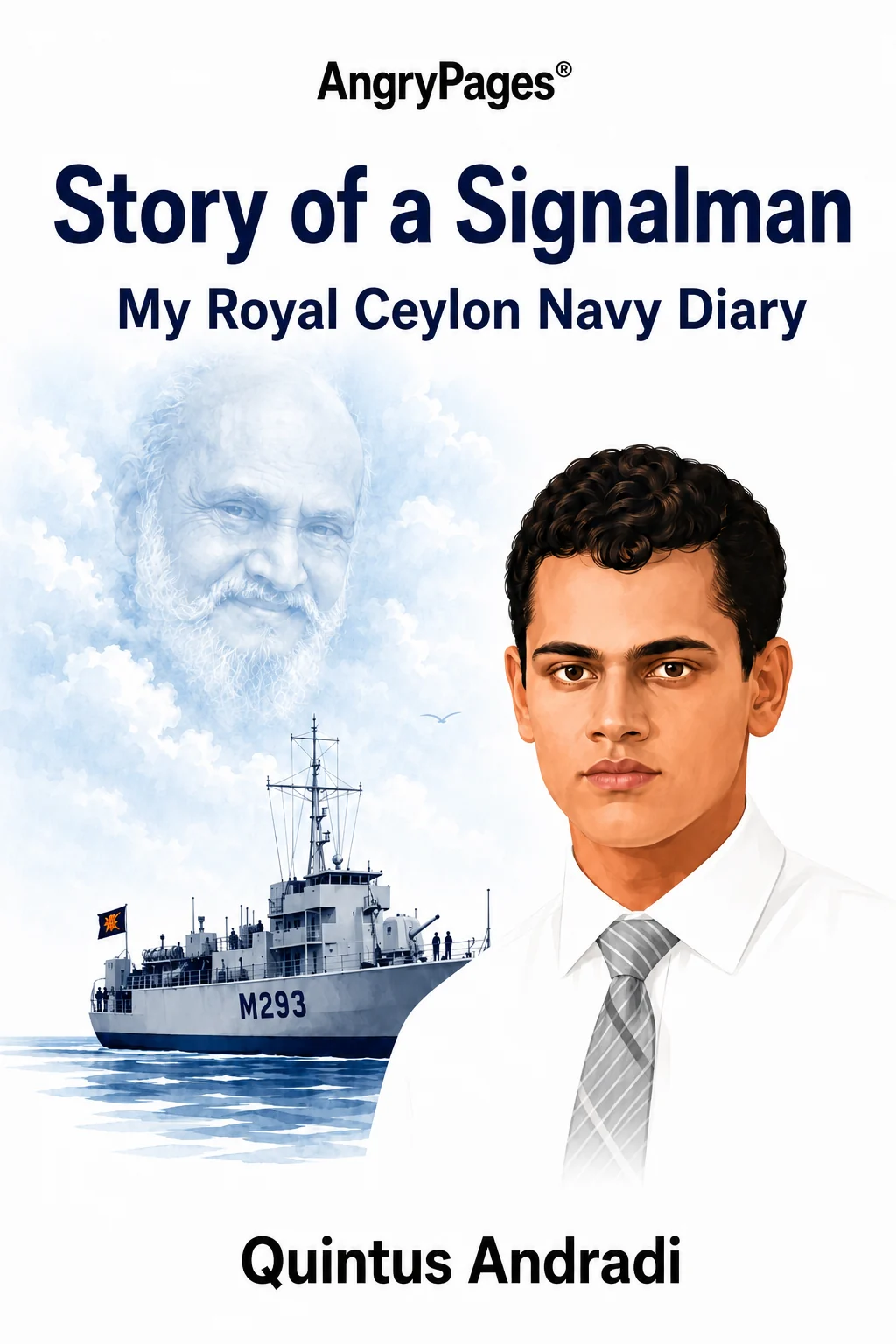
Story of a Signalman
He joined the Navy to see the world. He spent the rest of his life giving it back.
AngryPages Book
5.0 · 10 reviewsThe complete first-person account of a Royal Ceylon Navy signalman whose life moved from service at sea to decades of work for fellow veterans.
Understand the book quickly
- Read the complete first-person autobiography of a Royal Ceylon Navy signalman, from a postmaster's son in colonial Ceylon to a man decorated for veterans' work in 2025.
- Move through his full run: naval training, the Parakrama years, love and betrayal, a year in Sweden, and over twenty-five years organizing veterans, including major improvements to the Veterans Home.
- For readers of Sri Lankan history, naval life, diaspora stories, and first-person accounts written by the people who lived them.
Pages91 pages · 6 chapters
GenreIllustrated Sri Lankan naval memoir
CountrySri Lanka
PublisherAngryPages Inc
PublishedAvailable now
LanguageEnglish, Sinhala
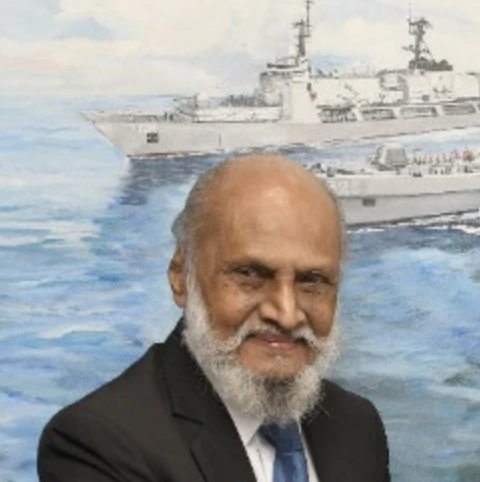
Meet the author
Read full bioWhere it begins
A boy who watched the harbour, then joined what he was watching
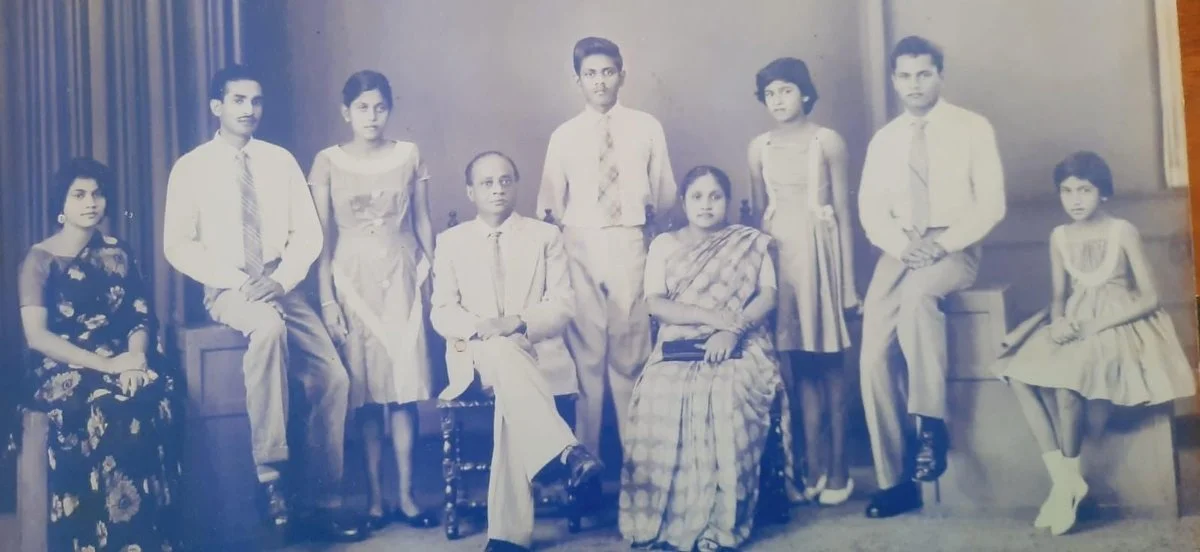
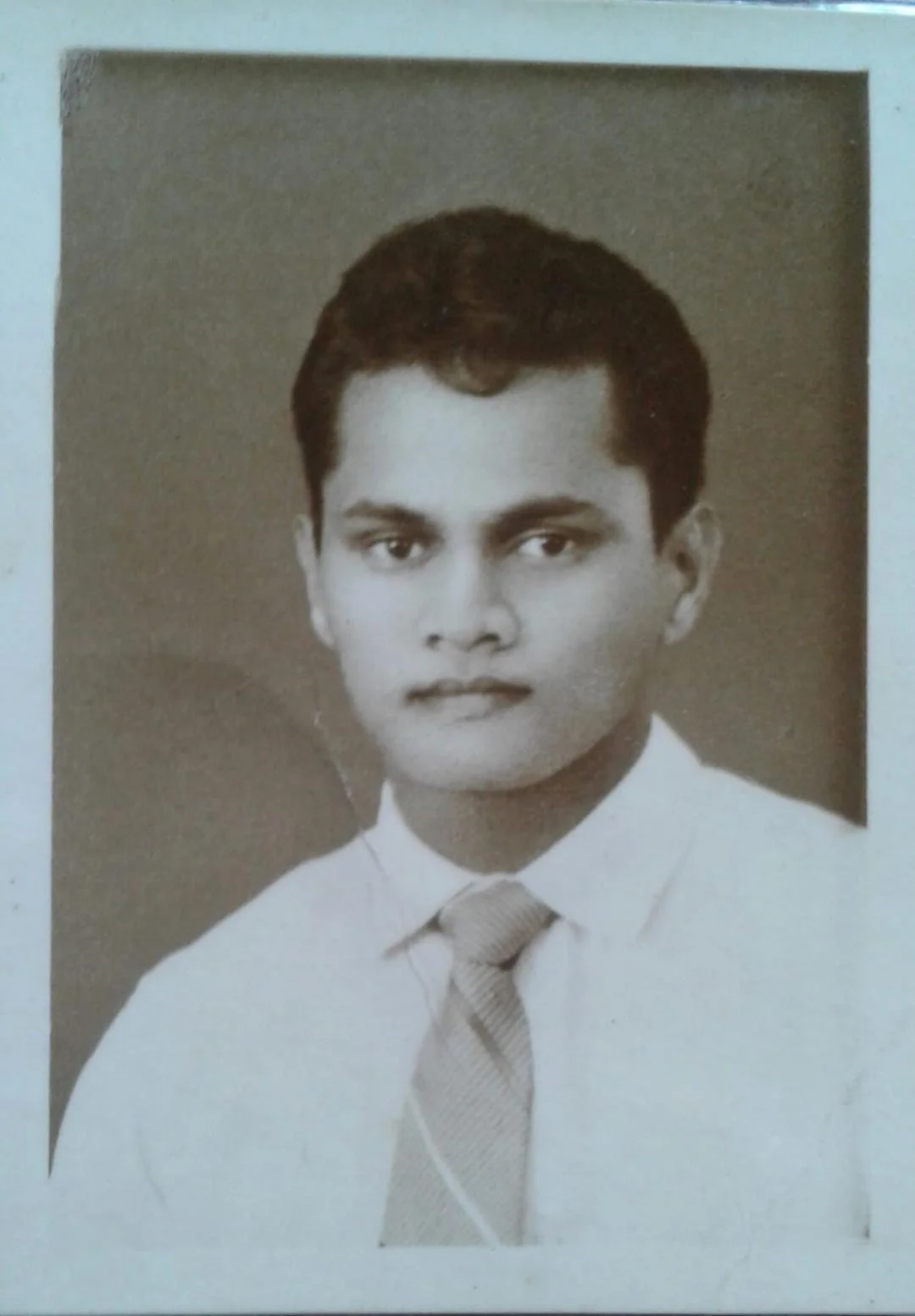
Andradi grew up moving between his father's postings as a postmaster, cut class to sit on the Galle Face wall and watch ships come in, and talked his way into the Navy Volunteer Force at seventeen.
Two years later he was in the largest intake the Regular Force had ever taken — nearly four hundred recruits. Barracks life after the 1958 riots was chaos: stolen kit, no passing-out parade, and a bout of hepatitis that put him in the sickbay for a month.
Restless and frustrated, he and a Tamil friend, Mylevaganam, tried to cross to India by catamaran from Point Pedro, planning to walk the rest of the way to England. A storm nearly drowned them; a fishing boat brought them back at dawn.
“I wrote to him saying I would be there for him even if I have to risk my life.”
In Andradi's own account, Chapter 3 — on hiding Commander Royce de Mel, Commander of the Navy, during a coup attempt.
The promise
Life on Parakrama — the years he calls the best of his life
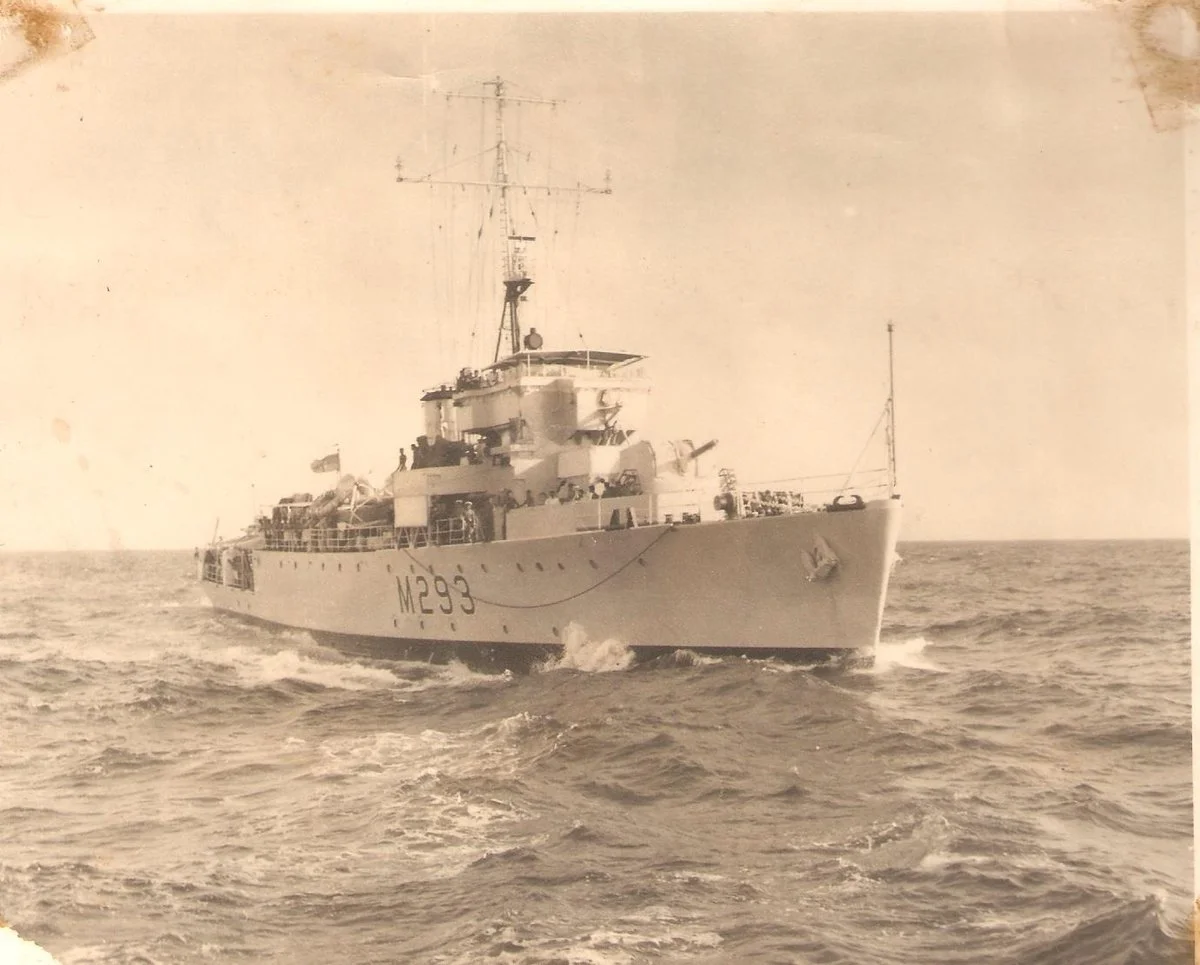
H.M.Cy.S. Parakrama, a gift from Britain, took him through Trincomalee patrols, a Far Eastern cruise, and a night in Hong Kong holding hands with a girl he seriously considered jumping ship for.
By his own account, when a coup attempt put the Commander of the Navy on the run, Andradi — a signalman with no rank to protect — hid him in Borella cemetery, on a promise made years earlier to a friend.
The cost of trust
He built businesses, trusted people, and paid heavily for both
He left the Navy for love, rose at CARE International from field rep to the highest post a local could hold, then built a safari touring company and a contract with the British engineering firm Kellogg's.
In 1977 he handed the whole arrangement to a colonel so he could accept a friend's invitation to Sweden — and the colonel never paid him back.
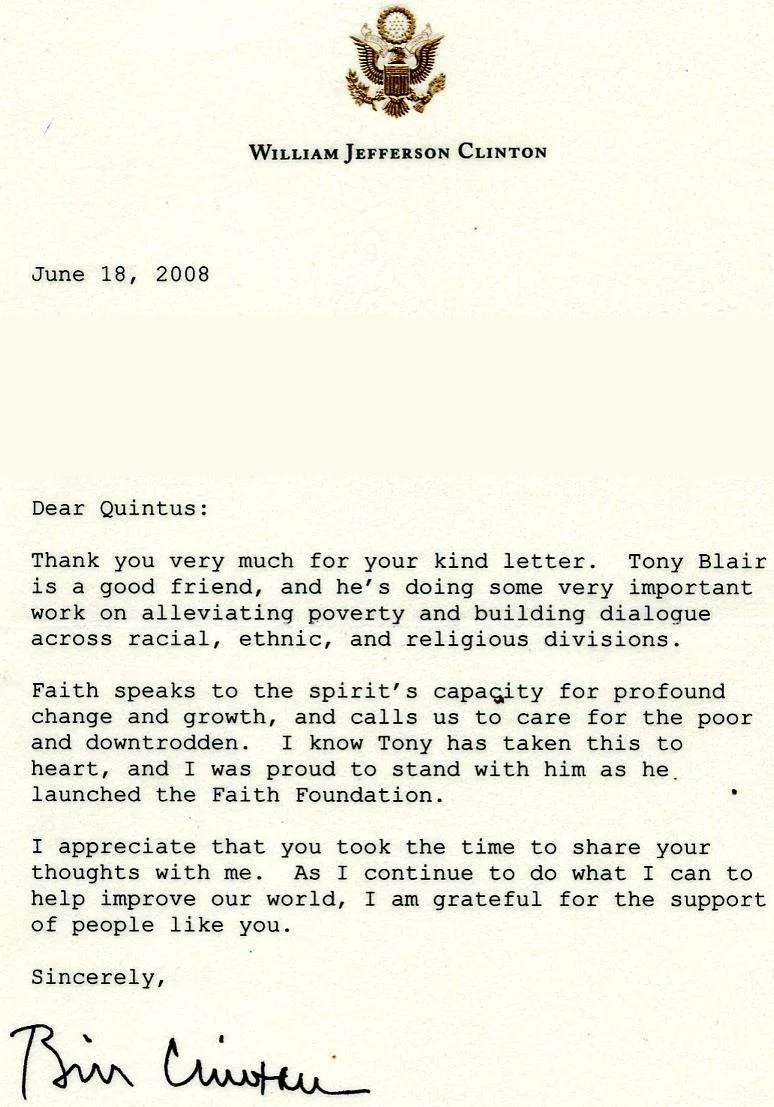
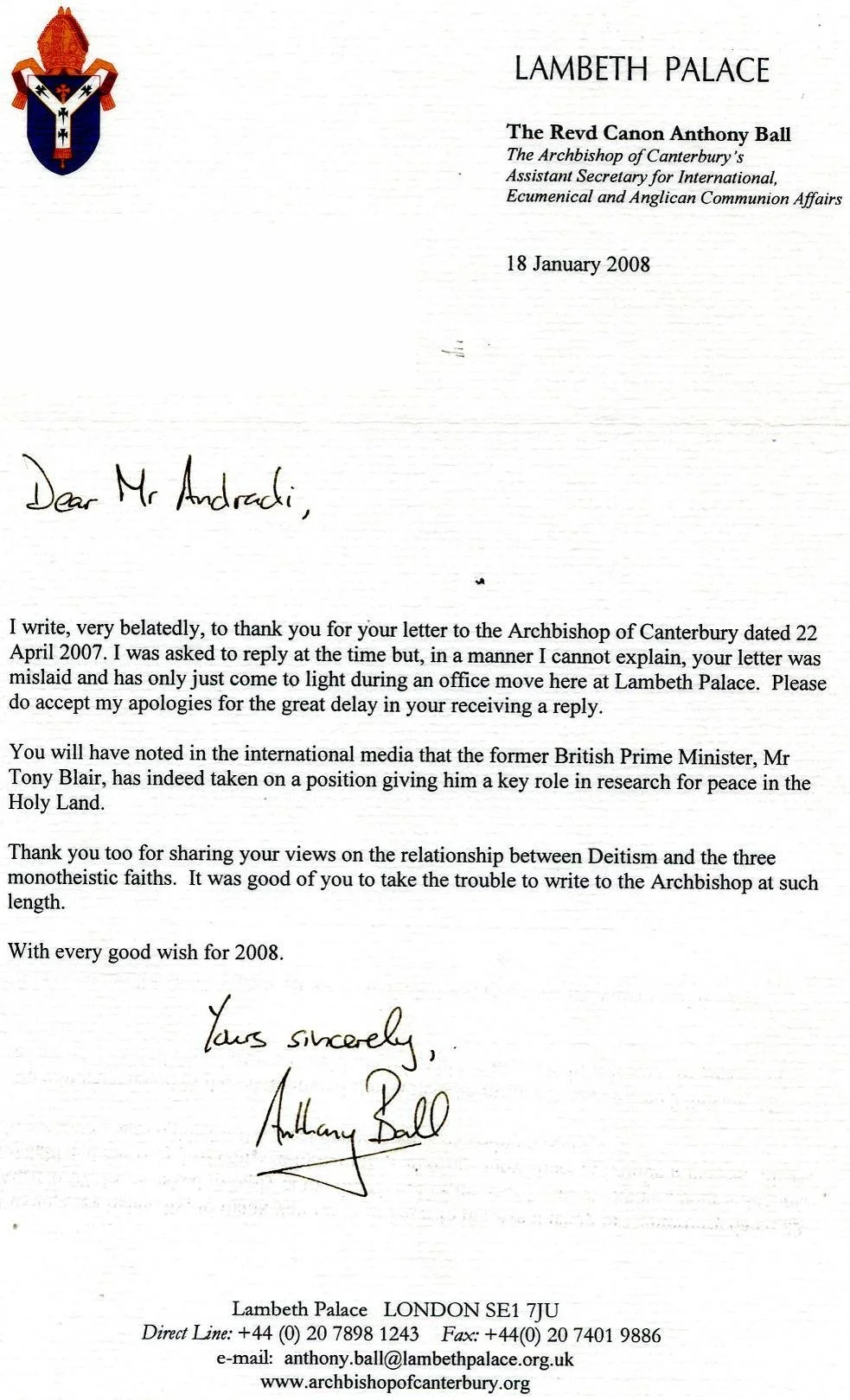
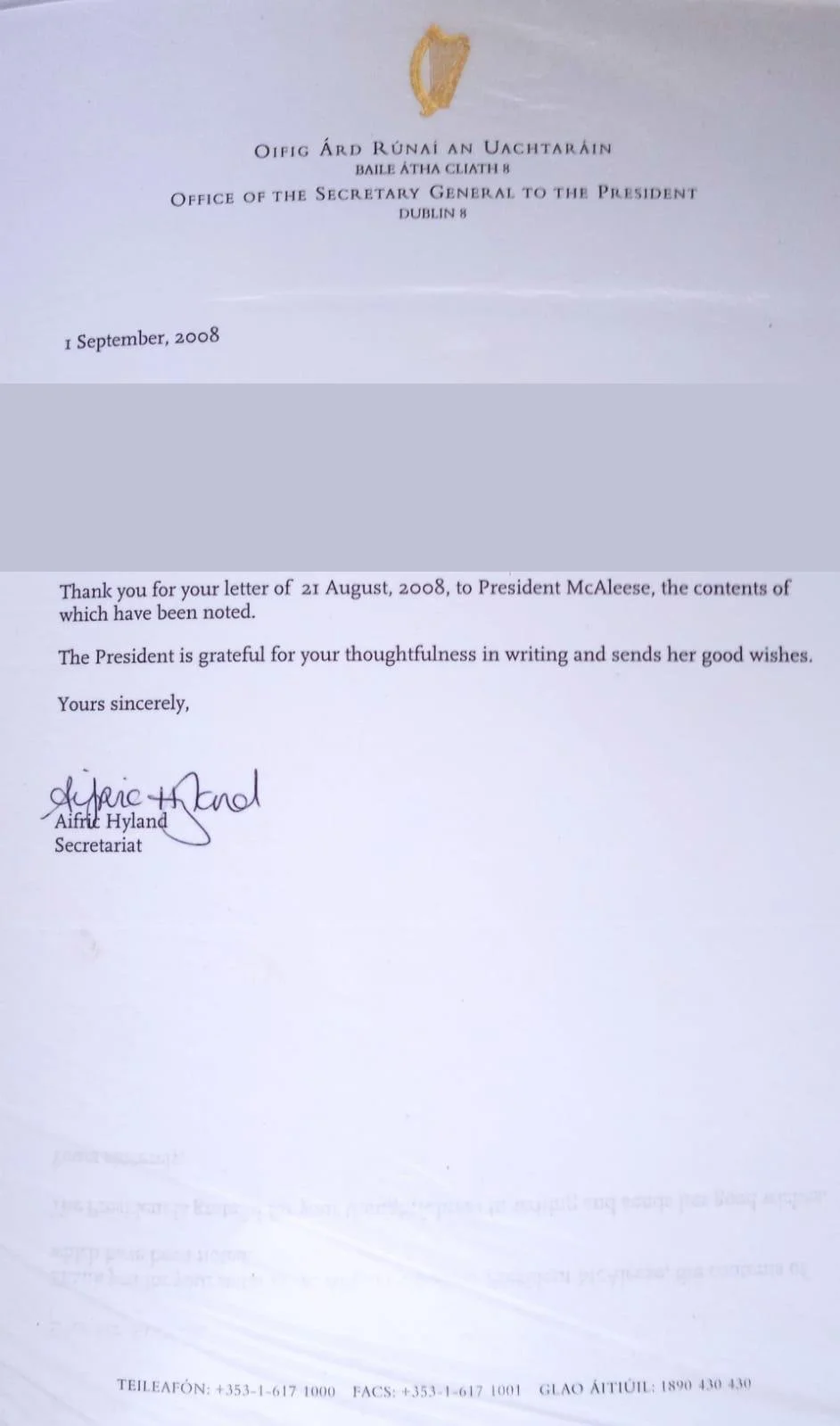
He spent a year in Sweden living on strangers' goodwill, candles lit and flags raised whenever he visited. Later came a spiritual retreat in Rajasthan, and two decades of letters to people who had no reason to write back: Tony Blair, Bill Clinton, the Irish President, the Archbishop of Canterbury. Several did.
“For my own self it was not a loss, for I enjoyed to the fullest…”
Chapter 5 — on giving up his safari business for a year in Sweden.
The giving years
The part where the giving becomes the whole story
In 1998 Andradi co-founded the Association of Veteran Naval Communicators. By his own account, over the next twenty-five years, as Secretary of the Veterans Home Management Committee, he raised or secured more than Rs. 20 million in support for veterans — a twenty-bed residential facility, a modern kitchen, a deep well, and furniture and equipment — almost entirely from ex-Navy friends scattered across Australia and Denmark.
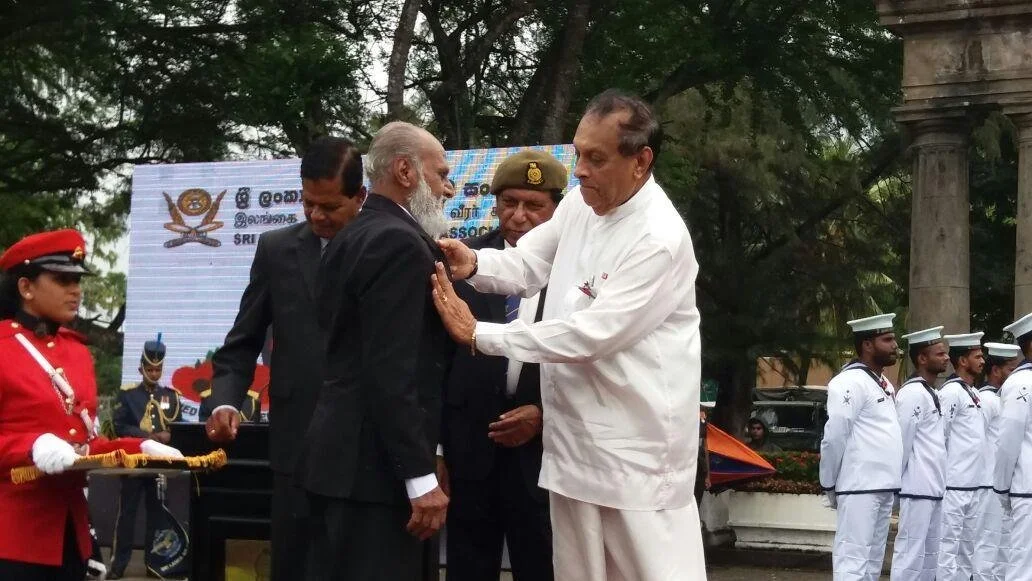
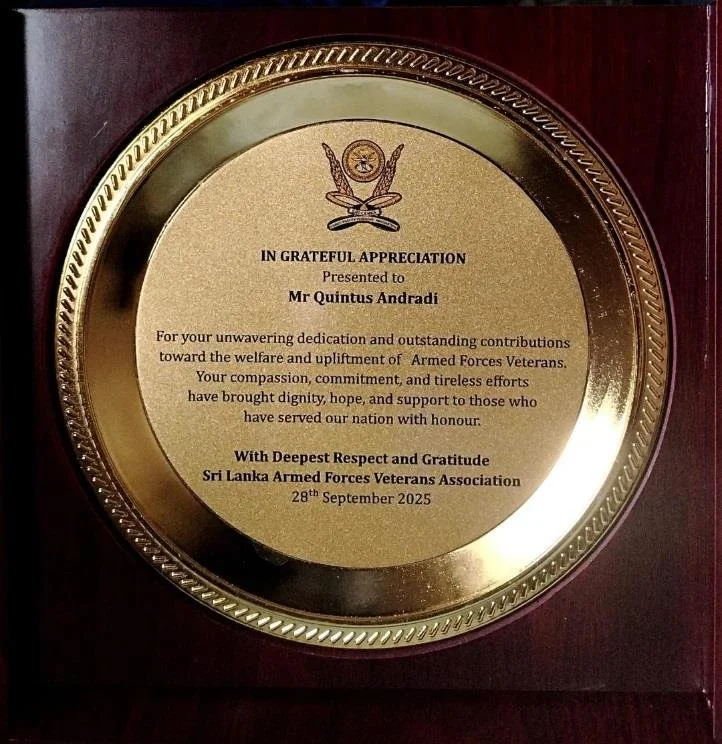
The honours followed: a medal from the Speaker of the House, a plaque from the Sri Lanka Armed Forces Veterans Association in September 2025, recognition as a Global Goodwill Ambassador. He was married for over fifty years to a doctor his friends called "the Florence Nightingale of Maharagama."
Letters to people who had no reason to reply
Replies from Downing Street, the White House, and Lambeth Palace
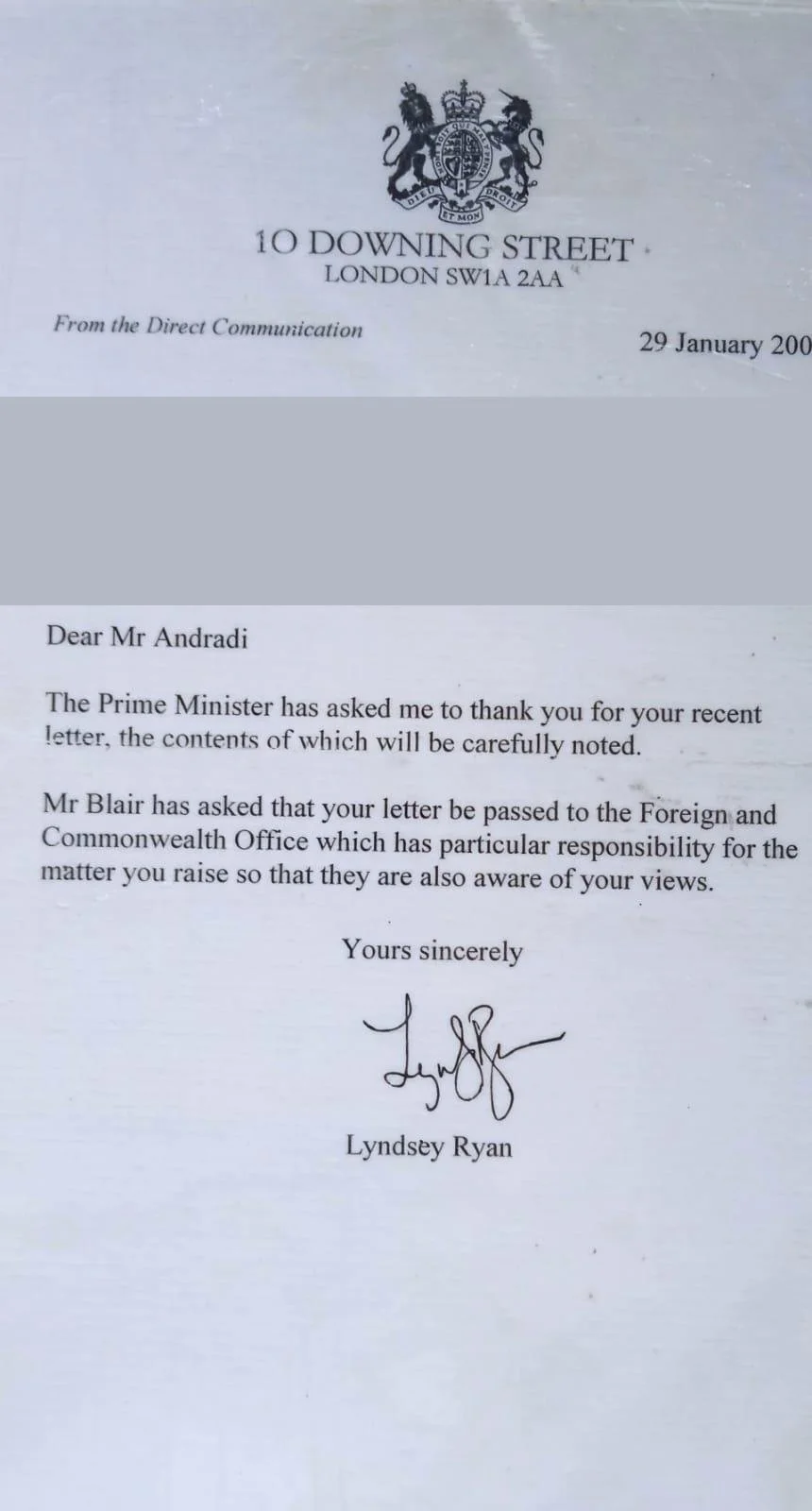
For over two decades Andradi wrote to heads of government and church. The book reproduces the replies as he received them — letterhead, signatures, and all.
- “I am grateful for the support of people like you.” — President Bill Clinton, 18 June 2008
- “The Prime Minister has asked me to thank you for your recent letter, the contents of which will be carefully noted.” — 10 Downing Street, 29 January 2002
- “Thank you too for sharing your views on the relationship between Deitism and the three monotheistic faiths.” — Lambeth Palace, 18 January 2008
- “The President is grateful for your thoughtfulness in writing and sends her good wishes.” — Office of the President, Dublin, 1 September 2008
Inside the Signalman's Story
Answering the Call
Life on Parakrama
Leaving the Navy, and a Run of Betrayals
Sweden, Rajasthan, and Letters to World Leaders
The Giving Never Stopped
A Life Married to Service
The Record of a Man Who Kept Nothing for Himself
Book offer
Buy the AngryPages book
Story of a Signalman in the Royal Ceylon Navy — the complete digital reader edition, in Quintus Andradi's own words.
Digital reader edition · $10.00 · One purchase, permanent access.
Reader reviews
5.0
10 Reader reviews
Review this book
Join this book’s thread. The author and other signed-in readers can write here.
Sign in to write a review-
A Review of Story of a Signalman in the Royal Ceylon Navy by Quintus Andradi
Some lives are measured by the positions a person holds, the medals he receives, or the places he visits. Other lives are measured by the people who were better off because that person passed through their lives. Story of a Signalman in the Royal Ceylon Navy by Quintus Andradi belongs unmistakably to the second kind. At first glance, this appears to be a naval memoir—the story of a young man who entered the Royal Ceylon Navy, travelled aboard H.M.Cy.S. Parakrama, witnessed a turbulent period in the country's history, and eventually left the service. But to read the book simply as a story about the Navy would be to miss its deeper significance. Beneath the uniforms, ships, voyages, adventures, disappointments and extraordinary encounters lies the portrait of a man for whom service became a way of life. Andradi's story begins with a boy watching ships from the shore. The son of a postmaster, constantly moving because of his father's postings, he developed an early fascination with the sea and the wider world. His youthful attempt to reach England by stowing away on the S.S. Stratheden, followed later by his extraordinary attempt to cross towards India by catamaran, reveals a restless young man who refused to accept the boundaries that circumstances had placed around him. Yet the irony of his life is striking. He joined the Navy because he wanted to see the world. In the end, the most important part of his life was not what he saw in the world, but what he gave back to the people around him. The chapters describing his naval years are among the most historically valuable sections of the book. They provide a personal window into the Royal Ceylon Navy at a formative moment in the country's post-independence history. His experiences aboard Parakrama, his training, patrols, overseas journeys and encounters in places such as Hong Kong bring a human dimension to naval history that official records can rarely provide. Particularly compelling is his account of the 1962 coup attempt and his role in protecting Rear Admiral Royce de Mel. Andradi was not a senior officer with institutional power behind him. He was a signalman. What he possessed instead was something more fundamental: loyalty. His decision to hide a senior naval officer because of a promise made to a fellow officer transforms an episode of political history into a deeply personal story about trust. In an age when loyalty is often measured by convenience, Andradi's account reminds us that a promise can sometimes demand courage greater than a command. But this is not a romanticised autobiography. One of the book's strengths is its willingness to acknowledge disappointment. Andradi writes about love, ambition, business, friendship and betrayal. He describes leaving the Navy, building a career, establishing business ventures and eventually suffering substantial financial loss after trusting someone with an opportunity he had created. These episodes are important because they prevent the memoir from becoming a simple heroic narrative. Andradi is not presented as a man who always succeeded. He is presented as a man who continued despite failure. His year in Sweden is especially revealing. Having surrendered his business arrangement to pursue an opportunity abroad, he found himself in circumstances very different from what he had imagined. Yet instead of allowing disappointment to define him, he absorbed the experience and continued searching—for knowledge, spirituality, friendship and meaning. His later spiritual journey in Rajasthan and his correspondence with prominent world leaders demonstrate a remarkable intellectual and spiritual curiosity. The letters reproduced in the book are fascinating not simply because some came from Downing Street, the White House, Lambeth Palace and the Office of the President of Ireland, but because of what they reveal about Andradi himself. He was willing to write to people who had no obligation to listen to him. That is perhaps one of the book's recurring themes: the courage to reach out. And then comes the transformation. The young man who once wanted to escape Sri Lanka becomes an older man deeply committed to serving those who had served the country. In 1998, Andradi became involved in the Association of Veteran Naval Communicators, and his subsequent decades of work for veterans became arguably the most consequential chapter of his life. His involvement with the Veterans Home included efforts to secure resources for accommodation and essential facilities for elderly veterans. His public profile likewise records his long-standing work with veteran welfare and housing. This is where Story of a Signalman rises above the category of memoir. It becomes a meditation on what it means to serve after one's official service has ended. Many people understand military service as something that begins with enlistment and ends with retirement. Andradi's life challenges that definition. His naval uniform may have been put away, but his sense of duty was not. He continued to serve through correspondence, fundraising, advocacy, friendship and practical assistance to fellow veterans. The most moving dimension of the book is therefore not the story of the adventurous young signalman. It is the story of the older man who discovered that his greatest voyage was still ahead of him. There is also something deeply Sri Lankan about this memoir. It captures a generation that lived through colonial Ceylon, independence, communal tensions, political upheaval, institutional change and the transformation of the armed forces. Yet it does not attempt to explain Sri Lanka through grand political theories. Instead, it allows history to emerge through one person's experiences. That makes the book valuable to historians—but also to ordinary readers. The memoir reminds us that history is not made only by presidents, generals and politicians. History also lives in the memories of signalmen, sailors, teachers, postmasters, mothers, veterans and ordinary citizens whose experiences rarely enter official archives. Andradi's life also raises an important question: What remains when a person has finished achieving things for himself? His answer appears to be service. The book's title, Story of a Signalman, might therefore initially sound modest. But the signalman in these pages is more than someone who transmitted messages aboard a naval vessel. In a symbolic sense, Andradi has spent his life transmitting something else—memory, friendship, loyalty, compassion and the conviction that those who served their country should not be forgotten. That is why the book deserves to be read not merely as a naval autobiography but as a document of human character. It is a story of adventure without glorifying adventure, a story of betrayal without becoming bitter, a story of faith without becoming preachy, and above all, a story of service without seeking applause. The most remarkable thing about Quintus Andradi's life is not that he travelled far, survived storms, served during a dangerous political crisis, built businesses, corresponded with world leaders or received recognition for his humanitarian work. It is that after everything life gave him—and everything life took from him—he continued to give. That is the true signal carried by this book. Story of a Signalman in the Royal Ceylon Navy is ultimately a book about the journey from wanting to see the world to wanting to make the world better for someone else. And that makes it much more than a memoir. It is a testimony. A testimony to friendship. A testimony to loyalty. A testimony to resilience. And, most importantly, a testimony to a life in which service did not end when the uniform came off.
-
A Remarkable Life of Service
I highly recommend Story of a Signalman in the Royal Ceylon Navy by Quintus Andradi—a heartfelt and inspiring account of courage, sacrifice, naval life, and lifelong service to fellow veterans. A fascinating read for anyone interested in Sri Lankan history and true-life stories.
-
A Life of Service and Sacrifice
Dear Mr. Quintus Andradi, your autobiography is a remarkable testament to courage, service, and perseverance. You have beautifully transformed your life experiences into a meaningful piece of Sri Lankan history. Your dedication to the Navy and veterans is truly admirable. Thank you for sharing your inspiring journey with honesty and heart.
-
Thank you Uncle Quintus
Uncle quintus was my dad's good friend from SLNavy..my father was a signalman and later was a instructor in signal school. Thanks so much for this book uncle ..this brings alot of memories of my father and the life he would have spent as a signalman ..i am really greatfull for you for this..thanks again❤️ May God bless you
-
A great story of real life. Found it very interesting. Having known the author personally for a long time, I recommend that every word in this book is true life story. Great work Quintus, these are the things that you leave for the future generations.
-
I bought this for the history and stayed for the person. Quintus writes without pretence — service, hardship, and decades looking after fellow veterans come through clearly.
-
This is a beautiful tale; I felt a yearning for the seas
It tooks a great deal of courage, to write this with no fear. This book is exactly what any young sailor needs, as a cheat code or a guide on how to be one of the best.
-
Clear, steady storytelling from a real signalman's life. I learned a lot and felt I was listening to someone who was actually there.
-
A rare first-person look at the Royal Ceylon Navy. Honest, grounded, and full of the kind of detail only someone who lived it can write.
-
This is the Sri Lankan navy story we don't get often enough. Practical, personal, and proud without being showy. Worth every page.
What this book is about
The complete first-person account of a Royal Ceylon Navy signalman whose life moved from service at sea to decades of work for fellow veterans.