Free preview · Opening 10%
The Corporate Ball Game
Title : The Corporate Ball Game
Sub title : “ Three decades, as a moving target on the firing line”
True life experiences compiled as anecdotes with humor and life lessons most unforgettable.
Sharanga Senanayake
FOREWORD
This book is dedicated to Mr Dian Gomes, the former Managing Director of MAS Intimates Pvt Ltd who recruited me to MAS, provided the necessary training and career advice and supported me throughout my corporate life, to the owners of MAS Holdings , the Amalean brothers Mr Mahesh, Mr Ajay and Mr sharad for uplifting the status of the apparel industry and for their overwhelming generosity, humility and sense of direction they provided to the company and to the country’s apparel sector at large.They elevated the same to unimaginable heights and placed Sri Lanka in a prominent place on the world map.
CORPORATE STORIES
1. WHEN ALL HOPE WAS LOST
Just before I retired from the corporate sector, I became determined to start something that could bring me a realistic monthly income. There were only a few things I felt I could do better than the average Sri Lankan. One was writing.
From childhood I loved writing—articles, letters to friends, stories from my imagination and just about anything else. If there was a blank sheet of paper, I wanted to fill it. The second thing I enjoyed was teaching.
The problem was that I had no idea how to earn a living from writing. So, I met a lifelong friend. Let's call him Mr G. He was a self-made millionaire who had built his businesses through sheer hard work and persistence.
His ventures ranged from recruitment to real estate. During the Covid period, he even spotted an opportunity in the soaring demand for sanitizer and made good money from it.
He sat me down in his office and asked, “Sharanga, what are you planning to do after retirement to earn a decent income?”
“I’m passionate about writing,” I replied. “That’s my USP. The moment I put pen to paper, the ideas just flow. I enjoy writing more than anything else.”
“What do you like to write?”
“Short stories.”
He smiled. “So, you want to do something you love and also get paid well for it?”
“Why not?”
“My dear friend,” he said, “you can always do what you enjoy in your free time. But if you expect people to pay you, give them real value.”
“What do you mean?”
“Solve one specific problem for them, and the money will follow.”
He paused before telling me how he had started his own business.
“I took a large sheet of paper and drew a line down the middle. On one side, I listed everyone I knew—classmates, neighbors, friends and acquaintances. Then I contacted many of them and asked what problems were holding back their businesses.”
He eventually identified twenty people with twenty different problems.
“One issue kept coming up,” he said. “They all needed reliable workers.”
That was how his recruitment company was born.
“Give people what they need,” he concluded, “and they’ll pay you.”
His advice was profound, but I still couldn’t shake my desire to earn through writing. Somewhere inside me, a stubborn little voice kept whispering, “Keep searching. There has to be a niche.”
Then AI and ChatGPT arrived, and my dream seemed to go from the frying pan into the fire.
I asked myself a simple question. When you hit a dead end, do you stand there feeling sorry for yourself, or do you change direction? My father always said that taking the easy way out was the path of least resistance. So changing direction became my only real option.
Then I remembered my grandmother’s words.
“Baba, where there is life, there is always hope.”
Around that time, Lehan, a young man with a remarkable understanding of the global book market, gave me fresh hope.
“AI can replace generic articles, letters and documents,” he said. “But it can’t replace your own life experiences. If you can tell genuine stories that entertain people, that’s something only you can do.”
For the first time in a long while, I saw a ray of hope.
That was the moment I decided to compile my life experiences into a book.
I hope you enjoy every story in this book.
Sharanga Senanayake
STORY 02 — THE LEFT-HANDED EMPLOYEE
The funniest audit I ever witnessed took place during a 5S certification at the multinational apparel company where I worked.
For several weeks, the Finance Department had been getting ready for the inspection. Every file had been labelled, every desk had been cleared, and everything had been put in its proper place. By the evening before the audit, the office looked less like a finance department and more like a showroom.
For those who are not familiar with 5S, it is a Japanese workplace management system based on five principles—Sort, Set in Order, Shine, Standardize and Sustain. The basic idea is simple: everything should have its proper place so that people can find what they need quickly and work efficiently.
On the day of the inspection, the auditor arrived with the department manager and the relevant process owners. With his checklist in hand, he went from one workstation to another, checking the shelves, files and general arrangement of the office.
Everything appeared to be in order.
Then, just as he was about to finish, he stopped.
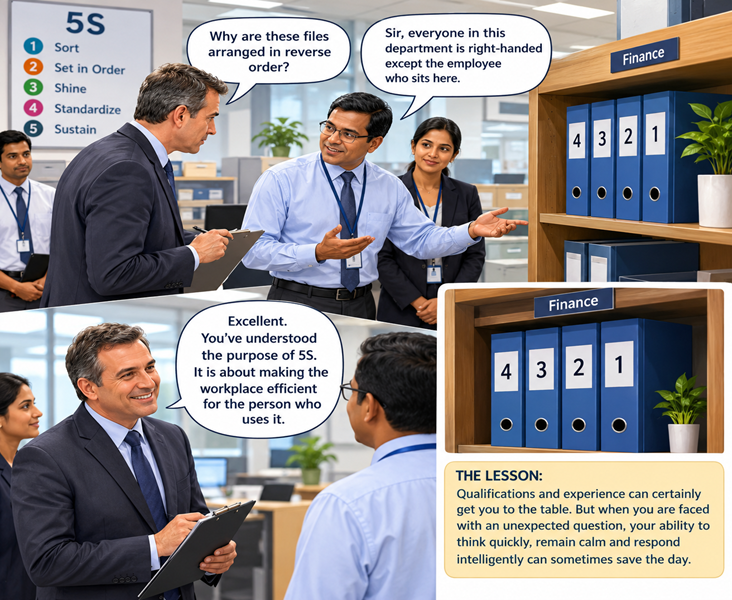
On one of the shelves, the files had been arranged in reverse order. Instead of being arranged from left to right—1, 2, 3, 4—they were arranged from right to left.
The room suddenly became very quiet.
It was actually a simple mistake. During the last-minute preparations the previous evening, someone had arranged that particular shelf the wrong way.
The auditor looked at the manager.
“Why are these files arranged in reverse order?” he asked.
Without even a moment's hesitation, the manager replied:
“Sir, everyone in this department is right-handed except the employee who sits here.”
The auditor looked at him, clearly puzzled.
“He is left-handed,” the manager continued. “He is absent today, but we arranged the files this way to make it easier for him to use them.”
For a few seconds, the auditor simply looked at the manager.
Then he smiled.
“Excellent,” he said. “You've understood the purpose of 5S. It is about making the workplace efficient for the person who uses it.”
He ticked something on his checklist and moved on.
The department passed the 5S certification without any further questions.
As I watched the auditor walk away, I couldn't help smiling. I still wonder whether the manager had actually thought of that explanation beforehand or whether it simply came to him at that very moment.
Either way, he certainly knew how to think on his feet.
THE LESSON: Qualifications and experience can certainly get you to the table. But when you are faced with an unexpected question, your ability to think quickly, remain calm and respond intelligently can sometimes save the day.
STORY 03 — BUYING OFFICE
The day I learned how millionaires think differently.
For a brief period, I worked directly under the owner of a large conglomerate. Unlike the sprawling company operations, his personal office was surprisingly small—just ten employees. Working that closely with him offered me a front-row seat to the way an accomplished businessman made decisions.
One day we began exploring a new venture: manufacturing winter wear for export.
My assignment sounded straightforward.
I had to contact every winter-wear manufacturer in Sri Lanka and gather two pieces of information: how much they produced and which countries they exported to.
After some research, I compiled a list of 44 factories.
Then I started calling.
The results were discouraging.
Only nine companies were willing to share their information. Most refused outright.
“That's confidential.”
Others were more diplomatic.
“Send us your request on your company letterhead, and we'll consider replying.”