The Big Dig’s $3 Billion ‘Pork’ Story Was Never Properly Counted
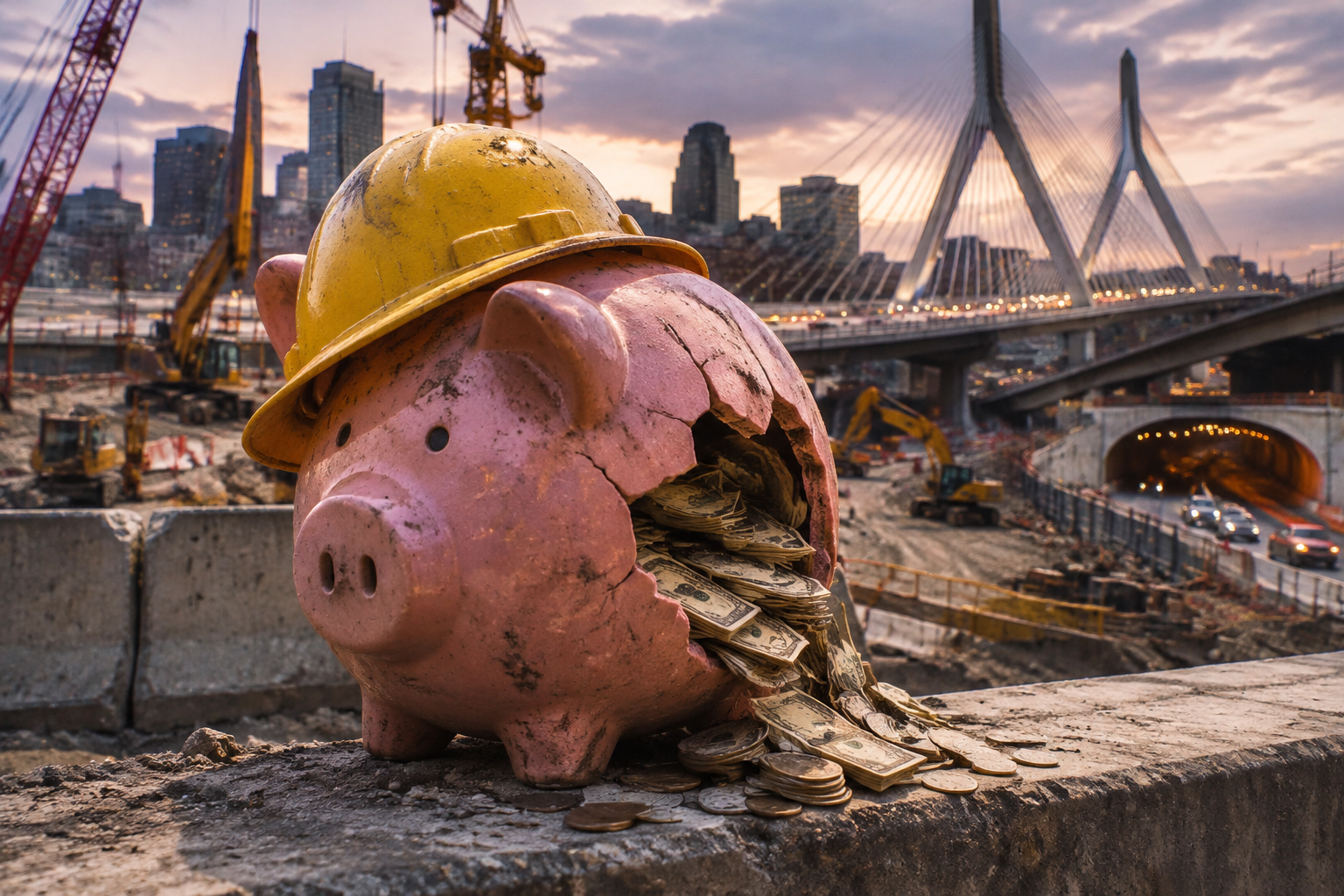
Lesley Stahl's 1997 investigation exposed genuine waste in Boston's Big Dig. But its central indictment—that more than $3 billion, roughly a third of the project's cost, was spent keeping local interests happy rather than building a highway—was never properly demonstrated.
The report also made a consequential financing error: it told viewers that federal taxpayers were paying 85% of the bill, although Congress had already restricted the project's special federal funding. And it dismissed inflation as a major explanation for rising costs, a position later contradicted by the project's own financial analysis.
The Big Dig deserved a ruthless investigation. It received a compelling television narrative instead of a properly reconciled financial account.
The $3 billion figure has an accounting problem
The broadcast lists eleven expenditures under its category of keeping everyone happy:
- Scheme Z redesign: $1.3 billion.
- Gillette Channel tunnel: $500 million.
- Picnic Island park: $130 million.
- Police overtime: $66 million.
- Boston Garden storage: $15 million.
- Ferry terminal: $3 million.
- Fish protection: $1 million.
- Holocaust memorial: $750,000.
- Harvard study: $267,000.
- Fireboat: $231,000.
- Science Museum exhibition: $500,000.
These named expenditures total approximately $2.017 billion, not $3 billion. The broadcast says the list continues beyond $3 billion but does not show the remaining approximately $983 million or explain how the total was calculated.
More importantly, it combines fundamentally different expenditures. A museum exhibition, a memorial, police overtime, environmental protection, a park created from excavated material and a highway crossing are not interchangeable categories of spending.
Some expenditures may have been unnecessary or excessive. Others were associated with construction, environmental compliance and maintaining traffic through an operating city.
A 2003 National Research Council assessment found that the original $2.6 billion estimate was expressed in 1982 dollars and excluded inflation and mitigation costs. The project management team's subsequent analysis attributed approximately half the cost growth to inflation and another 28% to increased scope and unplanned environmental and traffic mitigation. The committee acknowledged that it had not conducted an independent financial audit, so these figures should not be treated as a final forensic accounting. Nevertheless, they directly contradict Jon Stranix's assertion that the biggest increases were not caused by inflation or technical difficulties.
The 2005 congressional testimony of Bechtel/Parsons Brinckerhoff also described more than 1,500 mitigation agreements, which state officials reportedly associated with at least one-third of project costs. That is an interested party's account, not independent proof that every agreement was justified. But it demonstrates why calling the entire category political handouts is inadequate.
National Research Council assessment.
National Academies+3
The 85% federal funding claim was misleading
The broadcast states:
“85% of the price tag is paid for with federal money.”
That figure had a historical basis, but it was no longer an accurate description of the project's financing.
In 1987, Congress committed to financing approximately 85% of a project estimated to cost $3.1 billion. By 1991, however, the estimated cost had risen to $5.2 billion, and Congress capped the project's special Interstate funding. Future cost increases became Massachusetts' responsibility.
A 2004 Harvard Kennedy School study documented the change: special Interstate funding was subsequently expected to cover approximately 29% of the final project cost, with another 29% coming from ordinary federal highway allocations that Massachusetts could otherwise have spent on different projects.
The final Federal Highway Administration project profile records approximately $7 billion in federal aid and $7.8 billion in state bonds for a $14.8 billion project.
The original 85% commitment was not an unlimited federal guarantee. Presenting it as the share of the entire escalating bill gave viewers a fundamentally distorted picture of who was financially exposed.
There is an especially revealing detail in the fireboat example. The Massachusetts Inspector General confirmed that the federal government refused to fund its purchase. Massachusetts taxpayers paid the entire amount.
Harvard Kennedy School study. Federal Highway Administration project profile.
Harvard Kennedy School+2
The project was considerably more than seven miles of highway
The report repeatedly uses the seven-and-a-half-mile length to emphasize the extraordinary cost per mile.
But the project consisted of approximately 161 lane-miles of highway, almost half underground. It replaced the congested Central Artery, extended the Massachusetts Turnpike to Logan Airport through a harbor tunnel, reconstructed the Charles River crossing and required complex interchanges, utility relocations and construction sequencing.
The original Central Artery had been designed for 75,000 vehicles daily but was carrying approximately 200,000.
This was not a simple seven-mile road construction contract. It was a major reconstruction of Boston's transportation infrastructure while keeping the city operational.
That does not excuse its cost. It does make the broadcast's per-mile comparison an incomplete measure of what was purchased.
The report also raises the question of whether the project was primarily beautification rather than traffic relief without examining its eventual transportation performance.
Massachusetts transportation officials subsequently reported a 62% reduction in vehicle hours on the project highways between 1995 and 2003, estimated annual traveler savings of $168 million and a 12% reduction in citywide carbon monoxide levels. These are state-reported figures, not an independent impact evaluation, but they are material evidence the original story did not have.
National Research Council project assessment. Massachusetts project history.
National Academies+1
The real scandal was the failure of financial oversight
The most consequential Big Dig revelations emerged after the 60 Minutes broadcast.
In February 2000, a Federal Highway Administration task force investigated a previously undisclosed $1.4 billion potential cost overrun.
Its findings were severe. The state project director had deliberately withheld information about the potential increase from federal officials, while the FHWA had failed to independently examine financial information available to it.
The task force estimated that the realistic project cost had reached $13.4–$13.6 billion, substantially above the $10.8 billion repeatedly reported by project management.
This was not simply a disagreement over whether a park or a fireboat represented good value. The government responsible for overseeing federal expenditure was not receiving a complete picture of the project's financial exposure.
Read the Federal Highway Administration task force investigation.
Review of Project Oversight and Costs+2
The Securities and Exchange Commission subsequently established another serious failure.
In a July 2003 order, the SEC found that the Massachusetts Turnpike Authority and its chairman, James J. Kerasiotes, had negligently failed to disclose projected cost increases exceeding $1 billion in connection with three municipal bond offerings during 1999.
The offering materials represented that the project was on budget and would cost only $5.5 billion to complete. The cost increases were not disclosed because officials considered them insufficiently quantified or confirmed.
The SEC found violations of federal securities law. The respondents consented to the order without admitting or denying its findings.
This matters because bond investors, underwriters and credit-rating agencies were entitled to accurate financial information. The Big Dig's accountability problem extended beyond taxpayers funding construction.
SEC enforcement order, July 31, 2003.
SEC
Bechtel's management failures were real, but responsibility was shared
The broadcast questioned Bechtel/Parsons Brinckerhoff's nearly billion-dollar earnings and lack of contractual penalties for delays and overruns.
There was substantial justification for investigating the partnership.
In December 2003, the Massachusetts Inspector General reported that thirteen reviewed construction contracts had increased by approximately $125 million through 1,608 change orders.
The Inspector General identified more than $24.8 million in increases directly connected to issues previously raised in its reviews. It concluded that Bechtel/Parsons Brinckerhoff had mismanaged contracts and contract costs and recommended pursuing recovery.
But the governance structure matters. The National Research Council explained that Bechtel/Parsons Brinckerhoff had substantial control over design and construction while the Commonwealth retained formal authority to make actual project decisions. State and contractor personnel were subsequently integrated into a single management organization.
An investigation that discusses the contractor's earnings without following who approved the contracts, changes and payments has not completed the accountability exercise.
Massachusetts Inspector General, December 2003.
Massachusetts Government+2
Some of the broadcast's strongest examples survive scrutiny
I will not defend the fireboat.
The Massachusetts Inspector General's 1995 annual report confirms that the $231,526 procurement violated state purchasing law. The contractor was paid $100,000 more than the actual cost of the boat, and changes to its specifications generated another $25,376 in additional work without competitive bidding.
That is documented procurement failure, not an allegation invented for television.
The Gillette tunnel also deserves scrutiny. Bechtel/Parsons Brinckerhoff later acknowledged that the proposed Fort Point Channel crossing was substantially altered in response to a manufacturer's objections, but also to comply with federal wetlands and historic-preservation requirements.
The National Research Council separately questioned whether sufficient effort had been made to explore a cheaper bridge alternative.
The broadcast therefore identified a legitimate engineering and financial question. What it did not establish was that protecting a company's parking lot was the sole reason for the final decision.
The Charles River crossing presents a similar problem. The original Scheme Z involved an enormous sixteen-lane arrangement of elevated loop ramps, reportedly reaching 100 feet above the river. The eventual Leonard P. Zakim Bunker Hill Bridge was a different, ten-lane design with substantial architectural and engineering ambitions.
Harvard's subsequent research confirms that the final crossing cost at least $1 billion more than Scheme Z. The expense was real, but so were the design, engineering and permitting considerations. Describing the entire difference as the price of keeping residents happy conceals the actual decision being made.
Sources: Massachusetts Inspector General's 1995 report, Harvard's research on the Charles River crossing, and National Research Council assessment.
Massachusetts Government+2
The verdict: A real scandal, incompletely investigated
The Big Dig was an extraordinary financial failure in important respects. It suffered from escalating costs, inadequate contract management, procurement violations, weak federal oversight and seriously deficient financial disclosure.
But the 60 Minutes investigation reduced these failures to a convenient story about politicians distributing public money to keep businesses and neighborhoods satisfied.
That explanation was incomplete.
Its $3 billion accounting was not reconciled. Its 85% federal funding claim confused an original funding commitment with the financing of an enormously expanded project. Its dismissal of inflation as a major cost driver contradicted subsequent project analysis. And it failed to distinguish legitimate mitigation, engineering decisions and public amenities from unnecessary expenditure.
I would not defend the Big Dig's waste. I would demand a much better investigation of it.
The most disturbing question is not how much Boston spent on parks, museums or fireboats. It is how a project of this magnitude could be managed for years without reliable cost reporting, while officials withheld more than a billion dollars in projected increases from the very institutions responsible for overseeing and financing it.
The Big Dig did not merely demonstrate the danger of politicians spending other people's money. It demonstrated the danger of allowing the people controlling a public megaproject to control the information used to judge its financial performance.
References
1. Boston's Big Dig | 60 Minutes Archive — CBS News, 1997. The original Lesley Stahl investigation and its central financial claims.
2. Completing the Big Dig: Managing the Final Stages — National Research Council, 2003. Independent expert assessment of project scope, cost growth, inflation, mitigation and management, with explicit limitations on its financial audit.
3. Civic Leadership and the Big Dig — David Luberoff, Harvard Kennedy School, May 2004. Documents the organized business coalition, federal funding arrangements and political history behind the project.
4. 1995 Annual Report — Massachusetts Office of the Inspector General, published 1997. Records the fireboat procurement violation, taxpayer overpayment and additional noncompetitive work.
5. Review of Project Oversight and Costs — Federal Highway Administration Task Force, 2000. Documents the undisclosed $1.4 billion potential overrun and failures of state and federal financial oversight.
6. The Massachusetts Turnpike Authority and James J. Kerasiotes — Securities and Exchange Commission, July 31, 2003. Establishes the negligent failure to disclose substantial projected cost increases in municipal bond offerings.
7. A Big Dig Cost Recovery Referral — Massachusetts Office of the Inspector General, December 2003. Documents contract mismanagement, change orders and potential recovery claims against Bechtel/Parsons Brinckerhoff.
8. Digging Up the Facts: Inspecting the Big Dig — U.S. House Committee on Government Reform, April 22, 2005. Contains project management testimony about mitigation agreements and cost growth; its Bechtel/Parsons Brinckerhoff statements must be read as the company's own defense.
9. Boston Central Artery/Tunnel Project — Federal Highway Administration. Provides the completed project's cost, funding sources and infrastructure scope.