Pelindaba’s Nuclear Break-In Was Real. South Africa Never Properly Explained It.
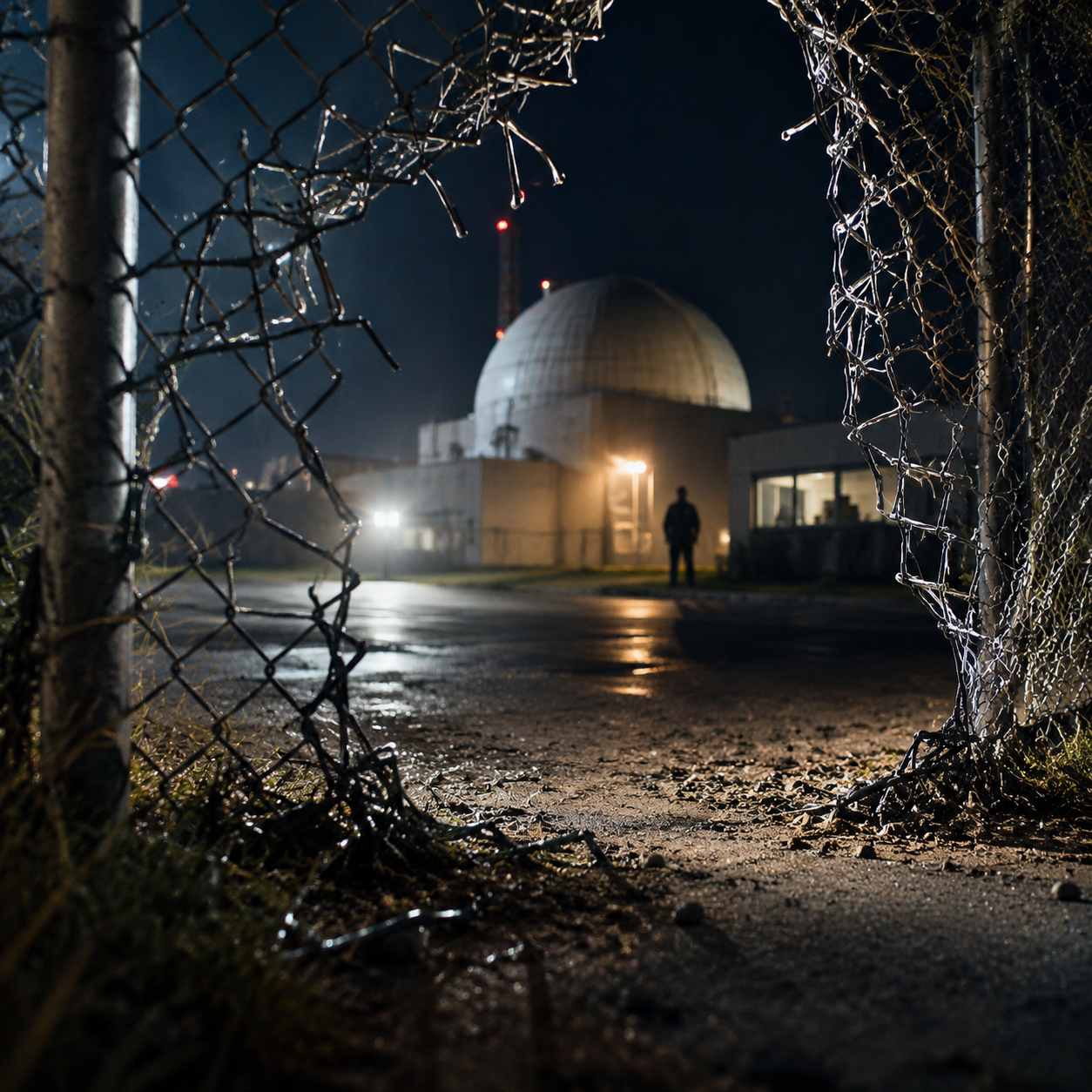
Four armed men penetrated one of South Africa’s most sensitive nuclear facilities, disabled its security systems, reached an emergency control centre, shot an employee and escaped. The government called it ordinary criminality. That explanation was never convincingly established, and the investigation that might have resolved the mystery remained largely hidden.
There is an important distinction: nobody proved that the attackers were trying to steal weapons-grade uranium, but nobody convincingly established that they were ordinary burglars either. South Africa's own records contain enough contradictions to make its public assurances deeply unsatisfactory.
The government's own account contradicts its confidence
In 2011, South Africa's government provided a detailed account of the November 8, 2007 breach in a written response to a parliamentary question.
It acknowledged that:
- Four intruders cut through Pelindaba's perimeter.
- Their methods suggested prior knowledge of electronic security systems.
- Surveillance cameras recorded them, but operators failed to detect them.
- They entered a fire-engine garage, removed a ladder and climbed into an adjacent building.
- They attacked two employees, shooting one.
- They stole two mobile phones and attempted to remove a computer containing no sensitive information.
- No radioactive material was unaccounted for.
The government nevertheless concluded that the attackers were more likely criminals than terrorists.
That conclusion went further than the evidence. The stolen phones and attempted computer removal support a possible burglary explanation, but they do not explain the technical preparation, the disabled alarms, or the second reported group of armed intruders. The government's own account acknowledged prior knowledge of the security arrangements without explaining how that knowledge was obtained.
South African National Assembly, Parliamentary Question 1411.
dmpr.gov.za
Rob Adam, then chief executive of the Nuclear Energy Corporation of South Africa (NECSA), offered another extraordinary argument during the 60 Minutes interview: if the attackers had been sophisticated terrorists, Gerber would not have survived.
That is not an investigation finding. An attacker's failure to kill a witness does not establish that the attack was ordinary criminality. Gerber survived being shot; the attackers escaped. Neither fact identifies their objective.
The nuclear threat was real, but the programme omitted an important finding
Pelindaba retained hundreds of kilograms of highly enriched uranium (HEU), the weapons-usable material left over from South Africa's former nuclear weapons programme.
Matthew Bunn's explanation of how relatively little HEU could produce a crude nuclear weapon was relevant. But explaining what terrorists could theoretically do with stolen uranium does not establish that these particular attackers intended to steal it.
There was already an important independent assessment available when 60 Minutes broadcast its investigation.
On January 24, 2008, the International Atomic Energy Agency announced that its experts had found:
“no evidence that sensitive nuclear areas were under any threat at any time during the incident.”
The IAEA also recommended specific security training and equipment. It considered the security upgrade plan, which Pelindaba's operator had begun implementing in 2006, an appropriate basis for protecting nuclear materials and facilities.
This was not a declaration that Pelindaba's security was flawless. The perimeter had been breached, employees had been attacked and the monitoring system had failed. But it was an important qualification to the impression that the attackers had nearly acquired weapons-grade uranium.
The programme acknowledged that additional security layers separated the intruders from the uranium, but did not give viewers the IAEA's assessment, which had been publicly available for approximately ten months.
International Atomic Energy Agency+1
A more recent assessment also deserves attention. In March 2026, former NECSA chairman Kelvin Kemm told BizNews that the attackers were nowhere near the uranium storage area.
“They were still far away from getting anywhere near that.”
Kemm also said that no satisfactory explanation had ever emerged. His assessment does not establish the attackers' motive, but it reinforces the distinction between a serious security breach and a demonstrated attempted nuclear theft.
MyBroadband
The most damaging evidence came from an investigation the public never saw
In 2015, the Center for Public Integrity published details of a previously undisclosed investigation commissioned by Rob Adam himself.
A former Kroll investigator had prepared a 98-page report, completed in March 2009. According to multiple people familiar with its contents, the report concluded that the raid was carefully planned, involved specially trained participants, relied on insider assistance and probably targeted the nuclear explosives.
The investigator reportedly identified two South African suspects and several possible accomplices using telephone records, interviews and polygraph examinations.
Yet, according to two sources familiar with the investigation, police never arrested or questioned those suspects.
The report was never publicly released. Its author declined to provide a copy, meaning its methodology, evidence and conclusions cannot now be independently examined by readers.
This is particularly troubling because Adam, who publicly described the incident as random criminality, had commissioned an investigation that reportedly reached a substantially different conclusion.
That does not establish that Adam knew the attackers were targeting uranium. It does establish that a much more serious assessment existed within the organisation responsible for the facility, while the public received a considerably simpler explanation.
Center for Public Integrity, March 14, 2015.
Center for Public Integrity+1
The investigation's arrest history was equally unsatisfactory.
Police initially announced three arrests, including a 17-year-old, shortly after the attack. By December 2008, however, police were saying nobody had been arrested. The Center for Public Integrity later reported that one Malawian man had been detained after using a SIM card from a stolen telephone, but police concluded that he had found the phone outside the facility and deported him.
No one had been charged with the assault by the time of the 2015 investigation.
The investigators also encountered difficulties obtaining mobile telephone records. MTN refused to provide records to the private investigator without a police subpoena.
These details do not prove that police deliberately protected anyone. They do demonstrate how an investigation involving a national nuclear installation could produce potential suspects without bringing the case to a satisfactory conclusion.
IOL+1
Security management had reasons to know the system was inadequate
The 60 Minutes report concentrated on the immediate failures. Subsequent evidence shows that concerns extended well beyond the night of the attack.
A September 2009 US diplomatic cable recorded an important difference between South Africa's public assurances and NECSA's operational concerns.
South African officials told American counterparts that Pelindaba had a clean bill of health and that most recommendations from the post-attack security assessment had been implemented.
Yet Joseph Shayi, NECSA's general manager for risk and infrastructure management, separately identified a need for:
- Additional perimeter sensors and cameras.
- More fencing.
- Training for security response personnel.
- Emergency response exercises involving police backup.
- Basic physical protection training for guards and site managers.
Shayi had taken over after his predecessor was dismissed following the 2007 breach.
This is not speculation about what management wanted. It is recorded in the US diplomatic cable.
The distinction matters: government representatives were offering reassurance while the organisation actually responsible for protecting Pelindaba was still asking for fundamental improvements.
US diplomatic cable 09STATE100237, September 2009.
WikiLeaks+1
The eventual security improvements came after American pressure
It would be inaccurate to claim that South Africa did nothing after the attack.
The United States eventually offered $8 million towards security improvements. According to the Center for Public Integrity, Washington also threatened to withhold fuel shipments for South Africa's American-built research reactor.
NECSA subsequently reported spending another $1.4 million on a new perimeter fence designed with assistance from Sandia National Laboratories and improvements to the Emergency Operations Center.
However, South Africa refused American security software over concerns that it might contain exploitable backdoors. Two sources familiar with the arrangements also told the Center for Public Integrity that the uranium vault still lacked a dedicated full-time guard force at its perimeter in 2015.
These are historical findings, not confirmation of the facility's present security arrangements.
There was also a wider political disagreement. Washington wanted South Africa to convert its weapons-usable uranium into a less dangerous form. Former US ambassador Donald Gips acknowledged that American policy extended beyond Pelindaba:
“No matter what country, we wanted that stuff out of everywhere, all over the world.”
South Africa had legitimate grounds to question the consistency of American nuclear policy. But a dispute about national sovereignty does not excuse failures in its own security arrangements.
Center for Public Integrity+1
The unanswered question is now bigger than the original attack
The consequences for the two employees were personal as well as institutional.
Anton Gerber and Ria Meiring filed civil claims against NECSA and security personnel. Gerber claimed R850,000 and Meiring R750,000 in damages and lost income.
Their court papers alleged that camera operators were asleep, a gate was unlocked and unguarded, and security personnel took 24 minutes to respond to emergency calls despite being approximately two minutes away.
These were allegations in civil proceedings, not established judicial findings. The outcome of the case remains unclear in the available reporting.
IOL+1
The broader accountability problem has survived for nearly two decades.
In April 2026, MyBroadband contacted NECSA for an update on the investigation. The organisation acknowledged the inquiry but had not provided a response after more than two weeks.
NECSA's 2023/24 annual report does provide some reassurance on a different issue: it records that the IAEA's 2023 safeguards assessment confirmed South Africa's nuclear facilities and materials remained in peaceful use. That is meaningful evidence about nuclear safeguards and material accounting, but it does not answer who breached Pelindaba in 2007 or establish how its physical security now withstands a determined armed attack.
parliament.gov.za+1
Verdict
South Africa was entitled to reject American proposals to remove its uranium. It was also entitled to insist that no nuclear material had been stolen when the evidence supported that position.
What it was not entitled to do was treat an unexplained armed penetration of a national nuclear installation as a solved burglary.
The cameras recorded the attackers. The alarms failed. Employees were assaulted. Security response times became the subject of litigation. A privately commissioned investigation reportedly identified possible suspects and insider assistance, yet its findings never became public. Subsequent security improvements required substantial American assistance and funding.
None of this proves a terrorist conspiracy or an attempted nuclear theft. But it makes the government's confident description of random criminality inadequate.
The most disturbing fact about Pelindaba is not that terrorists nearly acquired an atomic bomb. It is that armed intruders defeated the facility's first lines of defence, escaped, and left a mystery that the state has still not satisfactorily explained.
The uranium was not stolen. Accountability was never delivered.
References
1. 60 Minutes — Nuke Facility Raid: An Inside Job?, CBS News, November 20, 2008. Original reporting and interviews with eyewitnesses, nuclear security experts and South African officials.
2. National Assembly Parliamentary Question 1411, South African Government, 2011. Official account of the breach, missing material assessment, security evaluations and American assistance offer.
3. IAEA Experts Complete Visit to Pelindaba Nuclear Facility, International Atomic Energy Agency, January 24, 2008. Establishes the agency's finding that sensitive nuclear areas were not threatened during the incident.
4. The Assault on Pelindaba, Douglas Birch and R. Jeffrey Smith, Center for Public Integrity, March 14, 2015. Investigates the unpublished Kroll report, suspected accomplices and unresolved police investigation.
5. A Break-in at a South African Nuclear Complex Alarms Washington and Strains Relations Years Later, Douglas Birch and R. Jeffrey Smith, Center for Public Integrity, March 20, 2015. Documents the American diplomatic dispute, subsequent security upgrades, funding and continuing concerns.
6. US Diplomatic Cable 09STATE100237, US Department of State, September 2009. Records NECSA security management's requests for additional equipment and training despite government assurances.
7. Pelindaba Breach Still a Mystery, Eleanor Momberg, IOL, December 21, 2008. Documents the initial arrests, subsequent police position, civil litigation and IAEA assessment.
8. Thieves Attacked One of South Africa's Most Secure Facilities and No-One Knows Why, Jan Vermeulen, MyBroadband, April 10, 2026. Provides a recent account, Kelvin Kemm's assessment and NECSA's failure to respond to a request for an investigation update.