60 Minutes Missed the Minneapolis Shooting That Best Tested Its Story
The February 1 report by 60 Minutes got its central warning right: federal authorities were preventing Minnesota investigators from independently examining shootings involving federal officers. But the report made a serious editorial mistake. It concentrated on two deaths while leaving out a third shooting, already documented by state investigators, that would eventually produce some of the strongest evidence of official misconduct during Operation Metro Surge.
The omission matters. The January 14 shooting of Julio Sosa-Celis involved the same federal agencies, the same dispute over investigative access, and an official account that subsequently collapsed under video evidence. By February 1, the Minnesota Bureau of Criminal Apprehension had publicly described its difficulties investigating that incident. 60 Minutes could have included it.
Instead, viewers received a compelling account of institutional distrust without seeing the most revealing case study of why that distrust existed.
The third shooting was already in the public record
On January 14, an ICE officer shot Venezuelan immigrant Julio Sosa-Celis in the leg outside his Minneapolis home. Federal authorities subsequently accused Sosa-Celis and another man, Alfredo Aljorna, of attacking the officer with a broom and snow shovel.
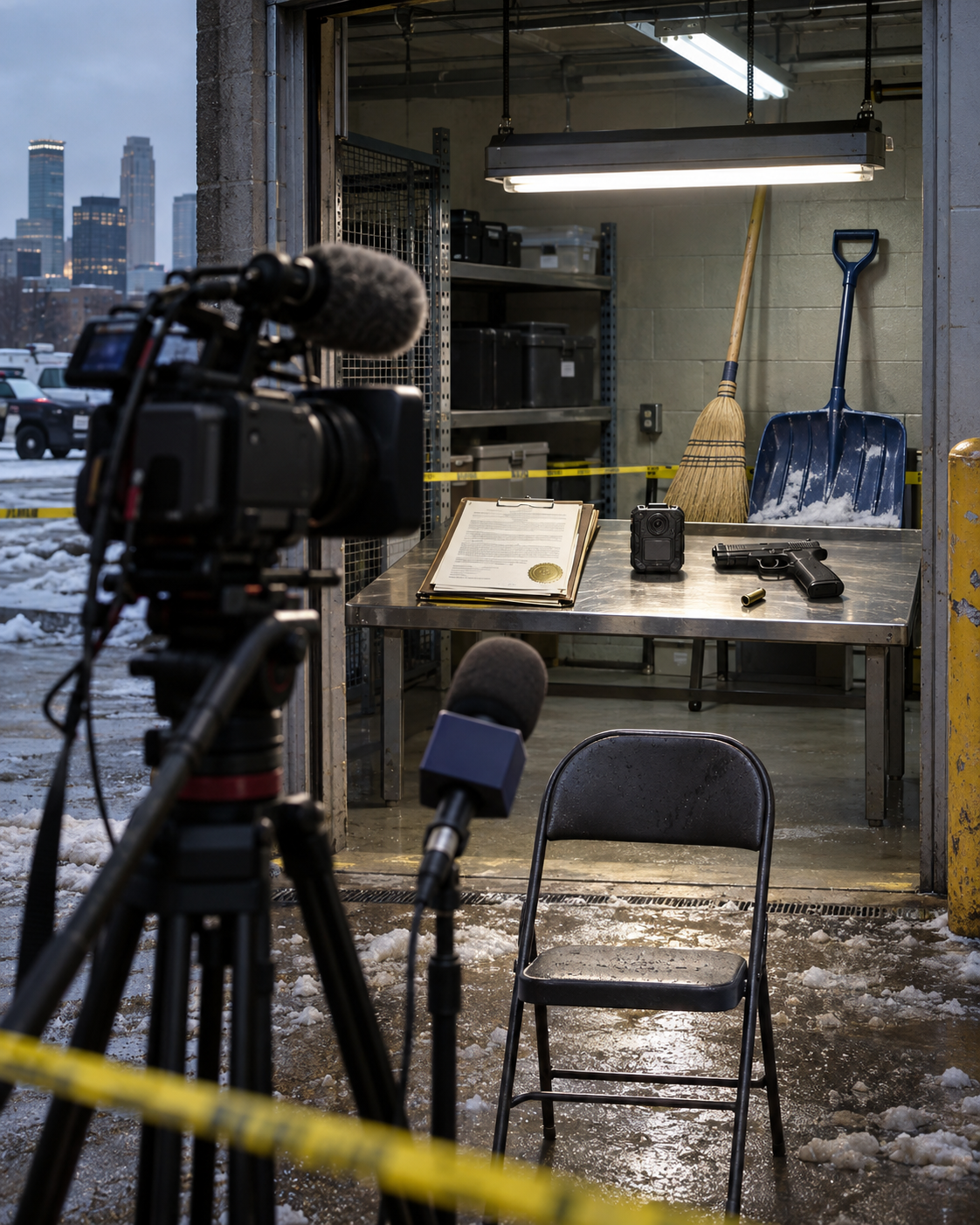
The Minnesota Bureau of Criminal Apprehension issued a detailed statement on January 22. It said investigators had recovered a plastic shovel, photographed the scene, and subsequently obtained a search warrant that allowed them to recover a broom, a shell casing and a bullet.
But the BCA also disclosed something particularly important: its investigators had not been permitted to interview the federal officer, did not know his identity or whether he wore a body camera, and had been told the FBI would not share its investigative findings.
All of this was public ten days before the 60 Minutes broadcast.
Source: Minnesota Department of Public Safety, January 22, 2026.
The subsequent developments were extraordinary.
On February 12, federal prosecutors dropped the assault charges against Sosa-Celis and Aljorna, saying newly discovered evidence was materially inconsistent with the allegations against them.
In May, Hennepin County prosecutors charged the ICE officer, Christian Castro, with four counts of second-degree assault and one count of falsely reporting a crime.
In September, a federal grand jury indicted Castro on six counts of making materially false statements to the FBI.
The federal indictment describes a physical encounter lasting approximately 11 seconds. Castro had reportedly told investigators that he had been fighting multiple attackers for approximately three minutes and had been struck with a broom and shovel.
The indictment is an allegation, not a conviction. Castro remains entitled to the presumption of innocence.
Nevertheless, the sequence is remarkable: federal authorities initially prosecuted the people involved in the shooting using the officer's account, subsequently abandoned those charges after contradictory evidence emerged, and ultimately indicted the officer for allegedly lying to federal investigators.
Sources: MPR News, February 12, 2026; Hennepin County, May 18, 2026; U.S. Department of Justice, September 4, 2026.
This is precisely the kind of institutional failure the 60 Minutes report was examining. Yet it was missing from the programme.
The later developments could not have been predicted on February 1. The January 14 shooting and the BCA's concerns, however, were already documented. Leaving them out deprived viewers of an important part of the story.
The search warrant was more revealing than another expert opinion
The report quotes former Justice Department prosecutor Sam Trepel describing the exclusion of Minnesota investigators as:
“Very unusual, and in fact, unprecedented in my experience.”
That is a consequential statement. But 60 Minutes should have shown viewers the concrete evidence behind it.
On January 24, the day Alex Pretti was killed, the Hennepin County Attorney's Office and BCA obtained a search warrant signed by a judge to access the shooting scene and collect evidence.
Federal agents nevertheless denied them access.
This was publicly announced by Hennepin County Attorney Mary Moriarty that same day. It was not a later discovery or an allegation that emerged months after the broadcast.
Source: Hennepin County Attorney's Office, January 24, 2026.
There was also a readily available historical comparison.
In June 2021, the U.S. Attorney's Office for Minnesota publicly announced that the BCA was leading an investigation into an officer-involved shooting involving members of the U.S. Marshals Fugitive Task Force in Minneapolis.
That is an official federal record of the very kind of state-led investigation Trepel described as normal practice.
Source: U.S. Attorney's Office, June 5, 2021.
The report could have shown viewers both examples and allowed them to understand why the January 2026 situation was different.
Instead, an expert's characterization carried the argument.
There is an important subsequent qualification. On February 2, one day after the broadcast, a federal judge dissolved a temporary restraining order concerning preservation of evidence in the Pretti case.
The judge accepted the FBI's explanation that its evidence collection had been curtailed because the scene became volatile and personnel safety was at risk. He also found that the federal government had not adequately explained how Pretti's firearm had been safeguarded, inferring that normal evidence-handling procedures had not been followed.
However, the judge explicitly declined to decide the merits of Minnesota's underlying claims. The ruling did not establish that federal authorities had acted lawfully by excluding state investigators.
Source: U.S. District Court, Minnesota Bureau of Criminal Apprehension v. Noem, February 2, 2026.
That distinction matters. A court declining to order further evidence-preservation measures is not the same thing as approving the federal government's investigative conduct.
The report allowed two different arguments about cooperation to become confused
One of the weakest moments comes near the end of the interview with Senator Rand Paul.
Paul says Minneapolis Mayor Jacob Frey has explicitly refused to cooperate with federal authorities and calls that a significant part of the problem.
The report does not ask him to explain precisely what cooperation he means.
Earlier, viewers are told that Minneapolis has a separation ordinance preventing its police from assisting federal immigration enforcement.
But refusing to participate in federal civil immigration enforcement is not the same as refusing to investigate criminal activity.
Minneapolis Police Department policy explicitly states that officers will continue addressing criminal behaviour regardless of immigration status. The city's own published explanation makes clear that its separation policy is intended to distinguish immigration enforcement from ordinary public-safety responsibilities.
Source: City of Minneapolis, Police Authority in Immigration Matters.
There is another important distinction: the investigations into Good and Pretti were being pursued by the Minnesota BCA and Hennepin County Attorney's Office, not by the mayor's office.
A mayor's refusal to help ICE conduct immigration enforcement does not explain why federal investigators refused to provide state investigators with evidence concerning fatal shootings.
Paul may have been making a broader political argument about the breakdown of relations between Minneapolis and Washington. But the reporter should have separated that argument from the specific question of investigative cooperation.
Instead, the two issues were left sitting beside each other, inviting viewers to treat them as equivalent.
They are not.
The Pretti shooting deserved a more precise reconstruction
The report describes Pretti having a firearm in his waistband and subsequently being shot after an officer shouted that he had found it.
That chronology leaves out a critical detail.
A Washington Post video analysis published January 25, before the 60 Minutes broadcast, found that a federal agent had already removed Pretti's handgun from his waistband and was walking away holding it when another officer fired.
The first shot followed less than a second after the gun was removed.
The footage does not establish whether the officer who fired knew that Pretti had already been disarmed. That qualification is important.
But the physical sequence is equally important. A firearm previously carried by a person is not necessarily an immediate threat at the moment officers shoot him.
The 60 Minutes narration never makes this distinction explicit.
Source: The Washington Post, January 25, 2026.
This is exactly where careful reporting matters. The question is not simply whether Pretti possessed a firearm. It is what happened to that firearm, who knew it had been removed, and what threat remained when shots were fired.
Nine months later, the evidence dispute remains unresolved
The subsequent investigation has hardly vindicated the administration's handling of the evidence.
On July 13, Hennepin County announced that state and federal agencies had begun exchanging previously withheld evidence. The BCA received hard drives containing material from the three shootings, and Renee Good's vehicle was placed in state custody.
But the cooperation did not last.
According to October court filings, evidence sharing stopped shortly after the July announcement. Hennepin County Attorney Mary Moriarty said the U.S. Attorney's Office told her on September 10 that the exchange would be paused indefinitely because of unspecified difficulties in Washington.
The BCA says important evidence remains outstanding, including officers' phones, firearms, recorded interviews, projectiles and shell casings.
The Justice Department disputes Minnesota's entitlement to the material. Its lawyers argue that federal agency rules governing the release of records, known as Touhy regulations, give federal agencies discretion to withhold information when the requests were made outside active legal proceedings.
Minnesota argues that the government has no legitimate basis for obstructing state criminal investigations.
There is also a conflicting account from an unnamed source familiar with the investigation, who told CBS Minnesota that almost all the evidence had been shared and that cooperation might resume.
That disagreement has not been resolved by a court.
Sources: Hennepin County, July 13, 2026; CBS Minnesota, October 22, 2026; CBS Minnesota, October 28, 2026.
Meanwhile, Alex Pretti's parents publicly appealed to the Justice Department on October 27 to release the evidence and provide answers about their son's death. No criminal charges have been filed in either the Good or Pretti fatal shooting.
Their request is not a substitute for an investigation. It is a reminder of what an unresolved investigation costs the people most directly affected.
The verdict: A correct warning, an incomplete investigation
I would not accuse 60 Minutes of inventing the Minneapolis evidence dispute. The subsequent documentary record substantially reinforces its central concern.
The failure is that the programme did not do enough to establish that concern for its viewers.
It had a judge-signed search warrant that federal agents refused to honour. It had a third shooting, already under investigation by the BCA, that exposed serious problems with federal accounts. It had an opportunity to distinguish immigration-enforcement disagreements from criminal-investigation responsibilities. And it had video evidence requiring a more precise reconstruction of Pretti's final seconds.
Instead, it relied heavily on interviews, expert judgments and political statements.
The distinction between a good television report and a strong investigation is not how many authoritative people appear on screen. It is whether the audience is given enough evidence to independently understand what happened.
60 Minutes identified a serious accountability problem. It failed to show the full extent of the evidence that made the problem worth investigating.
That is a missed journalistic opportunity in a story where the facts should have been doing most of the talking.
References
1. 60 Minutes — Minneapolis: Calls grow for independent probe — CBS, February 1, 2026. Original broadcast and reporting under review.
2. BCA releases information regarding use-of-force investigation — Minnesota Department of Public Safety, January 22, 2026. Documents the third shooting and the BCA's inability to access federal investigative information.
3. Evidence Submission Portal and investigation update — Hennepin County, January 24, 2026. Confirms that federal agents denied access despite a judge-signed search warrant.
4. Statement regarding the U.S. Marshals Task Force — U.S. Department of Justice, June 5, 2021. Establishes an earlier instance of the BCA leading an investigation involving federal task-force officers.
5. Opinion and Order, BCA v. Noem — U.S. District Court, February 2, 2026. Explains the limited scope of the evidence-preservation ruling and the court's findings about investigative procedures.
6. Charges dropped against men accused of attacking ICE officer — MPR News, February 12, 2026. Documents the federal prosecution's withdrawal after new evidence contradicted its allegations.
7. Hennepin County charges ICE agent Christian Castro — Hennepin County, May 18, 2026. Records the state criminal charges and the prosecution's account of the shooting.
8. Christian Castro indicted by grand jury for making false statements — U.S. Department of Justice, September 4, 2026. Provides the federal indictment's allegations and the detailed chronology of the encounter.
9. Minneapolis Police Update Policy Regarding Authority in Immigration Matters — City of Minneapolis, January 16, 2025. Establishes the distinction between immigration enforcement and ordinary criminal policing.
10. Two-way evidence sharing between state and federal agencies — Hennepin County, July 13, 2026. Documents the initial transfer of previously withheld evidence.
11. Feds stopped sharing evidence in Good and Pretti killings — CBS Minnesota, October 22, 2026. Details the subsequent suspension of evidence sharing and the competing legal positions.
12. Parents of Alex Pretti call on DOJ to resume evidence sharing — CBS Minnesota, October 28, 2026. Provides the family's latest appeal and the conflicting accounts of how much evidence has been exchanged.
13. Federal agent secured gun before fatal shooting — The Washington Post, January 25, 2026. Reconstructs the critical sequence in which Pretti's handgun was removed before the first shot.