The Dog-Cancer Breakthrough That 60 Minutes Didn't Tell Viewers Had Failed Its Bigger Test
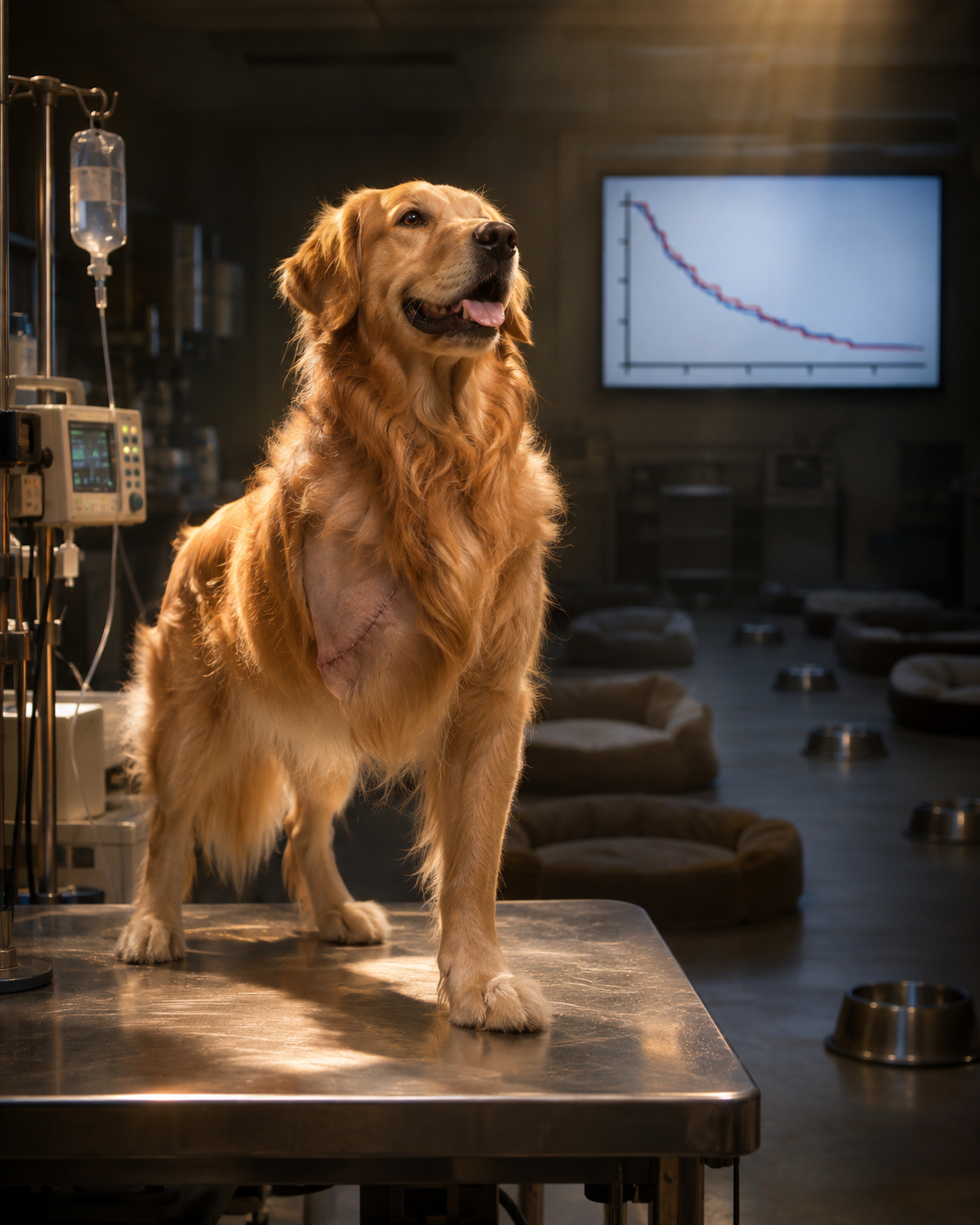
The most important evidence missing from the 60 Minutes report is not another promising patient story. It is a subsequent, much larger canine clinical trial that found no statistically significant improvement in survival or time before cancer returned from the experimental Listeria vaccine.
That finding changes the story. The treatment had generated genuine scientific excitement, and early results justified further investigation. But the distinction between an encouraging experiment and an effective cancer treatment is precisely what the report needed to explain.
The larger dog trial produced a very different result
In April 2025, Nicola Mason and colleagues published a prospective, multicentre study involving 118 dogs with naturally occurring osteosarcoma. The study compared standard treatment followed by the HER2-targeting Listeria vaccine against a contemporaneously enrolled historical standard-treatment group.
The results were not statistically significant:
- Median time before disease progression: 217 days with the vaccine versus 180 days without it.
- Median overall survival: 341 days versus 282 days.
- The survival comparison had a p-value of 0.10; the disease-free comparison had a p-value of 0.33.
The researchers explicitly acknowledged that the larger study did not reproduce the statistically significant survival improvement reported in their earlier, much smaller pilot study. This is not a minor qualification. It is the central clinical question the original broadcast left unanswered.
The vaccine did stimulate immune responses, and some dogs survived considerably longer than others. But demonstrating immune activation is not the same as demonstrating that a treatment helps patients live longer.
PMC+3
The human trial is not testing the treatment in the way viewers might imagine
The human Phase II study, NCT04974008, was designed for patients aged 12–39 whose osteosarcoma had returned in the lungs and whose detectable pulmonary metastases had subsequently been surgically removed.
Patients receive the experimental treatment every three weeks for 48 weeks, followed by three years of survival monitoring. It is therefore a maintenance strategy intended to prevent another recurrence, not a demonstrated treatment for patients with actively growing, unresected lung tumours.
The distinction matters. The broadcast shows Christie receiving an infusion and describes the trial as treating recurrent cancer, but does not explain the precise surgical and disease-status requirements defining the study population.
NCI+1
The first trial was a promising experiment, not a clinical verdict
The original evidence came from a 2016 Phase I study involving just 18 dogs. Fifteen developed HER2-specific immune responses, and the researchers reported longer survival compared with a historical group receiving amputation and chemotherapy alone. There was no randomized, concurrent control group.
PubMed
That distinction matters because the programme's description of the results as a significant survival improvement was accurate, but incomplete. Viewers were not given the sample size, the comparison method or the limitations of an early dose-escalation study.
Sandy's survival was extraordinary. But an individual survivor cannot establish how much of that outcome was caused by the vaccine, particularly when surgery and chemotherapy were also part of her treatment.
What happened when the experiment expanded to 118 dogs?
The subsequent multicentre COTC026 study was a much more demanding test. It enrolled 118 dogs; 80 began the Listeria treatment after standard therapy, and 75 completed all three vaccine doses.
PMC
The results were disappointing:
Outcome Vaccine group Standard treatment Median disease-free interval 217 days 180 days Median overall survival 341 days 282 daysNeither difference was statistically significant. The survival comparison produced a p-value of 0.10, while the disease-free interval comparison produced 0.33.
PMC
The researchers explicitly acknowledged that these findings were inconsistent with their earlier pilot study.
There are important qualifications. The original pilot required HER2-positive tumours and allowed booster vaccinations. The larger trial did not require HER2 expression and used three doses. The researchers proposed that patient selection and more frequent booster treatment might explain the difference.
That is a reasonable scientific hypothesis. It is not evidence that the treatment works.
The larger study also found that immune responses differed between long-term and short-term survivors. However, researchers identified these groups after observing their outcomes, a post-hoc analysis that the authors themselves acknowledged carried selection bias.
PMC
The distinction is critical: a treatment can activate the immune system without demonstrating a survival benefit across the treated population.
The human results are promising, but the comparison needs scrutiny
The human trial discussed by 60 Minutes became AOST2121, registered as NCT04974008.
It enrolled 41 patients aged 12–39 with recurrent osteosarcoma in the lungs after complete surgical removal of the detectable metastases. Participants received 16 infusions over 48 weeks.
This was a maintenance treatment intended to prevent or delay another recurrence. It was not a trial demonstrating that Listeria could eliminate existing, unresected lung tumours. That distinction was missing from the broadcast's explanation.
NCI+1
There is now encouraging human data. On October 6, 2026, OS Therapies reported a final three-year overall survival rate of 72.7%, compared with 45.8% in its historical control group, with a reported p-value of 0.0006. Four of the 41 enrolled patients were lost to follow-up.
OS Therapies, Inc.
That is a meaningful signal. It deserves serious attention, not dismissal.
But the design matters.
The trial was open-label and single-arm. Its comparison group was assembled from five previously published studies involving 467 patients.
Only 90 of those historical patients came from studies specifically involving recurrent, completely resected pulmonary metastases. The other 377 came from studies of recurrent, completely resected metastatic disease without restricting the site of metastasis.
Immunotherapy, Biomarkers, and Cancer Pathways
The treated patients and historical controls were therefore not drawn from identical study populations.
A statistically significant p-value cannot eliminate differences in patient selection, treatment periods, follow-up or clinical circumstances. Without a randomized concurrent control, it remains difficult to establish how much of the reported survival difference was caused by the treatment itself.
The FDA's March 2023 draft guidance on oncology trials identifies randomized controlled trials as the preferred approach for a more robust assessment of efficacy and safety. Single-arm trials can have a role, particularly in rare diseases, but their limitations must be understood.
FDA
There is another important regulatory detail. OS Therapies said in October 2026 that a confirmatory Phase III trial must commence before accelerated FDA approval can be granted. The treatment is still investigational; the FDA has not approved it for human use.
OS Therapies, Inc.
The public evidence trail is incomplete
ClinicalTrials.gov registration is not a substitute for publishing the results of a trial.
The University of Oxford's FDAAA TrialsTracker identified NCT04974008 as an applicable clinical trial whose results were overdue. Its August 25, 2026 assessment recorded no actual results-reporting date and calculated that the trial was 703 days late.
FDAAA Trials Tracker
The tracker cautions that its assessment depends on sponsor-supplied registry information and may be incorrect if those records are incomplete or inaccurate. This is not an FDA finding of a violation.
Nevertheless, there is a legitimate transparency concern: important human survival results have been communicated through company announcements while the public registry has not received its required summary results.
Patients, researchers and independent journalists should be able to examine the underlying clinical results without reconstructing the evidence from investor communications.
The commercial interests deserve disclosure
The Listeria treatment has developed into the lead commercial asset of publicly traded OS Therapies, which is pursuing regulatory approval for OST-HER2.
The company has also disclosed that, if granted a US Biologics License Application, it intends to sell the Priority Review Voucher associated with its rare pediatric disease designation. Its October announcement cited a $220 million voucher sale in August 2026, while explicitly acknowledging that it might not achieve a comparable value.
OS Therapies, Inc.
There is also a relevant scientific disclosure.
A separate 2026 study involving Listeria immunotherapy and radiation was co-authored by Nicola Mason. Its conflict-of-interest statement identifies her as an inventor on relevant patents and discloses that she has equity in OS Therapies and serves as an advisor to OS Therapies and OS Animal Health.
PubMed
This does not establish misconduct or invalidate her research. It does establish a financial relationship that readers should know about when evaluating the development of this technology.
That 2026 study involved only 15 dogs receiving a combination of palliative radiation and Listeria treatment. Five experienced delayed tumour progression and prolonged survival. It was a different treatment strategy and a small pilot, not confirmation that the earlier vaccine regimen works.
PubMed
What 60 Minutes should have made clearer
There is an important chronological distinction. The original 60 Minutes report aired on November 27, 2022. The current archive presentation identifies it as a 2022 report, so the journalists cannot reasonably be accused of ignoring studies published in 2025 and 2026.
CBS News+1
But the original segment had information available to it that deserved greater attention: the initial canine trial involved only 18 dogs and compared outcomes with historical controls.
Instead, its most memorable evidence was Sandy's survival, her fever following treatment and Christie's experience receiving an experimental infusion.
Those are real experiences. They are not substitutes for controlled clinical evidence.
The subsequent research makes the distinction unavoidable:
- The original 18-dog study produced an encouraging survival signal.
- The larger 118-dog study did not demonstrate a statistically significant survival benefit.
- The human Phase IIb study reported encouraging three-year survival, but relied on historical rather than randomized concurrent controls.
- A separate combination-treatment pilot has produced further signals worth investigating.
- A confirmatory Phase III study remains part of the regulatory pathway.
My verdict is that 60 Minutes presented a promising research programme with more narrative confidence than clinical certainty.
The science is not discredited. The treatment has not been proven ineffective. But neither has it established the breakthrough that the emotional arc of the report encourages viewers to imagine.
Sandy's four years were real. The scientific question is whether thousands of other patients can benefit from the same treatment, and that question still requires convincing evidence.
A promising immune response is not a cure. A remarkable survivor is not a clinical trial. And a treatment that has reached Phase II is not an approved cancer therapy.
The 2026 archive deserves an updated account of what happened after the cameras left.
References
1. Comparative Oncology | 60 Minutes Archive — CBS News, November 27, 2022. Original reporting, including Sandy, Christie and the claims made about early Listeria trials.
2. Immunotherapy with a HER2-Targeting Listeria Induces HER2-Specific Immunity — Clinical Cancer Research, 2016. Original 18-dog Phase I study, immune responses and comparison with historical controls.
3. Immunological Responses and Clinical Outcomes in Dogs with Osteosarcoma Receiving Standard Therapy and a Listeria Vaccine Expressing HER2 — Molecular Therapy, April 2025. The larger 118-dog study, its nonsignificant survival findings and the researchers' explanation of differences from the pilot.
4. Osteosarcoma Maintenance Therapy with OST31-164 — NCT04974008 — ClinicalTrials.gov. Official human trial registration and study design.
5. Final Three-Year Overall Survival Benefit for Herlystic-Treated Patients — OS Therapies, October 6, 2026. Company-reported human survival results, commercial plans and Phase III regulatory requirements.
6. Final Three-Year Overall Survival Reported for OST-HER2 — Targeted Oncology, October 7, 2026. Explains the five-study historical control population and the limitations of the comparison.
7. Clinical Trial Considerations to Support Accelerated Approval of Oncology Therapeutics — US Food and Drug Administration, March 2023. Draft guidance explaining why randomized controlled trials are preferred over single-arm designs.
8. NCT04974008: FDAAA TrialsTracker — University of Oxford, Bennett Institute for Applied Data Science, August 25, 2026. Records the overdue results-reporting status, while explaining the limitations of its registry-based assessment.
9. Combined Radiation and Listeria Immunotherapy Induces Cytotoxic Immunity — Molecular Therapy Oncology, June 2026. Reports the 15-dog combination-treatment pilot and discloses Nicola Mason's patents, equity and advisory relationships.