The $3 Laser Shot: What 60 Minutes Failed to Establish About AeroVironment
The most damaging weakness in 60 Minutes' March 15 report is not its enthusiasm for laser weapons. It is that the programme presented an unverified account of military deployment as an established operational success. Its claim that the US Army was routinely shooting down Mexican cartel drones with AeroVironment's Locust system is contradicted by the Army's own subsequent chronology: on August 31, the Army described its August operation as the first use of the laser to defeat cartel-linked drones along the southern border. Three drones were destroyed.
CBS News+2
That is not a minor chronological correction. It changes the story from an already operational weapon being used routinely against smugglers into a system that was still progressing towards operational deployment when 60 Minutes presented it to viewers as an established border defence capability.
The border operation that wasn't happening
The February incidents explain the discrepancy. On February 11, the FAA abruptly closed El Paso's airspace after Customs and Border Protection used a counter-drone laser near Fort Bliss without properly coordinating with aviation authorities. The object reportedly struck down may have been a balloon; its precise identity was disputed.
ABC News+1
On February 25, the military used a laser to destroy another drone near Fort Hancock. It belonged to Customs and Border Protection. The military apparently did not know that, because CBP had not informed the Defense Department that it was operating the aircraft. The incident prompted a second FAA airspace restriction.
CBS News+1
These were not two demonstrations of routine success against cartel drones. One involved an unidentified object; the other involved American forces destroying an American government's aircraft.
Yet the March 15 report described the Army as routinely shooting down cartel-operated drones. The subsequent Army account explicitly identified August 25 as the first use of its laser to defeat cartel-linked drones along the southern border.
The United States Army+1
The distinction matters. A weapon used in a confusing domestic deployment is not automatically an operationally established counter-cartel capability. 60 Minutes had enough information to distinguish the two. It did not.
The FAA incident exposed a different problem
The programme framed the two airspace closures largely as a question of whether Locust could accidentally damage a passenger aircraft. Nawabi categorically insisted it could not, telling Stahl that FAA tests had demonstrated the system would not harm an airliner. But the second incident involved something more revealing: American forces had destroyed an American government drone because they failed to identify it correctly.
CBS News+2
Tracking a target is not the same as identifying a hostile target. Garrity demonstrated that an operator could lock onto a drone and let AI track it. The segment never established how the system distinguishes friendly aircraft from hostile ones, what identification safeguards exist, or who has final authority to fire. The February incident exposed precisely the sort of coordination failure that those questions should have addressed.
There is an important qualification. On April 10, the FAA and Department of War announced a completed safety assessment following demonstrations at White Sands Missile Range. The FAA concluded that, with proper safety controls, the systems did not present an increased risk to the flying public. That supports controlled deployment, not the manufacturer's unconditional assurance that mistakes cannot happen.
Federal Aviation Administration+1
The distinction matters: the weapon's aviation safety and the government's ability to coordinate its use are separate questions. 60 Minutes concentrated on the first while overlooking the more revealing failure in the second.
Three dollars is not the cost of defending against a drone
Nawabi's most persuasive figure was $3 per shot, compared with approximately $4 million for a Patriot interceptor. But a marginal firing cost is not the same as the cost of operating a defence system, maintaining it, keeping it ready and successfully destroying a target.
The programme disclosed an approximately $8 million price for a Locust unit but never established what the $3 calculation included. Nor did it calculate the costs of batteries, cooling, maintenance, personnel, repairs, training, supporting radar and periods when the system cannot operate.
The Army itself subsequently identified this accounting problem. In August 2026, Brigadier General Matt Ross, director of Joint Interagency Task Force 401, described a year-long pilot to measure the fully burdened cost of directed-energy systems, including personnel, maintenance, outside technical support, electricity and operational downtime.
His warning was unusually direct:
If I procure that system and it costs me $6,000,000 and I take one shot a year, you can't tell me that that shot only costs 8 cents.
The United States Army+1
Ross was discussing directed-energy systems generally, not publishing a Locust-specific cost audit. Nevertheless, his point exposes exactly what the 60 Minutes comparison failed to establish.
The Congressional Budget Office's July 2026 assessment estimated that equipping a representative military installation with layered counter-drone defences would cost approximately $74 million, followed by at least $5 million annually in support. Those figures cover multiple detection and interception systems, not Locust alone. The CBO also concluded that no single system provides complete protection.
Congressional Budget Office
There is another discrepancy worth investigating. A September 2026 CBS report, citing military laser budget analysis, placed the cost of an individual Locust-family unit at approximately $17.4 million to $25 million. Those estimates concern later configurations and may not be directly comparable with the $8 million figure quoted in March. But the difference makes the missing cost breakdown even more important.
CBS News+1
The electricity may genuinely cost only a few dollars. That does not establish that destroying a drone costs only a few dollars.
The Patriot comparison hides the alternatives
The $4 million Patriot comparison is not fabricated. A September 2025 Center for a New American Security assessment estimated a PAC-3 interceptor at approximately $4.187 million.
But the same assessment identified substantially cheaper counter-drone options:
- Coyote interceptor: approximately $126,500.
- APKWS II rocket: approximately $24,900.
- 30mm ammunition: approximately $203 per round.
- 20mm ammunition: approximately $80 per round.
These are estimates, and the weapons are not interchangeable. Different targets require different capabilities. Nevertheless, they demonstrate that Patriot is not the only available comparison for the economics of drone defence.
Amazon Web Services, Inc.+1
The report never established why Patriot interceptors were the appropriate comparator for every Shahed engagement, which cheaper alternatives could handle those threats, or where Locust would fit into the existing defensive architecture.
That is an important omission. The question is not simply whether a laser is cheaper than a Patriot missile. It is whether the laser can destroy the particular target, in the particular conditions, more economically than the other weapons capable of doing the same job.
The demonstration proved less than the programme implied
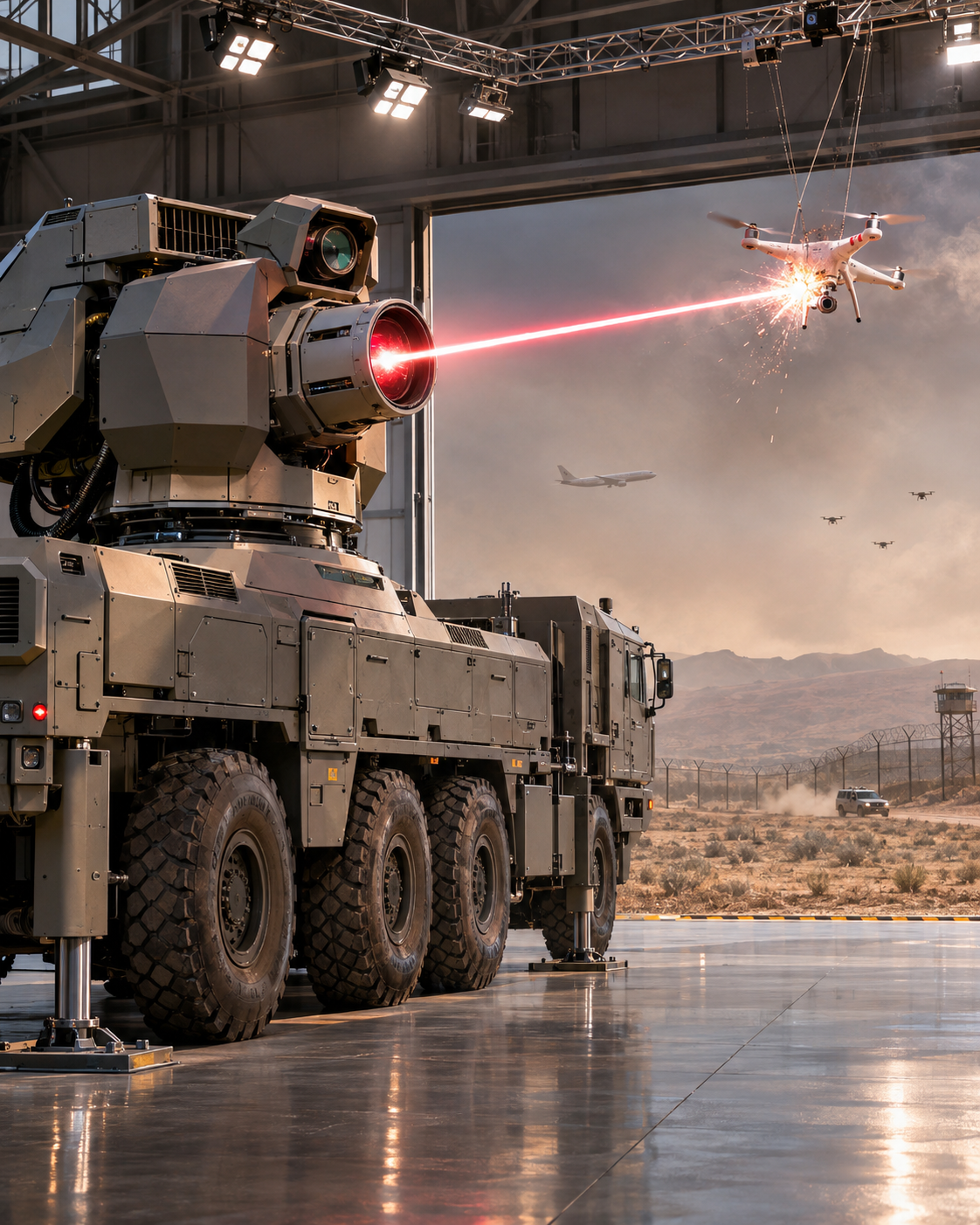
The Locust demonstration was visually impressive. A drone was placed inside a secured hangar, the operator fired the weapon, and infrared cameras showed the beam penetrating the aircraft and setting it alight.
But that demonstration established a limited fact: the laser could destroy an exposed drone under controlled conditions.
It did not independently establish the system's effectiveness against a moving Shahed, in desert conditions, during a simultaneous attack involving multiple targets.
Nawabi claimed previous success against Shahed drones in several military theatres but refused to identify where. Garrity said the new Locust system was specifically intended for the Shahed threat. Neither provided independently verifiable engagement records, kill rates or operational performance data.
CBS News+1
The interview also contained an unanswered question.
Stahl asked whether the system could shoot down 100 drones simultaneously. Garrity responded that some engagements took one second or less and that operators could move quickly through multiple targets.
That is not an answer about simultaneous engagement.
The Congressional Research Service's technical assessment explains why the distinction matters. High-energy laser weapons generally engage one target at a time, require several seconds to disable it and need additional time to redirect towards another target. Multiple simultaneous attackers can therefore overwhelm an individual laser system.
The same assessment identifies line-of-sight restrictions, atmospheric interference, rain, fog, dust, thermal effects and hardened or rapidly rotating targets as operational limitations. These are general high-energy laser limitations, not proof that Locust fails in every such condition.
Every CRS Report+1
60 Minutes did mention weather, battery weight, accuracy and cooling concerns. But when asked about sand, fog and dust, Garrity declined to discuss individual deployments and offered a general assurance that the systems had remained at their battle stations.
That is a manufacturer's response, not independent performance evidence.
What happened after the broadcast
The subsequent record provides important evidence in AV's favour, but it does not retrospectively establish everything claimed in March.
On August 25 and 26, the Army used its Multipurpose High Energy Laser system to defeat three hostile drones believed to be linked to drug cartels. The Army described this as the first use of the laser to defeat cartel-linked drones along the southern border.
By September 4, Northern Command reported 11 cartel-linked drone defeats using the system. CBS subsequently reported a roughly 75% decline in drone activity in the Rio Grande Valley, although military officials acknowledged that changing cartel routes could also explain some of the reduction.
The United States Army+2
This is meaningful operational evidence. It is also a very different timeline from the March report's assertion that the Army was already routinely shooting down cartel drones.
The later results concerned cartel-linked unmanned aircraft, not independently documented Iranian Shahed interceptions. The September CBS demonstration involved a small quadcopter. It cannot establish the weapon's effectiveness against every type of Iranian attack drone.
There was also substantial procurement progress.
On September 2, the Army awarded AeroVironment a $464.8 million production agreement for the Enduring-High Energy Laser programme. The agreement covers dozens of LOCUST X3 systems over the following years, marking the Army's first production contract for a high-energy laser weapon. The X3 is a 30-kilowatt system.
The United States Army+1
On September 8, AeroVironment announced its first international Locust purchase order, valued at more than $50 million. The company did not identify the buyer.
AeroVironment
These developments establish genuine military procurement, production investment and international commercial demand. Locust is not imaginary technology, and its adoption is no longer merely a demonstration programme.
But procurement is not proof of battlefield effectiveness against Shaheds. A production contract is not an independent performance evaluation. And a large purchase order does not validate a manufacturer's cost-per-kill calculation.
Closing verdict
AeroVironment may have developed an important addition to modern air defence. The Army's subsequent production contract and actual border engagements establish that the technology deserves serious attention.
That is not what I am challenging.
I am challenging the standard of evidence used to sell the story.
60 Minutes presented a manufacturer's $3 firing-cost claim as an extraordinary economic breakthrough without examining the full cost of operating the weapon. It showed a controlled demonstration without independently verifying the claimed Shahed combat record. Most seriously, it described routine cartel-drone interceptions when the Army's later official chronology identified August 2026 as the first operational use against cartel-linked drones along the southern border.
The programme also missed the most revealing detail of the FAA controversy: the military had destroyed a friendly government drone after failing to identify it correctly.
These are not reasons to dismiss laser weapons. They are reasons to demand better journalism before declaring a new weapon ready for the modern battlefield.
The laser may cost $3 to fire. The price of confusing a demonstration with proven military capability is considerably harder to calculate.
References
1. Iran's cheap drones are a drain on the U.S. weapons stockpile — CBS News / 60 Minutes, March 15, 2026. Original transcript containing the manufacturer's cost claims, Locust demonstration, Shahed deployment assertions and border-operation account.
2. FAA shutdown of El Paso airspace triggered by dispute over Pentagon laser weapon — ABC News, February 11, 2026. Establishes the first closure, lack of interagency coordination and conflicting accounts about the object engaged.
3. Pentagon shoots down Customs and Border Protection drone in Texas — CBS News, February 27, 2026. Confirms the second incident involved the military destroying a CBP drone with a laser and the agencies acknowledging communication failures.
4. Army lasers blast drones, proving directed-energy weapons are future — U.S. Army, August 31, 2026. Establishes that the August operation was the first use of the laser to defeat cartel-linked drones along the southern border.
5. FAA and DOW Sign Landmark Safety Agreement — Federal Aviation Administration, April 10, 2026. Records the formal safety assessment and the requirement for appropriate controls and continued coordination.
6. Department of Defense Directed Energy Weapons: Background and Issues for Congress — Congressional Research Service, August 22, 2023. Explains one-target-at-a-time limitations, saturation attacks, atmospheric interference and target hardening.
7. JIATF-401 Counter-UAS Media Roundtable — U.S. Army, August 24, 2026. Provides General Matt Ross's explanation of why procurement, maintenance, manpower, power consumption and operational availability must be included in cost calculations.
8. Options to Counter Small Unmanned Aircraft Systems — Congressional Budget Office, July 9, 2026. Estimates the cost of layered counter-drone protection and explains why individual systems cannot provide complete defence.
9. Countering the Swarm: Protecting the Joint Force in the Drone Age — Center for a New American Security, September 2025. Provides comparative estimates for Patriot, Coyote, APKWS and gun-based counter-drone ammunition.
10. Army awards production contract for Enduring-High Energy Laser System — U.S. Army, September 2, 2026. Confirms the $464.8 million production agreement and transition from prototype development to production.
11. AV Secures First International Order for LOCUST — AeroVironment, September 8, 2026. Records the company's announcement of an international purchase order exceeding $50 million; the buyer is not identified.
12. Drone activity at U.S.-Mexico border drops 75% after U.S. uses laser weapon — CBS News, September 7, 2026. Documents subsequent operational use, the small-quadcopter demonstration, reported unit-cost estimates and qualifications surrounding the claimed decline in drone activity.