The Data Center Backlash Is Real. But 60 Minutes Leaves the Biggest Questions Unanswered.
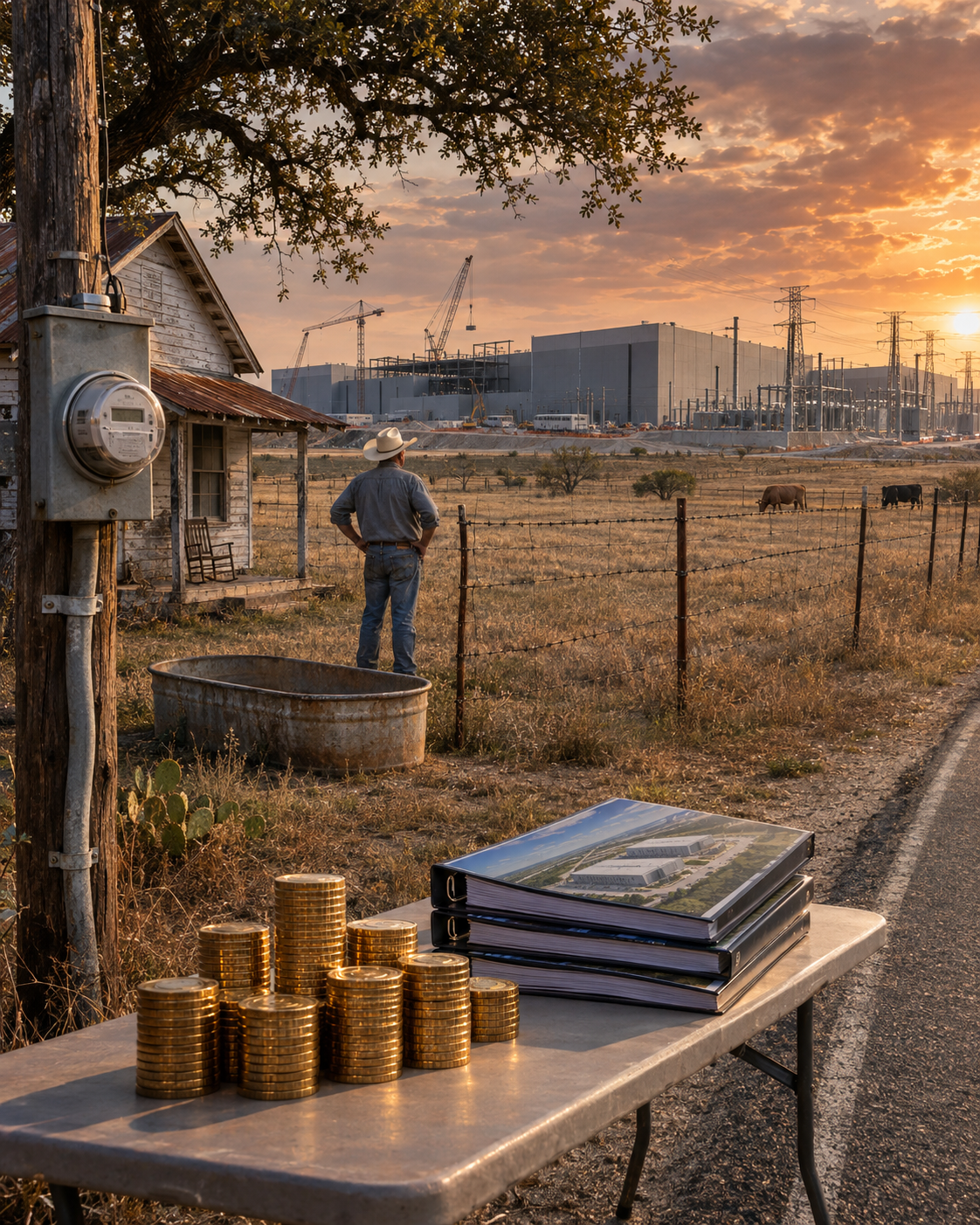
60 Minutes has found a genuine American conflict: technology companies want enormous amounts of rural land, electricity and political cooperation, while the people living nearby are being asked to accept developments they often cannot properly examine. But its investigation makes a serious mistake. It spends considerable time documenting public anger without doing enough to establish who is responsible, who actually pays, and what communities are being promised in return.
The most revealing part of the programme is not the protest meetings, the political speeches or the predictions about artificial intelligence. It is a negotiation in Hood County, Texas, where Amazon Web Services sought up to 90% in property-tax rebates for 30 years.
That is where the story stops being an argument about whether people like technology and becomes a question about public money, private investment and political accountability.
Unfortunately, 60 Minutes does not pursue that question nearly far enough.
1. Amazon's tax proposal deserved an investigation of its own
The AWS episode is the programme's strongest piece of evidence, but even here the reporting stops just when the financial questions become interesting.
AWS sought up to 90% in property-tax rebates for 30 years. Eagle rejected the proposal, and AWS subsequently pursued development in a neighbouring county, where it obtained the tax concession it wanted. Amazon confirmed that it ultimately chose not to build in Hood County. (CBS News, September 20, 2026).
The unanswered questions are substantial. How much tax revenue would Hood County have surrendered? What employment, infrastructure spending and public-service revenue would the company have delivered? How did the neighbouring county calculate the value of its concession, and what guarantees did Amazon provide?
A 90% rebate is not automatically a bad deal. A county might reasonably sacrifice some tax revenue to attract investment that would otherwise go elsewhere. But a 30-year concession is an extraordinary public commitment, and promises of future jobs are not a substitute for a financial model.
The programme found the negotiation but never properly investigated the bargain.
2. The $20 million campaign-donation claim needed forensic examination
Democratic candidate Gina Hinojosa accused Governor Greg Abbott of accepting $20 million from data-center executives and companies. The programme repeats the figure, then moves on to Abbott's change of position.
That figure deserved much closer examination.
An October 19 investigation by The Texas Tribune found that Abbott had received approximately $9 million from data-center-related donors since July 2025. Of that amount, $4.9 million came from people or companies directly involved in developing, owning or operating data centers; the remaining $4.1 million came from donors with indirect financial connections. (The Texas Tribune, October 19, 2026).
The difference matters. Hinojosa's $20 million figure uses a broader definition, including companies that lease data-center space and energy businesses that could supply the facilities. That is not the same as $20 million donated directly by data-center developers.
But the more troubling finding is what happened after Abbott began publicly restricting the industry.
The Tribune found that data-center-related donors gave Abbott $1.5 million in June, when he called for new regulations. After his August announcement pausing grid approvals, they contributed another $2.8 million that month.
These donations do not establish that Abbott changed policy because of campaign money, or that donors purchased favourable treatment. They establish something more specific: the governor continued receiving substantial financial support from industry-connected interests while presenting himself as the politician prepared to restrain that industry.
That relationship deserved more than a campaign accusation and a brief response.
3. Abbott's supposed reversal was more complicated than the programme suggests
The broadcast presents Abbott's August decision as a change of heart. The chronology deserves closer attention.
On August 3, Abbott directed the Public Utility Commission of Texas and ERCOT to audit data-center projects seeking grid connections before they could proceed. But the state's grid operator had already been developing a new system for evaluating large electricity users. The governor's intervention accelerated that process and added requirements. (The Texas Tribune, August 14, 2026).
The scale of the problem was considerable:
- More than 1,800 projects were in ERCOT's connection queue.
- Approximately 90% were data centers.
- The total potential demand exceeded 474 gigawatts.
- State officials said many proposals lacked financing or committed tenants and would never be built.
That final qualification is essential. A queue of proposed electricity demand is not a forecast of electricity that will actually be consumed.
By September 21, Abbott had gone further, directing Texas environmental regulators to halt data-center-related permits until the required audits were completed. (Texas Governor's Office, September 21, 2026).
This was a real escalation, not merely a speech.
But it also exposes the weakness in the broadcast's political framing: Abbott's position was evolving through several regulatory decisions, not one convenient election-season announcement. The investigation needed to examine which protections were new, which were already planned, and whether the measures would actually prevent developers from transferring costs to ordinary Texans.
4. Compass's Red Oak project needed the developer's actual plans, not just residents' fears
The Red Oak story is emotionally powerful. Residents fear that seven data-center campuses could eventually occupy more than a quarter of their town, while Compass proposes ten two-story buildings on agricultural land.
But the programme leaves a material part of the dispute underdeveloped: what exactly is Compass building, what land-use rights already exist, and what protections has it offered?
Compass's own project information, updated October 30, describes the Oglesby Road development as a 10-building, 400-megawatt campus. The company says most of the land is already zoned for data-center use and that it is seeking rezoning to incorporate additional setbacks, earth berms and landscaping. (Compass Datacenters, Red Oak project).
In its response to CBS, Compass also claimed that it had worked with local residents, civic organisations and public officials for more than five years. It said its plans included closed-loop water systems and investment in electricity infrastructure without shifting costs to households and businesses. (CBS News, company responses).
Those are company claims, not independently verified achievements. They deserve scrutiny.
Has the company actually secured the necessary permits? What water volumes will the campus consume? What electricity infrastructure will it finance? Are the promised protections legally binding? How much of the agricultural land is already committed to industrial use?
There is also a distinction between land already zoned for data centers and a new proposal to build on that land. Residents may still have legitimate concerns about the scale, design and cumulative effects of the project.
The problem is not that 60 Minutes interviewed residents. It is that the audience never received enough technical and planning evidence to judge the developer's actual obligations against those residents' concerns.
5. The electricity-bill story confuses a warning with a demonstrated bill
The programme says electricity bills have surged in Loudoun County, Virginia, partly because of growing data-center demand. That is a reasonable concern, but the report supplies no household bill comparisons, rate calculations or breakdown of the costs attributable to data centers.
Virginia's own legislative research offers a more complicated picture.
A 2024 study by the Joint Legislative Audit and Review Commission found that existing electricity rates generally allocated the direct costs of serving data centers to those customers. However, rapid demand growth could still create wider costs through transmission upgrades, changing energy prices and imperfect cost allocation. (Virginia JLARC, Data Centers in Virginia, December 2024).
Virginia regulators subsequently established a separate large-load electricity rate class. Under Dominion Energy's arrangements, qualifying data centers must pay at least 85% of transmission and distribution costs, even if they use less electricity than contracted. (Virginia State Corporation Commission, February 2026).
That is important because there are two different questions:
- Are data centers paying the direct costs of the electricity and infrastructure they require?
- Are their combined demands increasing wider system costs that eventually reach other customers?
The second problem does not disappear simply because regulators introduce special rates.
The programme should have explained that distinction. Instead, viewers hear that bills have risen and that data centers are partly responsible, without seeing the calculations needed to determine how much responsibility belongs to the industry.
6. The golf-course comparison is a distraction from the actual water question
One of the programme's most reassuring statistics is that golf courses across America consume more than twice as much water as data centers.
Even if the national comparison is correct, it does not answer the question being asked by residents of Chandler, Arizona.
Water availability is local. A gallon consumed in a water-rich region is not interchangeable with a gallon consumed in a desert community facing groundwater depletion.
The comparison also needs to distinguish potable water, reclaimed wastewater and other non-potable sources. It should account for cooling technology, seasonal demand and the water sources available to each facility.
Consider the difference: a data center might use relatively little water nationally while placing substantial pressure on one particular local supply.
The programme moves from a nationwide golf-course comparison to residents' local concerns without adequately explaining this distinction.
That is a poor comparison for a story about water scarcity. It answers which category consumes more water in aggregate, not whether a particular development is sustainable where it is being built.
7. The programme sells the AI arms race without examining the price of winning it
Michael Webber describes the expansion as a race for electricity, computing power and national security. The argument is that America must develop advanced AI before China or other potential adversaries.
That is a powerful political justification. It is also remarkably convenient for companies seeking enormous public resources.
The programme mentions possible artificial general intelligence, autonomous vehicles, robotic factories and medical discoveries such as cancer cures. But these are potential future benefits, not demonstrated returns from the particular developments being investigated.
What is missing is a serious examination of the alternative uses of the same electricity, land, water and investment.
What happens if projected AI demand fails to materialise? Who bears the cost of unused infrastructure? What happens to a rural community after a developer receives its tax concessions but the promised economic benefits prove smaller than expected?
The Texas electricity queue illustrates the problem. More than 474 gigawatts of proposed demand does not mean 474 gigawatts of viable projects. The Texas Tribune reported that many proposals lacked financing or committed customers.
An arms race is not an economic justification by itself. It is a description of competition. The public still deserves to know what winning costs and who receives the benefits.
Closing verdict
60 Minutes found an important story but did not finish investigating it.
Its strongest evidence concerns the relationship between developers and local government: concealed project identities, extraordinary tax concessions, enormous proposed developments and political donations flowing to a governor whose public position changed as opposition intensified.
Those are the foundations of a much stronger investigation than a collection of worried residents and political disagreements.
The most important questions are financial and institutional:
- What do developers actually promise local governments?
- What tax revenue do communities surrender?
- Who pays for electricity infrastructure and water?
- Which protections are legally enforceable?
- How much political influence do industry-connected donors exercise?
- What happens when the promised economic benefits fail to materialise?
The programme occasionally approaches these questions, then retreats into the familiar debate about whether technological progress is worth its environmental consequences.
That is not enough.
America is not simply deciding whether it wants more data centers. It is deciding who gets to control the infrastructure of the AI economy, who receives the financial rewards, and which communities must absorb the costs.
The public deserves an investigation of that bargain. 60 Minutes gave it a glimpse.
References
1. Data center developer tried to "razzle dazzle" while sharing few specifics, Texas county commissioner says — CBS News, September 20, 2026.\
Read the original investigation. Contains the AWS tax proposal, interviews with residents and officials, and the full company responses.
2. Greg Abbott raked in $9 million from data center-related donors as he called for regulations — The Texas Tribune, October 19, 2026.\
Read the investigation. Examines campaign contributions, distinguishes direct industry donors from indirect connections and documents donations received after Abbott announced restrictions.
3. Texas will audit up to 300 projects, mostly data center proposals, after Gov. Greg Abbott’s order — The Texas Tribune, August 14, 2026.\
Read the investigation. Explains ERCOT's project queue, the scale of proposed electricity demand and the distinction between proposed projects and viable developments.
4. Governor Abbott Directs TCEQ To Halt Data Center Permits — Office of the Texas Governor, September 21, 2026.\
Read the official announcement. Establishes the subsequent expansion of Abbott's restrictions to environmental permitting and water-use reporting.
5. Red Oak – Oglesby Road Campus — Compass Datacenters, updated October 30, 2026.\
Read the developer's project information. Provides the company's own description of the proposed 400-megawatt, ten-building campus, existing zoning and proposed landscaping and setbacks. These are developer statements, not independent verification.
6. Data Centers in Virginia — Virginia Joint Legislative Audit and Review Commission, December 2024.\
Read the report. Examines electricity cost allocation, infrastructure investment and the potential for costs to reach customers beyond data centers.
7. SCC Data Center Initiatives — Virginia State Corporation Commission, February 2026.\
Read the regulatory fact sheet. Details Virginia's separate large-load electricity rates, minimum payment requirements and safeguards against shifting infrastructure costs to other customers.