Alan Greenspan Saw the Subprime Warning. The Federal Reserve Failed to Act.
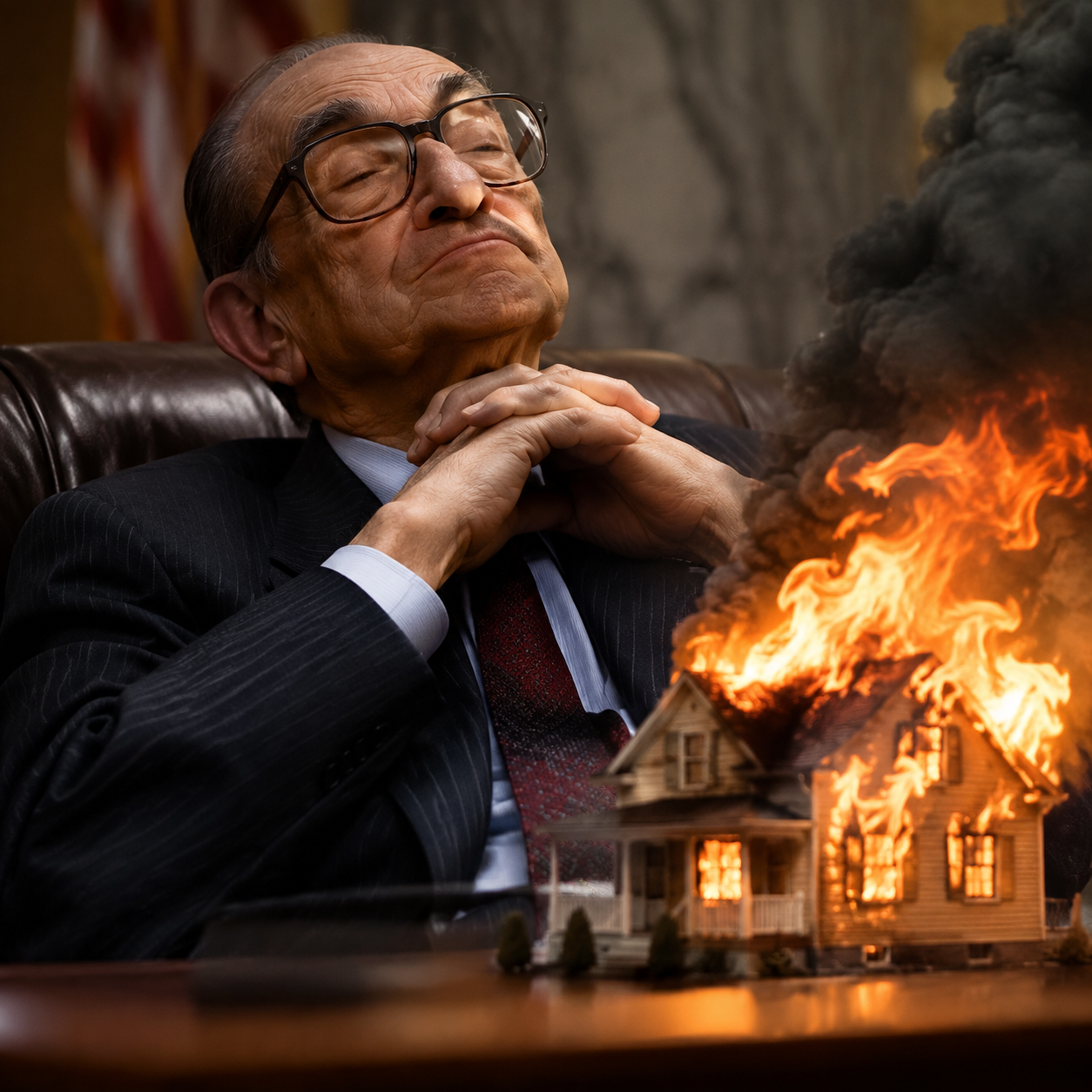
Alan Greenspan's most damaging admission was not that he failed to predict the housing crash. It was that he knew questionable mortgage lending was taking place, rejected a proposal to investigate it, and did not appreciate the scale of the problem until 2005 or 2006. By then, millions of borrowers had entered a mortgage market whose risks were spreading through the financial system.
The 60 Minutes interview presents this as a disagreement over what the Federal Reserve could realistically have done. That is too narrow. The more important question is what authority Greenspan possessed, what warnings reached him, and why the institution responsible for protecting the banking system did not use its available powers more aggressively.
Alan Greenspan Said There Was “Nothing to Look Into.” The Federal Reserve’s Record Says Otherwise.
Alan Greenspan's most damaging admission was not that he failed to predict the housing crash. It was that he knew questionable mortgage lending was taking place, rejected a proposal to investigate it, and did not appreciate the scale of the problem until 2005 or 2006. By then, millions of borrowers had entered a mortgage market whose risks were spreading through the financial system.
The 60 Minutes interview presents this as a disagreement over what the Federal Reserve could realistically have done. That is too narrow. The more important question is what authority Greenspan possessed, what warnings reached him, and why the institution responsible for protecting the banking system did not use its available powers more aggressively.
The interview never establishes what Greenspan actually rejected
The interviewer raises former Fed governor Edward Gramlich's proposal to investigate questionable mortgage lending. Greenspan responds that the Federal Reserve would not have been capable of doing what Gramlich suggested.
But what exactly was the proposal?
The Financial Crisis Inquiry Commission (FCIC), after reviewing Federal Reserve records and interviewing officials, established that there were two related but distinct proposals.
First, Federal Reserve staff proposed a pilot programme to examine lending practices at nonbank subsidiaries of bank holding companies. These included CitiFinancial and HSBC Finance, businesses whose influence in subprime lending was growing.
Second, Gramlich wanted substantially broader supervision of subprime lenders, including independent mortgage companies that were outside the Federal Reserve's routine supervisory jurisdiction.
These were not interchangeable proposals.
The Federal Reserve had authority to examine certain nonbank subsidiaries under the Bank Holding Company Act, although its authority to enforce consumer protection laws against them was unclear. Extending routine supervision to independent mortgage companies would have required additional congressional legislation.
The distinction matters because Greenspan's defence makes the problem sound like an impossible assignment involving thousands of unrelated lenders. The staff proposal was narrower: begin examining businesses connected to financial holding companies already within the Federal Reserve's regulatory structure.
The General Accounting Office (GAO) examined this issue in January 2004. Its conclusion was uncomfortable for Greenspan. The GAO said the Federal Reserve was well equipped to monitor and examine these nonbank subsidiaries routinely, potentially deterring predatory lending, although its legal authority needed clarification.
The GAO recommended that Congress give the Federal Reserve clearer authority to do so.
This was not an argument that the Fed could inspect every mortgage broker in America. It was evidence that meaningful supervisory action was possible, and that the legal gaps could be addressed.
GAO, Consumer Protection: Federal and State Agencies Face Challenges in Combating Predatory Lending
The Federal Reserve had another power that Greenspan's defence obscures
The most important omission in the 60 Minutes discussion concerns the Home Ownership and Equity Protection Act of 1994, or HOEPA.
Congress had given the Federal Reserve significant rulemaking authority under this legislation. The Board could prohibit unfair or deceptive mortgage lending practices, including practices extending beyond the narrow category of mortgages initially covered by HOEPA's special high-cost loan provisions.
The distinction is crucial.
The Federal Reserve did not need to become the enforcement agency for every independent mortgage company to establish broader rules governing mortgage lending.
And its own staff had already considered doing precisely that.
During its 2000 review of HOEPA, Federal Reserve staff proposed two reforms.
The first would have prevented lenders from granting mortgages based solely on the value of the property without properly considering whether borrowers could repay them. For high-cost loans, lenders would have to document and verify income and existing debt.
The second proposal targeted deceptive advertising, misrepresented loan terms and borrowers being asked to sign blank documents.
These were specific protections addressing identifiable abuses. They were not proposals to abolish subprime lending.
The FCIC's investigation found that Federal Reserve officials rejected the staff proposals.
That is a much more consequential finding than a disagreement over whether the Fed could send enough examiners into the mortgage industry.
The 2001 regulations barely reached the market they were supposed to protect
Greenspan defended the Federal Reserve's record by pointing to changes made to HOEPA in 2001.
There were genuine improvements. The Federal Reserve lowered the interest-rate threshold for high-cost mortgages and addressed practices such as repeated refinancing and the improper sale of single-premium credit insurance.
That last measure produced a measurable success: lenders largely abandoned the problematic insurance practice.
But the wider regulatory result was deeply inadequate.
Federal Reserve economists initially estimated that the revised rules could extend HOEPA coverage to between 9% and 38% of subprime loans. Lenders subsequently adjusted mortgage terms to avoid the revised thresholds.
By late 2005, the FCIC found that the regulations covered only about 1% of subprime loans.
Consider the mismatch: subprime mortgages accounted for approximately one-fifth of new mortgage originations in 2005, yet the Federal Reserve's principal high-cost mortgage protections reached only a tiny fraction of that market.
Greenspan later described the rules as a successful regulatory achievement. That assessment cannot be accepted without examining their actual coverage.
The question is not whether the Fed passed a rule. It is whether the rule meaningfully addressed the market that was producing the danger.
The warnings existed years before Greenspan recognised the danger
Greenspan's explanation was that he knew questionable lending practices existed but did not understand their significance until late 2005 or 2006.
That distinction deserves consideration. The rapid expansion of securitization changed the mortgage market, and it would be unfair to suggest that regulators in 2000 could have predicted the precise scale of the eventual international financial crisis.
But the warning record was considerably stronger than the interview establishes.
In March 1999, the federal banking agencies issued interagency guidance warning about the risks associated with subprime lending. It specifically identified the danger of high fees, high interest rates and compensation incentives encouraging predatory pricing.
In spring 2000, the Treasury and Department of Housing and Urban Development convened a National Predatory Lending Task Force. Its investigation involved hearings in Atlanta, Los Angeles, New York, Baltimore and Chicago.
The task force found substantial evidence of recurring abusive practices.
These included forged signatures, falsified income and property appraisals, illegitimate fees, deceptive sales tactics and repeated refinancing that stripped borrowers of their home equity.
These were not simply concerns about an unusual financial product. They were documented examples of misconduct affecting real borrowers.
Gramlich himself continued to discuss the problem publicly.
In an October 2003 Federal Reserve speech, he described loan flipping, fee packing, equity stripping, asset-based lending and outright fraud. He also discussed the need for stronger compliance examinations and enforcement.
By January 2004, the GAO had formally recommended that the Federal Reserve receive clearer authority to monitor nonbank mortgage subsidiaries.
The evidence does not establish that Greenspan personally understood the eventual systemic consequences of every warning. It does establish that the institution had years of opportunities to investigate, strengthen its rules and close regulatory gaps.
Edward Gramlich, An Update on the Predatory Lending Issue, October 2003
Greenspan's defence has a legitimate point, but it does not absolve the Fed
There is an important qualification.
Subprime lending was not inherently predatory. It expanded access to credit for borrowers who could not qualify for conventional mortgages. Many lower-income and minority households benefited from that expansion.
Greenspan was entitled to worry that indiscriminate restrictions could deny responsible borrowers access to homeownership.
He was also correct that the Federal Reserve was not the principal enforcement agency for independent mortgage companies. In his 2010 testimony to the FCIC, he noted that more than half of subprime mortgages originated in 2004 and 2005 came from independent mortgage companies outside the jurisdiction of federal banking regulators.
The Federal Trade Commission and state agencies had important enforcement responsibilities.
But this defence does not resolve the central issue.
The Federal Reserve had rulemaking authority under HOEPA. Its staff had proposed broader consumer protections. The GAO had identified the need for clearer supervisory authority. Gramlich had advocated stronger action.
The appropriate response to jurisdictional gaps was to address them, not to treat them as permanent reasons for inaction.
The subsequent chronology is revealing.
- 2000: Federal Reserve staff proposed stronger HOEPA rules and a pilot examination programme.
- 2001: The Federal Reserve adopted narrower amendments.
- 2004: The GAO recommended clearer authority to examine nonbank mortgage subsidiaries.
- July 2007: Under Ben Bernanke, the Federal Reserve announced a pilot programme to review selected nonbank lenders.
- July 2008: The Federal Reserve adopted substantially broader mortgage protections.
- October 2009: Those new rules became effective.
The 2008 regulations covered virtually all subprime mortgages within their higher-priced mortgage category. They required lenders to verify income and repayment ability, restricted certain prepayment penalties and introduced additional consumer protections.
The Federal Reserve had eventually developed a framework far more substantial than the one it had adopted during Greenspan's chairmanship.
The problem was timing. The subprime market had already collapsed.
Greenspan and Gramlich left conflicting accounts
There is another unresolved issue that deserved much greater attention.
Greenspan later told the Financial Crisis Inquiry Commission that Gramlich had chosen not to bring certain consumer-protection issues before the Federal Reserve Board.
He described Gramlich as an exceptionally knowledgeable governor and said the Board relied on his judgement in consumer affairs.
But the FCIC also recorded Gramlich's account to the Wall Street Journal in 2007:
"He was opposed to it, so I did not really pursue it."
The difference is significant.
Greenspan's account places responsibility on Gramlich for not escalating the issue. Gramlich's account suggests he backed away because the chairman opposed his proposal.
The available record does not conclusively resolve that disagreement.
What it does establish is that Gramlich supported stronger supervision, the staff had prepared proposals, and those proposals did not become meaningful regulatory protections.
The 60 Minutes interviewer never pursued this conflict. A direct question about who opposed the proposal, whether it reached the Board and why the staff recommendations were rejected would have been considerably more revealing than Greenspan's general explanation about regulatory limitations.
Financial Crisis Inquiry Commission, official hearing transcript, April 7, 2010
The interest-rate debate also needed more scrutiny
The interviewer challenged Greenspan over maintaining exceptionally low interest rates while the housing market expanded.
Greenspan defended the policy by pointing to the 13 rate increases beginning in June 2004.
But raising rates after a prolonged period of cheap credit does not, by itself, establish that the earlier policy was appropriate.
Nor does the interview settle whether Federal Reserve policy caused the housing bubble.
In his 2010 testimony, Greenspan argued that long-term mortgage rates, rather than the overnight federal funds rate, were the principal drivers of house prices. He attributed much of the decline in long-term borrowing costs to international capital flows and the global savings surplus.
That is an argument worth examining, not simply accepting or dismissing.
The housing bubble had multiple contributing forces, including monetary conditions, mortgage securitization, investor demand, weak underwriting and regulatory failures.
The interview never adequately separates these factors. Its brief exchange about rate cuts and subsequent increases cannot establish either that Greenspan created the bubble or that monetary policy was irrelevant.
A profile of the man replaced the investigation of the institution
There is nothing wrong with making a powerful public figure human.
The interview contains interesting material about Greenspan's marriage, childhood, musical ambitions, relationship with Ayn Rand, political relationships and deliberately obscure communication style.
But the editorial priorities are difficult to defend when the central subject is his responsibility for the Federal Reserve's response to mortgage lending abuses.
The interview obtains an extraordinary admission from a former chairman. It identifies a disagreement with a fellow governor. It gives Greenspan the opportunity to explain his decision.
Then it largely accepts his explanation.
It does not establish the exact scope of Gramlich's proposal, examine the available rulemaking authority, present the staff's rejected recommendations or investigate why the 2001 regulations ultimately covered so little of the subprime market.
Those questions were answerable through Federal Reserve documents, congressional testimony and regulatory records.
The Financial Crisis Inquiry Commission later produced a detailed account of these failures. Its final report was adopted by six commissioners, with four dissenting. The dissenters rejected explanations that treated insufficient regulation as the sole cause of the crisis, but acknowledged that high-risk nontraditional lending by nonbank lenders had flourished in an ineffectively regulated environment.
That distinction matters. Federal Reserve failures were not the only cause of the financial crisis, but they were a meaningful part of the story.
The verdict: Not predicting the crash was one failure. Not acting on the warnings was another.
I do not claim that Alan Greenspan could have prevented the financial crisis single-handedly. Nor does the evidence establish that every subprime mortgage was abusive or that stronger rules would have prevented the international collapse.
But Greenspan's defence rests too heavily on the argument that the Federal Reserve lacked the capacity to address the problem.
The historical record shows something more complicated.
The Fed had authority to write broader mortgage protections. Its own staff proposed specific measures. Government investigators documented abusive practices. A senior governor repeatedly advocated stronger supervision. The institution nevertheless adopted limited rules, resisted broader examinations and did not introduce substantially wider protections until the damage was already done.
Greenspan's admission that he failed to recognise the scale of the problem is credible as an account of his own understanding. It is not an answer to why the institution under his leadership failed to respond more forcefully to the evidence it already possessed.
The greatest failure was not that the Federal Reserve could not see the future.
It was that, when the warning signs were already on the table, it chose a regulatory response that proved far too small for the market it was supposed to protect.
60 Minutes found the admission. It did not finish the investigation.
References
- Former Federal Reserve Chairman Alan Greenspan — 60 Minutes Archive — CBS News, September 13, 2007. The original interview establishes Greenspan's admissions, his defence of the Fed's response and the questions the programme left unresolved.
- The Financial Crisis Inquiry Report — Financial Crisis Inquiry Commission, January 2011. Chapters 5 and 6 document the regulatory history, rejected staff proposals, HOEPA's limited coverage, Gramlich's warnings and the Federal Reserve's delayed response.
- Consumer Protection: Federal and State Agencies Face Challenges in Combating Predatory Lending — U.S. Government Accountability Office, GAO-04-280, January 30, 2004. Establishes the distinction between the Federal Reserve's supervisory capabilities and its uncertain authority over nonbank mortgage subsidiaries, and recommends legislative clarification.
- Home Ownership and Equity Protection Act of 1994 — Federal Reserve History, February 6, 2024. Explains HOEPA's original scope, the 2001 amendments, their limited coverage and the eventual 2008 regulatory expansion.
- Testimony of Alan Greenspan — Financial Crisis Inquiry Commission, April 7, 2010. Provides Greenspan's formal defence, including his arguments about regulatory jurisdiction, enforcement limitations, subprime lending and global capital flows.
- Board Issues Final Rule Amending Home Mortgage Provisions of Regulation Z — Federal Reserve Board, July 14, 2008. Establishes the scope of the later mortgage protections, including repayment verification and requirements applying across the mortgage lending industry.
- Fed Shrugged as Subprime Crisis Spread — Edmund L. Andrews, The New York Times, December 18, 2007. Provides contemporaneous reporting on Gramlich's private request, Greenspan's objection and the regulatory delays surrounding subprime lending.
- An Update on the Predatory Lending Issue — Edward M. Gramlich, Federal Reserve Board, October 9, 2003. Documents the abusive lending practices Gramlich was publicly identifying and his proposals for stronger examinations and enforcement.
- Official Transcript: Financial Crisis Inquiry Commission Hearing, April 7, 2010 — Financial Crisis Inquiry Commission, April 7, 2010. Records Greenspan's direct questioning about the rejected proposals, the 1% coverage figure and his conflicting account of Gramlich's decision not to bring the matter before the Board.
Tighten the opening argumentSeparate Greenspan's failures more sharplyReduce repeated claims about Fed authority