60 Minutes Turned McDowell County’s Water Crisis Into a Story Its Own Evidence Cannot Fully Support
The suffering in McDowell County is real. The problem is that 60 Minutes repeatedly moves from residents' experiences to sweeping factual conclusions without showing the evidence needed to establish them. In particular, its account of government funding, coal contamination and impending benefit losses deserves considerably more scrutiny than the broadcast provides.
The $8.3 Million Government Promise Was Not What Viewers Were Told
The report states that West Virginia's governor set aside $8.3 million in federal funds to upgrade sewage and water lines across McDowell County. The state's May 27, 2025 announcement describes a different arrangement: an $8.589 million project for Bradshaw's sewer collection and treatment system, affecting 106 customers, supported by a $1 million state infrastructure grant, $2 million from the Clean Water State Revolving Fund and other funding sources.
CBS News+1
That distinction matters. A project serving 106 customers in one town is not a countywide drinking-water improvement, and an $8.589 million total project cost is not an $8.3 million federal grant. The broadcast gives viewers a materially misleading impression of both the funding and the work being undertaken.
Correction: The $8.3 million figure in the preceding section was misidentified. It actually matches Governor Patrick Morrisey's February 13, 2026 announcement of federal Abandoned Mine Land Economic Revitalization grants: four McDowell projects received a combined $8.264 million, covering wastewater construction in Davy, waterline extensions in Jolo, sewer improvements in Gary and water expansion at Elkhorn Creek. The separate $8.589 million Bradshaw sewer project was not the source of the figure. The 60 Minutes funding statement was broadly accurate.
governor.wv.gov+1
The package was divided among four specific projects: a new wastewater system in Davy, a waterline extension in Jolo, sewer improvements in Gary and expanded water service at Elkhorn Creek. It was not a replacement for McDowell County's entire water infrastructure.
governor.wv.gov+1
The most revealing omission concerns Anawalt, the very town where 60 Minutes introduces Betty Stepp. A January 26 report documented an $11 million water project there that had not started because the public service district could not afford it; 55 residents were waiting for connections. Anawalt was not included in the February grant package.
Mountain State Spotlight+1
The scale of the shortfall is substantial. West Virginia's Department of Environmental Protection estimated that high-priority water projects in just four southern coalfield counties would cost $287 million. That figure supports the description of the $8.3 million package as inadequate, but 60 Minutes never shows viewers the underlying projects, costs or funding gap.
Mountain State Spotlight
Brown water is not a contaminant name
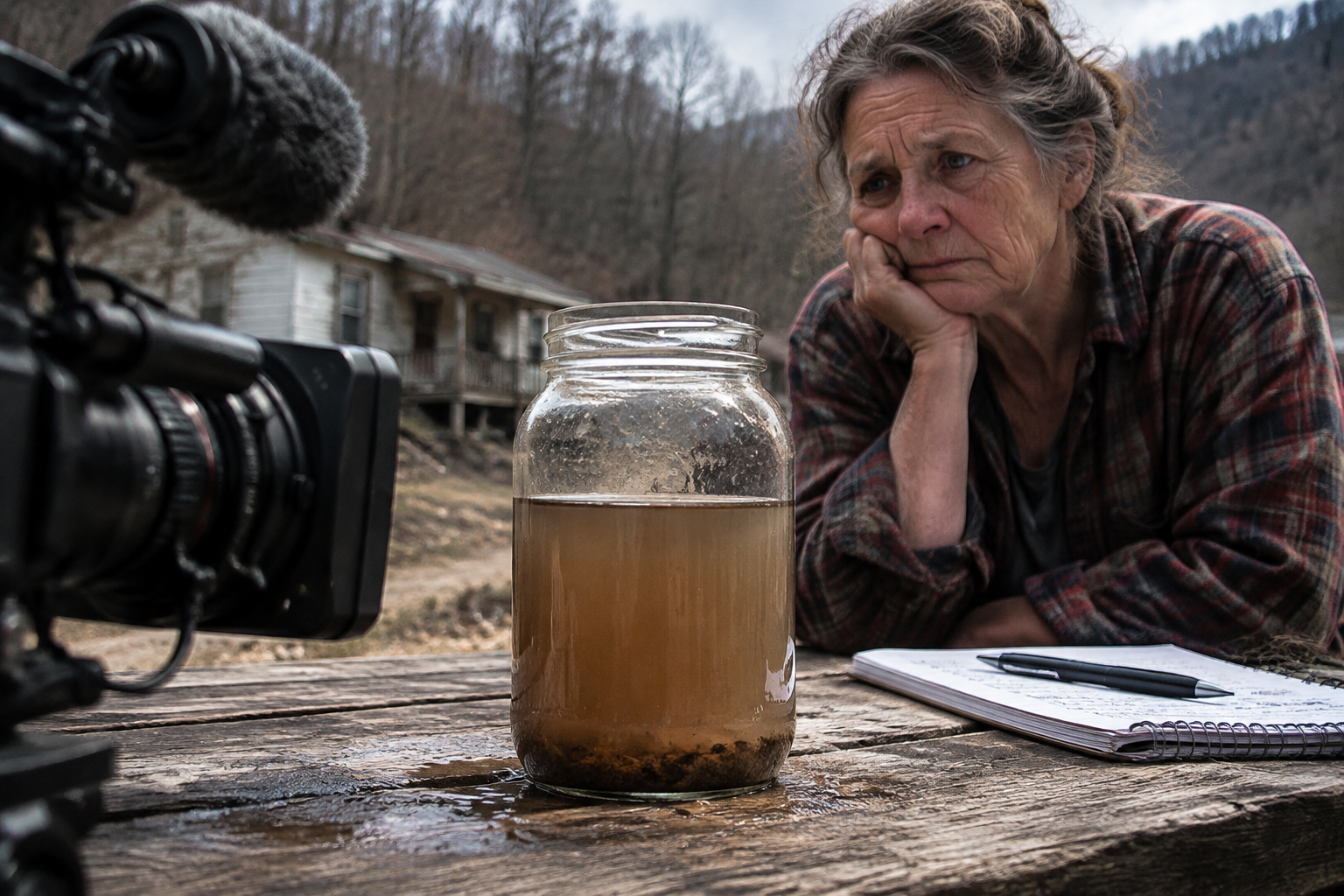
The broadcast describes black and brown water emerging from aging pipes and calls it contamination left behind by the coal industry. Pastor Davis then describes fumes making residents physically ill, with reports of skin rashes and burns. Yet viewers receive no laboratory results, identified pollutants, specific water-system records or medical evidence connecting those symptoms to the water.
I cannot establish the cause of the filmed discoloration from the broadcast. Brown water is evidence of a water problem, not a chemical analysis identifying its source.
There was relevant scientific research available before the broadcast. In November 2025, the U.S. Geological Survey published a study examining seven potential water sources from abandoned coal mines around Gary, McDowell County. Researchers analyzed 203 constituents and found substantial variation between sources. The Sawmill Hollow mine shaft was the only sampled source without a constituent exceeding the listed EPA contaminant, secondary contaminant or health-based thresholds; other sites showed elevated minerals, and E. coli was detected at four of the seven sources.
USGS Publications+1
This does not establish that the water shown by 60 Minutes was safe. Nor does it establish that it was contaminated. The USGS study itself was a preliminary assessment of potential water sources, not a certification of untreated drinking water.
Its findings demonstrate why identifying and testing the exact source matters. Some abandoned mine water in the region can be suitable for public supply after appropriate treatment; other sources have chemical or bacterial problems. The USGS also notes that acid mine drainage is not common in the particular coal seams examined. A blanket implication that mine-origin water is necessarily toxic is scientifically inadequate.
The broadcast never identifies the mine shaft shown or connects it to a tested water source. It also fails to distinguish contaminated source water from deteriorating pipes and unreliable distribution systems.
The actual infrastructure story was available
A July 2025 Associated Press report, published months before the 60 Minutes broadcast, provided a more specific explanation of McDowell's water problems.
Coal companies once built the water lines serving company-owned houses and mining communities. When the coal industry declined, those companies left behind aging pipes and drainage systems. The result is not simply a shortage of clean water; it is the collapse of infrastructure that entire communities inherited without sufficient resources to maintain it.
The report also identified DigDeep, a nonprofit working with the McDowell County Public Service District. DigDeep helps identify households needing water connections, secure funding to extend water lines and install wastewater treatment facilities for more than 400 residents. The exact number of people without dependable water remained unknown.
AP News+1
That missing context matters. The public service district, nonprofit organizations, state regulators, local authorities and federal funding programs all have different roles. The broadcast instead compresses these institutions into a generalized story of government promises and abandonment.
There was also a documented local accountability case worth examining.
In October 2024, West Virginia's Public Service Commission opened an investigation into Bradshaw's sewer system. Commission staff alleged that untreated sewage had been spilling near Bradshaw Elementary School and River View High School for four to six months. The town was also operating without a licensed sewer operator.
psc.state.wv.us+1
In August 2025, the commission approved transferring Bradshaw's sewer system to the McDowell County Public Service District. Commission staff had concluded that the town had been irresponsible and inefficient in managing the utility.
https\://www.wvva.com
This is a concrete example of institutional failure, with an identifiable operator, documented problems, regulatory intervention and a change in management. It is also a sewer-system case, not proof of coal contamination in the county's drinking water.
A report investigating government failure should be willing to identify the particular government institution that failed.
The pastor was also a participant in the policy campaign
Pastor Brad Davis is presented as a trusted community figure who listens to residents and presses politicians to improve conditions.
But a January 2026 Mountain State Spotlight investigation disclosed another relevant part of his role: Davis helped formulate a proposed $250 million drinking-water funding bill with West Virginia delegates David Green and Anitra Hamilton. The proposal sought to address water problems across nine southern coalfield counties.
Mountain State Spotlight
That does not invalidate his testimony or establish any improper motive. It does mean he was not merely observing the political debate; he was actively participating in it.
60 Minutes tells viewers that Davis pleads with politicians to do more, but does not explain his involvement in developing the proposed legislation. That context would help viewers distinguish firsthand community testimony from advocacy for a particular funding solution.
The benefit cuts are real. The individual consequences are not established.
The report's warning about federal benefit reductions is not invented. Congressional Budget Office estimates show that the 2025 reconciliation law will reduce federal Medicaid outlays by approximately $989.7 billion and SNAP spending by almost $187 billion over ten years. The combined reductions exceed $1 trillion.
Every CRS Report+1
But those are projected reductions in federal spending, not a single reduction applied uniformly to individual households.
For Medicaid, the Congressional Budget Office attributes approximately $325.6 billion in savings to the new work requirements. Changes to provider taxes and state-directed payments account for another $340.5 billion. SNAP reductions also involve changes to state financing, eligibility, benefit calculations and administrative funding.
Every CRS Report+1
The timelines are different, too:
- SNAP changes became effective July 4, 2025, with states required to implement the new work rules by November 2, 2025.
- Medicaid community engagement requirements begin December 31, 2026, or earlier if a state chooses.
The 60 Minutes report aired on February 22, 2026. It does not adequately distinguish changes already operating from Medicaid requirements that had not yet begun.
Every CRS Report
The prediction that tens of thousands of West Virginians could lose coverage is credible. The Center on Budget and Policy Priorities estimated that approximately 58,000 West Virginians could lose Medicaid coverage by 2034 under a scenario based on Arkansas's experience with work requirements. That is a projection, not a guaranteed outcome.
Center on Budget and Policy Priorities
Subsequent figures reinforce the seriousness of the SNAP changes. By May 2026, West Virginia had nearly 15,000 fewer SNAP recipients than before the legislation passed, including 4,010 fewer children, according to the West Virginia Center on Budget and Policy's analysis of state administrative data. Enrollment fell in 52 of 55 counties. These figures establish a substantial decline, although they do not prove that every individual departure was caused by the legislation.
West Virginia Center on Budget & Policy
The problem is how 60 Minutes connects those national policy changes to Tabitha Collins.
Tabitha is 26, works five days a week and supports a family of six. She cares for a toddler and her fiancé's three younger siblings. Her $480 electricity bill and disconnection notice demonstrate extraordinary financial pressure.
But the report never establishes whether she receives Medicaid, whether she is enrolled through the ACA expansion, how much SNAP assistance her household receives or which specific legislative provision threatens her benefits.
There is another important detail. Under the new SNAP and Medicaid work requirements, caregivers of dependent children under 14 are exempt. Tabitha is explicitly described as caring for a toddler. She therefore appears to fall within that exemption, although the broadcast does not provide enough eligibility information to establish her exact circumstances.
Every CRS Report
She may still be affected by other changes to SNAP benefits or program financing. But the report never investigates that question.
Her financial hardship is established. Her eligibility for the new work requirements is not.
That distinction matters when a journalist uses an individual family to demonstrate the consequences of a specific law. A family's dependence on assistance does not establish that the law will remove that assistance.
Closing verdict
60 Minutes got the human suffering right. It also identified a genuine threat to the federal safety net.
But its strongest claims needed more than sympathetic interviews and dramatic images.
It should have identified the contaminants, tested the water being shown, established whether the reported illnesses were connected to exposure, and explained which institutions operate the failing systems. It should have shown what the $8.3 million actually funds, why Anawalt's $11 million project remains stalled, and how the new benefit rules apply to the family at the center of its story.
It should also have disclosed that its principal water-policy advocate was helping develop a major funding proposal.
Instead, the report moves between contaminated-looking water, abandoned coal infrastructure, local utility failures, federal spending reductions and personal poverty as though they establish one continuous chain of government failure.
They do not. They are connected problems, but each has different causes, responsible institutions, remedies and consequences.
My indictment is not that McDowell County's suffering is exaggerated. It is that 60 Minutes had an opportunity to turn that suffering into an exceptionally useful investigation and stopped short of doing the necessary work.
A journalist should not merely show viewers that something is terribly wrong. The journalist must establish what is wrong, who is responsible, what the evidence proves and what happens next.
The residents of McDowell County deserve more than a compelling story about being forgotten. They deserve an investigation that makes it considerably harder for the people responsible to remain unidentified.
References
1. From coal mines to hard times: A West Virginia county braces for new public assistance cuts — CBS News / 60 Minutes, February 22, 2026. The original investigation and the statements examined in this critique.
2. Governor Morrisey Announces $9.5 Million in Water Infrastructure Investments — West Virginia Governor's Office, February 13, 2026. Establishes the five projects, their funding amounts and their intended beneficiaries.
3. Southern West Virginians have waited decades for clean water — Mountain State Spotlight, January 26, 2026. Documents Anawalt's stalled $11 million water project, 55 residents awaiting connections and the $287 million regional infrastructure estimate.
4. Reconnaissance of Potential Alternate Water Supply Sources for the City of Gary, West Virginia — U.S. Geological Survey, November 14, 2025. Provides actual chemical and bacterial sampling results from seven abandoned-mine water sources in McDowell County.
5. McDowell County, West Virginia, Birthplace of Food Stamps, Faces a Disappearing Safety Net — Associated Press / The Chronicle of Philanthropy, July 21, 2025. Explains the coal companies' abandoned water infrastructure and identifies DigDeep's work with the local public service district.
6. Commission Order, Case No. 24-0783-S-GI — West Virginia Public Service Commission, October 8, 2024. Records the investigation into Bradshaw's sewage failures and the allegations involving untreated sewage near two schools.
7. PSC approves Bradshaw sewer system takeover — WVVA, August 20, 2025. Documents the regulatory findings and transfer of utility management.
8. Health Provisions in P.L. 119-21, the FY2025 Reconciliation Law — Congressional Research Service, August 18, 2025. Breaks down Medicaid spending reductions and identifies the separate financing and eligibility provisions.
9. SNAP and Related Nutrition Programs in P.L. 119-21 — Congressional Research Service, August 15, 2025. Explains the $187 billion projected SNAP spending reduction and the distinct mechanisms affecting benefits and state costs.
10. Work Requirements: Comparison of Medicaid and SNAP After P.L. 119-21 — Congressional Research Service, December 11, 2025. Establishes the different implementation dates, covered populations and caregiver exemptions.
11. Medicaid Work Requirements Will Take Away Coverage From Millions — Center on Budget and Policy Priorities, July 22, 2025. Provides state-level projections, including the estimated 58,000 West Virginia Medicaid coverage losses under an Arkansas-like scenario.
12. Four Thousand Fewer WV Children Have SNAP Since Passage of HR 1 — West Virginia Center on Budget & Policy, August 18, 2026. Uses state administrative data to document subsequent SNAP enrollment declines, including the loss of 4,010 child recipients.