Germany's 2029 Rearmament Deadline Is Running Ahead of Its Army
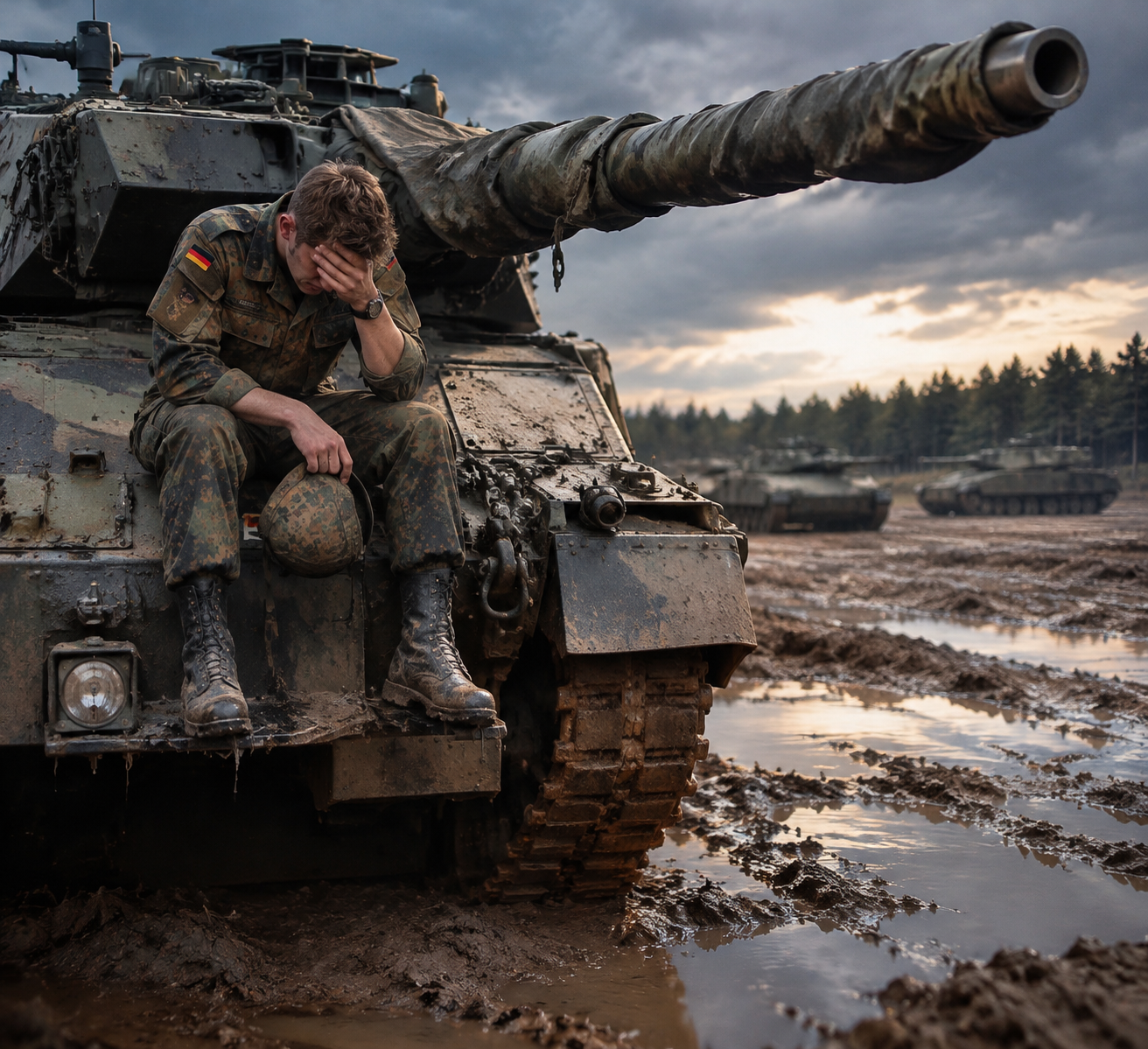
Germany has money, political determination and an expanding arms industry. What it has not yet demonstrated is that it can turn those advantages into a military capable of fighting a major European war by 2029.
60 Minutes takes viewers through military training, political promises, new factories, drone manufacturers and experimental battlefield technology. It gives considerable attention to the machinery of rearmament but never properly establishes whether the Bundeswehr can actually deliver the promised military capability.
Defense Minister Boris Pistorius supplies the deadline:
"We should do everything to be that in 2029."
He immediately acknowledges:
"This is still a way to go."
That qualification deserves considerably more attention than the programme gives it. The real story is not that Germany has decided to rearm. It is whether Germany can overcome decades of institutional neglect quickly enough to become a credible fighting force.
2029 is a target, not proof of readiness
The 2029 objective is not simply political rhetoric. On May 19, 2025, German Chief of Defence Carsten Breuer signed a directive ordering the military to become fully equipped with weapons and other material by 2029. Reuters reviewed the document and reported its priorities: rebuilding depleted air defences, developing precision-strike capabilities exceeding 500 kilometres, replenishing ammunition stocks, expanding electronic warfare and strengthening military capabilities in space.
This establishes a genuine military programme. It does not establish that Germany will be combat-ready by its deadline.
The distinction matters. Having a procurement programme is not the same as having operational formations with trained personnel, functioning equipment, ammunition, spare parts and reliable logistics.
Reuters' investigation of the 2029 directive.
The existing readiness picture is considerably less reassuring. In February 2025, Reuters interviewed military officials, lawmakers and defence experts who described Germany's land forces as operating at approximately 50% readiness. Colonel Andre Wuestner, head of the German Armed Forces Association, said readiness had deteriorated from approximately 65% before Russia's invasion of Ukraine in 2022.
The Defence Ministry declined to comment on overall readiness, citing classified information. It countered that Germany had provided NATO with a combat-ready division in high availability since January 1, 2025.
Those are materially different assessments. Neither should be casually presented as an independently verified measurement of the entire military.
Reuters' February 2025 investigation.
The 60 Minutes report never resolves this fundamental question. It does not establish a baseline of operational readiness against which Germany's 2029 ambitions can be measured.
The recruitment increase hides a retention problem
The programme reports a 23% increase in enlistments under Pistorius. That is accurate, but recruitment figures alone tell an incomplete story.
Germany's Parliamentary Commissioner for the Armed Forces reported that:
- 25,006 people joined the Bundeswehr in 2025, compared with 20,286 in 2024.
- 21,924 personnel left during 2025.
- 4,505 withdrew their commitment during the first six months of service.
- The provisional 2025 dropout rate was 19.8%.
- The final dropout rate for 2024 was 25.2%.
The resulting difference between entrants and departures in 2025 was approximately 3,100 personnel.
Germany is recruiting more people, but a substantial proportion of its recruitment effort is being absorbed by departures.
The same parliamentary report found that only 11% of surveyed Germans aged 16–29 could imagine working in the military, down from approximately 19% the previous year.
This measures interest in military employment, not willingness to fight. The 60 Minutes report cites a separate poll about young people's willingness to take up arms but does not identify its source or provide its precise question wording.
German Bundestag, Annual Report 2025.
The scale of the challenge becomes clearer when compared with the government's statutory targets.
Under Section 91 of Germany's Soldier Act, the Bundeswehr is supposed to reach:
- 198,000–205,000 active personnel by 2029.
- 120,000–140,000 reservists by 2029.
- Up to 260,000 active personnel and at least 200,000 reservists by 2035.
As of September 30, 2026, Germany had approximately 186,200 uniformed personnel. It has therefore reached the bottom of its 2026 target range, but still needs another 11,800–18,800 active personnel to reach its 2029 target.
This is not evidence that the target is impossible. It is evidence that recruitment and retention must improve substantially, not merely produce impressive annual enlistment headlines.
Lithuania exposes the difference between announcing a brigade and fielding one
The programme presents Germany's permanent deployment to Lithuania as a major demonstration of its renewed military strength.
It describes the 45th Armoured Brigade as Germany's first permanent deployment of a combat-ready brigade abroad since World War II.
The actual deployment timetable deserves closer examination.
The brigade was formally established in April 2025 and inaugurated in May. Its full operational capability is scheduled for the end of 2027, with approximately 4,800 military personnel and 200 civilian employees.
According to the Parliamentary Commissioner, only approximately 500 Bundeswehr personnel were stationed there by the end of 2025.
There has been substantial subsequent progress. In September 2026, the Bundeswehr reported that approximately 80% of the brigade's positions had been filled through voluntary applications. However, shortages in specialist areas, particularly logistics and information technology, have required additional compulsory assignments and temporary postings. The expected number of compulsory assignments is in the mid-hundreds.
More importantly, the parliamentary watchdog warned that supplying equipment to the Lithuania brigade was worsening existing equipment shortages among units remaining in Germany.
That is an important trade-off. Germany is strengthening NATO's eastern flank, but some of the equipment needed for the new formation is being drawn from an already constrained military.
The deployment is a serious strategic commitment. It is not evidence that Germany already has an additional fully equipped 5,000-person combat formation ready for war.
The money is arriving faster than the capabilities
Germany's 2026 defence-related budget reached approximately €108.2 billion. The scale of the financial commitment is extraordinary.
But appropriating money and delivering military capability are different exercises.
The Parliamentary Commissioner reported that in 2025:
- The regular defence budget received approximately €62.3 billion, of which €59.4 billion was spent.
- The Bundeswehr special fund had approximately €24 billion in estimated expenditure, of which €19.5 billion was spent.
Together, approximately €78.9 billion was spent against €86.3 billion in allocations and estimated expenditure.
The Commissioner also documented industry delays and disrupted procurement processes as causes of earlier spending shortfalls.
This does not mean every unspent euro represents a failed military purchase. It does mean that the relationship between money allocated and equipment delivered cannot be taken for granted.
The same parliamentary report identifies an enormous infrastructure problem: more than €67 billion in required military infrastructure investment extending into the 2040s, alongside approximately 8,000 pending construction projects.
One example is particularly revealing.
At Oberpfalz barracks in Pfreimd, home to the 104 Tank Battalion, a new accommodation building originally scheduled for 2020 is not expected to become available until 2029 at the earliest.
Most of the barracks' buildings date from the 1970s and require refurbishment.
The military is supposed to be preparing for a possible major war by 2029 while basic infrastructure projects are slipping by almost a decade.
Parliamentary Commissioner's Annual Report 2025, infrastructure and financial sections.
The drone revolution is real. Germany's operational gaps are real too.
The programme gives considerable attention to Quantum Systems, its €25 million contract for up to 750 intelligence and surveillance drones, and Swarm Biotactics' experimental cockroach reconnaissance technology.
These are interesting developments. But prototypes, contracts and demonstrations should not be confused with operational capability.
The Parliamentary Commissioner found that the Bundeswehr was still lagging in the deployment of modern unmanned systems. Soldiers had complained that some existing KZO and LUNA drones were outdated even when introduced. New systems still needed to enter series production, be manufactured in large quantities and delivered to the troops.
The problems extend to defending against enemy drones.
The Commissioner's report describes how foreign drones spied on the Arrow 3 missile-defence installation at Holzdorf/Schönewalde just two days before it entered operation in December 2025. The Bundeswehr was unable to neutralise them effectively.
Germany already possesses jammers, interceptor drones, lasers and microwave weapons, but these systems were not yet widely available throughout the armed forces.
The Commissioner concluded that additional capabilities would be necessary for Germany to become genuinely defence-capable.
This is the uncomfortable contrast the television report misses. Germany is showcasing futuristic surveillance technology while its parliamentary watchdog is documenting weaknesses in the much more immediate task of detecting and defeating enemy drones.
A cockroach that can crawl through rubble is an interesting research project. It is not an air-defence system.
Rheinmetall's success deserves scrutiny alongside Germany's readiness
The report presents Rheinmetall CEO Armin Papperger as a central figure in Germany's military transformation.
That is understandable. His company is expanding across Europe and has become one of the largest beneficiaries of the rearmament drive.
But there is another side to the story: the commercial rewards.
Rheinmetall's published 2025 financial results show:
- Sales of €9.935 billion, up 29%.
- Operating profit of €1.841 billion, up 33%.
- An order backlog of €63.8 billion, up 36%.
- An operating profit margin of 18.5%.
The company also reported that 38% of its sales came from Germany.
One qualification matters: the €63.8 billion backlog includes both binding orders and framework agreements. It should not be interpreted as €63.8 billion of completed or delivered equipment.
These figures do not establish misconduct or improper influence. They do establish that the defence industry has substantial commercial interests in the expansion being celebrated.
A CEO whose company is benefiting from government procurement is an important source on industrial capacity. He is not an independent authority on whether Germany's military will be ready on time.
The obvious questions are delivery schedules, production bottlenecks, cost overruns, contract performance and the proportion of promised equipment actually reaching operational units.
The programme does not pursue them.
The verdict: Germany is rebuilding an army, not proving it is ready
I do not dispute Germany's need to rearm. Russia's invasion of Ukraine has fundamentally changed Europe's security environment, and Germany's increased military investment is a consequential response.
But the 60 Minutes report makes the transformation look more complete than its underlying evidence establishes.
It documents political decisions, larger budgets, growing defence companies, recruitment campaigns, new technology and military deployments. Those are important developments.
What it does not establish is whether Germany can deliver a sufficiently large, trained, equipped and sustainable fighting force by 2029.
The distinction is enormous.
A factory is not a delivered weapon. A contract is not an operational system. A recruit is not necessarily a retained soldier. A brigade headquarters is not a fully equipped brigade. A defence budget is not a measure of how long an army can sustain combat.
Germany's own parliamentary watchdog has documented these problems in extraordinary detail.
The country has set itself an ambitious deadline. It has not yet demonstrated that it can meet it.
The real measure of Germany's rearmament will not be how much it spends or how many factories it opens. It will be how much military capability actually reaches the battlefield before the deadline arrives.
References
- Germany rearms, modernizes military after decades of embracing the peace dividend — 60 Minutes, CBS News. The original report and the statements by Pistorius, Papperger, recruits and defence technology companies examined in this critique.
- German chief of defence orders swift expansion of warfare capabilities — Reuters, May 25, 2025. Reports on the actual May 19 directive and its specific military capability priorities for 2029.
- 50% battle-ready: Germany misses military targets despite Scholz's overhaul — Reuters, February 13, 2025. Provides attributed military readiness estimates and the Defence Ministry's counterstatement.
- Annual Report 2025 (67th Report) — German Bundestag, Parliamentary Commissioner for the Armed Forces, March 3, 2026. Documents recruitment and attrition, procurement delays, drone-defence deficiencies, infrastructure problems, the Lithuania brigade's progress and actual defence expenditure.
- Soldier Act, Section 91 — German Federal Ministry of Justice, current legislation. Establishes the statutory personnel growth targets for active soldiers and reservists through 2035.
- Current Bundeswehr personnel statistics — Bundeswehr, October 21, 2026. Provides the September 30, 2026 military personnel count.
- Supplementary compulsory measures for the Lithuania Brigade — Bundeswehr, September 14, 2026. Documents voluntary staffing progress and remaining specialist personnel shortages.
- Significant increase in defence expenditure — German Bundestag, November 26, 2025. Records the approved 2026 defence-related budget of approximately €108.2 billion.
- Rheinmetall financial results for 2025 — Rheinmetall, March 11, 2026. Provides the company's reported sales, operating profit, margins and order backlog, including the distinction between binding orders and framework agreements.
Trim the article for sharper impactMake the opening argument more concise