The Oxford School Shooting: The Failures Were Documented. The Accountability Wasn't.
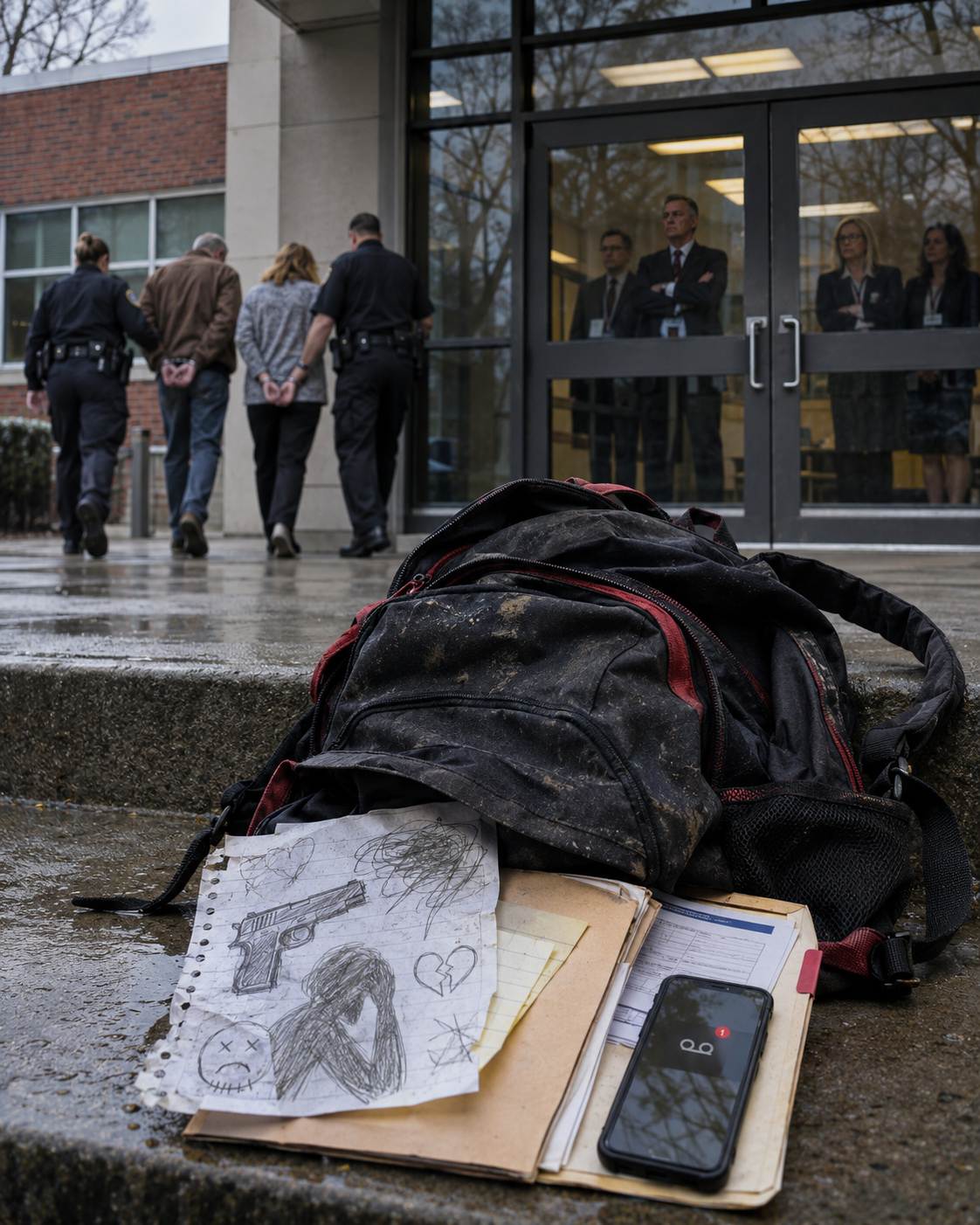
The most disturbing finding in the Oxford High School shooting was not simply that a teenager brought a gun to school. It was that multiple adults received warnings, a school had an opportunity to intervene, and the system failed to connect the information before four children died.
60 Minutes makes a compelling case against the shooter's parents. But its investigation leaves a more consequential question insufficiently examined: what happened when the institution responsible for those children was confronted with evidence of its own failures?
The answer is considerably more complicated than the broadcast's account suggests. Michigan's independent investigation documented failures reaching from the school board to the classroom. The district's response delayed that investigation, employees refused interviews, and the legal system ultimately protected school officials from civil liability. Yet the district later offered two victims' families settlements of $500,000 each.
That is a much more revealing accountability story than simply asking whether parents should go to prison.
The independent investigation uncovered a systemic failure
Guidepost Solutions did not merely criticize one counselor's decision on November 30, 2021. Its 572-page investigation examined the district's leadership, threat-assessment procedures, suicide-intervention policies, staff training and security arrangements.
Its conclusion was devastating: failures extended from the school board through the superintendent and school administration to individual staff members. The district had a written threat-assessment policy but had failed to implement it properly, and its suicide-intervention guidelines were outdated.
The investigators concluded that appropriate threat assessment and suicide intervention could have prevented the shooting. They also found that no senior administrators accepted responsibility for implementing the district's threat-assessment policy.
This matters because the broadcast's account can leave readers concentrating on the 12-minute counseling meeting. That meeting was a critical failure, but it was not the entire institutional failure.
The investigation described a system that had policies on paper without ensuring that staff knew how to put them into practice.
The district delayed the investigation — then weakened its ability to answer questions
The delay was not inevitable. Two weeks after the shooting, Oxford's school board voted to commission an immediate independent review. It subsequently declined multiple offers from Michigan Attorney General Dana Nessel to conduct one. For six months, the board followed advice from a lawyer retained by its insurance provider, SET SEG, to wait until criminal and civil litigation had concluded. Prosecutors had imposed no such requirement.
ProPublica+1
The insurance arrangement deserves scrutiny. A lawyer retained through the district's insurer was advising an institution facing potentially enormous liability. That creates an obvious tension between protecting the institution's legal position and providing the public with an immediate account of what went wrong. It does not prove a deliberate cover-up, but the incentive conflict should not disappear from the story.
ProPublica
The investigation was eventually commissioned in May 2022, following community pressure. Its final report appeared on October 30, 2023, almost two years after the shooting.
More importantly, the investigation itself was hampered by decisions made by the district.
Guidepost requested 161 interviews. Approximately 70 people refused or did not respond. The two employees who had the most direct knowledge of the meeting with Ethan and his parents, counselor Shawn Hopkins and dean Nicholas Ejak, refused to be interviewed.
In May 2023, Guidepost asked the district to consider making cooperation mandatory for current employees as a condition of continued employment. The district declined. Guidepost specifically reported that the school board had the authority to require Hopkins to cooperate, but chose not to exercise it.
guidepostsolutions.com+1
This is a substantially different accountability problem from simply having no power to compel witnesses. The outside investigators lacked subpoena authority, but the institution employing important witnesses had another means of securing their cooperation.
Guidepost did not allege a conspiracy. It explicitly said the mistakes were unintentional. It also stated that Guidepost alone controlled the final report's contents and conclusions, without influence from the board, district or its legal counsel, and that the board received the report simultaneously with the public.
The defensible criticism is therefore not that the report was secretly manipulated. It is that the investigation was delayed and its access to crucial witnesses unnecessarily restricted.
The parents were not the only people who made the decision that morning
The broadcast's account of the final school meeting gives considerable attention to the parents refusing to take Ethan home because of work.
But Guidepost documented another important part of the decision.
The counselor did not ask Ethan or his parents whether he had access to firearms. He did not complete the district's required suicide lethality assessment, safety action plan or home-safety discussion. The district's protocol required a student assessed at moderate or high suicide risk to be retrieved by a parent.
The parents asked whether Ethan could remain at school. Hopkins believed keeping him among his peers in a supervised setting was preferable, while Ejak saw no disciplinary reason to prevent his return to class. They allowed him to go back.
guidepostsolutions.com
The distinction matters. The parents refused the recommended course of action, but school employees still exercised professional judgment and made their own decision to return a visibly troubled student to class.
There is also an important qualification: the federal appeals court found no evidence that the employees knew the gun was inside Ethan's backpack. The failure was not proven knowledge of the weapon's location. It was the failure to ask about firearm access, follow the school's suicide-intervention procedures and escalate the situation appropriately.
law.justia.com
The state investigation was still unresolved when 60 Minutes aired
Perhaps the most consequential omission concerns the Michigan Attorney General's investigation.
The broadcast says the Attorney General's office is now investigating. That sounds reassuring. It suggests that an additional independent examination is underway.
But on January 30, 2026, just one month before the broadcast, The Trace published an investigation revealing that victims' families were still waiting for the promised state review.
After agreeing to conduct the investigation in November 2024, the Attorney General's office told Steve St. Juliana, Hana's father, that it needed approximately six months to review existing material and secure funding. That placed the expected start around July 2025.
By January 2026, the office had provided no public update establishing whether the investigation had actually begun.
Governor Gretchen Whitmer had proposed $1 million to fund it, but the money was excluded from the final 2026 state budget. An Attorney General spokesperson told The Trace that investigators were still waiting for documents from Guidepost and had only received important material from families' attorneys in late November.
The spokesperson insisted:
"Our review remains ongoing in earnest."
That is not the same as having completed an investigation or established accountability.
thetrace.org
The 60 Minutes segment should have explained this status rather than leaving viewers with the impression that the state investigation was progressing normally.
Another independent investigation was already public
There was also a second important report that the broadcast did not discuss.
On September 15, 2025, Oakland County published a separate, 275-page Guidepost Solutions after-action review of the county's emergency response. The county had approved $635,000 for the examination.
It found no evidence of neglect or dereliction of duty by individual emergency responders. But it documented significant operational failures:
- Approximately 25 minutes passed before formal incident command was established.
- Fire department dispatch was delayed until more than seven minutes after the first 911 call.
- The school resource officer was off campus when the shooting began, and the school's security officer was absent on approved leave.
- There was no proper reunification plan for students and families, leaving grieving families inadequately informed and supported.
The report also established something important about the deaths: independent medical experts concluded that all four victims' wounds were inherently fatal and that even immediate medical intervention would not have changed their outcomes. The report did not assess whether response delays affected surviving victims' injuries.
elections.oaklandcountymi.gov+3
This was not an investigation of the school's pre-shooting threat assessment failures, nor was it a substitute for the promised state investigation. But it was an important independent examination already available when 60 Minutes aired.
The broadcast missed an opportunity to distinguish between failures that could have prevented the shooting, failures during the emergency response, and failures in supporting families afterwards.
Government immunity is not the entire legal story
The programme says victims' lawsuits against school officials and the district were dismissed under Michigan government immunity laws.
That is broadly correct for the state-law claims, but it compresses two different legal proceedings into one explanation.
In September 2024, the Michigan Court of Appeals upheld dismissal of a state tort lawsuit. Under Michigan's Governmental Tort Liability Act, public employees generally need to have committed gross negligence that was also the proximate cause of the injury to lose immunity.
The court acknowledged that the individual school employees were factual causes of the plaintiffs' injuries. But it concluded that Ethan, who deliberately carried out the shooting, was the legally decisive proximate cause.
The court described the required standard as identifying the actor who was "the one most immediate, efficient, and direct cause."
Importantly, the plaintiffs in that particular appeal had not challenged the earlier dismissal of the school district itself.
Unpublished 09/18/2024
Federal lawsuits followed a different route.
In March 2025, the Sixth Circuit rejected the victims' federal constitutional claims under the narrow doctrine of state-created danger. That doctrine requires an affirmative government act increasing the risk of harm and conduct sufficiently outrageous to shock the conscience.
The court concluded that returning Ethan's backpack did not qualify because the gun was already inside it before the meeting, and the employees had not been shown to know it was there. It also treated the failure to inform other officials as an omission rather than an affirmative act increasing the danger.
The court considered the counselor's threat to contact Child Protective Services evidence of an attempt to reduce the risk, rather than callous indifference.
law.justia.com
These decisions did not establish that the school followed its own policies. Nor did they overturn Guidepost's findings about institutional failures.
They established that the plaintiffs had not satisfied the demanding legal tests required for those particular claims.
That distinction is essential. Legal immunity, constitutional liability and institutional responsibility are not interchangeable concepts.
The two employees also had agreements with prosecutors
There is another detail missing from the broadcast.
In January 2022, Shawn Hopkins and Nicholas Ejak signed proffer agreements with Oakland County prosecutors. These agreements provided that statements they made to prosecutors would not be used against them in the prosecution's case-in-chief in any potential criminal prosecution of their own.
They were not granted blanket immunity or promised favourable treatment. Neither employee was charged.
The agreements were not disclosed to Jennifer Crumbley's defence before her 2024 trial. In February 2025, a judge suggested that the nondisclosure likely violated prosecutorial discovery rules, although she subsequently upheld the conviction and denied a new trial.
clickondetroit.com+2
This does not establish that prosecutors protected the employees from prosecution. But it is a significant part of the history of how the two central school witnesses were treated.
A programme examining accountability should not leave this out.
The district made settlement offers, but money is not a finding of fault
In June 2025, the district's attorney emailed the estates of all four murdered students an offer of $500,000 each.
The deadline was 8 a.m. the following morning.
Hana St. Juliana's father and Tate Myre's father publicly rejected the offer. The board subsequently said it had not known about the specific correspondence and apologised for the way it was delivered.
In August 2025, attorneys confirmed that the families of Madisyn Baldwin and Justin Shilling had accepted $500,000 settlements each. The families of Hana St. Juliana and Tate Myre had not accepted.
The district's attorney described the agreements as a reasonable resolution of disputed claims.
WXYZ 7 News Detroit+1
I will not pretend that a settlement proves negligence. It does not establish legal liability, and the district did not admit wrongdoing through these agreements.
But the existence of these settlements is material when the programme discusses the absence of school accountability.
The financial outcome was not simply that every family's lawsuit failed and nothing followed. Two families accepted substantial settlements; two refused the offers. The way those offers were delivered created another confrontation between the district and the families it was supposed to serve.
That deserved attention.
The 90 percent statistic needs its denominator
The researchers' claim that more than 90% of school mass shooters broadcast their intentions before attacking is powerful.
But the underlying research deserves more careful presentation.
A 2021 study by Jillian Peterson, James Densley and colleagues examined 170 mass public shooters from 1966 to 2019. Within that sample, the K-12 school subgroup contained just 13 perpetrators. Twelve had communicated an intention to harm others, producing the reported 92.3%.
The study defined this communication, called leakage, broadly: any communication to another person of an intention to cause harm.
Across the entire sample of perpetrators who leaked, only 44.3% communicated specific plans about a mass shooting. More than half communicated nonspecific intentions involving generalized violence.
The researchers themselves warned that the limited number of cases reduced statistical power and that the sample was not representative of all mass shootings.
JAMA Network+2
The 90% figure is not fabricated. But saying that more than 90% of all school mass shooters broadcast their plans gives readers a stronger impression than the underlying evidence warrants.
Communicating generalized violent intentions is not the same thing as announcing a specific school shooting.
The distinction matters when the entire argument rests on how many opportunities institutions have to identify a planned attack.
Prevention and physical protection are not competing ideas
The programme also gives considerable weight to the researchers' criticism of metal detectors, clear backpacks and school security drills as theatrical measures.
Their argument that mental-health services and threat-assessment teams deserve more resources is worth examining.
But the Guidepost investigation found that some physical security measures and emergency training actually saved lives at Oxford.
Hundreds of students followed evacuation, lockdown and shelter procedures. The installed classroom door-barricading devices worked.
The distinction is straightforward: threat assessment can help prevent an attack; emergency training and physical protection can reduce harm once an attack begins.
A school needs both.
It is reasonable to question whether metal detectors or clear backpacks are effective investments. It is not reasonable to dismiss emergency drills and functioning barricades as useless simply because they cannot guarantee that an attack will never occur.
Guidepost Solutions
The FBI explanation also needs correction
The broadcast says the FBI is typically required to investigate only when a school shooting is classified as terrorism or a hate crime.
That is an inaccurate description of its investigative authority.
The FBI has authority to investigate federal crimes not exclusively assigned to another agency. Its responsibilities extend across violent crime, civil rights violations, public corruption, cybercrime and other federal offences.
It can also assist state and local authorities in investigations when requested.
That does not mean the FBI automatically takes over every school shooting. Most mass shootings are primarily state and local criminal matters.
But the absence of a federal mandate requiring a nationwide review after every school shooting is a different issue from claiming the FBI's investigative role is restricted to terrorism and hate crimes.
FBI+2
This is precisely the sort of distinction a serious investigative report should make.
The Georgia case has since produced another conviction
The broadcast opened with the father of the Apalachee High School shooter standing trial.
That trial concluded two days after the programme aired. On March 3, 2026, a jury convicted Colin Gray of second-degree murder and other charges relating to the deaths of four people.
On July 30, he was sentenced to 15 years in prison. His son, Colt Gray, had pleaded guilty and received life imprisonment without parole. Colin Gray became the first parent in the United States convicted of murder in connection with a mass school shooting committed by their child.
ABC News+1
The episode's central premise about parental criminal responsibility has therefore moved beyond the original Michigan precedent.
But that development does not resolve the unanswered Oxford questions.
The verdict: A powerful investigation that stopped short of accountability
The Crumbley parents' convictions were supported by evidence of extraordinary parental failures. Nothing in this investigation diminishes that responsibility.
But the school district's own independent investigation found failures at every administrative level. The board failed to oversee its superintendent. The superintendent failed to establish functioning threat-assessment procedures. School employees failed to follow existing suicide-intervention protocols. Key witnesses refused interviews, and the district declined to require their cooperation.
The state investigation was still unresolved when 60 Minutes aired. Two families had accepted settlements. Courts had dismissed claims under different and demanding legal standards, without declaring that the school had complied with its own policies.
The programme had enough material to tell a much stronger story.
Instead, it concentrated on the unprecedented prosecution of parents and treated institutional accountability as an unresolved side issue.
That is the central weakness.
The most important question is not whether parents should be held responsible when their children commit mass murder. Oxford has already demonstrated that they can be. It is why the institutions entrusted with protecting children can document their own failures, restrict the process of examining them, and still leave families waiting years for a definitive account of what happened.
References
1. How Parents Are Being Held Responsible After School Shootings — 60 Minutes, CBS, March 1, 2026. Original broadcast and primary work under review.
2. Oxford Community Schools Independent Investigation Report, Guidepost Solutions, October 30, 2023. The primary 572-page investigation documenting board, superintendent and staff failures, witness-access limitations and successful emergency security measures.
3. Report on Oxford High School Shooting Finds Multiple Failures, Troubled Aftermath, ProPublica, October 31, 2023. Documents the investigation delay, insurer's counsel, staff cooperation problems and the district's handling of the review.
4. The Oxford High Shooter Is Behind Bars. Families Still Want to Know How He Went Undetected, The Trace, January 30, 2026. Establishes the unresolved status of the Attorney General's investigation immediately before the 60 Minutes broadcast.
5. Oakland County Government Independent After-Action Report, Guidepost Solutions, September 15, 2025. Documents emergency-response deficiencies, family reunification failures and the medical findings concerning the victims' fatal injuries.
6. A.W. v. Oxford Community Schools, Michigan Court of Appeals, September 19, 2024. Establishes the precise governmental-immunity and proximate-cause grounds for dismissing the state tort claims.
7. St. Juliana v. Oxford Community School District, U.S. Court of Appeals for the Sixth Circuit, March 20, 2025. Explains why the federal constitutional claims failed under the state-created-danger doctrine.
8. Oxford Counselor, Admin Have Proffer Agreements With Prosecutors, WDIV, March 21, 2024. Details the agreements involving the two school employees who met Ethan before the shooting.
9. The Convicted Mother of a Michigan School Shooter Is Seeking a New Trial Over Witness Deals, Associated Press via Michigan Public, February 1, 2025. Reports the undisclosed witness agreements and the judge's concerns about prosecutorial disclosure.
10. Oxford Families Rebuke Board's Settlement Offer That Came With Ultimatum, WXYZ, June 10, 2025. Documents the $500,000 offers, the short acceptance deadline and the board's apology.
11. Two Families of Students Killed in Oxford School Shooting Accept Settlement, WDIV, August 21, 2025. Confirms the two accepted settlements and the two families who rejected them.
12. Communication of Intent to Do Harm Preceding Mass Public Shootings in the United States, 1966 to 2019, JAMA Network Open, November 4, 2021. Provides the underlying sample, leakage definition, school-shooter denominator and statistical limitations.
13. Where Are the FBI's Authorities Located?, Federal Bureau of Investigation. Explains the FBI's broader federal investigative jurisdiction and authority to assist other agencies.
14. Father Sentenced to 15 Years in Prison for Buying Gun Used by Son in School Shooting, ABC News, July 30, 2026. Confirms the outcome and sentence in the Georgia prosecution featured at the beginning of the broadcast.