60 Minutes Made Montana’s Ranchers the Face of a Land-Sale Bill That Exempted Montana
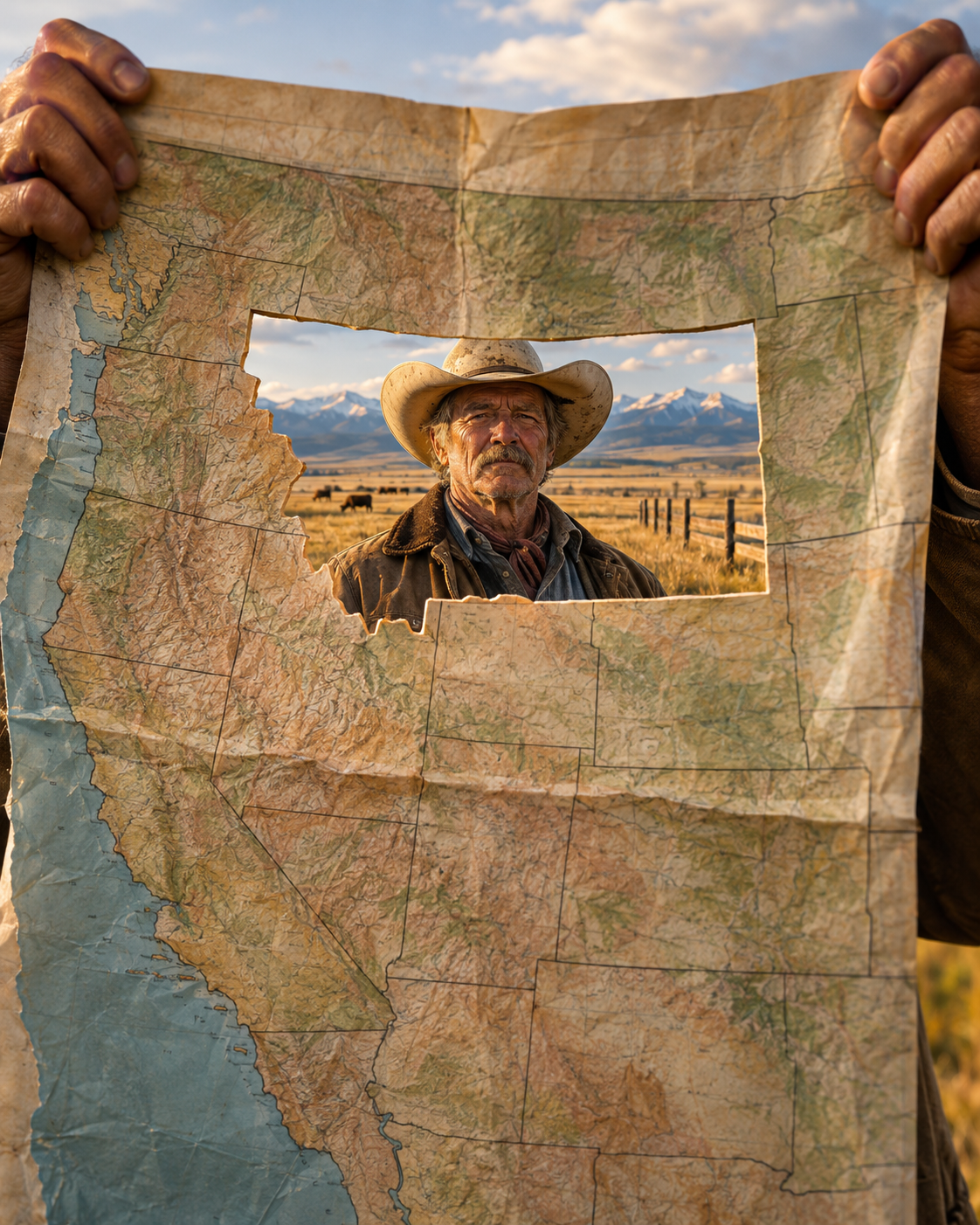
The most damaging weakness in 60 Minutes’ November 23, 2025 report is hiding in its own chronology: the Montana ranchers and business owners featured in the story lived in a state that was excluded from the federal land-sale proposal.
The program gives viewers a vivid warning. A ranching family depends on federal grazing land. A fishing guide says her business would disappear without public access. Ryan Zinke emerges as the Republican politician willing to fight Washington.
But the report never properly reconciles those human stories with the legislation. It eventually mentions that Senator Mike Lee had exempted Montana, but does not return to explain what that exemption means for the people whose livelihoods have been used to illustrate the danger.
Their dependence on public land is real. Their direct exposure to this particular legislation is not established.
The people featured were outside the bill's geographical reach
Lee's June 11, 2025 Senate proposal covered eleven Western states: Alaska, Arizona, California, Colorado, Idaho, Nevada, New Mexico, Oregon, Utah, Washington and Wyoming.
Montana was absent.
The exclusion followed objections from Montana lawmakers, including Senator Steve Daines. The Associated Press reported the exemption when the proposal was introduced.
There was another important protection. The original legislative text prohibited the disposal of land subject to valid existing rights, explicitly including grazing permits issued under the Taylor Grazing Act.
That matters enormously to the Mannix family.
The program explains that Brian Mannix, his uncle and cousin operate a ranch using approximately 55,000 acres, including federal land for which they pay grazing fees. Logan Mannix says losing their public leases would significantly reduce the family's income.
That may be entirely true. But Montana was outside the proposal's geographic scope, and existing grazing permits were separately protected.
The report never establishes that the family's particular leases were candidates for disposal.
The same problem applies to Donna McDonald, whose fishing and hunting guide business operates around her Montana property. Her statement that there would be no business to run without public land establishes the importance of public access, not the likelihood that Lee's bill would have taken away her access.
This distinction is essential.
Montanans could legitimately oppose the sale of public land elsewhere. Their political solidarity was meaningful. But a journalist investigating a specific legislative proposal must distinguish between people directly exposed to its provisions and people defending a broader principle.
60 Minutes does not do that work.
Nor does it interview a rancher, guide or local business owner from any of the eleven states actually covered by the original proposal.
The Associated Press documented the eligible states and Montana's exemption.
Affordable housing was the sales pitch, not a statutory guarantee
The report says Lee and his Republican colleagues argued that selling federal land would address America's housing shortage and help reduce national debt.
It never investigates whether the proposed legislation could actually deliver affordable housing.
The original Senate draft required disposal of between 0.5% and 0.75% of Bureau of Land Management and National Forest System holdings in eligible states, amounting to approximately 2.2 million to 3.3 million acres.
This was not an unrestricted sale of every federal property.
The proposal excluded fifteen categories of federally protected land, including national parks, monuments, wilderness areas and wildlife refuges. It also protected existing grazing permits and other legally recognized rights.
Sales were to secure at least fair market value. The legislation also required a restrictive covenant keeping sold land in its planned use for at least ten years.
Those qualifications matter. But so does what the legislation did not require.
The bill required land to be used for housing or associated community needs, as defined by the Interior and Agriculture secretaries. It did not require the resulting homes to be affordable.
There were no statutory requirements establishing affordable purchase prices, rental limits or income-based eligibility for residents.
The financial arrangements are revealing, too. The proposed legislation directed 90% of sale proceeds to the Treasury's general fund. Five percent would go to local governments for housing-related infrastructure, and another 5% would address deferred maintenance on remaining federal land.
In other words, the legislation promoted as an affordable-housing initiative did not guarantee affordable homes, and most of its sale proceeds were not earmarked for local housing construction.
The Salt Lake Tribune's examination of Lee's original proposal identified the absence of an affordability requirement. The legislative text confirms it.
This was exactly the question 60 Minutes should have put to Lee: What prevents a developer from purchasing public land at market value and building expensive homes rather than housing ordinary local families?
Instead, the program repeats the affordable-housing rationale and moves on.
The report never properly examines how the land would have been selected
The program acknowledges that Lee's proposal did not identify specific parcels.
That is true, but incomplete.
The legislation would have required federal agencies to identify land after enactment, publish lists of selected parcels and solicit nominations from interested parties, including state and local governments.
Priority consideration would have gone to land that:
- Was adjacent to existing developed areas.
- Had access to existing infrastructure.
- Was suitable for residential housing.
- Reduced fragmented or checkerboard land ownership.
- Was isolated and inefficient for federal agencies to manage.
This creates an important problem for the report's interviews.
Emily Cleveland argues that much public land is too far from the infrastructure necessary for large-scale housing development.
That may describe substantial portions of the federal estate. But the proposal specifically prioritized parcels near existing development and infrastructure.
Her general observation does not answer whether the particular land eligible for sale would have been suitable for housing.
The reporter never tests that claim against the legislation's selection criteria.
There is an even more consequential omission.
The proposal would have deemed its disposals compliant with relevant provisions of the Federal Land Policy and Management Act (FLPMA), including existing land-use planning and disposal requirements.
Under existing law, federal land sales are subject to specific disposal criteria, including whether a parcel is uneconomical to manage or whether a proposed sale serves important public objectives that outweigh the benefits of retaining federal ownership. Land-use planning also requires public involvement.
The proposed legislation substituted a mandatory disposal target and its own selection process.
It required consultation with governors, local governments and applicable Indian tribes, but did not establish an equivalent general public-hearing and comment process.
This is not a technical footnote. It goes to the heart of the dispute: who gets to decide which public land is disposable, and how much influence ordinary citizens retain over that decision?
The original bill also required tribal consultation, not tribal consent. Yet the 60 Minutes report, despite acknowledging the forced removal of Native Americans during western expansion, includes no tribal representative explaining what this new process could mean for their interests.
A sentence acknowledging historical dispossession is not a substitute for hearing from the people whose history is being discussed.
The existing federal land-sale law and the proposed Senate legislation make this distinction clear.
Zinke's victory story conceals a more complicated political defeat
Ryan Zinke deserves credit for helping defeat the earlier House public-land proposal.
But the House and Senate measures were separate legislative efforts.
In May 2025, Representatives Celeste Maloy of Utah and Mark Amodei of Nevada advanced a proposal targeting federal land in their states. Zinke helped organize opposition, and House Republican leaders removed that provision on May 21.
In June, Mike Lee introduced a different and substantially broader Senate proposal covering eleven Western states.
The 60 Minutes report moves from Zinke's House victory to his coordination with Senate colleagues, then presents the abandonment of Lee's proposal as a continuation of the Montana-led fight.
That account leaves out several decisive developments.
On June 23, Senate Parliamentarian Elizabeth MacDonough ruled that Lee's original proposal violated the Byrd Rule, which limits what can be included in budget reconciliation legislation.
Lee subsequently revised the proposal. He removed National Forest System land from eligibility and narrowed the remaining Bureau of Land Management sales to parcels within five miles of population centers.
The proposal was already facing serious opposition within the Republican Senate caucus.
On June 28, Montana Senator Tim Sheehy threatened to oppose the procedural vote to advance the larger budget bill unless the land-sale provision was removed. Republican leadership subsequently agreed to let him lead an amendment stripping the provision, with Steve Daines also involved.
Lee withdrew the provision before that amendment could be voted on.
His stated explanation was particularly revealing: the constraints of reconciliation prevented him from securing enforceable safeguards guaranteeing that land would go only to American families rather than corporations or foreign interests.
That is an important admission about the limitations of the proposal.
It also complicates the report's presentation of the defeat as primarily a Montana political victory.
Zinke's House intervention was real. His opposition in the Senate mattered. But the parliamentary ruling, revised legislation, Republican Senate resistance and the threatened Sheehy amendment were all part of the actual sequence.
The program names none of the two Montana senators as central participants in the Senate confrontation and does not explain the parliamentarian's ruling or Lee's stated reason for withdrawing.
Deseret News documented Sheehy's threatened vote and Lee's withdrawal.
Roll Call reconstructed the Senate negotiations and amendment threat.
Zinke opposes selling public land. That does not make him a conservationist.
The report describes Zinke as having no ideological objection to changing public-land use on a case-by-case basis.
Yet his position deserves more examination.
He supports keeping public land in federal ownership while allowing timber harvesting, grazing, oil, coal and natural-gas development.
That is a coherent political position. But public ownership and environmental conservation are not interchangeable.
During his first tenure as Interior Secretary, Zinke recommended reducing the boundaries of Utah's Bears Ears and Grand Staircase-Escalante national monuments. President Trump signed proclamations implementing those changes in December 2017.
The Bureau of Land Management's own announcement documents Zinke's recommendation and Trump's action.
His opposition to selling public land does not erase that record.
A government can retain ownership while opening land to substantially more commercial extraction or reducing protections for particular landscapes.
The distinction matters because the 60 Minutes segment repeatedly associates opposition to privatization with the preservation of Montana's natural inheritance.
Those are related arguments, not identical ones.
The report should have examined what Zinke's preferred model of federal land management actually protects, what it permits and who bears the consequences.
Instead, it largely accepts his public-land philosophy as a satisfactory answer.
The verdict: A powerful Montana story, but an incomplete investigation
The Montana coalition's opposition was genuine. The Mannix family's connection to its land was genuine. Zinke's role in defeating the House proposal was genuine.
None of that excuses the missing policy analysis.
The report does not establish direct exposure for its featured ranchers, despite Montana's exemption and the protection for existing grazing rights. It does not test Lee's affordable-housing promise against the actual statutory language. It does not explain how the proposal would have bypassed ordinary public-land disposal procedures. And it simplifies a Senate defeat involving parliamentary rules, multiple Republican lawmakers and a failed attempt to secure restrictions on potential buyers.
Most importantly, it never gives viewers a clear picture of what could actually have been sold, where it could have been sold, who could have bought it and what would have happened afterward.
Public land deserves serious scrutiny. So does a proposal to sell millions of acres of it.
But beautiful scenery, heartfelt testimony and a compelling political hero do not replace an examination of the legislation.
60 Minutes delivered a memorable defence of Montana's identity. It did not deliver the rigorous investigation of the land-sale proposal that the story demanded.
References
1. Why Montana fought to protect federal public lands and what's at stake if they were sold off — CBS News, November 23, 2025. The original report and transcript, establishing the interviews, claims and political narrative examined here.
2. Chairman Lee Releases ENR Budget Reconciliation Text — U.S. Senate Committee on Energy and Natural Resources, June 11, 2025. The original legislative proposal and accompanying official materials establish the acreage targets and intended policy.
3. Original Senate legislative text, Subtitle C — Lands — Senate Legislative Counsel, June 11, 2025. Establishes the eligible states, grazing-rights exemptions, land-selection procedures, consultation requirements, restrictive covenants and distribution of sale proceeds.
4. 43 U.S.C. §1712 — Land use plans and 43 U.S.C. §1713 — Sales of public land tracts — United States Code. Establishes the existing public-involvement requirements and statutory criteria for federal land disposal.
5. Sen. Mike Lee pushes back on campaign against public land sales — Deseret News, June 20, 2025. Examines the proposed exemptions and confirms that the original housing language did not guarantee affordable homes.
6. A public lands sell-off has been yanked from the budget bill, but other threats to public lands remain — Rocky Mountain Community Radio / Wyoming Public Media, June 30, 2025. Reconstructs the parliamentarian's ruling, the revised proposal, Montana's exemption and the broader political opposition.
7. Senate votes to take up 'big, beautiful' revised budget bill — Roll Call, June 28, 2025. Documents Sheehy's threatened procedural vote, the proposed amendment and Lee's eventual withdrawal.
8. Republicans remove language in Trump budget bill to sell public lands in Utah — Deseret News, May 21, 2025. Establishes the separate House proposal and the earlier negotiations that removed it.
9. President Trump and Secretary Zinke Announce Modification to Utah Monuments — Bureau of Land Management, December 4, 2017. Documents Zinke's recommendation and the subsequent changes to Bears Ears and Grand Staircase-Escalante national monuments.
10. Senate GOP plan would sell millions of acres of Western public land — The Washington Post, June 12, 2025. Provides the proposed acreage, agency holdings and projected $5–10 billion in sale proceeds over fiscal years 2025–2034.