60 Minutes Called It Synthetic Life. The Missing Cell Changes the Story.
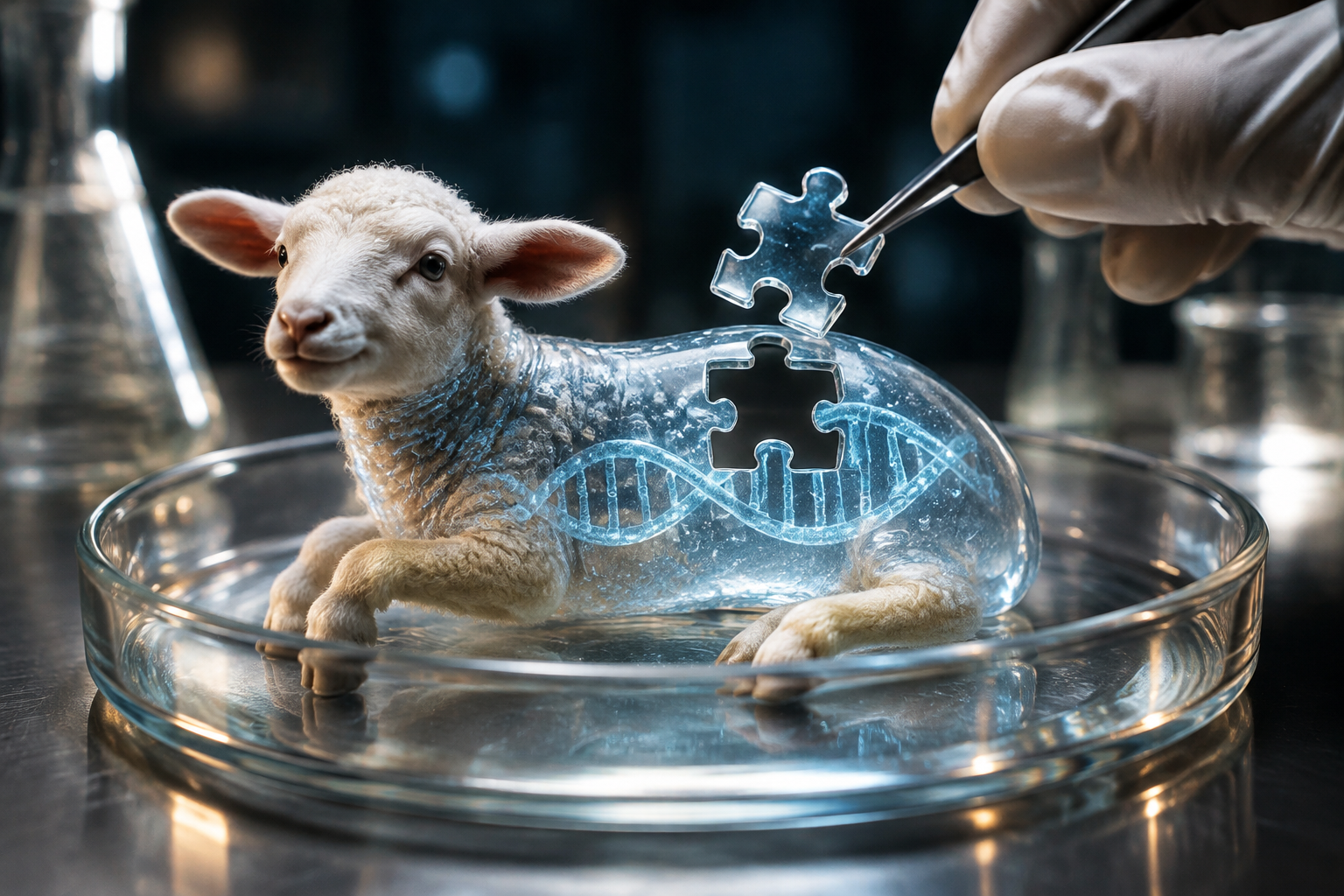
In 2010, 60 Minutes presented J. Craig Venter's achievement as a landmark in the creation of synthetic life. The science was extraordinary. But the programme left out a distinction that matters enormously: Venter's team manufactured a bacterial genome, not an entire living cell from scratch.
That is not a minor technical qualification. It is the difference between writing a new set of instructions for an existing biological machine and manufacturing the machine itself.
The original scientific paper makes this distinction explicitly. The television report does not explain it to viewers with anything like the same clarity.
The breakthrough was real. The description was misleading.
The 2010 scientific paper describes something considerably more precise than the television narrative.
The team synthesized a 1.08-million-base-pair genome based on an existing strain of Mycoplasma mycoides. They assembled it from 1,078 DNA cassettes, then transplanted it into a living Mycoplasma capricolum recipient cell. The recipient's original genome was displaced, and the resulting cells reproduced under the control of the synthetic chromosome. (Gibson et al., Science, 2010)
NCBI Bookshelf
The distinction is explicit in the paper. The authors describe their achievement as producing a synthetic cell, while acknowledging that the recipient cell's cytoplasm was not synthetic. They also explain that the genome contained only limited modifications from its naturally occurring counterpart.
This was not a completely invented biological blueprint. It was a chemically manufactured version of an existing organism's genetic instructions, with modifications and identifying watermarks.
The Venter Institute itself later described JCVI-syn1.0 as nearly identical to wild-type Mycoplasma mycoides subspecies capri, a bacterial parasite commonly found in goats. (JCVI, 2021)
J. Craig Venter Institute
The Presidential Commission for the Study of Bioethical Issues subsequently made the distinction unmistakable:
The achievement did not amount to creating life because it relied on an existing natural host. The human-made genome had been inserted into an already living cell.
That conclusion does not diminish the breakthrough. It identifies what the breakthrough actually was.
There is another revealing detail. On May 27, 2010, nearly six months before the broadcast, the House Energy and Commerce Committee had already described the achievement as synthesizing bacterial genetic instructions and using them to reprogramme another bacterial cell. Its hearing included Venter, Stanford's Drew Endy, Berkeley's Jay Keasling and NIH infectious-disease chief Anthony Fauci.
The more precise explanation was available long before Steve Kroft interviewed Venter. (Congressional hearing, May 27, 2010)
GovInfo
The safety assurances were never properly tested
The interview becomes particularly uncomfortable when Kroft challenges Venter about safety.
Venter responds:
"I can tell you what we're doing is safe."
He then explains that his team is working with algae cells designed not to survive outside a laboratory or facility.
But the synthetic organism featured earlier in the programme was a bacterium, not algae. These were separate research projects.
The distinction matters. A containment strategy for one engineered organism does not establish the safety of another, much less every future organism produced using synthetic biology.
Venter also admits that he cannot guarantee that other scientists will conduct safe experiments.
The programme accepts his explanation without establishing precisely which organisms the safeguards cover, how containment works, or what independent evidence supports the assurance.
The Presidential Commission's December 2010 report provides a more useful framework. It found no justification for a moratorium or additional federal regulatory agencies at that stage, but recommended ongoing risk assessments, monitoring, containment mechanisms and assessments before environmental release.
That was a measured position: the technology could proceed, but confidence was not a substitute for oversight.
Citation: Presidential Commission, New Directions, December 2010.
bioethicsarchive.georgetown.edu
Bioethics Research Library
The 24-hour vaccine prediction became a different proposition
Venter tells Kroft that synthetic DNA processes could potentially produce the following year's influenza vaccine in 24 hours or less.
This was an attractive promise. It was also a claim that needed careful qualification.
On October 7, 2010, Synthetic Genomics Vaccines Inc. and the Venter Institute announced a three-year collaboration with Novartis, supported by the US Biomedical Advanced Research and Development Authority (BARDA).
The actual objective was to accelerate production of influenza vaccine seed strains: the starter viruses used to manufacture larger quantities of vaccine. The announcement suggested that the technology could reduce production time by up to two months. It did not promise a finished vaccine in 24 hours.
(JCVI and Novartis collaboration announcement)
J. Craig Venter Institute
The subsequent scientific results are revealing.
In May 2013, researchers published a successful proof of concept demonstrating that synthetic vaccine viruses could be constructed in four days and four hours. The DNA cassettes encoding two important influenza proteins could be assembled in approximately ten hours, but that was only one stage of the process.
The researchers still had to introduce the genetic material into qualified manufacturing cells and recover the vaccine viruses.
They had accelerated an important part of vaccine development. They had not demonstrated that a finished influenza vaccine could be produced in 24 hours.
(Dormitzer et al., Science Translational Medicine, 2013; JCVI's announcement)
PubMed+1
This is precisely the distinction a serious science programme should make: synthesising genetic material quickly is not the same as manufacturing, testing and distributing a vaccine.
Exxon's $300 million was not an unconditional commitment
The programme tells viewers that ExxonMobil committed $300 million to Venter's company to develop algae capable of converting carbon dioxide into oil suitable for gasoline production.
The original ExxonMobil announcement tells a different financial story.
The company expected to spend more than $600 million across the programme, including $300 million in its own internal research costs and potentially more than $300 million paid to Synthetic Genomics.
Crucially, payments to Synthetic Genomics depended on research and development milestones being achieved.
That is not the same as an unconditional $300 million investment in Venter's company.
(ExxonMobil's original announcement, July 2009)
ExxonMobil Holdings Corporation
There was genuine scientific progress. In 2017, ExxonMobil and Synthetic Genomics announced an engineered algae strain whose oil content had increased from 20% to more than 40% without significantly inhibiting growth.
But even ExxonMobil acknowledged that additional research and testing were necessary before commercial application. Its research executive described commercial availability as potentially many years away.
ExxonMobil
By the end of 2022, Exxon had begun withdrawing its support. In March 2023, The Colorado Sun reported that the company had abandoned its 14-year algae research programme after spending approximately $350 million.
An Exxon spokesperson acknowledged that algae had not reached the commercial and global scale necessary to economically replace existing energy sources.
The research was not worthless. But the commercial breakthrough remained elusive after more than a decade and hundreds of millions of dollars.
(The Colorado Sun, March 6, 2023)
The Journal
The 2010 programme did acknowledge the enormous scale required and mentioned commercial scepticism from Venter's competitors. That deserves recognition.
What it failed to do was distinguish conditional investment funding from committed capital, or independently examine the economics behind the proposed fuel.
The scientific paper disclosed financial interests the programme left unexplored
There is an even more important omission.
The original scientific paper contains a financial disclosure that viewers of the programme never hear.
Synthetic Genomics funded the research. Venter was the company's chief executive and co-chief scientific officer. Hamilton Smith was also co-chief scientific officer and a member of its board. Clyde Hutchison chaired its scientific advisory board.
All three authors and the J. Craig Venter Institute held Synthetic Genomics stock. The institute had also filed patent applications covering some of the techniques described in the paper.
These disclosures do not invalidate the scientific findings. Nor do they establish that anyone acted improperly.
But they matter enormously when a television programme combines a scientific breakthrough with predictions of commercial applications, major corporate investments and a scientist's personal financial success.
Venter was not simply an independent academic describing an interesting experiment. He was also leading a private company positioned to commercialise the technology.
The programme mentioned that relationship, but never explained the extent of the financial interests disclosed in the scientific publication.
That was a material omission, particularly because the programme relied so heavily on Venter's own assessment of the technology's future value.
Original scientific paper and financial disclosures.
NCBI Bookshelf
The final verdict
Craig Venter's team achieved something extraordinary. They chemically synthesized a bacterial genome, transferred it into an existing living cell and demonstrated that the synthetic genetic instructions could control a self-replicating organism.
That is a genuine scientific milestone.
But it was not the creation of life from scratch. It was not the invention of a new biological species. It did not demonstrate finished vaccine production in 24 hours. And the corporate investment in algae did not deliver commercially viable fuel at the scale originally imagined.
The failure of 60 Minutes was not that it celebrated an important discovery. It was that it allowed the scientist's own language, ambitions and commercial predictions to dominate the explanation.
The programme had access to the scientific paper, the financial disclosures and a substantial public debate about the technology. It could have explained what was genuinely new, what remained dependent on existing biology, and what was still an unproven commercial promise.
Instead, viewers received a compelling portrait of a man designing life, with insufficient scrutiny of what he had actually designed.
Science deserves better than mythology. And journalism should know the difference.
References
1. Designing Life: What's Next for J. Craig Venter? — CBS News, November 18, 2010. The original interview and narration establish exactly what Venter claimed and what the programme presented.
2. Creation of a Bacterial Cell Controlled by a Chemically Synthesized Genome — Gibson et al., Science, 2010. The primary scientific account establishes the recipient-cell procedure, genome modifications, cytoplasm qualification, funding and financial disclosures.
3. Effects of Developments in Synthetic Genomics — US House Committee on Energy and Commerce, May 27, 2010. The congressional record provides an earlier, more technically precise explanation of the breakthrough and includes testimony from independent scientific and medical experts.
4. New Directions: The Ethics of Synthetic Biology and Emerging Technologies — Presidential Commission for the Study of Bioethical Issues, December 2010. The commission explicitly distinguishes the Venter achievement from creating life from nonliving chemicals and establishes the recommended safety and oversight framework.
5. ExxonMobil to Launch Biofuels Program — ExxonMobil, July 2009. The original corporate announcement establishes that payments to Synthetic Genomics were conditional on research milestones.
6. Synthetic Genomics Vaccines and Novartis Collaboration — J. Craig Venter Institute, October 7, 2010. The announcement identifies the actual vaccine objective: accelerating production of synthetic seed strains.
7. Synthetic Generation of Influenza Vaccine Viruses for Rapid Response to Pandemics — Science Translational Medicine, May 15, 2013. The peer-reviewed study establishes what the subsequent vaccine technology actually achieved and the biological steps still required.
8. ExxonMobil and Synthetic Genomics Report Breakthrough in Algae Biofuel Research — ExxonMobil, June 19, 2017. The company's own announcement documents genuine progress while acknowledging that commercial application remained years away.
9. Exxon Drops Algae Research, but Colorado Labs Press On in Hunt for Green Fuel — The Colorado Sun, March 6, 2023. Documents Exxon's withdrawal after 14 years and approximately $350 million in spending, including the company's explanation for ending support.