60 Minutes Let ICE Explain Its Powers. It Never Asked Where Those Powers End.
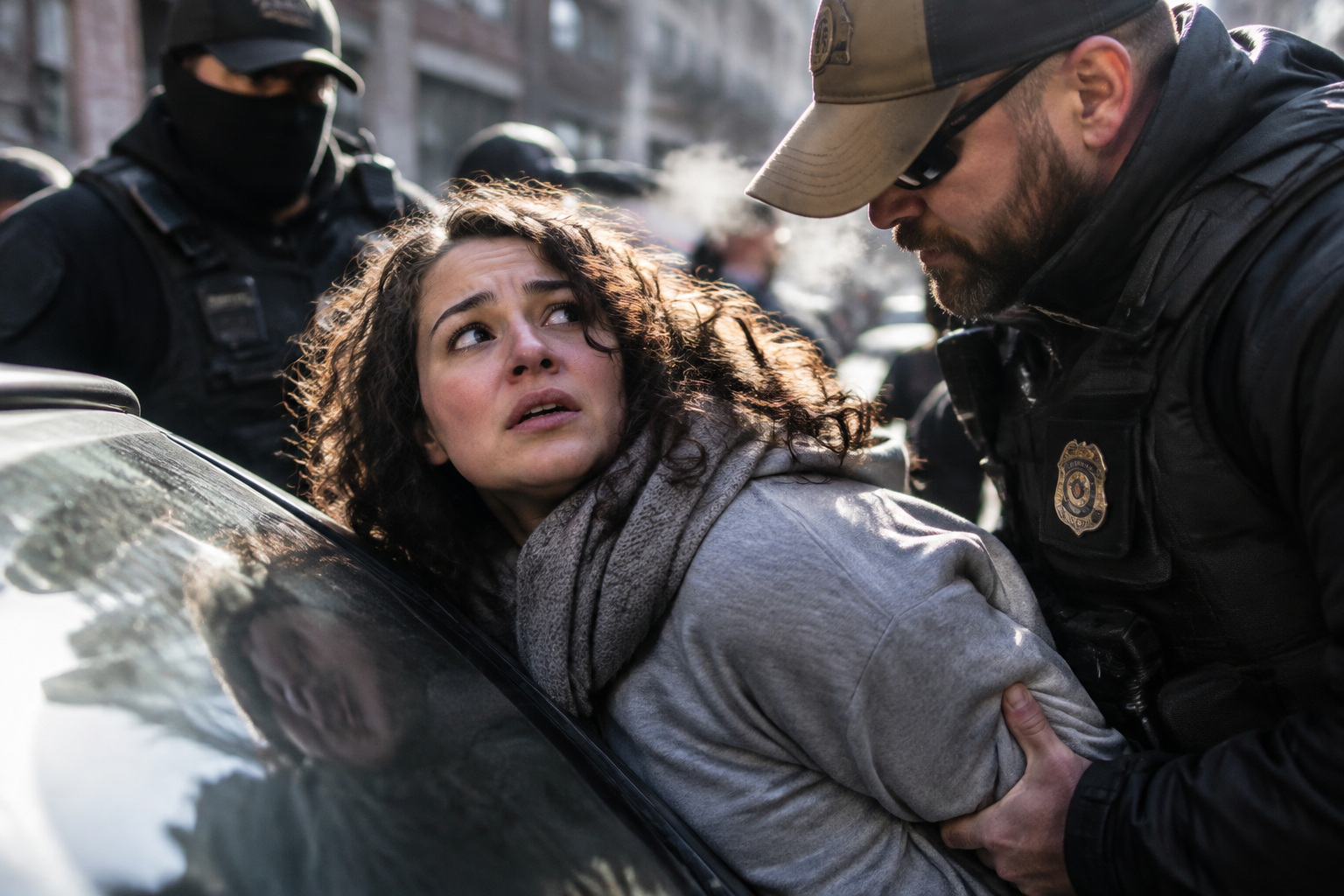
The most revealing moment in this 60 Minutes investigation comes when ICE official Marcos Charles is asked how agents can justify questioning American citizens during immigration operations. His answer should have prompted a much harder investigation. Instead, the programme moves on without establishing the legal boundary between asking questions, detaining someone and arresting them.
That distinction is not technical trivia. It is the difference between an officer asking a person for information and the government compelling that person to submit to an investigation.
The legal distinction Charles was never forced to explain
Charles says ICE officers are authorised to approach anyone they encounter while travelling towards an enforcement target and establish their citizenship. The interviewer challenges him, but never asks the most important question: Can the person refuse and walk away?
Federal regulation 8 CFR §287.8(b) makes the distinction explicit. Immigration officers may question anyone, provided they do not restrain that person's freedom to leave. Brief detention requires reasonable suspicion, based on specific articulable facts, that the individual is committing an offence or is unlawfully present.
LII / Legal Information Institute
The Supreme Court reinforced the constitutional boundary in INS v. Delgado (1984): questioning someone about citizenship does not automatically constitute a seizure, but circumstances that make a reasonable person believe they cannot leave can turn questioning into detention.
LII / Legal Information Institute
Charles's explanation therefore answers only half the question. ICE can initiate conversations; that does not give agents unlimited authority to stop people, demand identification or detain anyone who happens to be nearby.
60 Minutes had the regulation available to investigate. It did not put that distinction to the official responsible for the operation.
A federal judge later examined the exact answer
On March 9, 2026, US District Judge Eric Tostrud issued a 111-page opinion in Hussen v. Mullin, examining allegations that federal agents had unlawfully stopped people during Operation Metro Surge.
The opinion quoted Charles's explanation that agents could question anyone encountered near an enforcement target. The judge specifically concluded that Charles's comments did not answer whether ICE maintained a policy of conducting investigative stops without reasonable suspicion.
Justia Dockets & Filings
The judge went considerably further. He found that plaintiffs had made a clear showing that federal authorities had adopted a policy authorising immigration stops based on race or ethnicity without reasonable suspicion. Approximately two dozen people had been stopped without reasonable suspicion between mid-December 2025 and mid-January 2026.
Justia Dockets & Filings
The accounts included Somali and Hispanic residents being stopped while similarly situated white people nearby were not. Agents frequently requested identification without explaining the reason for the stop and sometimes without identifying themselves. The government presented testimony that officers were trained not to rely solely on race, but the judge found that this did not explain the specific encounters documented in court.
There was another particularly damaging finding: ICE acknowledged that it had no policy requiring officers to document investigative stops. The government consequently could not produce specific justifications for most of the encounters under examination.
Justia Dockets & Filings
This is the documentary evidence the broadcast needed to pursue. An agency cannot convincingly demonstrate that its street encounters are properly targeted if it cannot produce a systematic record of why people were stopped.
There is an important qualification. Judge Tostrud denied the plaintiffs' preliminary injunction because they had not demonstrated a sufficiently imminent risk of being stopped again. He did not issue a final judgment after trial. Nevertheless, he expressly concluded that the plaintiffs were likely to succeed on the merits of their Fourth Amendment claims if they established standing.
Justia Dockets & Filings+1
"Targeted enforcement" became a label, not a demonstrated fact
The distinction matters because ICE's own arrest records later offered a more complicated picture.
An April investigation by the Minnesota Reformer examined ICE data obtained through a Freedom of Information Act request. Approximately 1,300 of 3,785 recorded arrests during Operation Metro Surge were classified by ICE as collateral arrests: people who were not the intended targets of the operation. That was approximately 35%, compared with 19% of recorded arrests in Minnesota during the preceding September–November period. During the first two weeks of the surge, collateral arrests actually outnumbered targeted arrests.
Minnesota Reformer
This does not mean every collateral arrest was unlawful. Officers can encounter someone else who is independently subject to immigration enforcement. But it does mean that describing the operation simply as targeted enforcement conceals a substantial part of what happened.
There is another problem with the records. ICE refused to define its collateral classification and disputed the accuracy of the underlying dataset, despite having supplied the information. The Reformer identified an incident in which people who were not the intended targets were classified inconsistently. The data is valuable, but it is not a fully audited account.
Minnesota Reformer
The broadcast should have demanded the operational figures: targeted arrests, collateral arrests, citizenship checks, temporary detentions, arrests of American citizens and the legal grounds recorded for each category. Instead, viewers received an argument about what the word targeted meant.
American citizens were arrested in numbers the programme never established
In September, Axios obtained an August 18 letter from acting ICE director David Venturella to Representatives Ilhan Omar and Angie Craig.
ICE reported arresting 131 American citizens in Minnesota between January 8 and May 20 for alleged assaults on or interference with federal officers. Only 44 cases were accepted for federal prosecution. Of those, just 14 remained active as of May 20; the other 30 had been dismissed, resolved through pretrial diversion or declined.
Axios Twin Cities
These figures do not establish that all 131 arrests were unlawful, or that the individuals were arrested for immigration-status questioning. DHS maintained that its officers faced a coordinated campaign of violence. But the numbers make the absence of a detailed examination of citizen arrests in the broadcast harder to excuse.
The same ICE letter reported 4,674 noncitizen arrests, of whom 1,864 had criminal histories. That is approximately 40%. The agency did not provide a breakdown in this disclosure establishing that the remaining arrests involved violent offenders. Calling the operation a search for the worst offenders is not a substitute for showing who was actually arrested.
Axios Twin Cities
The Rahman footage needed an investigation, not just a reaction
Aliya Rahman was one of the strongest pieces of evidence in the broadcast. She was an American citizen with autism and a traumatic brain injury, trying to reach a medical appointment when federal agents pulled her from her vehicle. She was arrested and released without criminal charges.
MPR News+1
But the programme left the central dispute unresolved. Charles said she had ignored repeated warnings to move her vehicle. The contemporaneous MPR account also reported that she appeared to drive around a group of agents and observers occupying the street. That context deserved examination, not dismissal.
MPR News+1
In June, Rahman's lawyers filed a civil-rights complaint alleging excessive force, unlawful detention and failures to accommodate her disabilities. DHS rejected the allegation that she was denied medical care and maintained that she had obstructed officers by ignoring multiple commands. These remain competing accounts, not an adjudicated finding of misconduct.
MPR News+1
The obvious questions were never properly answered: What exactly was the lawful order? What federal offence justified the arrest? Was the instruction clear and audible? Why was she detained after identifying herself as disabled? Charles's assertion that an officer gave a warning did not establish that the subsequent arrest was lawful.
Federal immunity was another unanswered legal question
The programme also aired Stephen Miller's declaration that ICE agents had federal immunity while performing their duties. Charles declined to explain it, and the programme moved on.
That claim needed correction. The Supreme Court's decision in In re Neagle establishes a limited protection against state prosecution for federal officers acting under federal authority and doing what is necessary and proper to perform their duties. It does not create blanket immunity for everything an officer does while on duty. Courts must examine the circumstances and the conduct in question.
Justia U.S. Supreme Court Center+1
Miller's statement was therefore not a satisfactory description of the law. 60 Minutes asked whether agents could act without consequences but never explained the actual legal test. That omission matters when the same programme is reporting allegations of excessive force and excluded state investigators.
The missing records are the story
There is a further problem with the programme's treatment of citizenship checks. Federal regulations permit immigration officers to ask questions without particularized suspicion in certain public settings, provided the encounter remains voluntary. They cannot turn that permission into an involuntary detention without reasonable suspicion based on specific articulable facts.
eCFR
The distinction is fundamental. A citizen does not lose constitutional protection simply because an immigration officer wants to establish their identity.
A 2021 Government Accountability Office investigation had already identified weaknesses in ICE's tracking of encounters involving potential American citizens. ICE subsequently implemented recommended improvements to its citizenship-recording procedures, but the later Minnesota court proceedings exposed a separate failure: the absence of a policy requiring documentation of investigative stops.
The government cannot demonstrate that its officers consistently respected constitutional limits when it cannot produce the basic records needed to examine those encounters.
U.S. GAO+1
The verdict: an important interview without the necessary investigation
I am not arguing that every ICE encounter was unlawful, that every person detained was innocent, or that officers had no authority to question people.
The programme itself raised serious questions. It showed disturbing footage, challenged Charles about the geographical scope of enforcement and confronted him with the treatment of an American citizen.
But it repeatedly stopped where the investigation should have begun.
Charles was asked to explain ICE's authority. He offered a broad interpretation. He was asked about accountability. He declined to explain the immunity claim. He defended an arrest by referring to a lawful instruction without establishing the legal basis for that instruction.
The programme never obtained the operational directives, systematic stop records or arrest-level justifications needed to test those explanations.
A federal judge subsequently examined precisely this territory and found strong evidence of unconstitutional enforcement policies, while denying preliminary relief on standing grounds. Later ICE disclosures and FOIA records supplied numbers that the original interview never established.
60 Minutes showed Americans what federal immigration power looked like on the streets of Minneapolis. It did not adequately investigate the legal limits governing that power.
That is its central failure. An interview with the official responsible for an operation is not an investigation of the operation. And an official's confidence is no substitute for documentary evidence.
References
1. Minneapolis' police chief fears possible "moment where it all explodes" as ICE operation continues — CBS News, January 18, 2026. The original investigation and transcript, establishing exactly what Cecilia Vega asked and what Marcos Charles answered.
2. 8 CFR §287.8 — Standards for enforcement activities — Electronic Code of Federal Regulations, current October 29, 2026. Establishes the distinction between voluntary questioning, investigative detention and arrest.
3. INS v. Delgado, 466 U.S. 210 — US Supreme Court, April 17, 1984. Establishes when immigration questioning becomes a Fourth Amendment seizure.
4. Hussen et al. v. Noem et al., Findings of Fact and Conclusions of Law — US District Court, District of Minnesota, March 9, 2026. Contains the judge's findings on racial profiling, suspicionless stops, missing documentation and the legal significance of Charles's own statements; also explains why preliminary relief was denied.
5. ICE labeled 1,300 arrests during Operation Metro Surge as 'collateral' — Minnesota Reformer, April 8, 2026. Analyses ICE's FOIA-released arrest classifications and documents the limitations and inconsistencies in its collateral-arrest data.
6. ICE reports arresting more U.S. citizens during Metro Surge — Axios, September 3, 2026. Reports ICE acting director David Venturella's figures on citizen arrests, prosecution outcomes and noncitizen arrests.
7. Woman dragged by ICE agents into unmarked car — MPR News, January 13, 2026. Provides contemporaneous eyewitness reporting on Aliya Rahman's arrest and the circumstances surrounding the encounter.
8. Woman ICE pulled from car in Minneapolis files civil rights complaint — CBS Minnesota, June 23, 2026. Documents Rahman's subsequent complaint and DHS's response, distinguishing allegations from the agency's account.
9. Are Federal Officials Immune From State Prosecution? — Lawfare, November 6, 2025. Explains why federal officers do not enjoy blanket immunity from state criminal prosecution.
10. In re Neagle, 135 U.S. 1 — US Supreme Court, April 14, 1890. Establishes the limited constitutional protection for federal officers acting within their authorised duties.