Reza Pahlavi Has Support. But Who Gave Him the Right to Lead Iran?
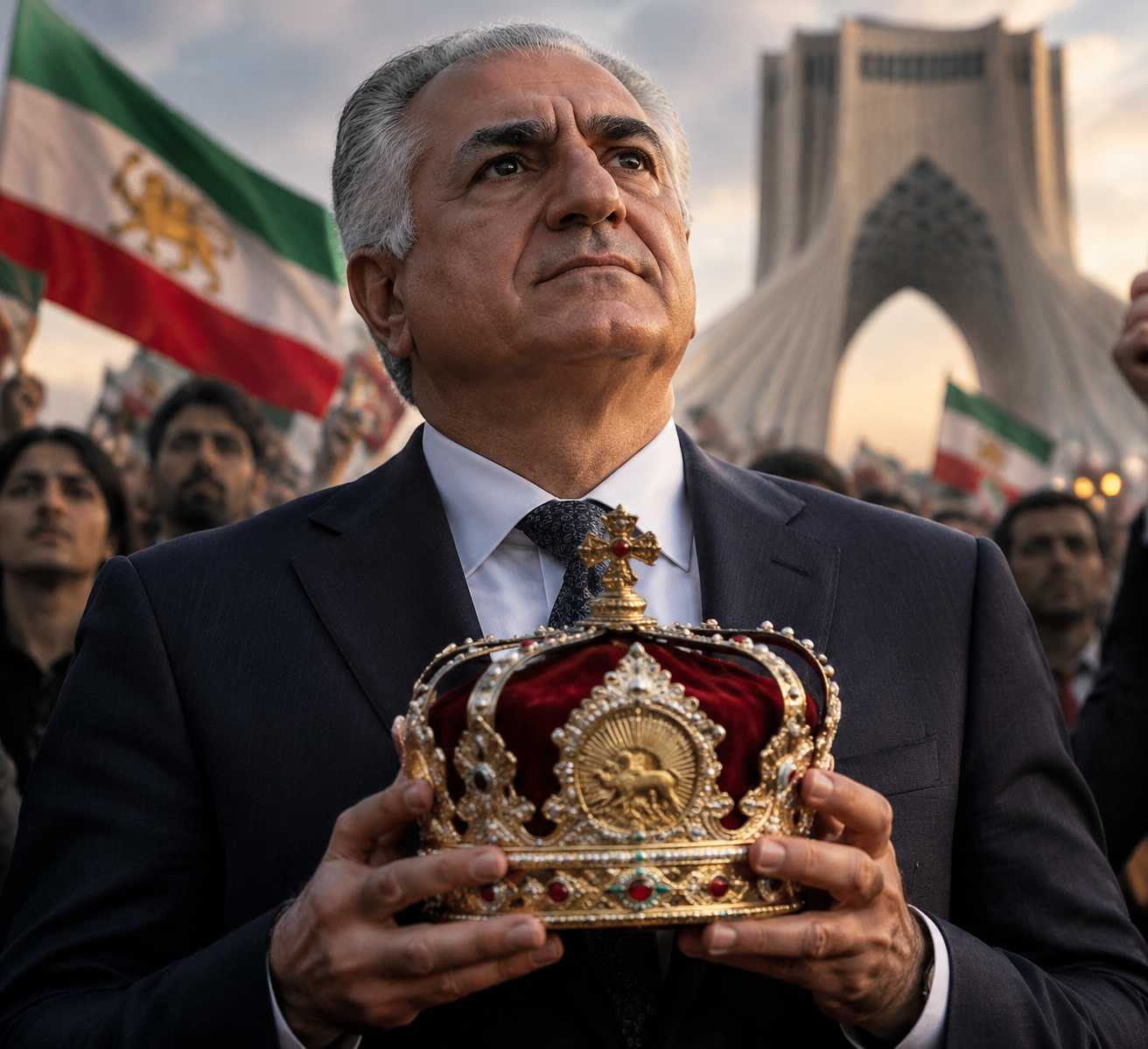
Reza Pahlavi may be Iran's most recognizable opposition figure. That does not make him the country's chosen leader. In its interview with the exiled son of Iran's last shah, 60 Minutes gives considerable space to his ambitions, his proposed democratic transition and his claims of support inside Iran, but fails to establish the crucial distinction between being a popular opposition figure and possessing a legitimate mandate to govern.
The distinction matters. GAMAAN's 2024 survey found Pahlavi was the most popular named opposition figure, selected by approximately 31% of respondents as a first or second choice. That is meaningful support, not an electoral mandate. The same survey found approximately 26% preferred a secular republic and 21% a monarchy. Wanting the Islamic Republic gone, supporting Pahlavi personally and wanting the restoration of a monarchy are three different political positions. GAMAAN's 2024 survey.
His popularity is real. His mandate is not.
The evidence does not support dismissing Pahlavi as an irrelevant exile. It also does not support treating his popularity as permission to govern.
A more recent GAMAAN survey conducted inside Iran between June 20 and 27, 2026, included 31,450 weighted respondents. Its findings are revealing:
- 45% reported consistently positive views of Pahlavi.
- 28% reported consistently negative views.
- 34% preferred some form of monarchy.
- 28% preferred a republic.
- 13% preferred the Islamic Republic.
- Approximately one-quarter either lacked sufficient information or had no particular preference.
Even monarchist slogans were divisive. The slogan "Long live the Shah" received 54% agreement and 31% disagreement. "Pahlavi will return" received 50% agreement and 34% disagreement. GAMAAN's findings.
Gamaan+1
There is another important distinction. Among January's protesters, 55% cited Pahlavi's call as one reason for participating. But 71% cited dissatisfaction with the Islamic Republic and 62% cited inflation, high prices and corruption.
He helped mobilize the opposition. He did not create all its grievances, and participation in his demonstrations was not a vote to make him head of state.
GAMAAN uses online recruitment, VPN partnerships and demographic weighting because conventional polling in Iran is compromised by state repression and self-censorship. Its findings are valuable, but they are not an election or a conventional probability sample.
Gamaan+1
His own transition plan gives him extraordinary power
This is where the interview becomes particularly inadequate.
Pahlavi tells Scott Pelley:
"They trust me as a transitional leader."
He insists he does not want to become king or president. He says his mission is simply to bring Iran to the point where its people can choose their future.
That sounds reassuring. But his own Iran Prosperity Project provides a much more consequential picture.
The project's February 2026 Emergency Phase Booklet contains 14 policy papers covering Iran's proposed political, military, economic and institutional transition.
Its political framework establishes Pahlavi as the Leader of the National Uprising, with substantial authority over the transitional government.
Under the published proposal:
- Pahlavi establishes the National Uprising Council and a Temporary Executive Team.
- Both operate under his leadership, and their members' names are released at his discretion.
- He appoints the members of the initial Transitional Mehestan, the legislative branch.
- He appoints and removes the heads of the transitional government and judiciary after consulting the Mehestan.
- He serves as Commander-in-Chief of the armed forces.
- He appoints senior military commanders.
Even the initial legislature's membership and size are subject to his authority. Its members can vote to change their composition, but those changes require his approval.
Iran Prosperity Project+2
There are genuine democratic provisions in this blueprint, and they deserve acknowledgment.
It proposes:
- A referendum within four months to choose between a parliamentary monarchy and a republic.
- Equal access for supporters of both systems during the campaign.
- An elected Constituent Assembly.
- A referendum on the new constitution.
- Elections and the eventual transfer of power to an elected government.
The proposed transition is expected to last 18–24 months, with restrictions on extensions.
Iran Prosperity Project+2
But here is the problem.
The democratic choice comes after Pahlavi has already been given control over the transitional legislature, military command and appointments to the executive and judiciary.
The published framework does not establish a popular process for selecting or recalling him during this initial period.
The proposed referendum is important, but it does not answer who authorizes the person exercising power before that referendum.
There is another unanswered question. If Iranians choose a monarchy, the blueprint provides for a coronation within two weeks of approval of the constitution. It does not identify the monarch. Pahlavi told 60 Minutes he would not be the future king.
Who, then, would be crowned? The interviewer never asked.
The legal framework goes further. It says replacement laws and institutions will be drawn from the Pahlavi Imperial era, with modifications where necessary. It also proposes restoring the Lion and Sun flag and replacing the Islamic Republic's national anthem.
The proposal is not simply a neutral administrative arrangement while citizens decide their future. It gives the former dynasty's legal and symbolic inheritance a prominent place before that decision is made.
Iran Prosperity Project+2
I am not claiming that this blueprint proves Pahlavi intends to establish another dictatorship. I am saying that someone asking to exercise this much unelected authority must explain precisely how that authority will be restrained.
60 Minutes never put that question to him.
The opposition he claims to unite has already fractured
Pahlavi's political challenge is not simply winning over supporters of the Islamic Republic's removal. He must persuade people with fundamentally different ideas about what should replace it.
His previous attempt at coalition-building is instructive.
In 2023, prominent Iranian opposition figures, including Pahlavi, formed a coalition committed to establishing a secular, democratic Iran. It brought together people from different political traditions, including activists and human rights figures.
Less than two months later, it had collapsed.
The Washington Post reported that disagreements over membership, a lack of strategic organization and strong opposition from much of Pahlavi's own support base contributed to its failure. Pahlavi's adviser Saeed Ghasseminejad disputed the suggestion that Pahlavi himself was responsible.
The Washington Post
This is not an insignificant historical detail.
A transition requires cooperation among people who disagree about monarchy, republicanism, political decentralization, ethnic rights and the future distribution of power.
Pahlavi's territorial-integrity principle does not resolve those disagreements.
The problem is particularly visible among Iran's ethnic minorities.
The Washington Post reported that Pahlavi's support is lower in Kurdish, Azeri and Baluch regions. Kurdish political leader Abdullah Mohtadi said Pahlavi had not, to his knowledge, initiated dialogue with Kurdish groups. Baluch activist Fariba Baloch questioned his failure to provide a concrete plan for minority rights and political participation.
Pahlavi's adviser rejected these criticisms, arguing that his approach was inclusive. That disagreement itself demonstrates why independent scrutiny matters.
The Washington Post
GAMAAN's 2024 survey provides further detail. Support for Pahlavi was approximately 15% in Kurdistan, 17% in West Azerbaijan and 20% in East Azerbaijan. Support for federal political arrangements was particularly strong in several ethnic minority regions.
Gamaan
A leader promising national unity must explain how the country's competing political and regional interests will be accommodated.
An appeal to territorial integrity is not a substitute for answering that question.
The military defections remain unverified
One of Pahlavi's most consequential claims is that elements of Iran's military and police have already signalled their willingness to abandon the government.
This matters enormously. A political transition cannot succeed merely because an opposition figure is popular. It must establish control over armed forces, security institutions and the machinery of government.
Yet the interview provides no independently verifiable details about the units involved, their commanders, their numbers or the extent of their commitments.
Pahlavi's own transition blueprint confirms how central this strategy is.
It identifies maximum defections as one of five strategic priorities. Its military planning describes defectors and revolutionary cells as important to maintaining order after the regime falls.
It also proposes a National Defection and Cooperation Platform, involving secure communications, identity verification and registration of people seeking to cooperate with the transition.
Iran Prosperity Project+1
This is a substantial operational proposal. But a mechanism for recruiting and verifying defectors is not evidence that the claimed military units have already committed themselves.
Pahlavi need not expose endangered officers publicly. Independent verification could protect their identities while establishing whether the claims are credible.
The interview does not attempt that verification.
Instead, the audience receives an extraordinary claim about the potential loyalty of Iran's armed forces without the evidence needed to evaluate it.
His support for Trump's intervention is not a national consensus
Pahlavi praises President Trump for intervening militarily against Iran.
He says he is speaking on behalf of millions of compatriots who thank the American president, and predicts Trump will become one of the most celebrated foreign leaders in Iranian history.
That is an extraordinary political endorsement.
But a subsequent GAMAAN survey conducted inside Iran found a divided population.
Approximately 42% regarded the US-Israeli military operation as aggression against Iran. Around 40% considered it humanitarian intervention, while approximately 48% disagreed with that characterization.
Public attitudes toward Trump were almost evenly divided: 44% positive and 44% negative.
The survey also found that 38% consistently supported foreign military intervention as a means of changing Iran's political system, while 27% consistently opposed it. More respondents moved from support to opposition than from opposition to support following the war.
Gamaan+1
These figures do not establish that Pahlavi lacks millions of supporters. Nor do they measure the Iranian diaspora.
They establish something narrower but important: his support for American military intervention cannot automatically be presented as the position of the Iranian population.
Pahlavi may be a prominent opposition figure. He may have played an important role in mobilizing protesters. Neither fact gives him permission to speak for everyone affected by the war.
Pelley did challenge him about Trump's reservations concerning his domestic acceptance. He should also have asked whether the Iranian people he claims to represent actually share his enthusiasm for American military intervention.
His father's departure does not settle his father's record
Pelley asks a legitimate question about the former shah's repression and wealth.
Pahlavi responds that his father voluntarily left Iran to avoid bloodshed, quoting him as saying a king should not build his throne on the blood of his people.
But that answer addresses the final departure, not the preceding decades.
Amnesty International's historical documentation describes severe restrictions on political expression under Mohammad Reza Shah, arbitrary arrests by SAVAK, systematic torture, unfair military trials and the execution of more than 300 people following unfair trials between 1972 and 1976.
Amnesty also records that the shah introduced human rights reforms during his final two years, reducing torture, political imprisonment and executions. Nevertheless, political repression, corruption and inequality persisted.
Amnesty International+1
The shah left Iran on January 16, 1979. That historical fact does not erase what happened under his government.
Pahlavi is not personally responsible for his father's crimes. But he is responsible for explaining what his movement intends to do about that history.
His own transition blueprint proposes a transitional justice programme addressing serious human rights violations and abuses by Islamic Republic officials and their affiliates.
It does not specify a comparable process for investigating abuses committed under the Pahlavi monarchy.
That is a significant omission, particularly when the same blueprint proposes drawing replacement laws and institutions from the imperial era.
A movement cannot selectively invoke its family's institutional legacy while leaving its family's historical record outside the conversation.
The question is not whether Pahlavi should inherit guilt. It is whether he is prepared to apply the same standards of accountability to his own political inheritance that he promises to apply to the Islamic Republic.
Even the massacre figure needed proper attribution
The broadcast states that the January crackdown killed an estimated 20,000 citizens.
That figure is not without supporting evidence. A UK Home Office country bulletin updated October 21, 2026 records estimates ranging from approximately 12,000 to 20,000 deaths by mid-January.
However, the same bulletin reports that HRANA had confirmed 6,221 deaths by January 28, with another 17,091 under investigation.
GOV.UK
There is a difference between a high-end estimate and a confirmed death toll.
CBS does describe the figure as an estimate, but does not identify its source or explain the uncertainty. On a subject this consequential, that distinction deserves more than a passing sentence.
The massacre should not be understated. Its numbers should be properly explained.
The verdict: A democratic promise is not a democratic mandate
Reza Pahlavi has genuine political support. His call helped mobilize protesters, his opposition to the Islamic Republic is clear, and his project contains a substantial programme for rebuilding Iran.
Those facts deserve recognition.
But they do not establish that he has the authority to lead a national transition.
The interview allows three different things to become blurred: popular opposition to the Islamic Republic, support for Pahlavi personally, and consent to the extraordinary powers his proposed transitional government would give him.
They are not interchangeable.
His political coalition has fractured before. His support is uneven across Iran's regions. His claimed military contacts remain unverified. His enthusiasm for foreign intervention is not shared universally. His proposed transitional government gives him substantial authority before citizens exercise their democratic choice.
And the historical record of his father's monarchy remains insufficiently addressed.
I do not need to predict that Pahlavi would become another authoritarian ruler. The evidence does not establish that.
I do need to ask why a man promising democracy should begin his proposed transition by appointing the legislature, commanding the armed forces and controlling appointments to the highest executive and judicial offices.
The purpose of democracy is not to find a sufficiently reassuring individual and trust him with power.
It is to build institutions in which nobody is above accountability.
60 Minutes found an important opposition figure and gave him a platform to explain his ambitions. It did not establish that he has the mandate, coalition or safeguards necessary to deliver the future he promises.
For a country that has already experienced the consequences of concentrated political power, that is not a minor omission.
It is the central question.
References
1. Iran's Prince Reza Pahlavi says "this is our chance" after Khamenei's death — CBS News, March 1, 2026. The original interview establishes Pahlavi's claims, his answers about his father and his proposed leadership.
2. Analytical Report on Iranians' Political Preferences in 2024 — GAMAAN, August 20, 2025. Provides political preferences, Pahlavi's popularity and regional differences.
3. Iranians' Attitudes Toward the 2026 Protests and War — GAMAAN, July 27, 2026. A weighted survey of 31,450 respondents inside Iran examining Pahlavi's popularity, protest participation, political preferences and attitudes toward foreign intervention.
4. GAMAAN's Methodology — GAMAAN. Explains its online recruitment, VPN partnerships, sampling limitations and demographic weighting.
5. Emergency Phase Booklet — Iran Prosperity Project — Iran Prosperity Project, February 2026. The primary document establishing Pahlavi's proposed transitional powers, military strategy, legal framework, referendum process and institutional arrangements.
6. Iran's opposition is battling to oust regime but hobbled by divisions — The Washington Post, January 14, 2026. Documents the collapse of the 2023 opposition coalition and disagreements involving ethnic minorities and competing political movements.
7. Blood-soaked secrets: Why Iran's 1988 prison massacres are ongoing crimes against humanity — Amnesty International, 2018. Its historical section documents human rights violations under Mohammad Reza Shah, including SAVAK repression, torture and executions.
8. Country bulletin Iran: protests of December 2025 to January 2026 — UK Home Office, updated October 21, 2026. Provides the death-toll estimates and distinguishes confirmed deaths from cases still under investigation.