60 Minutes Let Waymo Call Itself “Five Times Safer” Without Explaining the Evidence
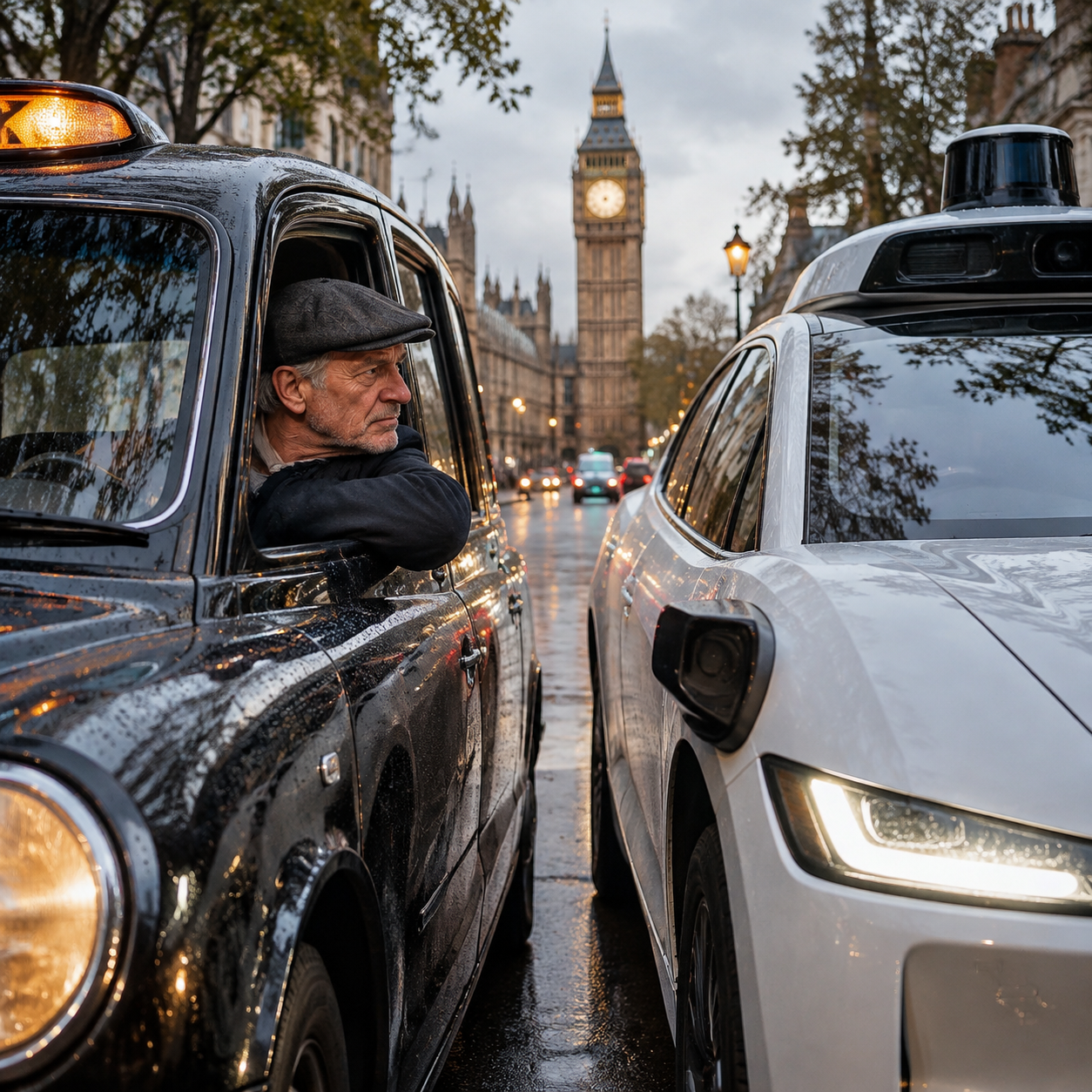
There is a difference between reporting that a technology company claims to be safer and establishing that it is safer. In its May 17, 2026 report on London's black-cab drivers, 60 Minutes blurred that distinction.
Waymo co-CEO Tekedra Mawakana tells Anderson Cooper that her company's driverless vehicles are five times safer than human drivers. The programme presents sophisticated sensors, millions of miles of driving experience and impressive demonstrations. It also shows vehicles making mistakes, including passing stopped school buses and entering an active police scene.
But the central question is never properly examined: What exactly does five times safer mean, who calculated it, and how much confidence should the public place in that comparison?
I am not arguing that Waymo's technology is demonstrably less safe than human driving. The available research actually points in the opposite direction. I am arguing that 60 Minutes presented a corporate safety claim without giving viewers the information necessary to judge it, then used dramatic footage without consistently supplying the context.
That is not enough for a programme presenting itself as serious investigative journalism.
Five times safer is not the same as five times safer in every respect
Mawakana's claim has a genuine research basis. A 2024 peer-reviewed study examined 7.14 million miles of Waymo's driverless operation in Phoenix, San Francisco and Los Angeles.
It found 0.6 injury-reported crashes per million miles for Waymo, compared with 2.80 for the human-driving benchmark. That is where the fivefold comparison comes from: the human benchmark had approximately five times the injury-reported crash rate.
But the same study produced a considerably different result when examining police-reported crashes. Waymo recorded 2.1 crashed vehicles per million miles, compared with 4.68 for human drivers. That is approximately 2.2 times the rate, not five times.
The researchers also acknowledged that their broader comparison involving property damage or injury produced inconclusive results because of difficulties establishing a comparable human benchmark.
PubMed
These distinctions matter enormously.
A reduction in injury-reported crashes is valuable. It does not automatically establish that a vehicle is five times safer across every conceivable measure of road safety. Nor does it establish a fivefold reduction in fatalities.
Yet the programme gives viewers the broader statement without explaining the narrower statistical result.
The research itself deserved attention. Instead, the audience received the headline number.
The research is stronger than the programme suggests, but its authors matter
There was an opportunity to investigate this properly.
On May 16, 2025, exactly one year before the broadcast, a substantially larger Waymo safety study was published online in Traffic Injury Prevention.
It examined 56.7 million driverless miles through January 2025. The researchers found statistically significant reductions in injury-reported crashes, airbag deployments and crashes involving suspected serious injury or worse. They also examined 11 different crash categories.
PubMed
This is meaningful evidence. It would be dishonest to dismiss it simply because Waymo benefits from the findings.
But there is an important qualification: all six authors were affiliated with Waymo LLC.
The research was peer-reviewed, which matters. It was not simply an advertising brochure. Nevertheless, research conducted by a company's own employees is not the same as an independent evaluation of its safety performance.
The programme could have explained this distinction in seconds. It could have asked Mawakana to identify the study, explain its limitations and distinguish company research from independent verification.
It did none of those things.
Independent research supports Waymo, but exposes the limits of the comparison
An independent assessment subsequently became available.
On July 23, 2026, the Insurance Institute for Highway Safety (IIHS) published research comparing Waymo's driverless vehicles with human drivers using federal crash records.
The researchers examined approximately 50 million driverless miles and identified 64 police-reportable crashes involving Waymo vehicles operating without a driver.
Their findings were encouraging for Waymo:
- Overall police-reportable crash involvement was 68% lower than the human benchmark.
- Injury crashes per vehicle mile were 81% lower.
- However, Austin recorded a 4% higher crash involvement rate, with a relatively small sample.
IIHS Crash Testing
This study appeared after the 60 Minutes broadcast, so its absence from the original programme is not a fair criticism. It is, however, an important independent test of the argument presented to viewers.
It broadly supports the conclusion that Waymo currently performs better than human drivers on several measurable safety outcomes.
But the IIHS also identified a serious problem with the underlying reporting system.
Autonomous vehicle companies historically had to report relatively minor collisions, while human drivers generally report crashes meeting particular injury or property-damage thresholds. Human crashes are also frequently never reported to police.
The IIHS had to remove duplicate records, exclude irrelevant incidents and determine which autonomous-vehicle crashes would reasonably have been reported by a human driver.
It concluded that federal data collection was not yet adequate for continuously monitoring safety as autonomous vehicles expand.
IIHS Crash Testing+1
That is the qualification missing from the television report.
The evidence supports a promising safety advantage. It does not justify treating a single company-generated comparison as a universal verdict.
The school-bus problem was considerably more specific than the broadcast explained
The programme mentions autonomous vehicles passing stopped school buses, a software recall and a federal investigation.
That is accurate. But the underlying documents contain details worth knowing.
On December 10, 2025, Waymo submitted a safety recall covering 3,067 vehicles equipped with its fifth-generation automated driving system.
The software could cause a vehicle to resume driving while a school bus still displayed flashing red lights or had its stop arm extended.
Waymo explained that the system could incorrectly conclude it was obstructing a priority vehicle and decide to move forward when it should have remained stationary.
The company deployed updated software to affected vehicles between November 5 and November 17, 2025.
Its recall report recorded 12 related citations and stated that no collisions had occurred as a result of the behaviour.
NHTSA+1
Those details change the discussion. This was not merely an occasional awkward encounter with a bus. It was a recognized software problem serious enough to trigger a formal recall.
But the subsequent chronology is even more revealing.
A remote human operator gave the wrong answer, and the vehicle moved
On January 12, 2026, a Waymo vehicle in Austin approached a stopped school bus displaying flashing red lights and extended stop arms.
The vehicle initially stopped.
It then contacted a remote assistance agent in Novi, Michigan, asking:
"is this a school bus with active signals?"
The agent replied:
"No"
The vehicle resumed driving and passed the school bus while its stop arms remained extended.
The National Transportation Safety Board documented the incident in an investigation released on March 3, 2026. It also reported multiple similar incidents involving Austin school buses, including a January 14 incident involving a special-needs school route. No collision occurred in the January 12 incident.
NTSB
This raises a question the television report never explored.
Waymo describes its technology as an extraordinarily experienced artificial driver. But its autonomous operation also relies on remote human assistance to interpret unusual situations.
That is not necessarily a flaw. Human assistance can be an important safety feature.
However, when a vehicle asks a human whether a school bus has active signals and receives the wrong answer, the relationship between artificial intelligence and human supervision becomes a safety issue in its own right.
This incident occurred after the November software update. It does not establish that the recalled defect remained unresolved; the NTSB investigation must determine the circumstances. But it demonstrates that the safety question cannot be reduced to the quality of the vehicle's sensors.
The human support system matters too.
A nine-year-old was struck near a school
There was another significant development before the 60 Minutes broadcast.
On January 23, 2026, a driverless Waymo vehicle struck a nine-year-old student pedestrian in a school zone in Santa Monica, California.
According to the NTSB's preliminary account, the vehicle was travelling at 17 mph when the child emerged between queued vehicles and entered the roadway. The vehicle braked but collided with the child near its front-right headlight.
The child sustained minor injuries and did not require medical transportation.
The vehicle was operating without a human safety operator. A remote assistance agent subsequently contacted emergency services.
The NTSB opened an investigation, while NHTSA separately examined whether the vehicle exercised appropriate caution around an elementary school during morning drop-off hours, including its speed and treatment of vulnerable pedestrians.
NTSB+1
There is no final finding of fault in these preliminary records. The circumstances matter: the child entered the road rapidly between vehicles, creating a difficult situation for any driver.
But that is precisely why this incident deserved attention.
A system's ability to recognize an unexpected pedestrian is not an abstract technical demonstration. It is a question of whether a child gets home safely.
The incident occurred almost four months before the programme aired. The NTSB had published its preliminary account on March 3.
Yet the transcript contains no mention of it.
Instead, viewers are shown demonstrations of sensor capabilities and a woman crossing in front of a Waymo vehicle, where the AI responds impressively.
One demonstration shows what the system can do. The other incident shows why the remaining questions matter.
Both belong in an honest examination of autonomous driving.
The police-scene footage needed more context
The programme also shows a Waymo vehicle driving through an active police scene in Los Angeles.
The footage is genuine. The circumstances, however, are more complicated than the presentation suggests.
According to ABC7's December 3, 2025 reporting, the vehicle encountered a street blocked by police vehicles before turning into an area that had not been closed to other traffic. Other vehicles were travelling through that area.
The Los Angeles Police Department said the incident did not affect police tactics. Waymo stated that the vehicle was in the vicinity of the incident for no more than 15 seconds.
ABC7 Los Angeles
This does not establish that the vehicle made an appropriate decision.
It does establish that the footage alone cannot prove that it interfered with the police operation.
The distinction matters because the programme uses the scene to illustrate autonomous vehicles making rookie mistakes. It then moves into discussion of emergency responders being obstructed.
Those are not automatically the same event.
A vehicle entering an area where police are conducting an operation is a legitimate subject for scrutiny. A vehicle obstructing emergency responders is a different and potentially more serious allegation.
Journalism should distinguish them.
The threat to London's cabbies remains largely unmeasured
There is another weakness in the programme's framing.
Its headline presents autonomous taxis as a threat to London's black-cab drivers. Yet the vehicles were not approved to carry passengers in London at the time of the report.
Waymo and Wayve were testing their technology, and both hoped to begin operations later in the year.
The report also acknowledges that London's black-cab industry had already lost approximately 9,000 drivers over a decade, falling from 25,000 to 16,000. It attributes the decline and falling incomes to Uber and other ride-hailing companies.
That is an established competitive threat.
But the programme offers no meaningful estimate of the additional threat posed by autonomous taxis.
How many vehicles will be deployed? What will they charge? How much of the existing taxi market could they capture? What happens to licensed cab drivers if autonomous services become cheaper and more widely available?
None of these questions is answered.
The programme presents an impending technological confrontation without establishing its likely economic consequences.
The distinction is important. A technology being tested is not the same as a commercially viable competitor replacing an established workforce.
The final verdict: A compelling demonstration is not a safety investigation
I find the programme's central weakness in the way it handles evidence.
Waymo has substantial research supporting its safety claims. The 2025 peer-reviewed study found significant reductions across several important crash outcomes, and subsequent independent IIHS research also found substantially lower crash rates than human benchmarks.
That evidence deserves recognition.
But the company has also experienced documented failures involving school buses, remote human assistance and vulnerable pedestrians. Regulators have investigated these incidents, and some investigations remain unresolved.
The correct conclusion is neither that Waymo is dangerously inferior nor that its vehicles are five times safer in every meaningful sense.
It is that autonomous driving has demonstrated substantial safety potential while retaining specific operational weaknesses that must be independently examined.
60 Minutes had the opportunity to explain that distinction.
Instead, it gave viewers a corporate superlative, impressive technology demonstrations and a collection of alarming incidents without adequately connecting the statistical evidence to the operational failures.
It also left out two important 2026 incidents already documented by federal investigators.
The result is a story that creates an impression of technological inevitability without doing enough work to establish what the technology has actually proved.
Waymo does not need television journalists to advertise its ambitions. It needs independent scrutiny of its evidence. London's cabbies deserve more than a sentimental defence of tradition. Passengers deserve more than a promise that the machine is smarter than the person behind the wheel.
And the public deserves to know exactly what "five times safer" means before being asked to trust it.
References
1. Robotaxis coming to London pose a threat to traditional cabbies who memorize 25,000 streets to earn licenses — CBS News, May 17, 2026. The original report, including the five-times-safer claim and the programme's presentation of Waymo's operational failures.
2. Comparison of Waymo rider-only crash data to human benchmarks at 7.1 million miles — Traffic Injury Prevention, published November 1, 2024. Establishes the precise statistical basis for the fivefold injury-crash comparison and documents the limitations of broader crash comparisons.
3. Comparison of Waymo Rider-Only crash rates by crash type to human benchmarks at 56.7 million miles — Traffic Injury Prevention, published online May 16, 2025. Provides the larger, peer-reviewed Waymo-authored study available before the broadcast.
4. Waymo's driverless cars crash less often than people — Insurance Institute for Highway Safety, July 23, 2026. Provides an independent assessment of Waymo crash rates and explains the serious limitations of federal autonomous-vehicle crash reporting.
5. Part 573 Safety Recall Report 25E084 — National Highway Traffic Safety Administration, December 10, 2025. Documents the school-bus software defect, 3,067 affected vehicles, 12 citations and the absence of collisions associated with the recalled behaviour.
6. Automated Driving System-Equipped Vehicle Passed School Bus Loading Student Passengers — National Transportation Safety Board, March 3, 2026. Records the January Austin incident in which a remote assistance agent incorrectly identified a school bus's active signals.
7. Automated Driving System-Equipped Vehicle Collision with Student Pedestrian — National Transportation Safety Board, March 3, 2026. Provides the preliminary account of the January 23 collision involving a nine-year-old student and identifies the ongoing investigation.
8. Waymo AV striking a child in the area of a school — PE26001 — National Highway Traffic Safety Administration, January 28, 2026. Establishes the federal investigation into the vehicle's caution, school-zone behaviour and post-impact response.
9. Waymo self-driving taxi takes passenger through active police scene in downtown LA — ABC7 Los Angeles, December 3, 2025. Supplies the police department's account and the important qualification that the vehicle entered an area not closed to other traffic, without affecting police tactics.