Brightline's $21 Billion Problem: The Private Railway That Needs Washington to Pay
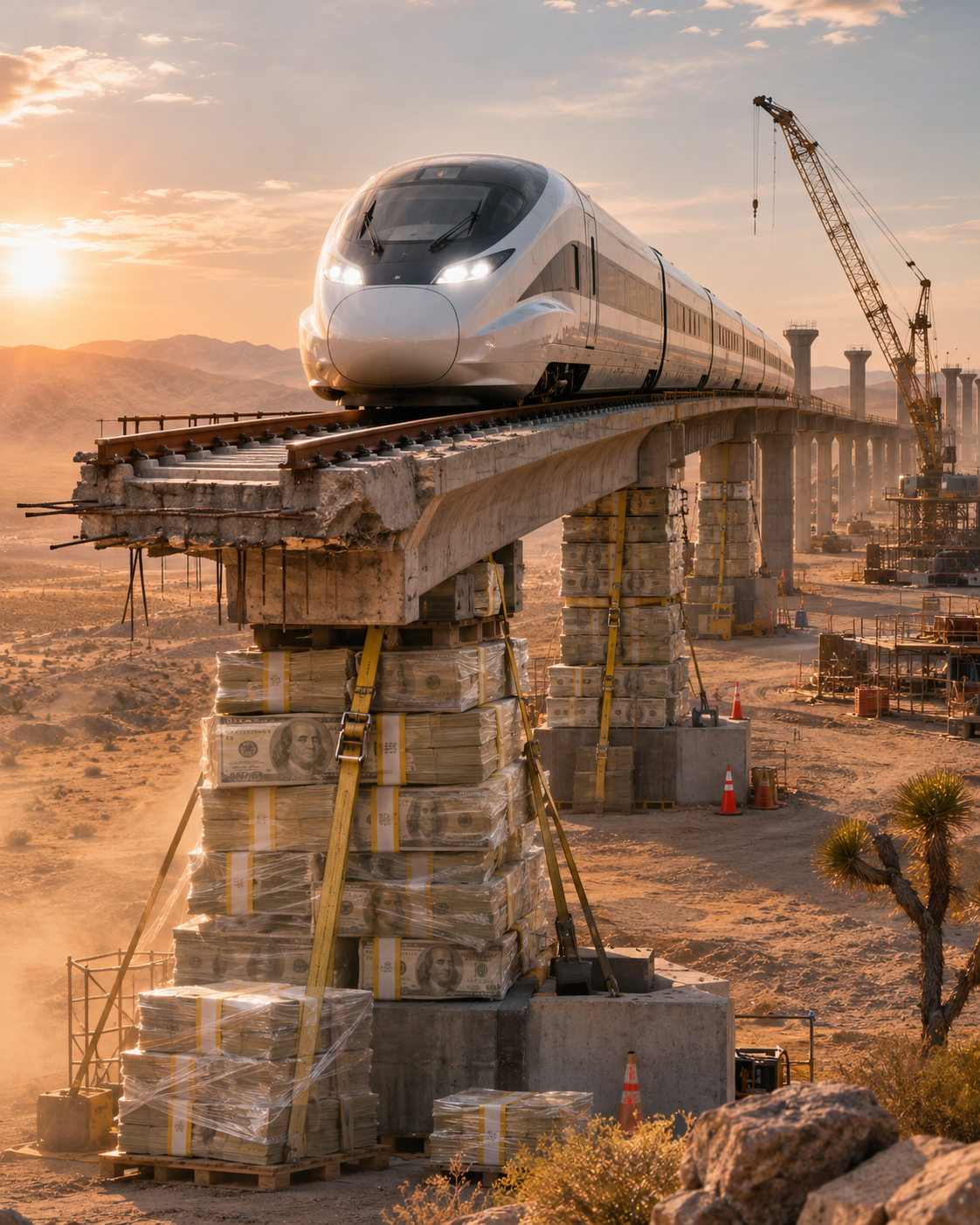
60 Minutes presents Brightline as the private-sector answer to California's high-speed rail disaster. That is an attractive story: government cannot build a railway on time or within budget, so private enterprise steps in and gets the job done. But the financial structure behind Brightline West makes that contrast considerably less convincing. The company has already received a $3 billion federal grant, raised $2.5 billion through publicly authorized tax-exempt bonds, and is seeking another $6 billion federal loan. Its projected construction cost has climbed from $12 billion to approximately $21 billion. This is not private enterprise replacing public investment. It is a private company asking taxpayers and public institutions to carry a substantial part of the financing risk.
US Department of Transportation+2
The public money missing from the private-sector story
The distinction matters. Brightline West's $2.5 billion in private activity bonds were issued through California and Nevada public authorities, using federal allocations. The bonds finance a private project, but they are not ordinary private equity. The federal government separately awarded the project a $3 billion grant in 2023. The proposed $6 billion loan is additional financing, not money already secured.
US Department of Transportation+3
The Nevada Independent reported that the project's estimated cost had risen from $12 billion to $16 billion and then $21 billion by September 2025. Even with the grant, bond proceeds and proposed federal loan, the project would still need approximately $9.5 billion from private investors. That is a far less reassuring picture than a private railway simply overcoming government incompetence.
The Nevada Independent
One qualification matters: the $2.5 billion in private-activity bonds is not a taxpayer guarantee. The Department of Transportation explains that these bonds are issued through public authorities but must be repaid by the private developer from project revenues; their tax-exempt status simply makes borrowing cheaper. The $3 billion grant, awarded to Nevada's transportation department, is genuine public funding, while the proposed $6 billion RRIF facility would be a repayable federal loan.
Build America+2
That distinction does not rescue the private-sector narrative. It makes the real question more interesting: can a private railway attract enough passengers and private capital to repay its enormous financing obligations, even with government assistance?
The $6 billion loan is not secured
The October 1, 2026 federal financing pipeline lists Brightline West under Complete Letters of Interest. Its $6 billion loan request and $21.05 billion project cost are recorded, but the formal application, approval and financial-close fields remain blank. The projected financial close is in the first quarter of fiscal 2027.
transportation.gov
This is not a bureaucratic formality. The federal RRIF programme requires a creditworthiness assessment examining the financing plan, projected revenue, collateral and the reasonable likelihood of repayment before an applicant is invited to submit a formal application.
Build America
The financial gap is substantial. The Nevada Independent reported approximately $5.5 billion in funding secured, against a $21 billion target; even if the $6 billion loan is approved, another $9.5 billion must come from private investors. The proposed federal loan would therefore unlock only part of the financing needed to finish the railway.
The Nevada Independent
And the private money is not arriving on schedule.
In November 2025, Brightline West announced a commitment to raise at least $400 million in equity by March 31, 2026. Of that amount, $250 million was earmarked to redeem bonds, leaving approximately $150 million to advance construction.
brightlinewest.com
The company missed the original deadline. Bondholders subsequently granted extensions, requiring an updated business plan and moving the latest reported deadline to November 2, 2026.
Bloomberg+2
This is important because investors are not simply waiting for a spectacular railway to emerge. They are demanding additional capital, revised financing arrangements and evidence that the project can be completed.
Construction has started, but the financing remains unfinished
I would not describe Brightline West as imaginary. Construction began in 2024, station work has taken place, and the company says environmental approvals, right-of-way and major construction agreements are secured.
But on October 27, 2026, Brightline West confirmed to FOX5 Las Vegas that it was still finalizing financing. Its own statement said that completing the financing would allow the project to move into full-scale construction. The company nevertheless maintains that service will begin in 2029.
https\://www.fox5vegas.com
A business owner near the Las Vegas station told FOX5 that construction activity had slowed and that the area was seeing fewer construction workers. A UNLV construction professor also questioned whether the project could proceed without the federal financing.
Brightline may still deliver the railway. But a groundbreaking, station structures and preliminary construction are not evidence that the complete financing package has closed.
The original target was to have the railway operating before the 2028 Los Angeles Olympics. That has moved to late 2029, while the project's cost has increased approximately 75% from the $12 billion estimate announced by the Transportation Department in January 2024 to the $21.05 billion figure in its October 2026 financing pipeline.
US Department of Transportation+1
The distinction between construction activity and financial completion is precisely what the 60 Minutes segment should have examined more rigorously.
The advertised two-hour Los Angeles journey is actually three
There is also a straightforward problem with the presentation of the passenger experience.
The 60 Minutes report describes a bullet train connecting Los Angeles and Las Vegas in just over two hours. Brightline West's own website says its actual Southern California terminus is Rancho Cucamonga, not Los Angeles Union Station. The two-hour journey begins there; passengers travelling from downtown Los Angeles must connect to Metrolink, bringing the advertised total journey to approximately three hours.
CBS News+1
That extra hour and the required transfer matter. The report compares a five-hour car journey with a two-hour train journey, when the company's own published information puts the complete downtown Los Angeles journey at approximately three hours.
This is not a minor geographical detail. Travel time is the product being sold.
The report also says Brightline's Florida train opened in 2018 and runs between Miami and Orlando. The chronology is wrong: service began between Miami and West Palm Beach in 2018, while the Orlando extension began passenger service in September 2023. Furthermore, the 125-mph maximum speed is achieved only on the fenced Orlando Airport–Cocoa section, not throughout the entire corridor.
AP News
Calling Florida a beta test for a 200-mph railway is therefore a limited comparison. It demonstrates that Brightline can operate intercity passenger trains, not that the economics of its western high-speed project have been proven.
Growing passenger numbers do not establish financial viability
The most revealing statement in the interview comes from Mike Reininger:
"The business is in fact growing month over month, year over year. That's a great thing. That solidifies in our mind the viability of the business."
Growth is useful. But growth does not pay interest unless it produces sufficient cash.
The segment had already acknowledged that Brightline's passenger numbers were below expectations and that analysts had downgraded its debt to junk. In December 2025, S&P had lowered the ratings on $2.219 billion of Brightline Trains Florida senior secured debt to CCC, citing depleted liquidity and an increased probability of default by January 2027.
S&P Global Ratings
Subsequent financial statements made the problem much harder to dismiss.
Brightline Florida's 2025 audited financial statements reported:
- Revenue of $214 million, up from $188 million in 2024.
- An operating loss of $127 million.
- A total net loss of $233 million.
- Cash reserves of approximately $139 million, down 52%.
- $117 million in deferred interest payments.
Its auditor, Ernst & Young, reported substantial doubt about the company's ability to continue as a going concern. Brightline also faced more than $2 billion in long-term debt and over $2.5 billion in scheduled interest payments over the coming decades.
WLRN
The audit was published after the April 5 broadcast, so these figures cannot fairly be described as information 60 Minutes deliberately omitted. They are, however, the subsequent evidence needed to test Reininger's optimism.
The latest passenger figures reinforce the distinction. AP reported that Brightline carried approximately 3.5 million passengers annually and generated about $240 million in revenue, less than half the passenger volume and one-third the revenue projected in 2024. Ridership and revenue were nevertheless growing in 2026. Both things can be true: the business can attract more passengers while remaining unable to support its financial obligations.
AP News
In September 2026, certain Brightline parent entities entered Chapter 11 proceedings as part of a restructuring. The arrangement included $490 million in additional financing, comprising $140 million in senior debt and $350 million in junior debt. The $2.2 billion in Florida operating-company bonds remained outstanding, and KBRA subsequently downgraded those bonds to C, citing financial stress and deferred debt-service payments.
AP News+1
There is an important qualification: Brightline Trains Florida LLC, the company operating the trains, did not itself file for Chapter 11. Brightline West is also a separate project with its own financing structure, and AP confirmed that the Florida restructuring does not directly affect it. The Florida situation is a warning about the wider business and investor environment, not proof that the western railway is bankrupt.
https\://www.fox5vegas.com+1
But it makes one thing unavoidable: a growing railway is not necessarily a financially sustainable railway.
The safety comparison deserves more precision
The report's figure of more than 200 deaths involving Brightline trains is serious and supported by investigative reporting. But a death count should not be confused with a finding that every death resulted from company negligence.
The Miami Herald and WLRN's investigation found that 41% of the 182 deaths documented by July 2025 were classified as suicides. Its analysis also found that 96% of Brightline's crossings were at grade and that its fatality rate per million miles travelled was 1.5 times that of the next-highest passenger railroad in its comparison.
WLRN
Those distinctions matter because Brightline West is designed to run in the I-15 median without the same street-level crossings. Its safety exposure is materially different from Florida's.
I would not use Florida's death toll as proof that the western project will be equally dangerous. The proper question is whether the western design has been independently assessed and whether its promised safety advantages survive scrutiny.
The verdict: a promising railway is not a proven business
60 Minutes makes a persuasive case that California's high-speed rail project has suffered extraordinary planning and financial failures. It also gives Brightline's managing director an opportunity to explain his company's ambitions and acknowledges that government funding is normal for major infrastructure.
But it gives viewers too little information to judge whether Brightline West is a viable alternative.
The $21 billion cost, $3 billion federal grant, $2.5 billion in issued tax-exempt bonds, $6 billion pending federal loan, $9.5 billion remaining private funding requirement and repeatedly extended equity commitment tell a considerably more complicated story than a private company building what government cannot.
The two-hour Los Angeles claim also needs correcting, and the Florida operation's financial difficulties demonstrate why passenger growth cannot be treated as proof of commercial viability.
I am not arguing that Brightline West must fail. Its route, highway right-of-way and early construction work are genuine advantages. The company says it has secured major construction agreements and remains committed to its 2029 target.
But the evidence does not yet establish that its financial model works.
The question 60 Minutes should have left viewers asking is not simply whether America can build a 200-mph train. It is whether Brightline can secure the remaining capital, complete the railway, attract enough passengers at viable fares and service its debt without continually returning to public financing.
Until those questions are answered, Brightline is a substantial infrastructure wager, not proof that private enterprise has solved America's high-speed rail problem.
I found no public evidence of a financial or sponsorship relationship between CBS and Brightline that would establish compromised editorial independence. The criticism here is of the reporting's financial scrutiny, not an allegation of hidden collusion.
References
1. 60 Minutes — Other countries have 200 mph passenger trains. Why has high-speed rail not tracked here?, CBS News, April 5, 2026. The original reporting and interview statements examined in this critique.
2. U.S. Department of Transportation approves $2.5 billion in private activity bonds allocation for Brightline West, USDOT, January 23, 2024. Documents the original $12 billion project estimate, the $3 billion federal grant and additional station funding.
3. Private Activity Bonds, USDOT Build America Bureau, updated December 10, 2025. Explains why tax-exempt private activity bonds reduce borrowing costs without making the government responsible for repayment.
4. TIFIA/RRIF Pipeline — October 2026, USDOT Build America Bureau, October 1, 2026. Records Brightline West's $6 billion loan request, $21.05 billion eligible project cost and outstanding financing stages.
5. Applying to RRIF, USDOT Build America Bureau. Sets out the creditworthiness, repayment, collateral and application requirements for federal railway loans.
6. Brightline off the rails? Financial woes, delayed loan lead to concerns for Vegas high-speed train, The Nevada Independent, 2026. Provides the funding gap, project cost escalation and remaining private investment requirement.
7. Brightline West announces transaction support agreement relating to $2.5 billion of Series 2025A bonds, Brightline West, November 20, 2025. Documents the bond restructuring and the $400 million equity commitment.
8. Brightline West bondholders give company more time to raise cash, Bloomberg, May 4, 2026. Reports the missed original equity deadline and investor extensions.
9. Brightline's California counterpart cinches bondholder extension, 9fin, August 5, 2026. Documents further deadline extensions and bondholder demands for a revised business plan.
10. Las Vegas high-speed rail project may hinge on $6B federal loan, Smart Cities Dive, September 16, 2026. Reports the November 2 equity deadline and the continuing dependence on federal financing.
11. Brightline West still waiting on federal funding for Las Vegas high-speed rail project, FOX5 Las Vegas, October 27, 2026. Provides the company's latest financing statement, construction status and continued 2029 target.
12. Brightline West FAQ, Brightline West. Establishes the Rancho Cucamonga terminus and the company's own three-hour estimate from downtown Los Angeles.
13. Brightline East LLC and Brightline Trains Florida LLC debt ratings lowered to CCC, S&P Global Ratings, December 19, 2025. Documents the liquidity deterioration and increased default risk before the 60 Minutes broadcast.
14. Brightline cuts losses yet substantial doubt remains it can avoid bankruptcy, WLRN, May 4, 2026. Reports the 2025 audited financial results, deferred interest and auditor's going-concern warning.
15. Brightline reworks debt in bankruptcy court but its high-speed trains will keep running in Florida, Associated Press, September 2026. Distinguishes the Florida parent restructuring from the operating railway and Brightline West.
16. KBRA downgrades ratings for Brightline Florida's $2.2 billion revenue bonds to C, KBRA, October 2, 2026. Documents the debt-service deferrals and deteriorating credit position.
17. How WLRN and the Miami Herald found Brightline's death toll, WLRN and Miami Herald, July 15, 2025. Provides the underlying fatality methodology, suicide classifications and railway-crossing safety analysis.