60 Minutes: A Real Threat Crisis, but an Incomplete Investigation
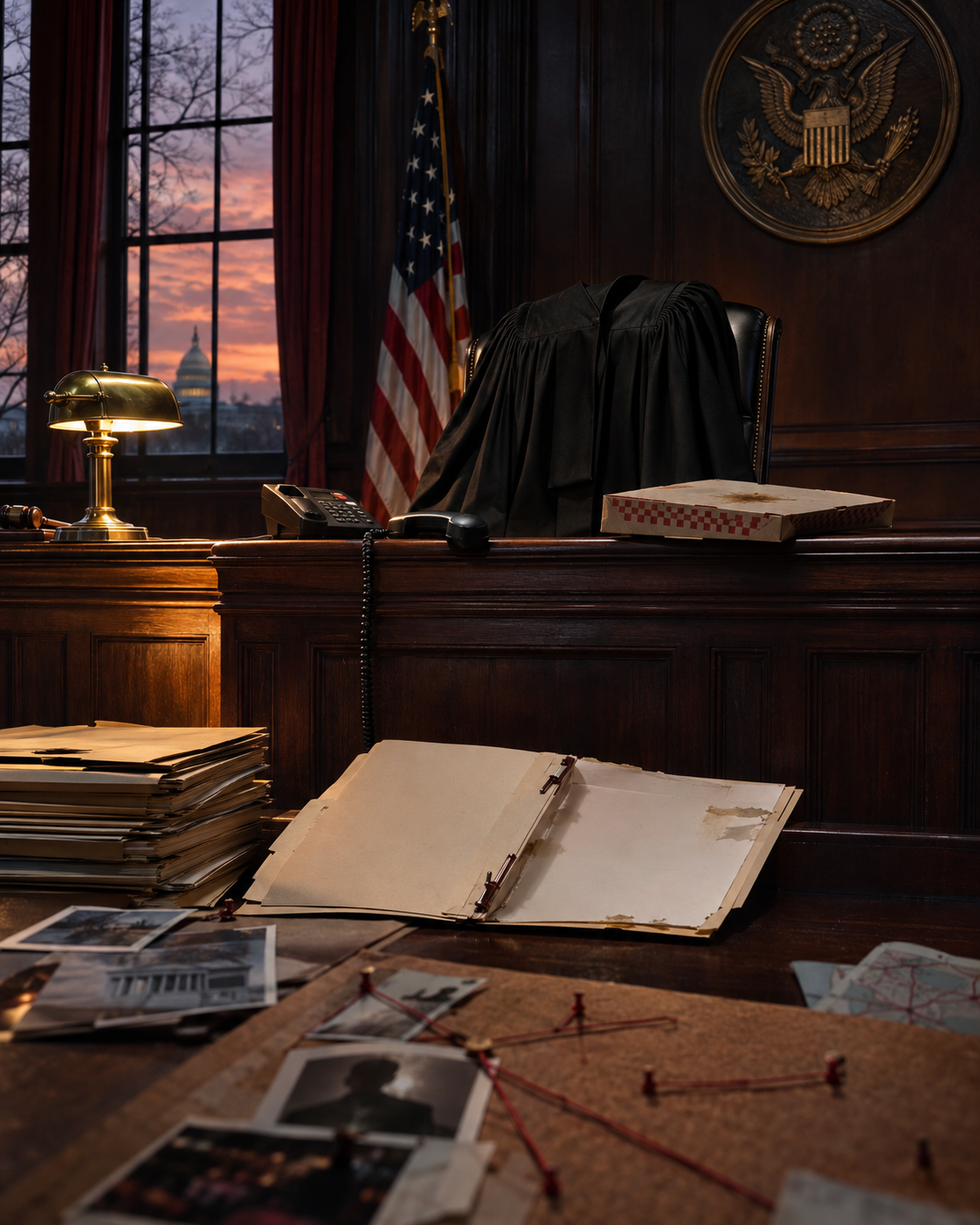
The danger facing American judges is real. But 60 Minutes makes a serious investigative mistake: it treats evidence that threats followed Donald Trump's attacks on judges as sufficient evidence that his rhetoric caused the wider surge in political violence.
The distinction matters. The programme documents frightening incidents, but does not establish who is responsible for most of them, how many perpetrators were influenced by presidential statements, or how much of the increase predates Trump's second presidency. It has a compelling warning about judicial safety. It does not deliver the rigorous investigation needed to establish the full explanation.
The programme confuses sequence with causation
The central accusation is that Trump's attacks on judges provoke violent threats from his followers. Bill Whitaker explicitly says that inflammatory comments have "provoked a torrent of death threats."
There is credible evidence supporting a connection. One recorded caller invokes Donald Trump by name, and Judge John Coughenour describes receiving an extraordinary volume of threats after blocking Trump's birthright citizenship order.
But the programme never establishes the identity or political affiliations of the callers, how many threats explicitly reference Trump, or whether the perpetrators were responding to his statements rather than independently held political grievances. It presents selected recordings and judges' interpretations without a systematic examination of the people making the threats.
CBS News+1
The statistics are alarming, but the timeline is missing
The programme's headline figure is broadly credible, but its presentation leaves out important distinctions.
The current U.S. Marshals Service statistics record 395 unique judges targeted in protective investigations during fiscal 2025, alongside 562 individual threat entries and 807 investigations. These are three different measurements. The 60 Minutes report gives approximately 400 judges and a 78% increase but does not identify the precise underlying measure or publish the earlier comparison figures.
U.S. Marshals Service+1
More importantly, the trend did not begin with Trump's second presidency. The Marshals' own series records 455 unique judges in fiscal 2023, 379 in 2024 and 395 in 2025. The highest figure came before Trump returned to office. The long-term increase is real, but it cannot be presented as evidence that his second-term rhetoric produced the entire increase.
U.S. Marshals Service
There was, however, a genuine short-term spike after his return. The Washington Post obtained Marshals data showing 197 judges were threatened between March 2 and late May 2025, compared with 80 during the preceding five months. Of those 197, 162 were recorded between March 2 and April 14. Yet the same report found that the average monthly number of threats investigated during the first eight months of fiscal 2025 was only modestly higher than in fiscal 2024.
The Washington Post
That distinction is precisely what the programme needed to explain. A concentrated burst of threats during confrontations between the administration and the courts is significant evidence. It is not the same thing as proving that presidential rhetoric caused the entire four-year increase.
The 26 judges interviewed also constitute a collection of testimonies, not a representative survey of the federal judiciary. Nine were Democratic appointees and 17 Republican appointees, but CBS provides no selection methodology, breakdown of how many experienced direct threats, or detailed distinction between sitting and retired judges.
The Marshals' institutional failure predates Trump
The programme says the Marshals are overwhelmed. It should have investigated why.
The Department of Justice Inspector General had already identified serious failures in June 2021. Its audit found that the Marshals lacked sufficient resources and proactive threat-detection capabilities, particularly for online and social-media threats.
The findings were unusually specific:
- District-level threat investigators performed security work as an additional responsibility, rather than as a full-time job.
- The agency faced significant staffing shortages.
- Resource limitations prevented planned improvements to threat detection.
- Security incidents, inappropriate communications and threats against protected officials had increased 89% between fiscal 2016 and fiscal 2019.
These findings predate Trump's second presidency by several years.
U.S. DOJ Office of Inspector General
The funding problem remained visible in April 2025. The federal judiciary reported that its $750 million Court Security programme had been frozen at fiscal 2023 funding levels for a second consecutive year. The Marshals were operating with reduced staffing, while 67 judges in high-profile cases were receiving enhanced online security screening.
United States Courts
Chief Justice John Roberts had also provided a crucial enforcement statistic in his December 2024 report: the Marshals had investigated more than 1,000 serious threats against federal judges over five years, with approximately 50 individuals criminally charged.
Roberts made another distinction that the television report should have explored more carefully. He explicitly separated legitimate public criticism of judicial decisions from violence, intimidation, disinformation and threats to defy court orders. Criticism is not itself an attack on judicial independence.
Supreme Court
60 Minutes spends considerable time showing the consequences of hostile political language but almost none investigating the machinery responsible for protecting judges.
Where are the staffing requirements? What happened to the Inspector General's recommendations? How many investigations produce prosecutions? Why are threat investigators still stretched across competing responsibilities?
A judge who receives a death threat needs more than another politician condemning political violence. The judge needs an effective protection system.
The congressman behind the wanted poster is left unnamed
One of the report's most consequential allegations concerns a congressman who displayed a wanted poster featuring judges, including Coughenour.
The programme leaves him unidentified.
There was no need to. The Associated Press had identified him as Representative Andy Ogles, a Republican from Tennessee, in July 2025. The Federal Judges Association subsequently documented that the poster contained photographs and names of 18 federal judges. It was removed after the Federal Bar Association and Judge Esther Salas requested its removal.
AP News+1
At a June 2025 congressional hearing, Representative Sydney Kamlager-Dove also stated that nine of the 18 judges were Republicans.
FirstBranch
This is a particularly important omission because it turns an identifiable act by an elected official into an anonymous anecdote.
Coughenour described the poster as containing everything except the words "dead or alive." That is his characterization. The programme does not show the actual poster, reproduce its complete wording, identify its creator or explain the circumstances surrounding its removal.
Why not name Ogles? Why not show the poster? Why not ask him to explain why he considered it appropriate to publicly display photographs of federal judges who had ruled against the administration?
A public official displaying a wanted poster of judges is a legitimate subject of investigation. The audience deserves to know who did it, what the poster actually said and what explanation the congressman offered.
Instead, the programme leaves the most directly identifiable political actor in that particular incident unnamed.
The pizza intimidation story needs a proper audit
The unsolicited pizza deliveries are among the most disturbing details in the investigation. They are also among the least thoroughly explained.
60 Minutes reports hundreds of deliveries to judges and their children, including at least 20 orders made using the name of Esther Salas's murdered son, Daniel.
The Associated Press reported in July 2025 that Salas said the Marshals had told her about more than 100 pizza-doxing incidents since 2024, most occurring during 2025. She also described additional incidents involving state judges, which would fall outside the Marshals' federal judicial protection responsibilities.
AP News+1
The distinction matters because the television report does not explain how it arrived at its figure of hundreds.
It does not identify the people placing the orders, establish how many separate judges were targeted, explain whether repeat deliveries were counted individually, or demonstrate whether the incidents were connected.
The evidence establishes a disturbing pattern of intimidation. It does not establish that all the deliveries were part of one centrally coordinated operation.
There is another source issue.
Ron Zayas, whom CBS identifies as Ironwall's CEO, provides the programme's explanation of how threats are evolving. His company markets online privacy protection, personal-data removal and threat-response services to judges, courts and other public-facing professionals.
Ironwall by Incogni+1
That commercial interest does not make his observations false. But it does mean his assessment is not independent of the industry in which he operates.
The programme does not disclose his company's relevant client relationships, financial interests or independent evidence supporting his claim that he has never witnessed so many violent threats in 14 years.
His expertise is relevant. His commercial position is relevant too.
A serious investigation should distinguish expert knowledge from independent corroboration.
The legal dispute is flattened into a morality play
The programme should distinguish between an administration attacking judges and an administration challenging the legal scope of their orders. Those are not the same thing.
Consider Coughenour's birthright citizenship case. Trump's January 20, 2025 executive order did not seek to deny citizenship to every child born to non-American parents. It specified two categories: children whose mothers were unlawfully present, or lawfully but temporarily present, when they gave birth, provided their fathers were neither American citizens nor lawful permanent residents.
Every CRS Report
There is also an important procedural distinction missing from the report.
Coughenour issued a temporary restraining order on January 23, 2025, initially lasting 14 days. He subsequently issued a nationwide preliminary injunction on February 6. These were interim judicial orders, not a final Supreme Court determination of the constitutional question.
Justia+1
The Supreme Court subsequently addressed two separate questions:
- June 27, 2025 — Trump v. CASA: The Court restricted the use of nationwide injunctions, limiting how broadly federal judges can block government policies. It did not decide whether Trump's birthright citizenship order was constitutional.
- June 30, 2026 — Trump v. Barbara: The Court held that the Fourteenth Amendment protects citizenship for children born on American soil to parents who are temporarily or unlawfully present, invalidating the executive order.
The second decision ultimately confirmed the constitutional position underlying Coughenour's ruling.
Every CRS Report+1
This chronology matters. There was a genuine legal dispute about the scope of judicial injunctions, even though the administration ultimately lost on the underlying constitutional question.
Deputy Attorney General Todd Blanche complained about overbroad and inadequately reasoned injunctions. CBS included his statement but did not examine a particular injunction, explain the relevant legal standards or investigate whether his criticism had merit in any specific case.
It is not enough to quote the administration's accusation and then move on. A serious investigation should establish what the judges actually ordered and why.
The opening tariff example contains a similar simplification. The Supreme Court invalidated tariffs imposed under the International Emergency Economic Powers Act, not every tariff programme available to Trump. Other statutory authorities, including Sections 232 and 301, remained available.
Every CRS Report+1
None of these legal distinctions excuses threats against judges. They matter because criticism of a court order, however forceful, is not automatically intimidation. The report needed to defend that distinction rather than blur it.
The closing argument is stronger than the investigation
The programme's emotional conclusion rests heavily on Judge Salas's personal tragedy and her fear for the future of American democracy.
Her experience deserves to be heard. Her son Daniel was murdered in an attack that the programme explicitly acknowledges was not politically motivated. The later use of his name in threatening deliveries is a separate and deeply disturbing development.
But Salas's fear that political rhetoric could produce another attack is a warning about future danger, not proof of the precise causes of every threat currently being investigated.
The same distinction applies to Judge Jones's claim that Trump is attempting to delegitimize the judiciary. That is a reasonable interpretation of the president's public conduct. It is not direct evidence of his private intentions.
The programme repeatedly allows credible witnesses' interpretations to become the explanation for events without independently establishing every link.
That is the difference between reporting what judges fear and investigating how the threat environment actually operates.
To be fair, CBS did seek responses from the administration. The White House supplied a statement, Blanche provided a written response saying threats against officials were unlawful, and both Blanche and Attorney General Pam Bondi declined interviews. The programme deserves credit for including those responses. Its failure is that it does not independently test the administration's legal arguments.
CBS News+1
Verdict
60 Minutes has documented a genuine threat to judicial independence. It has shown frightening testimony, recorded death threats, political attacks and intimidation of judges' families.
But it has not established the full explanation it asks viewers to accept.
It does not adequately distinguish long-term trends from the second-term surge, identify the political affiliations of most perpetrators, establish the extent of coordination behind the pizza deliveries, or investigate the institutional failures that leave judges exposed.
It also leaves an identifiable congressman unnamed and compresses important legal distinctions into a simpler political narrative.
The strongest indictment is not that the programme invented the danger. It is that it had enough evidence to investigate much more deeply and stopped short.
Judges deserve protection from political intimidation. The public deserves to know exactly who is threatening them, who is encouraging hostility, why the protection system is failing, and what the evidence actually establishes.
A moving account of endangered judges is not a substitute for answering those questions.
References
1. CBS News, Federal judges who've ruled against Trump administration denounce threats against themselves, their families (March 1, 2026; updated June 7, 2026). — Establishes the programme's claims, 26 interviews, recorded threats and responses from the administration.
2. U.S. Marshals Service, Protective Investigations – Threat Statistics (data through September 30, 2026). — Separates unique judges, individual threat records and investigations, showing the FY2023 peak and subsequent figures.
3. The Washington Post, Spike in threats to judges prompts calls for more security (May 29, 2025). — Documents the early-2025 surge, its concentration in March and April, and the funding and staffing pressures facing the Marshals.
4. Department of Justice Office of Inspector General, Audit of the U.S. Marshals Service Judicial Security Activities (June 2021). — Establishes that inadequate staffing, resources and online threat-detection capabilities were documented years before Trump's second presidency.
5. Administrative Office of the U.S. Courts, Funding Shortfalls Adversely Affect Key Judiciary Programs (April 18, 2025). — Documents frozen court-security funding, reduced Marshals staffing and enhanced protection for 67 judges.
6. Chief Justice John Roberts, 2024 Year-End Report on the Federal Judiciary (December 31, 2024). — Records more than 1,000 serious threats over five years, approximately 50 criminal charges and the distinction between legitimate criticism and intimidation.
7. Associated Press, Federal judges detail rise in threats, 'pizza doxings,' as Trump ramps up criticism (July 31, 2025). — Identifies Representative Andy Ogles and provides additional reporting on the pizza incidents and Judge Salas's account.
8. Federal Judges Association, The Bench Press (July 2025). — Documents the 18-judge wanted poster and its removal following intervention by the Federal Bar Association and Judge Salas.
9. House Judiciary Subcommittee hearing transcript (June 24, 2025). — Records congressional discussion of the wanted poster, including the statement that nine of the 18 judges were Republicans.
10. Oregon Department of Justice, Birthright Citizenship: Washington v. Trump (2025–2026). — Provides the procedural chronology of Coughenour's temporary restraining order, preliminary injunction and subsequent appeals.
11. Congressional Research Service, Trump v. CASA, Inc. and Nationwide Injunctions During the Second Trump Administration (July 16, 2025). — Explains the Supreme Court's procedural ruling limiting nationwide injunctions without deciding the birthright citizenship merits.
12. Congressional Research Service, Trump v. Barbara: Supreme Court Holds Birthright Citizenship Executive Order 14160 Unconstitutional (August 13, 2026). — Establishes the Supreme Court's subsequent decision upholding birthright citizenship and invalidating the executive order.
13. Congressional Research Service, Supreme Court Rules Against Tariffs Imposed Under the International Emergency Economic Powers Act (February 23, 2026). — Explains precisely which tariffs the Supreme Court invalidated and which alternative statutory authorities remained available.
14. Ironwall by Incogni, About Us (undated). — Identifies Ron Zayas as founder and CEO and documents the company's commercial business in online privacy protection and personal-data removal for judges and other high-risk professionals.