60 Minutes Found the Money Trail. It Didn't Follow the Money Far Enough.
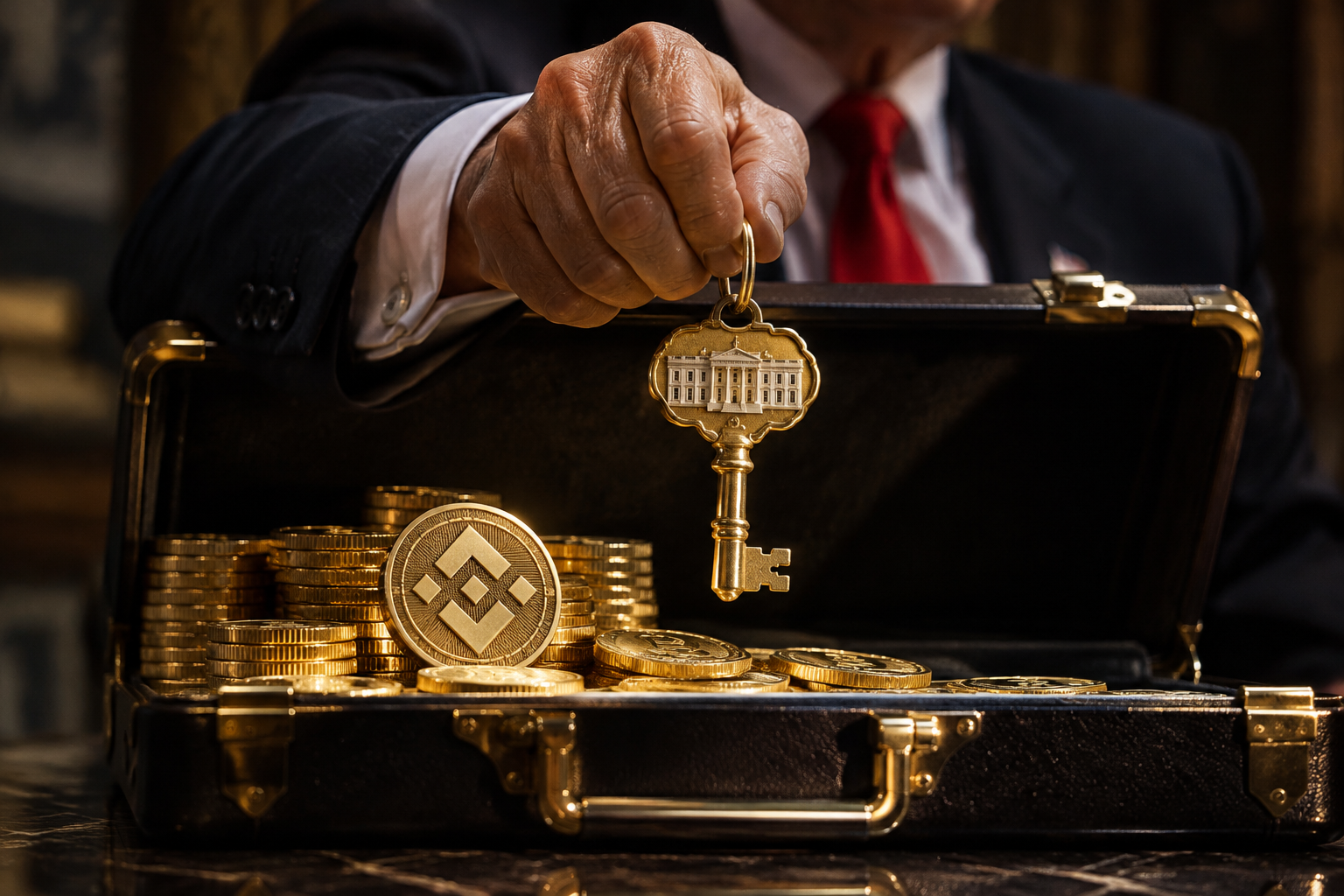
The 60 Minutes investigation makes a serious case that Donald Trump's presidential pardon of Changpeng Zhao deserves scrutiny. But it repeatedly blurs the distinction between a suspicious financial relationship, a demonstrable personal benefit and evidence of a political favour. That distinction matters. If a television investigation wants to accuse a president of turning public office into a private business arrangement, it must get the financial mechanics, criminal record and constitutional arguments exactly right. Here, some of its most dramatic passages are also its least carefully established.
The $2 Billion Transaction Is Not Explained Properly
The investigation's central financial story concerns a $2 billion investment by Abu Dhabi's MGX in Binance, settled using World Liberty Financial's USD1 stablecoin. But the programme describes Binance as leaving $2 billion deposited in the Trump family's business, giving Zhao power over whether that business survives.
That description collapses three different things: MGX's investment in Binance, the USD1 tokens transferred to Binance, and the reserve assets backing those tokens. They are not interchangeable.
The Wall Street Journal's detailed reconstruction of the transaction, published October 29, 2025, reports that MGX purchased USD1 from World Liberty, transferred the tokens to Binance, and that Binance subsequently held most of them on its platform. The corresponding reserve assets were held to support redemption of the stablecoin. This is a much more precise account than simply saying Binance left a deposit with the Trump family.
The distinction is not academic. MGX was buying a minority stake in Binance, not placing a $2 billion investment in USD1. The Wall Street Journal reported that Binance requested payment in cryptocurrency and asked MGX to use USD1. MGX subsequently defended its selection by citing business suitability. World Liberty Financial separately told US senators that, without USD1, the transaction probably would have been settled in a foreign currency, most likely UAE dirhams. The programme never properly investigates why Binance wanted this particular payment method.
WSJ+1
The reserve money is also being described incorrectly. World Liberty's own disclosures identify BitGo as the issuer of USD1 and the custodian of its backing reserves. Binance received the tokens; the corresponding reserve assets were held or maintained by BitGo. BitGo and World Liberty-affiliated entities are entitled to interest generated by those reserves. A Trump-affiliated entity has an indirect economic interest through approximately 38% beneficial ownership of an affiliate entitled to that interest.
Team, Vision & Mission
The $80 million annual figure is therefore a hypothetical gross yield, not a demonstrated $80 million payment to Trump. It assumes the $2 billion remains in reserve for a full year and earns approximately 4%. The programme never establishes the precise division of that income between BitGo and World Liberty's affiliated entities.
Nor does the fact that Binance holds most of the USD1 tokens establish that Zhao personally controls World Liberty's survival. Binance's corporate plea agreement required Zhao to resign and prohibited his involvement in operating or managing the company. He retained an ownership interest, but the programme provides no evidence that he could personally direct Binance's decisions about redeeming those tokens. Its dramatic account of Zhao holding a sword over World Liberty is an anonymous source's interpretation, not an established fact.
justice.gov+1
The stronger evidence was already public before the broadcast
This is where the investigation becomes particularly difficult to defend.
On October 29, 2025, the Wall Street Journal published a substantially more detailed account of Binance's relationship with the Trump venture. The 60 Minutes segment aired on November 16.
The Journal reported that:
- Binance established a high-level task force to negotiate a deal with World Liberty that could be leveraged into clemency for Zhao.
- Binance deployed more than a dozen engineers ahead of USD1's launch.
- Binance requested that MGX settle its $2 billion investment using USD1.
- Binance representatives had approached Trump allies around the election about resolving the exchange's American legal problems.
- The pardon could help Binance pursue a return to the US market, which had previously represented as much as one-third of its revenue.
These were allegations based partly on people familiar with the discussions, not independently established proof of a bargain. Binance and World Liberty disputed improper involvement, and World Liberty denied participating in the pardon. But these were the most consequential reported connections between the business arrangement and the clemency decision. CBS did not explain them.
WSJ+1
The engineering dispute deserved particular attention. Binance's attorney denied providing personnel or technical support. World Liberty's lawyers acknowledged receiving freely available software. Yet the Journal reported that Binance had deployed a team of engineers to help build the technology.
Those are materially different accounts. CBS should have established who provided the engineers, what they built, who directed the work and what Binance received in return. Instead, it left viewers with a vague software donation and an anonymous source's assertion that the technology would not exist without Zhao.
The lobbying records make the omission even more consequential.
Federal lobbying disclosures show substantial Binance spending during 2025. The recorded outside lobbying fees through the third quarter total approximately $710,000. The Journal reported that $450,000 went to Checkmate Government Relations and $260,000 to BakerHostetler, with the lobbying effort including a push for Zhao's pardon and work on cryptocurrency policy and executive relief. The filings establish the spending; the Journal's reporting connects the activity to clemency. The filings themselves do not prove that a pardon was purchased.
receipts.report+1
Trump's explanation that he acted at the request of a lot of very good people deserved much harder examination. Who were they? Who contacted the administration? Who paid the lobbyists? What did they request, and when?
The public record offered a route into those questions. The programme barely took it.
The Trump family's financial interest was much larger than $80 million
The most consequential omission concerns World Liberty's underlying business model.
Reuters reported on March 31, 2025, that World Liberty had already raised approximately $550 million through sales of its separate WLFI governance token. A Trump-family entity held a 60% interest in WLF Holdco and was entitled to 75% of net token-sale revenue and 60% of future operating revenue. Reuters estimated the family was entitled to approximately $400 million in fees. These figures were publicly available more than seven months before the 60 Minutes broadcast.
investing.com
This matters because USD1 and WLFI are different products. The $2 billion Binance transaction dramatically increased USD1's circulation and gave World Liberty greater commercial credibility. The Journal reported that this success also helped sales of the separate WLFI token.
The financial benefit to the Trump family was therefore not limited to interest earned on the USD1 reserves. The family had substantial contractual rights to revenue from another part of the same business.
Yet the programme never explains this arrangement.
It quotes Eric Trump saying:
My father has nothing to do with our company.
That statement needs qualification. The current company disclosures say Trump and his family members are not officers, directors or employees of World Liberty. That is a statement about management, not ownership or financial benefit.
The same disclosures identify DT Marks DEFI LLC, affiliated with Donald Trump and family members, as holding approximately 38% of WLF Holdco. The entity is entitled to 75% of WLFI token-sale proceeds after agreed deductions. A separate Trump-affiliated entity also has an indirect economic interest in an affiliate entitled to interest on USD1's reserves.
Team, Vision & Mission
The distinction is straightforward: not running the business does not mean having no financial interest in it.
The programme should have presented these figures when examining the trust arrangement and the White House's denial of conflicts. Instead, it relied heavily on a constitutional scholar's general explanation of why a family-operated trust does not necessarily protect a president from financial conflicts.
Later financial disclosures established the scale more concretely.
Donald Trump's 2025 annual financial disclosure, received by the Office of Government Ethics on June 29, 2026, lists:
- Approximately $526.8 million in WLFI token-sale proceeds across the reported cash and cryptocurrency-wallet entries associated with DT Marks DEFI LLC.
- $65.625 million in net proceeds from the sale of WLF Holdco equity.
- $196.875 million in net proceeds from new-member capital contributions and the sale of Class C units in Stablecoin Holdco through DT Marks SC LLC.
The filing also identifies 38.25% ownership interests in WLF Holdco and Stablecoin Holdco through the respective Trump-affiliated entities. These figures are reported proceeds, not all operating profits or money personally withdrawn by Trump. The Stablecoin Holdco amount includes capital contributions and equity transactions, not merely interest earned on reserves.
Google Sheets+1
These disclosures postdate the broadcast, so CBS cannot be faulted for not reporting the exact figures. But Reuters had already documented the family's substantial revenue rights before the programme aired.
The $80 million projection was only one part of a much larger financial relationship.
The foreign investor was not simply an anonymous Emirati fund
The programme repeatedly refers to an Emirati fund without identifying the institution behind the investment.
It was MGX, an Abu Dhabi investment company established through the Artificial Intelligence and Advanced Technology Council in partnership with Mubadala and G42.
MGX's own records identify Sheikh Tahnoon bin Zayed Al Nahyan as its chairman. He is the Deputy Ruler of Abu Dhabi and the UAE's National Security Adviser. He also chairs the country's Artificial Intelligence and Advanced Technology Council.
MGX
That identity matters. The programme discusses a $2 billion transaction involving a Trump-family business and, two weeks later, an American decision to provide the UAE with highly restricted AI chips. It correctly says there is no evidence directly linking the two arrangements. But it never tells viewers who chaired the investment vehicle on the Emirati side.
Another important relationship is also missing: Steve Witkoff, Trump's special envoy to the Middle East, was identified as World Liberty's co-founder emeritus, while his son Zach was a co-founder. Reuters documented Witkoff's role in bringing the venture's founders into Trump's circle. The company's own website listed these relationships before the 60 Minutes broadcast. The programme never names him.
banking.senate.gov+1
Later reporting revealed a much larger financial connection.
On January 31, 2026, the Wall Street Journal reported that a vehicle backed by Sheikh Tahnoon had secretly agreed to purchase a 49% stake in World Liberty Financial for $500 million. The agreement was signed on January 16, 2025, four days before Trump's inauguration. The first $250 million payment directed approximately $187 million to Trump-family entities.
wsj.com
This transaction was not publicly known when 60 Minutes aired, so its omission cannot fairly be charged against the programme.
But it changes the context substantially. The senior Emirati official chairing MGX's $2 billion Binance investment was also connected to a separate, substantial equity investment in the Trump family's cryptocurrency venture.
That does not establish that the investment purchased AI-chip access or Zhao's pardon. It does establish that the financial relationship was considerably broader than the single transaction examined by CBS.
The criminal and constitutional claims need greater precision
Zhao's conviction was serious, but the programme blurs what he was convicted of
Changpeng Zhao personally pleaded guilty to causing Binance to fail to maintain an effective anti-money-laundering programme. The statement of facts describes approximately $890 million in transactions between US users and Iranian users over five years, alongside transactions involving other sanctioned jurisdictions. Binance separately pleaded guilty to corporate offences involving money transmission, anti-money-laundering failures and sanctions violations.
justice.gov+1
These are serious offences. But the programme's description of Zhao as having been prosecuted for sending money to Al-Qaeda, Hamas and ISIS blurs the distinction between Binance's platform being used by illicit actors and the specific offence Zhao admitted committing.
The Justice Department described Binance's failures as allowing money to flow to terrorist organisations. That does not make Zhao's personal conviction a direct terrorism-financing conviction.
A serious investigation should get the criminal record exactly right. The distinction does not excuse his conduct; it prevents viewers from being given a more specific conviction than the court record establishes.
A constitutional conflict is not automatically a constitutional violation
Michael Gerhardt calls the arrangement a classic conflict of interest that the Constitution was designed to prevent.
His ethical argument deserves examination. His constitutional conclusion needs more explanation.
The ordinary federal financial-conflict statute, 18 U.S.C. §208, expressly excludes the President from its definition of covered officers and employees. That does not exempt a president from every other legal restriction. The Foreign Emoluments Clause could be relevant to financial benefits involving foreign governments. But whether an ordinary commercial transaction involving a foreign government-linked investor constitutes a prohibited emolument is a disputed legal question.
uscode.house.gov+1
The programme never explains which constitutional provision Gerhardt believes applies, how the transaction meets its requirements, or whether the relevant payment is a commercial return, a foreign emolument or something else.
There is a difference between an ethically troubling arrangement and an established constitutional violation. The programme should not blur it.
Gerhardt also alleges that federal tax dollars are being used to promote Trump's private business. Yet the segment identifies no particular federal expenditure, government contract, agency communication, official event or budget allocation supporting that assertion.
The campaign-era promotional material shown in the programme does not establish the use of taxpayer money. That allegation needed evidence.
Elizabeth Oyer was not the official who reviewed Zhao's application
Elizabeth Oyer's experience as former Pardon Attorney makes her an important witness. But the timing matters.
Oyer was dismissed on March 7, 2025. Zhao's formal pardon application was submitted in late April, according to the reporting published at the time. She therefore was not in office when his application was submitted and did not personally vet his file. Her assessment that Zhao fell far short of normal pardon guidelines is an informed opinion, not the finding of the official who reviewed his application.
schiff.senate.gov+1
There is another important qualification.
The ordinary Justice Department rules prescribe a five-year waiting period after release before a pardon petition should be filed. Zhao was nowhere near that period. However, the regulations expressly state that they are advisory and do not restrict the President's constitutional clemency power. The President makes the final decision on applications.
United States Department of Justice+2
This distinction matters. Zhao's treatment was extraordinary under normal Justice Department standards, but departing from those standards does not, by itself, establish an unlawful pardon.
The important unanswered questions are:
- Who actually reviewed Zhao's application?
- What recommendation was made to the President?
- Was the normal Justice Department process followed?
- Who communicated with the White House on Zhao's behalf?
- What information did Trump receive before signing the pardon?
The programme identifies none of these things.
It gives viewers an experienced former official's condemnation without establishing the actual decision-making process behind the pardon. That is a substantial gap in an investigation supposedly about how the pardon was obtained.
Closing verdict
I do not dispute the existence of a serious conflict worth investigating.
Binance helped World Liberty's cryptocurrency business. A $2 billion investment in Binance was settled using the Trump family's stablecoin. The family had substantial financial interests in World Liberty. Binance was lobbying for executive relief, according to contemporaneous reporting, and Zhao subsequently received a presidential pardon.
Those are meaningful facts.
But 60 Minutes fails to establish that the pardon was exchanged for the business arrangement. It does not demonstrate that Trump personally knew the details of the transaction, agreed to a bargain, or granted clemency in return for financial benefits.
More importantly, the programme leaves out the stronger available evidence: Binance's reported internal task force, its engineering involvement, its lobbying expenditure, the family's existing revenue rights, the identities of important business partners and the actual mechanics of the stablecoin transaction.
Later disclosures have made the financial relationships considerably more troubling. They still do not prove a purchased pardon.
The report's central failure is not that it asks difficult questions. It is that it substitutes dramatic interpretation for the documentary work needed to answer them.
A presidential pardon, a foreign government's investment, a family business and a cryptocurrency exchange deserve more than insinuation. They deserve an exact financial ledger, a documented chronology and an identifiable chain of decision-making.
60 Minutes had a serious investigation in its hands. It published only part of it.
References
1. Trump pardon of billionaire sparks concerns — CBS News, 60 Minutes, November 16, 2025. Original investigation. The primary account under review.
2. How a Billionaire Felon Boosted Trump's Crypto Company en Route to a Pardon — The Wall Street Journal, October 29, 2025. Read the investigation. Reports the Binance task force, engineering involvement, USD1 payment request, lobbying and clemency discussions, while recording company denials.
3. How the Trump family took over a crypto firm as it raised hundreds of millions — Reuters, March 31, 2025. Read the investigation. Documents the family's ownership, revenue-sharing arrangements, token sales and Steve Witkoff's involvement.
4. Senate Banking Committee correspondence with World Liberty Financial, MGX and Binance — US Senate, May–June 2025. May 14 letter and June 10 correspondence. Records the questions about ownership, revenue rights and the company's explanation of alternative settlement currencies. These are oversight letters, not findings of wrongdoing.
banking.senate.gov+1
5. Tahnoon bin Zayed chairs inaugural meeting of MGX — MGX, May 28, 2024. Official announcement. Establishes MGX's government-linked origins and Sheikh Tahnoon's positions as chairman, Deputy Ruler of Abu Dhabi and UAE National Security Adviser.
MGX
6. World Liberty Financial — About and corporate disclosures — World Liberty Financial, current disclosures. Official company disclosures. Identifies the Trump-affiliated ownership and revenue arrangements, BitGo's role in issuing USD1 and holding reserves, and the sharing of reserve interest.
Team, Vision & Mission
7. United States v. Changpeng Zhao and United States v. Binance Holdings Ltd. — US Department of Justice, November 21, 2023. Zhao's criminal case. The plea records establish the precise personal offence and distinguish it from Binance's separate corporate convictions and management restrictions.
justice.gov+1
8. Office of the Pardon Attorney — Frequently Asked Questions and clemency regulations — US Department of Justice. Pardon guidance. Explains the five-year guideline, the President's final authority and the advisory nature of departmental regulations.
Frequently Asked Questions+1
9. The Emoluments Clauses and the Presidency: Background and Recent Developments — Congressional Research Service, November 5, 2019. Read the report. Explains the competing legal interpretations of foreign emoluments and private commercial transactions.
EveryCRSReport.com
10. Donald J. Trump 2025 Annual Financial Disclosure — US Office of Government Ethics, received June 29, 2026. Official disclosure. Provides the reported ownership interests and financial proceeds associated with World Liberty and Stablecoin Holdco.
Google Sheets+1
11. 'Spy Sheikh' Bought Secret Stake in Trump Company — The Wall Street Journal, January 31, 2026. Read the investigation. Reports the previously undisclosed $500 million investment, 49% stake and payments to Trump-family entities.
wsj.com
12. Binance Holdings Ltd. lobbying disclosures — US Senate Lobbying Disclosure records, 2025. Filing index. Provides the reported lobbying payments and links to the underlying disclosure records.
Receipts Report
13. Statement of Elizabeth Oyer to Congress — April 7, 2025. Official testimony. Establishes her March dismissal and her account of the circumstances surrounding it.
schiff.senate.gov