Project Sapphire Was a Purchase, Not a Blueprint for Seizing Iran’s Uranium
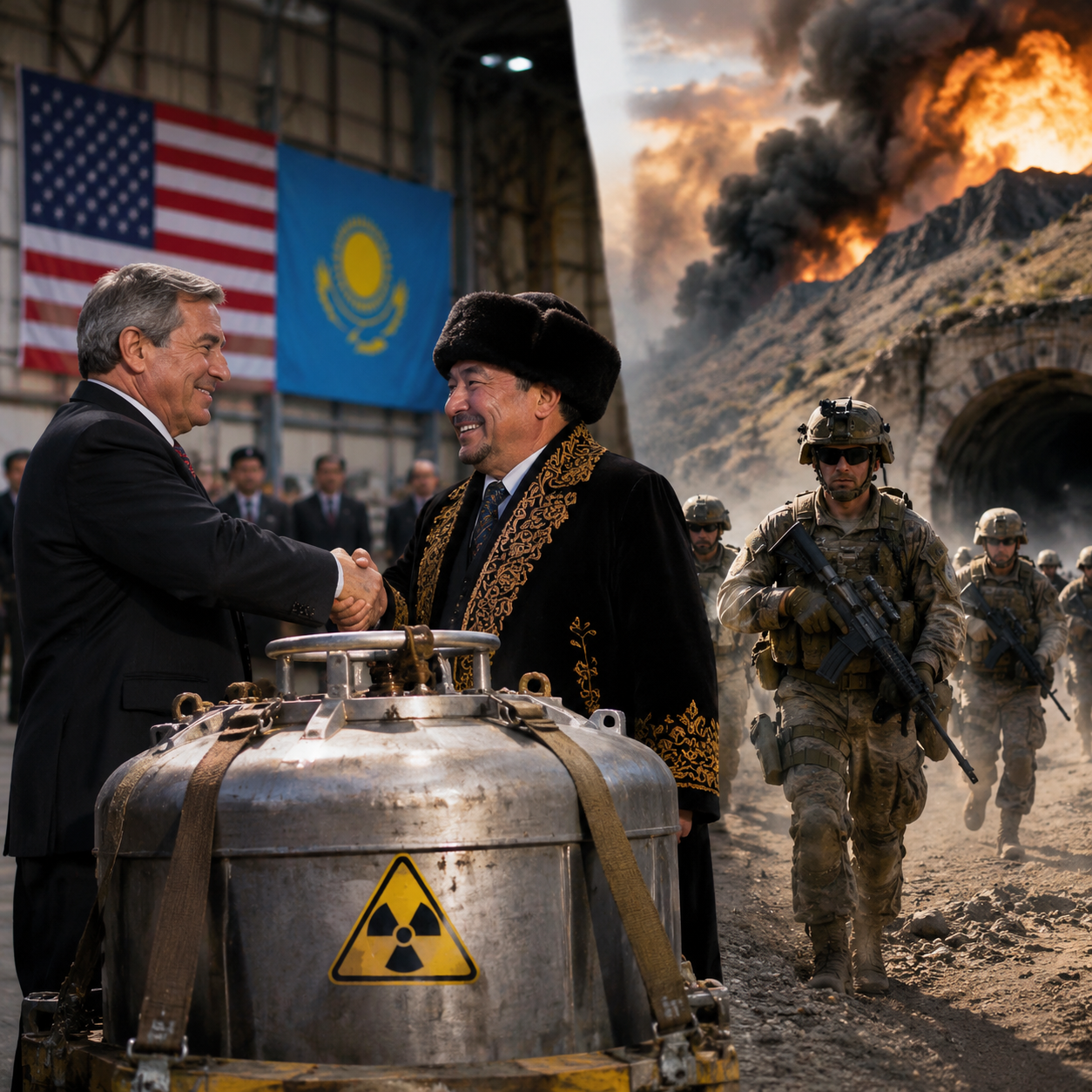
The most important distinction in 60 Minutes’ investigation is also the one its dramatic military scenario cannot overcome: America removed Kazakhstan’s weapons-grade uranium because Kazakhstan wanted it removed. Iran has not agreed to surrender its stockpile.
The April 19 report, What it would take for the U.S. to secure Iran's highly enriched uranium, offers Project Sapphire as a historical precedent before exploring an American military operation inside Iran. It interviews people with considerable experience in nuclear security and special operations. But an experienced military officer saying an operation is possible does not establish that it is feasible, strategically sensible, or likely to recover all the material.
The report actually contains the evidence that undermines its own comparison. Former National Nuclear Security Administration official Scott Roecker says international cooperation is essential and that he has never seen a successful removal operation without a willing partner.
That admission deserves considerably more attention than it receives.
Kazakhstan was paid to cooperate. Iran is being threatened.
The broadcast gives considerable attention to Andrew Weber's personal diplomacy, including his relationship with a factory director and a moose-hunting trip that helped establish trust.
The story is memorable. But the official historical record reveals a much larger diplomatic operation.
According to the Defense Threat Reduction Agency's 2014 institutional history, Kazakhstan's Atomic Energy Agency director, Vladimir Shkolnik, learned about the uranium stockpile from the Ulba plant director, Vitalii Mette, in 1992. By July 1993, President Nursultan Nazarbayev and his advisers had decided that Kazakhstan must either secure the material to international standards or remove it. They approached the American ambassador.
This was already a government-level initiative before the personal diplomacy described in the television report.
The financial negotiations were substantial. In March 1994, American officials proposed purchasing the uranium for $16,000 per kilogram, approximately $10 million in total. A formal bilateral agreement followed, and American officials consulted Russian Prime Minister Viktor Chernomyrdin, who ultimately agreed to the arrangement.
Kazakhstan received between $15 million and $20 million in cash and material support through the uranium transaction and the Cooperative Threat Reduction programme. This included approximately $7.7 million in medical equipment, as well as vehicles, computers and other assistance.
These details matter. Kazakhstan was not simply allowing American commandos into a hostile facility. It was participating in a negotiated transaction that served its own security and political interests.
The existing American-Kazakh cooperative framework, presidential authorization, Russian consultation, financial compensation and cooperation between technical teams made the operation possible.
The moose hunt may have helped build personal trust. It did not replace the diplomatic architecture.
The historical record: Defense Threat Reduction Agency, With Courage and Persistence.
There is another important omission.
Project Sapphire did not end when the uranium reached Oak Ridge, Tennessee. The Department of Energy subsequently developed a plan to blend the highly enriched uranium down into low-enriched material suitable for commercial nuclear reactor fuel.
The objective was not merely to move dangerous material from one country to another. It was to make that material unsuitable for nuclear weapons.
The DOE's 1995 disposition assessment documents this next stage.
That distinction is essential. Transport is not the same as eliminating a proliferation risk.
A military plan is not a proven military capability
Retired Vice Admiral Robert Harward tells 60 Minutes that an American operation could succeed.
His experience as a Navy SEAL and former deputy director of U.S. Central Command makes his assessment worth hearing. But the broadcast does not establish that the operation has been demonstrated under comparable conditions.
The scale of the actual proposal is considerably more alarming than a conventional special-forces mission.
On April 1, The Washington Post reported that Trump had personally requested a military plan to seize Iran's uranium. The proposal involved potentially hundreds or thousands of troops, excavation equipment, heavy logistical support and construction of a runway for cargo aircraft.
The operation could take weeks, under fire, deep inside Iran.
The newspaper described it as an operation of a type never previously attempted during wartime. The White House also cautioned that preparing military options did not mean Trump had authorized the mission.
The Washington Post's investigation provides a more revealing account of the actual military proposal than the television segment's general description.
Harward's statement, "we can do it," is a judgment about American military capability. It is not evidence that the operation can recover the entire stockpile.
The questions remain unanswered:
- What is the probability of recovering every known container?
- How would American forces distinguish genuine material from decoys?
- What happens if the tunnels are more extensively damaged than expected?
- How would the operation protect nuclear specialists and troops handling the material?
- What happens if the military recovers only part of the stockpile?
The report describes the perimeter, bulldozers, aircraft and Iranian drones. It does not establish a reliable answer to the most important question: can America actually secure all the uranium?
The United States does not know exactly where the uranium is
The 970-pound figure deserves closer scrutiny.
The IAEA's September 2025 report estimated that Iran possessed 440.9 kilograms of uranium enriched to 60 percent as of June 13, 2025.
That is the last pre-strike estimate, not a current verified inventory.
The agency explicitly stated that it had lost the ability to conduct the necessary field verification and could no longer quantify Iran's stockpile with the same confidence or determine its whereabouts.
The 60 Minutes report acknowledges the inspection gap, but repeatedly presents the approximately 970-pound figure as the quantity believed to remain.
The distinction is not academic. Nobody has established precisely how much survived the strikes, where every container is located, or whether any material was moved.
In March 2026, IAEA Director General Rafael Grossi estimated that slightly more than 200 kilograms of the 60-percent-enriched material had been stored in Isfahan's underground tunnels. He believed it was probably still there. He also acknowledged that some material held elsewhere might have been destroyed and that uranium remained at Natanz.
Reuters reported Grossi's assessment on March 9, 2026.
The problem is larger than Isfahan.
Matthew Bunn, the Harvard nuclear-security expert interviewed in the 60 Minutes report, subsequently examined the problem in considerably greater detail in Arms Control Today.
He identified possible locations at Isfahan, Natanz, Fordow and potentially other underground facilities.
His most important question concerns verification.
Before the strikes, the IAEA had monitored the material and recorded the canisters and their serial numbers. Since then, inspectors have not been able to examine the stockpile.
Bunn asks what would happen if American forces recovered only 70 percent of the known canisters. Would Washington know whether the remainder was buried under rubble or held somewhere else?
That is the difference between recovering nuclear material and proving that the nuclear stockpile has been secured.
Matthew Bunn's May 2026 technical assessment explores this problem in detail.
The situation remains unresolved. On October 27, 2026, IAEA Director General Grossi told the UN Security Council that the agency still could not verify the status of Iran's previously declared 440 kilograms of highly enriched uranium or establish that no material had been diverted.
Importantly, the inspection gap began when the IAEA withdrew its inspectors for safety following the June 2025 attacks. Iran subsequently suspended cooperation and has not accepted the agency's repeated requests for access.
The October 27 UN Security Council transcript records Grossi's latest assessment.
The report's military scenario therefore rests on an uncomfortable reality: the United States may be planning to retrieve a stockpile whose complete whereabouts it cannot independently establish.
The report overlooks a diplomatic alternative that was already on the table
The broadcast presents two principal possibilities: Iran hands over its uranium, or American troops take it.
That is an unnecessarily narrow description of the available choices.
On February 26, 2026, American and Iranian negotiators met in Geneva for another round of nuclear negotiations. Oman's foreign minister described the discussions as having made substantial progress. Technical negotiations were scheduled for March 2.
The United States and Israel launched their attacks on February 28.
According to Kelsey Davenport's April 2026 investigation for Arms Control Today, Iran had proposed a multiyear pause on enrichment, broad IAEA oversight, no accumulation of enriched uranium gas, and downblending its existing 60-percent stockpile to lower enrichment levels.
The proposal was not a completed agreement. Iran envisaged eventually resuming limited enrichment, potentially up to 20 percent, and the parties had not settled detailed monitoring and verification arrangements. It also failed to meet Washington's demands for no enrichment, dismantling facilities and exporting the stockpile.
Nevertheless, it was a genuine negotiating proposal.
Arms Control Association's April investigation documents the competing positions.
There was another possibility.
On March 13, Axios reported that Vladimir Putin had offered to move Iran's enriched uranium to Russia as part of a potential agreement to end the war. Trump rejected the proposal.
Iran had previously rejected transferring its stockpile abroad and offered instead to dilute the material inside its own facilities under IAEA supervision.
Axios documented the Russian proposal and Trump's rejection.
Neither proposal constituted an agreed solution. Neither guaranteed that Iran would cooperate. But both were meaningful alternatives that deserved examination in a report about how to secure the material.
The nonproliferation objective is to make the uranium unusable for nuclear weapons and verify that outcome. American ownership is one possible arrangement, not the objective itself.
A supervised blend-down in Iran, followed by international monitoring and potentially a transfer to a third country, deserves serious consideration.
The broadcast gives the audience a military scenario without adequately examining these diplomatic possibilities.
That is a consequential omission.
The cargo is a chemical hazard, not simply radioactive material
There is another technical problem with the comparison.
Iran's 60-percent-enriched uranium is stored as uranium hexafluoride, commonly called UF6, in cylinders resembling scuba tanks.
The U.S. Department of Energy's own safety data sheet identifies UF6 as highly toxic by inhalation and corrosive. When exposed to air and moisture, it generates hydrogen fluoride and uranyl fluoride, both hazardous substances.
A damaged cylinder inside a wet, rubble-filled underground tunnel presents a serious chemical safety problem.
This is not simply a matter of placing a security perimeter around a nuclear container and carrying it to an aircraft.
The Department of Energy's UF6 safety data sheet documents these hazards.
Project Sapphire also involved a different mixture of nuclear materials.
The Defense Nuclear Facilities Safety Board's December 1995 review identified seven forms of uranium-bearing material in the Kazakhstan shipment, including uranium metal, oxides, uranium-beryllium alloys and contaminated graphite.
More than 93 percent of the approximately 1,300 cans contained beryllium.
The board found that the material had been received, stored and reshipped safely. But it also identified serious shortcomings in the safety preparation: the material had been insufficiently characterized, the hazards analysis was inadequate, and a planned sampling programme was never completed before the material was shipped onward.
The report had presented Project Sapphire as a successful operation. The official safety review shows that success did not mean every technical procedure had been completed properly.
Defense Nuclear Facilities Safety Board, December 21, 1995.
That matters when someone proposes using the operation as a model for an entirely different nuclear-material recovery mission.
Iran's stockpile is predominantly UF6. The chemical hazards, underground conditions, damage to the storage environment and possibility of compromised cylinders all require specialist planning.
The television report discusses drones, missiles, bulldozers and runways. It gives considerably less attention to the material the soldiers would actually be handling.
The final verdict: A successful negotiation does not prove a successful invasion
I do not dispute the seriousness of Iran's remaining uranium stockpile. Nor do I dispute that American specialists have extraordinary experience securing dangerous nuclear materials.
But those facts do not establish that a forced extraction in Iran is a practical or reliable solution.
Project Sapphire succeeded because Kazakhstan requested assistance, the United States negotiated a purchase, Russia was consulted, both governments cooperated, specialists inventoried the material, and the uranium was eventually converted into a form unsuitable for weapons.
Iran presents a different situation: an unwilling government, underground facilities, an unverified stockpile, hazardous chemical material, possible multiple storage locations and a military operation without a comparable wartime precedent.
The 60 Minutes report contains several of these warnings. Its own experts provide the evidence. Yet it does not follow those warnings to their logical conclusion.
Project Sapphire is evidence that nuclear material can be removed through international cooperation. It is not evidence that American troops can reliably seize an unknown quantity of uranium from a hostile country at war.
The distinction could mean the difference between actually eliminating a nuclear threat and risking American lives to retrieve some containers while leaving the larger problem unresolved.
That is the question 60 Minutes should have made central.
References
- What it would take for the U.S. to secure Iran's highly enriched uranium — 60 Minutes, CBS News, April 19, 2026. Original investigation and primary source for the interviews, claims and military assessments examined here.
- With Courage and Persistence — Joseph P. Harahan, Defense Threat Reduction Agency, 2014. Official U.S. government history documenting Project Sapphire's negotiations, purchase price, Russian consultation, compensation and operational chronology.
- Finding of No Significant Impact for the Disposition of Highly Enriched Uranium Obtained from Kazakhstan — U.S. Department of Energy, May 25, 1995. Establishes that the operation's intended final disposition involved blending down the uranium into material suitable for commercial reactor fuel.
- Staff Observations of DOE and Lockheed Martin Energy Systems' Support of Project Sapphire — Defense Nuclear Facilities Safety Board, December 21, 1995. Records the successful receipt and shipment but identifies incomplete material characterization, inadequate hazard analysis and uncompleted sampling.
- GOV/2025/50: Verification and Monitoring in the Islamic Republic of Iran — International Atomic Energy Agency, September 11, 2025. Establishes the June 13, 2025 stockpile estimate and the agency's inability to verify subsequent quantities or locations.
- Much of Iran's near-bomb-grade uranium likely to be in Isfahan, IAEA's Grossi says — Reuters, March 9, 2026. Reports Grossi's estimate of more than 200 kilograms at Isfahan and the uncertainty surrounding material held elsewhere.
- Risky commando plan to seize Iran's uranium came at Trump's request — The Washington Post, April 1, 2026. Reports the scale, logistical requirements and unprecedented wartime risks of the proposed military extraction.
- Analysis: U.S. Negotiators Were Ill-Prepared for Serious Nuclear Talks With Iran — Kelsey Davenport, Arms Control Today, April 2026. Details Iran's February negotiating proposal, its limitations and the competing American demands.
- Trump rejected Putin offer to move Iran's uranium to Russia — Axios, March 13, 2026. Documents Russia's proposed transfer arrangement and the American rejection.
- Safety Data Sheet: Uranium Hexafluoride — U.S. Department of Energy, National Nuclear Security Administration. Documents UF6's inhalation toxicity, corrosive properties and hazardous reaction products.
- Non-proliferation, UN Security Council meeting 10253 — United Nations, October 27, 2026. Records the IAEA Director General's latest account of the missing verification, previously declared uranium stockpile and unsuccessful efforts to restore inspections.
- Managing the Dangers of Iran's Remaining Nuclear Capabilities — Matthew Bunn, Arms Control Today, May 2026. Provides detailed analysis of the uranium's possible locations, chemical form, canister-accounting problem and the risks of recovering only part of the stockpile.
Tighten the historical comparisonSeparate evidence from editorial judgment