60 Minutes Put a Rolex Beside a Tariff Cut. Then It Looked Away.
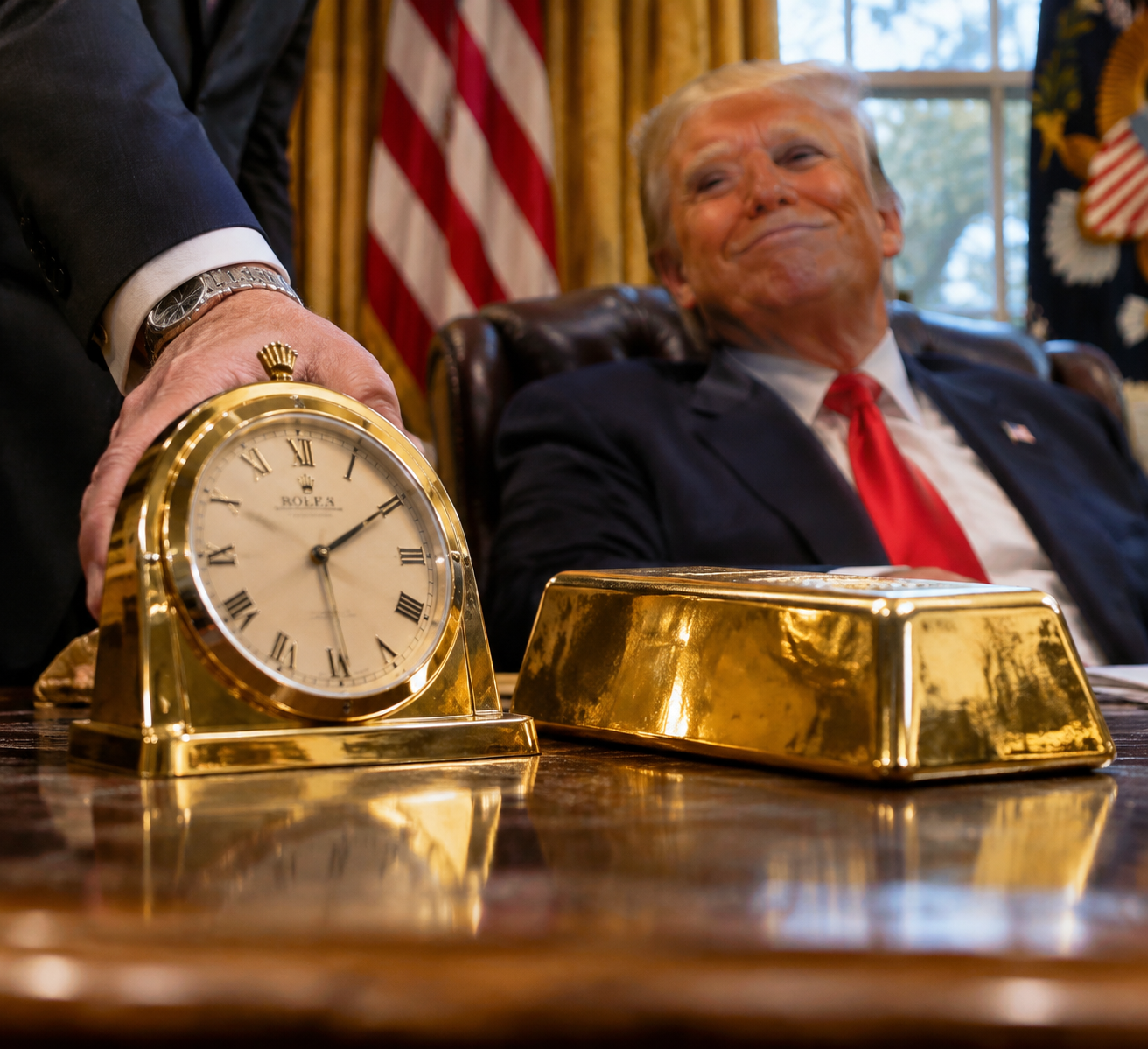
The most revealing moment in 60 Minutes’ Swiss watchmaking report lasts only a few seconds. Jon Wertheim explains that Swiss business executives visited Donald Trump, after which American tariffs on Swiss goods fell from 39% to 15%. Then comes the aside: “And yes, that gold-plated desk clock was a gift from the CEO of Rolex.”
CBS News
That is an extraordinary political detail to drop into a luxury-watch travelogue. But the programme neither investigates the relationship nor establishes what the gift had to do with the tariff decision. It offers viewers an insinuation without the evidence needed to judge it.
The problem is not that 60 Minutes failed to prove bribery. The problem is that it introduced a potentially consequential question and abandoned it.
The clock was only half the gift
On November 4, 2025, six prominent Swiss business leaders met Trump in the Oval Office. They included Rolex CEO Jean-Frédéric Dufour, Richemont chairman Johann Rupert, Partners Group co-founder Alfred Gantner, Mercuria president Daniel Jaeggi, MSC president Diego Aponte and MKS PAMP executive Marwan Shakarchi.
Reuters+1
Trump received two gifts, not one: the Rolex desk clock and an engraved one-kilogram gold bar worth more than $130,000. Shakarchi presented the gold bar, while Dufour presented the clock.
U.S. Senate Committee On Finance+1
The distinction matters because these were not described simply as courtesy presents. Gantner subsequently explained their intended symbolism: the gold bar represented plans to establish gold-refining operations in Oklahoma within 12–18 months, while the Rolex clock represented the Swiss investment programme and a promise to reduce the trade deficit with Swiss precision.
The gifts were therefore part of a wider commercial presentation. The business leaders were promoting investments and trying to persuade Trump that Switzerland would address his complaints about the trade imbalance.
SWI swissinfo.ch
There was also an existing relationship. Just weeks before the Oval Office meeting, Dufour had invited Trump to watch the US Open men's tennis final from Rolex's corporate box. That does not establish an improper exchange, but it is relevant when examining how the Swiss executives obtained access to the president.
SWI swissinfo.ch
60 Minutes reduced this entire episode to a gold-coloured clock and a knowing aside.
The meeting was private, but not detached from government
The official chronology makes the story more complicated.
Switzerland had been negotiating with Washington for months. On August 4, 2025, its Federal Council decided to continue negotiations and prepare a more attractive offer. The following day, Swiss President Karin Keller-Sutter and Economics Minister Guy Parmelin travelled to Washington with senior officials, including SECO chief Helene Budliger Artieda. The 39% additional tariffs took effect on August 7.
Federal Council of Switzerland+2
The November business delegation was not the beginning of negotiations. It was a later attempt to use private-sector relationships to accelerate an existing diplomatic process.
Gantner told Swiss public broadcaster SRF that the meeting idea originated under the leadership of Budliger Artieda and Parmelin. He said they wanted to bring together people who knew Trump and could represent the substantial investments Swiss businesses intended to make in America.
SECO offered a more carefully qualified account: the businessmen organised the meeting as a private initiative, received a general briefing on the official negotiations, and were not given confidential information. It insisted that the formal trade agreement was negotiated by the Federal Council and economics ministry, not by the businessmen in the Oval Office.
SWI swissinfo.ch
These accounts are not necessarily contradictory. The government could help create the opportunity without formally negotiating through the executives.
Indeed, Parmelin subsequently explained that when officials learned some business representatives had direct access to the Oval Office, they saw an opportunity to put the tariff issue at the top of Trump's agenda.
SWI swissinfo.ch
Gantner also described what happened during the meeting: after approximately 40 minutes, Trump turned to Trade Representative Jamieson Greer and asked whether the Swiss deal was good enough to obtain treatment comparable to the European Union. Greer agreed. According to Gantner, the deal was finalised in the following days.
SWI swissinfo.ch
That is considerably more informative than the television segment's suggestion that business executives simply visited and tariffs subsequently fell.
The important question is not whether the businessmen formally negotiated the agreement. They did not, according to both their account and SECO's. It is how their access, investment commitments and presentation influenced the president's decision to accelerate the process.
The actual trade agreement had substantial financial terms
The November 14 framework was a broad economic bargain involving Switzerland, Liechtenstein and the United States. It was not simply a reduction in exchange for a Rolex.
The White House+1
Its principal commitments included:
- Switzerland intended to encourage and facilitate at least $200 billion in investment in the United States over five years.
- Switzerland and Liechtenstein agreed to improve access for American industrial goods, seafood and selected agricultural products.
- Switzerland agreed to duty-free quotas covering 500 tonnes of American beef, 1,000 tonnes of bison meat and 1,500 tonnes of poultry.
- The United States agreed to a 15% tariff rate for covered Swiss goods, subject to the framework's tariff rules.
The $200 billion was an intended private-sector investment programme, not a guaranteed government payment. The framework also expressly stated that it was not legally binding under international law.
cms.news.admin.ch+1
There is another important detail missing from the television report: the 15% figure was not simply an additional 15% tax on top of ordinary American import duties. The subsequent Federal Register implementation specified a combined rate of 15%, comprising the normal most-favoured-nation duty and the reciprocal tariff, where the normal duty was below 15%. If the normal duty was already higher, it remained applicable.
cms.news.admin.ch
The arrangement was also conditional. The December 18, 2025 Federal Register notice said the United States would review and reconsider the tariff modifications if a final agreement was not successfully negotiated by March 31, 2026.
That deadline passed without the permanent agreement being completed. As of November 2026, Switzerland's SECO still reports continuing negotiations. Since July 24, 2026, the United States has also introduced a different Section 301 tariff structure, with a combined MFN and additional rate of up to 12.5% for Swiss imports under the applicable rules.
90 FR 59281+1
The 15% announcement was therefore an important temporary framework, not the end of the trade dispute.
The White House later defended the reduction by pointing to Switzerland's promised investments and improved access for American products. That is a substantive alternative explanation for the agreement, and it deserves serious consideration.
SWI swissinfo.ch+1
But it does not answer whether the gifts were disclosed during negotiations, who approved the investment presentation, or how much weight Trump gave to the executives' personal access.
Trump eventually supplied a much more revealing account
On January 21, 2026, Trump addressed the Swiss tariff dispute at the World Economic Forum in Davos.
He said he had initially intended to impose a 30% tariff on Switzerland, but increased it to 39% after a conversation with Keller-Sutter because she had rubbed him the wrong way.
He then described what happened next:
"I was paid visits by everybody. Rolex came to see me, they all came to see me."
He continued:
"But I realized, and I reduced it because I don't want to hurt people."
This was Trump's own public account of the tariff decision. He explicitly connected visits from Swiss businesses, including Rolex, with his subsequent decision to lower the tariff.
World Economic Forum
It does not establish that the Rolex clock or gold bar purchased preferential treatment. It does, however, make the connection between business access and presidential tariff decisions considerably harder to dismiss as mere coincidence.
It also raises a separate question: if Trump's own explanation is accurate, was the original 39% tariff based on an objective assessment of trade conditions, or was it partly the product of a personal disagreement?
Senator Ron Wyden, the ranking Democrat on the Senate Finance Committee, pursued precisely these questions. In a January 28 letter to US Trade Representative Jamieson Greer, he requested answers to five questions, including:
- Which officials decided that Switzerland should receive a 39% tariff?
- Why was 39% selected?
- Which officials negotiated the framework?
- Who recommended reducing the tariff to 15%?
- Were US trade officials informed about the gifts before or after they were presented to Trump?
Wyden argued that the sequence created an apparent conflict of interest and a public perception that gifts and personal access might be more effective than formal trade negotiations. These were questions requiring documentary answers, not proof of criminal conduct.
U.S. Senate Committee On Finance+1
This is where the 60 Minutes report could have provided genuine investigative value. Instead, its audience received a brief reference to a Rolex clock.
The tariff shock was more than a luxury price increase
The programme says the 39% tariffs drove Swiss watch prices higher, but provides no actual price comparisons or evidence of how much of the additional cost reached American buyers.
The consequences were more serious than a higher retail price. Swiss watch exports to the United States plunged 56% in September 2025. Smaller manufacturer Grovana took three months to restart US shipments, while other companies cut costs, furloughed workers and reduced workshop hours.
SWI swissinfo.ch
There were other pressures too: weakening Chinese demand, expensive gold, a stronger Swiss franc and a drop in orders following shipments being brought forward ahead of the tariffs.
The report presents the tariff as another obstacle for luxury watches. It misses the damage to the smaller specialist manufacturers whose skills and suppliers sustain the industry.
The legality remains an open question
Two Swiss parliamentarians, Greta Gysin and Raphaël Mahaim, filed criminal complaints over the gifts in November 2025. Switzerland's Attorney General confirmed receiving three complaints but specifically cautioned that receiving them did not mean a criminal investigation had been opened.
SWI swissinfo.ch
Swiss Criminal Code Article 322 prohibits offering an undue advantage to a foreign official in exchange for an act connected to that official's discretionary duties. Legal experts identified the need to establish an improper advantage and a connection between the gift and an official decision.
There are complications. The gifts were presented in the United States, creating questions about Swiss criminal jurisdiction. MKS PAMP maintained that the gifts were intended for the Presidential Library and had been cleared with White House ethics counsel. Former White House ethics counsel Richard Painter questioned whether a gift to a presidential library, which is a private organisation, could properly be described as a gift to the American people.
SWI swissinfo.ch+1
The foreign-government gift statute also cannot automatically settle the matter: 5 U.S.C. §7342 defines covered gifts as those tendered by a foreign government, whereas the executives described their gifts as a private-sector initiative. Other legal and constitutional questions remain separate.
U.S. Code+1
In October 2026, Switzerland's trade chief Helene Budliger Artieda said the gifts were registered at the White House and would eventually enter a presidential library if all went well. She maintained that the Swiss government itself had given nothing. A parliamentary report on the affair was still awaited.
SWI swissinfo.ch
There is no established finding that Rolex or the other executives committed bribery. There is also no basis for treating the library explanation as a final legal determination.
The verdict: a politically loaded aside without investigative accountability
I have no objection to 60 Minutes celebrating Swiss watchmaking. Philippe Dufour's extraordinary craftsmanship, MB&F's deliberately limited production and the engineering behind Jaeger-LeCoultre deserve the attention.
But the programme chose to introduce a politically explosive detail into that story. Once it did, it owed viewers more than a knowing reference to a gold-plated clock.
The missing information changes the entire picture: a second gift worth more than $130,000, six powerful business leaders, an investment presentation, government involvement in arranging access, a substantial trade agreement, subsequent presidential remarks connecting Rolex's visit to the tariff reduction, and unresolved legal questions.
None of this proves that a watch bought a tariff concession. The evidence does, however, establish that private business access became part of an important trade-policy process.
The real story is not whether a Rolex is worth enough to impress a president. It is whether access to the president, backed by private investment promises and valuable gifts, became an effective route to changing American trade policy.
60 Minutes placed that question in front of millions of viewers and then walked away.
That is the failure. It offered the appearance of an investigation without doing the investigation.
References
1. What goes into making luxury watches in Switzerland, where timepieces can sell for millions — CBS News, December 7, 2025. Original report and the passage connecting the Rolex gift with the tariff reduction.
2. US tariffs: Federal Council to adapt negotiations — Swiss Federal Council, August 4, 2025. Establishes that formal negotiations and preparations for a revised offer preceded the November business delegation.
3. Executives from Mercuria, Rolex other Swiss firms meet Trump — Reuters, November 5, 2025. Identifies the six executives and records their statement that they did not negotiate directly with Trump.
4. Swiss CEO discusses attending Oval Office meeting — SWI swissinfo.ch / SRF, November 28, 2025. Provides Gantner's account of the meeting's organisation, the government's role, the gifts' symbolism and Trump's exchange with his trade representative.
5. Joint Statement on a Framework for a United States–Switzerland–Liechtenstein Agreement — White House, November 14, 2025. Establishes the investment commitments, tariff arrangements and intended market-access concessions.
6. Implementing Certain Tariff-Related Elements of the Framework — Federal Register, December 18, 2025. Specifies the combined 15% tariff formula and the March 31, 2026 deadline for completing the wider agreement.
7. Rolex, Gold Gifts to Trump Spur Call for Swiss Investigation — SWI swissinfo.ch / Bloomberg, November 28, 2025. Documents the Swiss lawmakers' complaints, estimated gift values and Attorney General's response.
8. Is offering a Rolex to a foreign official considered bribery under Swiss law? — SWI swissinfo.ch, December 9, 2025. Explains the relevant Swiss criminal provisions, the quid-pro-quo requirement and the unresolved jurisdictional questions.
9. Davos 2026: Special Address by US President Donald J. Trump — World Economic Forum, January 21, 2026. Contains Trump's own account of raising and subsequently reducing Swiss tariffs after visits from businesses including Rolex.
10. Wyden Letter to USTR on Swiss Tariffs — US Senate Committee on Finance, January 28, 2026. Sets out five specific questions concerning tariff-setting decisions, officials involved and whether trade negotiators knew about the gifts.
11. Swiss Tariff Deal Brings Relief to Struggling Watchmakers — SWI swissinfo.ch / Bloomberg, November 15, 2025. Documents the 56% decline in US watch exports and the effects on smaller manufacturers and their workers.
12. Swiss-US trade relations — State Secretariat for Economic Affairs (SECO), updated 2026. Establishes the subsequent tariff changes and confirms that negotiations on a legally binding trade agreement remain ongoing.
13. Rolex and Gold Were for US and Not Trump, Swiss Trade Chief Says — SWI swissinfo.ch / Bloomberg, October 14, 2026. Provides the Swiss government's latest public explanation of the gifts and the status of the parliamentary review.