
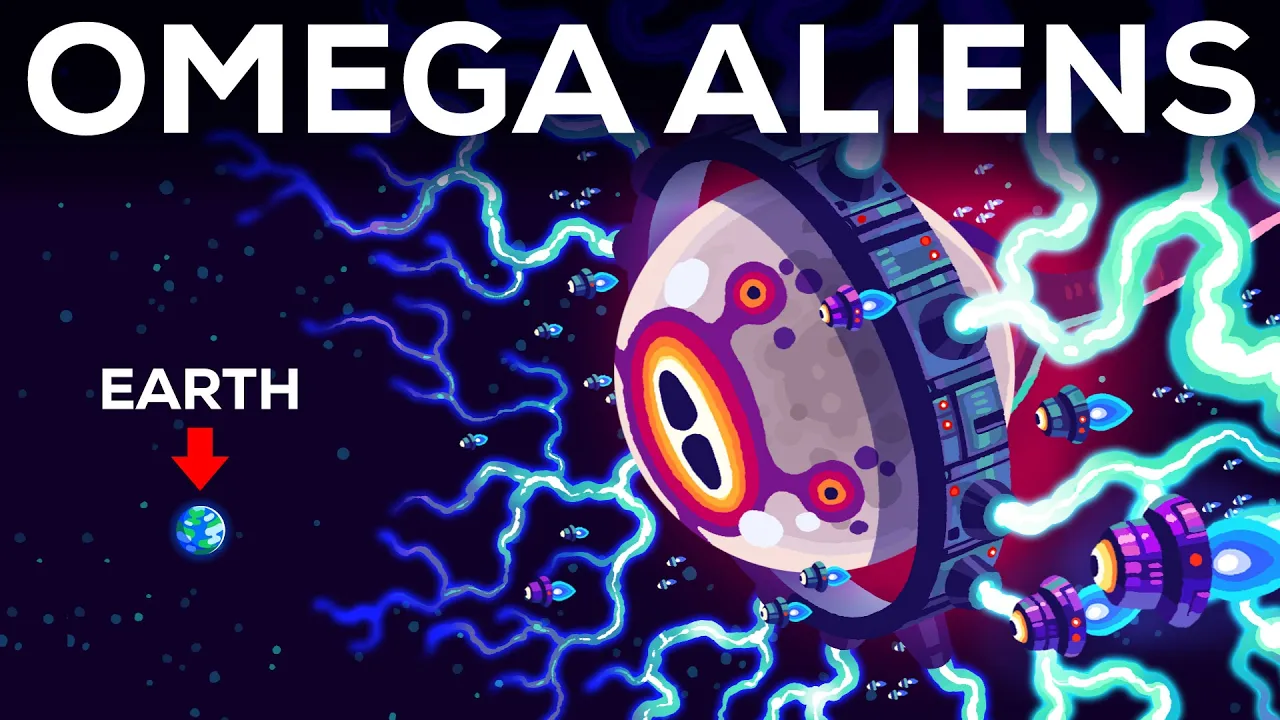
- Advanced alien civilizations might become more powerful by mastering microscopic reality rather than conquering space. Humanity assumes progress means bigger structures, greater energy consumption, and galactic expansion, but sufficiently advanced civilizations might achieve extraordinary capabilities without leaving their home systems.
- The Barrow scale offers an alternative to the Kardashev scale for measuring civilization's technological advancement. Kardashev measures energy control from planetary to galactic levels, while Barrow measures mastery of progressively smaller structures, reflecting how writing, chemistry, genetics, and transistors transformed humanity without requiring territorial expansion.
- A Type 2-minus civilization could potentially overcome biological aging and radically redesign living organisms. Building on genetic engineering and processes observed in the rejuvenating jellyfish Turritopsis dohrnii, such a civilization might eliminate diseases, grow replacement organs, enhance human abilities, and create entirely new species.
- Genetic engineering might eventually allow civilizations to reshape entire ecosystems and address environmental problems. The episode imagines plants engineered to absorb atmospheric carbon dioxide rapidly and permanently store the carbon, alongside organisms designed to repair damaged ecosystems or perform functions unavailable in nature.
- Type 3-minus and Type 4-minus civilizations could turn ordinary matter into programmable technology. Precise manipulation of molecules and atoms might produce self-repairing infrastructure, adaptive buildings, microscopic surgical robots, and swarms of nanomachines capable of assembling into everyday objects.
- Atomic-scale recycling could make material scarcity largely disappear and reduce the need for interstellar expansion. If civilizations could rearrange discarded materials into useful products repeatedly, conquering distant planets for raw materials might become unnecessary, while extraordinarily dense information storage could enable immensely powerful computers.
- Type 5-minus civilizations could harness atomic nuclei for extraordinary energy production and potentially revolutionary computing. The episode claims that fusing hydrogen from a medium-sized lake could theoretically power present-day humanity for millions of years, while nuclear processes might enable computers operating far beyond conventional transistor speeds.
- The highest hypothetical Barrow stages extend to manipulating fundamental particles and potentially creating new universes. Type 6-minus civilizations might control quantum-scale physics, while Omega-minus civilizations could conceivably generate universes through the quantum vacuum; the episode acknowledges that these possibilities remain speculative and may still require large-scale resources.