Kurzgesagt – In a Nutshell

Kurzgesagt – In a Nutshell

Watch Facts Elle's

September 22, 2026

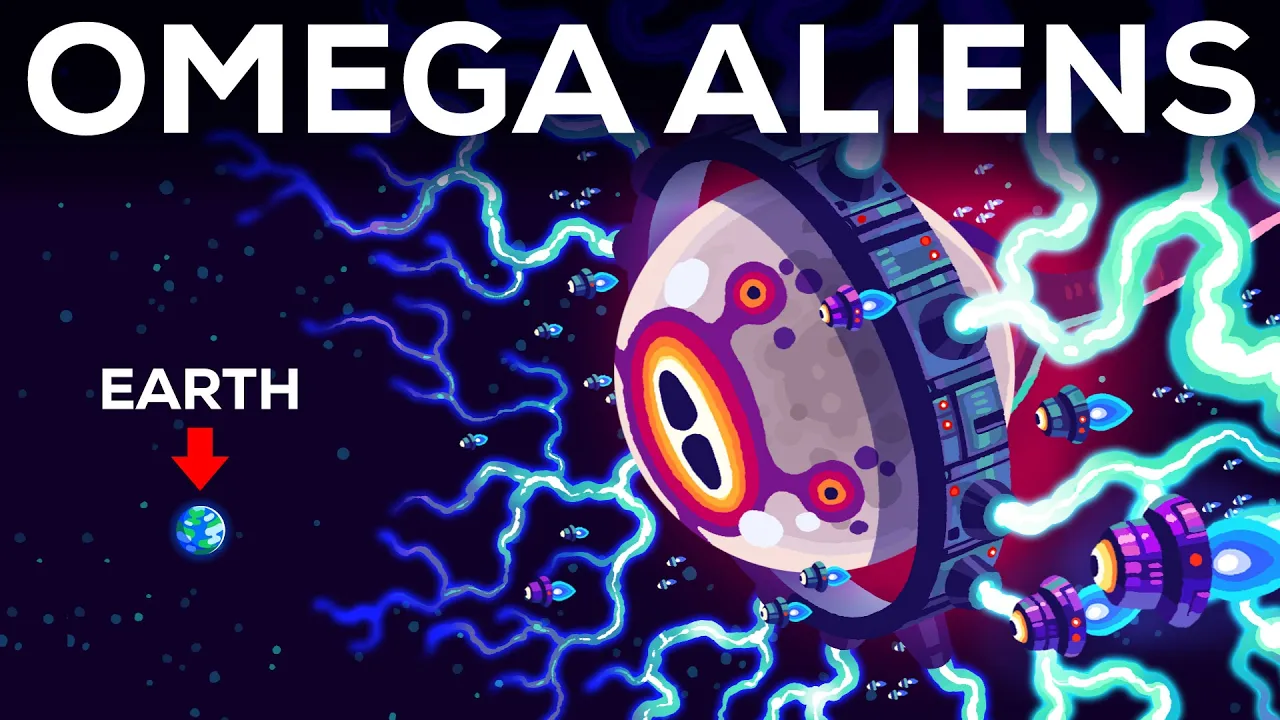
This Is What a Godlike Civilization Would Look Like

Facts

This Is What a Godlike Civilization Would Look Like

- Advanced alien civilizations might become more powerful by mastering microscopic reality rather than conquering space. Humanity assumes progress means bigger structures, greater energy consumption, and galactic expansion, but sufficiently advanced civilizations might achieve extraordinary capabilities without leaving their home systems.

- The Barrow scale offers an alternative to the Kardashev scale for measuring civilization's technological advancement. Kardashev measures energy control from planetary to galactic levels, while Barrow measures mastery of progressively smaller structures, reflecting how writing, chemistry, genetics, and transistors transformed humanity without requiring territorial expansion.

- A Type 2-minus civilization could potentially overcome biological aging and radically redesign living organisms. Building on genetic engineering and processes observed in the rejuvenating jellyfish Turritopsis dohrnii, such a civilization might eliminate diseases, grow replacement organs, enhance human abilities, and create entirely new species.

- Genetic engineering might eventually allow civilizations to reshape entire ecosystems and address environmental problems. The episode imagines plants engineered to absorb atmospheric carbon dioxide rapidly and permanently store the carbon, alongside organisms designed to repair damaged ecosystems or perform functions unavailable in nature.

- Type 3-minus and Type 4-minus civilizations could turn ordinary matter into programmable technology. Precise manipulation of molecules and atoms might produce self-repairing infrastructure, adaptive buildings, microscopic surgical robots, and swarms of nanomachines capable of assembling into everyday objects.

- Atomic-scale recycling could make material scarcity largely disappear and reduce the need for interstellar expansion. If civilizations could rearrange discarded materials into useful products repeatedly, conquering distant planets for raw materials might become unnecessary, while extraordinarily dense information storage could enable immensely powerful computers.

- Type 5-minus civilizations could harness atomic nuclei for extraordinary energy production and potentially revolutionary computing. The episode claims that fusing hydrogen from a medium-sized lake could theoretically power present-day humanity for millions of years, while nuclear processes might enable computers operating far beyond conventional transistor speeds.

- The highest hypothetical Barrow stages extend to manipulating fundamental particles and potentially creating new universes. Type 6-minus civilizations might control quantum-scale physics, while Omega-minus civilizations could conceivably generate universes through the quantum vacuum; the episode acknowledges that these possibilities remain speculative and may still require large-scale resources.

Gathered content

This Is What a Godlike Civilization Would Look Like

- Advanced alien civilizations may develop inward rather than expand across space. The central argument is that humanity could be mistaken in assuming technological progress must lead to Dyson spheres, interstellar travel, galactic empires, and ever-greater consumption of resources. Civilizations millions of years ahead of us might instead concentrate on controlling increasingly smaller layers of physical reality.

- Human ideas about alien civilizations reflect humanity's own expansionist history. Humans spread across Earth, eliminated many large animal populations, cleared roughly a third of its forests, excavated enormous quantities of minerals, and burned fossil fuels for energy. The episode argues that projecting this pattern into space may reveal more about human instincts than about the future of intelligence.

- Expansion historically produced wealth and security because land provided resources. For most of human history, controlling more territory meant obtaining more food, materials, and protection. This helps explain why people instinctively associate technological superiority with controlling larger areas.

- The Kardashev scale measures civilizations by the energy they can harness. A Type I civilization controls resources on its home planet, Type II commands the energy of its star system, and Type III operates on a galactic scale, potentially engineering stars, terraforming planets, and constructing enormous spacecraft.

- The Kardashev scale may overlook the most important direction of future progress. Although useful for describing large-scale energy consumption, it assumes that increasingly advanced civilizations continue expanding their physical reach. The episode proposes that mastery of microscopic processes could become more consequential than gathering additional territory or energy.

- Writing is presented as a greater technological achievement than the pyramids. The pyramids demonstrated humanity's ability to construct objects approximately 100 times larger than their builders. Writing, operating at a much smaller physical scale, allowed knowledge to survive individual lifetimes and travel across generations and geographical distances.

- Several transformative human advances came from manipulating increasingly smaller structures. Metal alloys produced better tools, engineered medicines prevented disease, industrial fertilizer production supported billions of people, and semiconductor technology transformed sand-derived materials into electronic components.

- Miniaturization made modern computers enormously more powerful. Advances in transistors compressed machines that once occupied entire rooms into handheld devices with vastly greater computational capabilities. The episode describes an improvement of hundreds of millions of times.

- The Barrow scale offers an alternative way of measuring technological advancement. Instead of measuring a civilization's energy consumption or territorial reach, it classifies civilizations according to how deeply they can manipulate the microscopic structure of reality.

- Type 1-minus represents control over ordinary human-scale objects and materials. This stage includes mining, refining minerals, constructing buildings, and combining materials into useful objects. According to the episode, it describes most of human technological history until the late nineteenth century.

- Type 2-minus represents comprehensive mastery of biology through DNA. A civilization at this level could understand and deliberately control the genetic instructions governing living organisms, fundamentally changing medicine, reproduction, evolution, and the biological environment.

- Humanity may be entering the earliest stages of Type 2-minus development. The episode cites the deciphering of the genetic code roughly 60 years earlier and the development of CRISPR gene-editing technology roughly a decade earlier as important milestones. These are presented as beginnings rather than evidence of complete genetic control.

- The jellyfish Turritopsis dohrnii provides a biological example of extreme rejuvenation. It can revert cells to earlier developmental states, potentially repeating its life cycle rather than undergoing ordinary aging. The episode uses this naturally occurring process to suggest that controlled biological rejuvenation might eventually become possible in other organisms.

- Advanced genetic engineering might eliminate many diseases and enable radical changes to human bodies. Possible applications include improving blood, bones, and muscles, repairing biological damage, and deliberately redesigning physical characteristics. These are hypothetical capabilities of a mature Type 2-minus civilization.

- Engineered organs could provide abilities humans do not naturally possess. Examples include eyes capable of perceiving additional colors, skin that heals without scarring, and brains capable of detecting magnetic fields.

- Artificial organ banks could transform transplantation and emergency medicine. Rather than relying on donated organs, a civilization might grow replacement hearts, lungs, and eyes that are available when someone experiences injury or organ failure.

- Genetic mastery could extend the lifespans of animals and alter entire species. The episode suggests that advanced civilizations might prevent aging in pets, modify organisms that threaten them, and redesign other species for human purposes.

- Biotechnology could allow civilization to deliberately reshape the planetary biosphere. Scientists might create entirely new organisms for practical or aesthetic purposes, potentially producing a burst of biological diversity comparable to the Cambrian explosion.

- Engineered plants could theoretically help reverse climate change. The proposed approach involves extremely fast-growing vegetation that absorbs atmospheric carbon dioxide and locks its carbon into materials resistant to decomposition. The episode explicitly acknowledges that such plants remain speculative rather than an existing solution.

- Planet Wild is presented as an example of conservation methods available today. The crowdfunding organization reportedly has more than 25,000 members financing monthly environmental restoration projects, with missions documented publicly through YouTube videos.

- A Planet Wild project in Canada helped reconnect habitat fragmented by highways. Infrastructure funded through the initiative was intended to create safer movement routes for grizzly bears and connect protected areas into a larger wildlife corridor.

- The episode suggests that humanity might approach Type 2-minus capabilities within decades to centuries. This is an optimistic technological possibility, not an established forecast. Full biological control would require advances far beyond current gene-editing techniques.

- Type 3-minus and Type 4-minus civilizations would manipulate individual molecules and atoms. Their technological capabilities would extend beyond ordinary chemistry, allowing them to assemble and rearrange matter with precision comparable to humans stacking building blocks.

- Atomic-scale manipulation could fundamentally change the properties of manufactured materials. The episode imagines substances substantially stronger, more adaptable, and more versatile than those currently available.

- Clothing and surfaces could respond dynamically to environmental conditions. Examples include fabrics that change texture according to weather conditions and coatings that transform into electronic displays.

- Infrastructure could become capable of maintaining and adapting itself. Roads and bridges might repair cracks before structural deterioration occurs, while buildings could respond to light, sound, and physical stress by changing their insulation, openings, or structural reinforcement.

- Matter could eventually become programmable. Instead of manufacturing permanently fixed objects, advanced civilizations might create physical materials whose structures and functions can be changed through computational instructions.

- DNA demonstrates how enormous amounts of information can be stored in tiny physical structures. The episode identifies biological DNA as an exceptionally dense information-storage system and argues that its efficiency comes from the precise arrangement of atoms rather than any unique supernatural property.

- Microscopic robots could perform tasks inside organisms and environments. Proposed applications include removing pollutants from water and conducting delicate surgical procedures within the human body.

- Utility fog could allow physical objects to assemble and reassemble themselves. The concept involves billions of microscopic robots coordinating into larger structures, potentially forming furniture, tools, or other objects on demand.

- Advanced nanotechnology could blur the distinction between physical objects and software-controlled machines. A sufficiently sophisticated material system could behave like hardware whose physical form and function are determined by software.

- The episode recognizes that highly programmable matter could be extremely dangerous. It does not describe atomic-scale manufacturing as an automatically beneficial development, acknowledging that the ability to manipulate matter so extensively would introduce major risks.

- Precise atomic rearrangement could radically reduce waste. Because ordinary objects consist of atoms in particular arrangements, damaged, discarded, or decomposed materials could theoretically be reconstructed into useful products rather than permanently thrown away.

- Atomic recycling could dramatically reduce material scarcity. A civilization able to reuse its existing resources repeatedly might satisfy much of its demand without continually extracting new raw materials.

- Mastery of matter could eliminate much of the economic motivation for interstellar expansion. If a planet already contains most of the atoms needed for an advanced civilization, traveling light-years to obtain more resources may offer little advantage compared with efficiently recycling what is locally available.

- Molecular-scale information storage could enable extraordinarily compact computers. The episode speculates that the combined computing capacity of today's data centers might eventually fit into a device approximately the size of a human fist.

- Much greater computing capacity could accelerate artificial intelligence, simulations, and scientific research. Such machines might support investigations that are currently computationally impossible, including detailed simulations of complex physical and biological systems.

- Type 5-minus civilization represents mastery of atomic nuclei. Atomic nuclei are described as structures approximately 10,000 times smaller than atoms themselves. Controlling them would mean manipulating the components responsible for nuclear reactions and much of the energy released by stars.

- Nuclear fusion could provide energy on a scale that makes conventional resource constraints nearly irrelevant. The episode claims that fusing the hydrogen contained in a medium-sized lake could theoretically supply present-day humanity's energy needs for millions of years. This is offered as an illustration of nuclear energy's enormous potential, not as an existing engineering capability.

- Reliable control of nuclear processes could make Dyson spheres unnecessary. A civilization obtaining abundant energy through local nuclear manipulation might have little reason to construct enormous structures around stars to capture their radiation.

- Information processing could become the primary frontier once material and energy scarcity disappear. When health, physical resources, and energy are effectively abundant, further progress would depend increasingly on the ability to calculate, design, and reorganize those resources.

- Atomic nuclei might support computing speeds far beyond conventional electronics. The episode describes internal proton and neutron processes occurring sextillions of times per second, billions of times faster than modern transistors switch states.

- Harnessing nuclear processes for computation could create an entirely new class of computers. If those extremely rapid physical changes could be controlled and used to encode information, the resulting machines might exceed the capabilities of ordinary electronic computers by enormous margins.

- Nuclear-scale computers could potentially design new forms of matter and life. The episode suggests that such processing power might allow civilizations to explore complicated scientific problems and engineer structures that are impossible to calculate using present-day technology.

- These advanced stages are explicitly presented as speculation rather than established technological pathways. The episode acknowledges that manipulating matter at extremely small scales requires substantial energy and that predicting the capabilities of distant civilizations is inherently uncertain.

- The difficulty of imagining advanced technologies is compared with humanity's historical inability to predict modern inventions. People living centuries ago could not readily have anticipated the internet, genetic engineering, or drone warfare. The argument is that present-day humans may be similarly unable to anticipate technologies available to much older civilizations.

- Type 6-minus represents manipulation of elementary particles. This stage extends beneath atomic nuclei to particles such as electrons, neutrinos, and quarks, approaching the fundamental structures described by modern particle physics.

- The quantum vacuum becomes the next hypothetical technological frontier. The episode describes particles as excitations emerging from underlying quantum fields, with the vacuum forming part of the fundamental physical structure of reality.

- A civilization controlling elementary particles might discover applications of physics that humans cannot presently imagine. The episode emphasizes that there is no reliable way to predict the practical abilities associated with such profound control.

- Control over microscopic physics might hypothetically allow access to additional spatial dimensions. The possibility is raised that extremely advanced civilizations could discover and manipulate dimensions or physical structures inaccessible to current human technology.

- Advanced civilizations might theoretically alter local physical conditions, including the passage of time. The episode speculates about manipulating physical laws or changing how time passes across areas as large as planets or star systems. It does not establish that either capability is physically achievable.

- Omega-minus civilization represents the hypothetical ability to create new universes. The episode proposes that complete mastery of the quantum vacuum could provide control over processes potentially responsible for the emergence of entire universes.

- The universe's possible origin in a quantum-vacuum instability provides the basis for the universe-creation hypothesis. If our cosmos emerged from a tiny fluctuation that underwent rapid expansion, the episode suggests that sufficiently advanced technology might reproduce something resembling that process.

- Universe creation is illustrated through the hypothetical possibility of generating a cosmos inside a laboratory. The episode uses the image of seeding new universes in test tubes to convey how radically different Omega-minus capabilities would be from conventional space exploration.

- An Omega-minus civilization would possess capabilities resembling those traditionally attributed to cosmic gods. The comparison refers specifically to its hypothetical command over the smallest foundations of reality and the possible creation of entire universes.

- The inward-development hypothesis does not prove that advanced civilizations would abandon outward expansion. The episode explicitly acknowledges that even extremely sophisticated microscopic technologies might require substantial resources gathered through conventional large-scale infrastructure.

- Civilizations could pursue microscopic mastery and large-scale expansion simultaneously. Rather than treating the Kardashev and Barrow scales as mutually exclusive, the episode leaves open the possibility that both describe complementary forms of technological development.

- Highly advanced civilizations might remain geographically concentrated rather than becoming visible galactic empires. If control over matter, energy, and computation enables nearly unlimited capabilities locally, a civilization could potentially become extraordinarily powerful without occupying vast regions of space.

- The absence of conspicuous galactic engineering would not necessarily imply an absence of advanced intelligence. The episode's reasoning allows for civilizations whose technological achievements are primarily microscopic and therefore less visible through conventional astronomical observations. This is a possible interpretation, not evidence that such civilizations exist.

- The ultimate limits of civilization may be determined more by the laws of physics than by available territory. The episode argues that the route toward extreme longevity, technological power, and control over nature might run through increasingly fundamental physical structures rather than through territorial conquest.

- Kurzgesagt identifies merchandise sales as an important source of funding for its free videos. The channel states that its shop is reaching its tenth anniversary and has become one of its most important income streams, helping finance content available without payment.

- The Human Era Calendar is identified as one of Kurzgesagt's most sought-after products. The episode announces an upcoming edition, indicating that the calendar remains an established part of the channel's merchandise business.

- Kurzgesagt has introduced a merchandise rewards program called Cosmic Expedition. Customers can accumulate experience points and receive benefits including discounts and exclusive products, adding a loyalty mechanism to the channel's existing merchandise operation.

Read Facts →
...

August 4, 2026

Why Humanity Will Never Leave The Solar System

Facts

Why Humanity Will Never Leave The Solar System

- Even humanity's fastest spacecraft would take approximately 2,500 years to reach the outer edge of the solar system. At the Parker Solar Probe's cited speed of 635,000 km/h, Mars would take just two weeks, but the distant Oort cloud creates an enormous barrier before interstellar travel even begins.

“The barrier of nothingness that might trap us in the solar system forever.” — Kurzgesagt

- Nuclear fusion or antimatter propulsion could theoretically make nearby stars reachable within a human lifetime. Kurzgesagt imagines a spacecraft traveling at 20% of light speed, or 216 million km/h, capable of reaching the outer Oort cloud in eight years and Alpha Centauri in approximately 20 years.

- Interstellar dust could make extremely fast spacecraft dangerously vulnerable. At 20% of light speed, a single dust grain could strike with grenade-like energy, while a golf-ball-sized rock could release more than twice the energy of the Hiroshima atomic bomb, requiring extraordinary shielding.

“We might have reached our natural speed limit here” — Kurzgesagt

- A 40-year journey at 20% of light speed would reach only eight light-years, with no known destination clearly suitable for human settlement. Astronauts could spend decades traveling through deadly conditions only to discover scientifically fascinating but uninhabitable planets.

“Imagine traveling your entire life and then arriving at a Mars.” — Kurzgesagt

- Our stellar neighborhood offers surprisingly few promising destinations. Kurzgesagt describes a region 25 light-years across containing 34 stars and six brown dwarfs, with only three Sun-like stars, including our Sun and Alpha Centauri A; most neighboring stars are red dwarfs.

- Being inside a star's habitable zone does not mean a planet can support humans. Mars provides a nearby warning, while potentially promising planets such as GJ 1061 d remain uncertain; genuinely habitable worlds could lie dozens or thousands of light-years away.

“But, Mars is also in the habitable zone of the Sun and it is really bad.” — Kurzgesagt

- Future interstellar expansion may depend on changing how humans travel rather than merely building faster engines. Kurzgesagt considers eliminating biological aging, sending AI-controlled spacecraft carrying embryos, and developing advanced telescopes to identify suitable planets before committing to voyages lasting centuries.

“Maybe they could send AI spaceships with embryos or some version of that into space.” — Kurzgesagt

- Kurzgesagt acknowledges that its pessimistic predictions could be overturned by revolutionary technology. The video cites a 1903 New York Times prediction that powered flight was millions of years away, followed by the first successful flight 69 days later and the Moon landing 66 years afterward.

“We genuinely don’t know.” — Kurzgesagt

Gathered content

Why Humanity Will Never Leave The Solar System

- Humanity may never escape the solar system in a meaningful way. Kurzgesagt argues that enormous distances, dangerous interstellar matter, and the limits of propulsion could prevent humans from establishing civilizations around other stars, even with major technological advances.

- Millions of alien civilizations could face the same physical barriers. The video proposes that intelligent life might be widespread while meaningful travel between star systems remains extremely rare or impossible for biological civilizations.

- The scale of space is difficult for humans to comprehend. Human intuition evolved to understand distances encountered on Earth, making it difficult to distinguish between journeys that are merely enormous and those that are millions of times longer.

- The fastest humans have traveled was approximately 40,000 kilometers per hour. Astronauts returning from the Moon in 1969 reached this speed, which remains extremely slow compared with the distances between stars.

- NASA's Parker Solar Probe demonstrates how much faster an uncrewed spacecraft can travel. The video cites a speed of approximately 635,000 kilometers per hour, achieved after seven years of gravitational maneuvers involving Venus and the Sun.

- At 635,000 kilometers per hour, a spacecraft could circle Earth in approximately four minutes. It could also cover the distance between Earth and the Moon in roughly 36 minutes, illustrating how extraordinary the probe's speed is by conventional standards.

- Conventional rockets require approximately seven to ten months to reach Mars. A hypothetical crewed spacecraft traveling at the Parker Solar Probe's cited speed could reduce that journey to about two weeks under the video's simplified assumptions.

- Pluto would still be approximately a year away at Parker Solar Probe speeds. Even a spacecraft traveling much faster than conventional vehicles would require substantial time to reach the outer solar system.

- Crossing the heliopause would take approximately two additional years after reaching Pluto. The heliopause marks the boundary where the solar wind gives way to the surrounding interstellar environment, although it is not the outermost limit of the solar system.

- The hypothetical spacecraft would pass Voyager 2 roughly another year later. Voyager 2 took more than five decades to reach the distance used in the comparison, showing how dramatically faster the imagined spacecraft would be.

- Reaching the outer edge of the Oort cloud would take approximately 2,500 years at Parker Solar Probe speeds. The video treats this distant region of icy objects as the solar system's true outer boundary, beyond which lies interstellar space.

- The journey across the outer solar system could exceed the lifespan of entire civilizations. Kurzgesagt compares 2,500 years with the period from the founding of the Roman Republic to the present, emphasizing that the enormous journey would still bring travelers nowhere near another star.

- The greatest initial obstacle to interstellar travel is the enormous distance across largely empty space. Even reaching the outer solar system would require extraordinary resources while offering comparatively little progress toward another star.

- No established technology allows humans to travel faster than light, teleport, or suspend biological activity indefinitely. The video therefore excludes warp drives, teleportation, and human freezing from its practical travel scenarios.

- Nuclear fusion and antimatter propulsion could theoretically enable much faster spacecraft. These energy sources are presented as physically plausible ways to achieve substantial fractions of light speed, although their engineering and energy challenges remain unresolved.

- Kurzgesagt assumes an optimistic future spacecraft capable of traveling at 20% of light speed. That corresponds to approximately 60,000 kilometers per second, or 216 million kilometers per hour, far beyond current spacecraft capabilities.

- At 20% of light speed, a spacecraft could reach the outer regions of the solar system in approximately 3.5 days. Under the video's assumptions, it could also reach the outer Oort cloud in about eight years.

- Alpha Centauri could be reached in approximately 20 years at 20% of light speed. As the closest stellar system to the Sun, it becomes the first plausible interstellar destination in the hypothetical high-speed scenario.

- Interstellar space is not completely empty. It contains energetic particles, individual atoms, gas, dust, and larger objects, all of which become potential hazards to spacecraft traveling at relativistic speeds.

- Even individual atoms can damage a spacecraft moving at 20% of light speed. Kurzgesagt describes how an iron atom striking a spacecraft at this velocity could produce a damage track several tenths of a millimeter deep.

- Repeated atomic impacts could gradually destroy a spacecraft's hull. Over decades of high-speed travel, enormous numbers of microscopic collisions could accumulate into serious structural damage.

- An advanced spacecraft would require substantial forward-facing shielding. The video imagines a protective sail or shield designed to absorb, deflect, or slow incoming particles before they reach the main spacecraft.

- Shielding against individual atoms would not eliminate the danger from larger debris. Even if protection were effective against gas and microscopic particles, collisions with dust grains and rocks would pose much greater threats.

- A single grain of dust could strike with energy comparable to a grenade at 20% of light speed. The impact would rapidly vaporize the grain, causing an explosive release of energy that could erode or damage the spacecraft's protective shield.

- A golf-ball-sized rock could produce an impact exceeding twice the energy of the Hiroshima atomic bombing. The example illustrates how small objects become extraordinarily destructive when struck at a substantial fraction of light speed.

- Increasing spacecraft speed would make collision hazards progressively worse. Kurzgesagt suggests that the danger from interstellar matter could create a practical speed ceiling, even if more powerful propulsion systems become available.

- Twenty percent of light speed is presented as a possible practical limit, not a proven physical speed limit. The video acknowledges uncertainty but suggests that sufficiently advanced shielding might allow spacecraft to survive journeys to nearby stars at approximately this speed.

- Alpha Centauri would take roughly 10,000 years to reach using the earlier, slower spacecraft scenario. The comparison with the hypothetical 20-year journey demonstrates how strongly interstellar travel depends on propulsion advances.

- A 20-year interstellar journey would create serious challenges for a human crew. Astronauts would spend decades confined to a relatively small spacecraft, facing social, psychological, and survival problems before reaching their destination.

- Communications with Alpha Centauri would take approximately four years to reach Earth. Even after arriving successfully, astronauts could not immediately report their discoveries or conduct real-time conversations with people at home.

- Reaching another star would not guarantee finding a habitable world. The video's fictional Alpha Centauri mission ends with astronauts discovering interesting planets that are nevertheless deadly or unsuitable for human settlement.

- Scientific exploration and human colonization offer different rewards. A hostile planetary system could produce valuable astronomical discoveries without offering any realistic opportunity for people to live there.

- An interstellar expedition could consume decades while delivering no settlement opportunity. The video questions whether people would accept the dangers and personal sacrifices of such a journey when the destination might be less hospitable than Earth.

- A 40-year journey at 20% of light speed would cover approximately eight light-years. This defines the video's illustrative range for human exploration within a substantial portion of one lifetime, ignoring additional travel complications.

- The number of attractive destinations within eight light-years appears extremely limited. Kurzgesagt argues that none of the nearby targets is known to offer living conditions that clearly justify decades of dangerous travel.

- The Sun occupies a relatively sparse part of the galaxy. The video suggests that the local shortage of appealing nearby star systems makes interstellar expansion especially difficult for humanity.

- The Sun's galactic surroundings could change over millions of years. As the solar system moves through the Milky Way, the proximity of other stars may change, potentially creating more favorable circumstances for interstellar exploration.

- Small civilizations spanning nearby star systems might still be possible. Kurzgesagt leaves open the prospect of localized interstellar settlements where stars are sufficiently close together, without assuming a galaxy-wide connected civilization could form.

- The video examines a stellar neighborhood approximately 25 light-years in diameter. This region is described as representing just 0.02% of the Milky Way, illustrating how small even an expanded local exploration zone would be relative to the galaxy.

- The defined neighborhood contains 34 stars and six brown dwarfs. Brown dwarfs are objects that lack sufficient mass to sustain ordinary hydrogen fusion like true stars.

- Only three stars in the video's defined neighborhood are described as similar to the Sun. These include the Sun itself and Alpha Centauri A, leaving very few nearby Sun-like stars as potential exploration targets.

- Most nearby stars are red dwarfs. Their planetary systems may contain worlds exposed to harsh conditions, complicating the search for destinations suitable for human life.

- A planet's location in its star's habitable zone does not make it habitable. The habitable zone describes distances where liquid water might exist under suitable conditions, but it does not guarantee a safe atmosphere, favorable temperatures, or Earth-like conditions.

- Mars demonstrates the limitations of the habitable-zone concept. Although the video places Mars within the Sun's habitable zone, its actual surface conditions are extremely hostile to unprotected humans.

- GJ 1061 d is presented as an intriguing but uncertain potentially Earth-like destination. Its apparent promise does not establish that it possesses breathable air, liquid oceans, or other conditions necessary for human settlement.

- Remote observations cannot guarantee that an apparently promising planet is suitable for settlement. Explorers might devote an entire lifetime to reaching a world only to discover conditions comparable to Mars.

- The most attractive potential destinations might be dozens or thousands of light-years away. Planets with stable oceans, breathable atmospheres, and other favorable characteristics could exist far beyond the local stellar neighborhood.

- A genuinely Earth-like world could also offer evidence of extraterrestrial life. The video suggests that planets with oceans and breathable atmospheres might support microbial organisms or more complex life, making them especially important scientific targets.

- Traveling to distant habitable planets could require hundreds or thousands of years. Even at a substantial fraction of light speed, distances of dozens to thousands of light-years create enormous journey times.

- Long-distance interstellar settlement would require more than fast propulsion. Future civilizations would need reliable protection from collisions, life-support systems capable of operating for extraordinary periods, and ways to sustain human populations over immense distances.

- Solving biological aging could change what counts as an acceptable journey. If future humans could remain healthy for centuries, voyages lasting several hundred years might become personally feasible rather than requiring many generations of travelers.

- Artificial intelligence could make interstellar missions possible without transporting adult humans. One proposed approach involves autonomous spacecraft carrying embryos or other biological material, potentially establishing human populations after reaching suitable destinations.

- Highly advanced telescopes could reduce the danger of choosing unsuitable destinations. Future civilizations might identify planetary conditions much more accurately before committing to centuries-long expeditions.

- Finding viable ways to reach other stars would not automatically create a connected interstellar civilization. The enormous separations between settlements would still make communication, coordination, transportation, and sustained relationships difficult.

- Even highly advanced descendants of humanity might struggle to maintain a civilization spanning multiple star systems. The video distinguishes between sending individual expeditions and creating a durable, interconnected society across interstellar distances.

- Current rockets, computers, and even hypothetical fusion reactors are considered inadequate for ambitious interstellar expansion. Kurzgesagt argues that ordinary technological progress may not be enough to overcome the combined barriers of distance, speed, collisions, and human biology.

- Meaningful interstellar civilization might require technology radically beyond today's capabilities. The video compares the necessary transformation to technologies that would have seemed unimaginable to prehistoric hunter-gatherers.

- The video's pessimistic conclusion is deliberately qualified by uncertainty about future discoveries. Its argument rests on presently understood physics and plausible engineering limits, not on proof that interstellar travel will remain impossible forever.

- A 1903 New York Times editorial is used to demonstrate the danger of technological predictions. Kurzgesagt cites Flying Machines Which Do Not Fly, describing its prediction that powered flight would take another one to ten million years to achieve.

- Powered flight reportedly arrived just 69 days after the newspaper's prediction. The rapid achievement is used to show how confidently stated technological forecasts can be overturned by unexpected progress.

- Humans landed on the Moon only 66 years after the first successful powered flight. The extraordinary technological advances between 1903 and 1969 provide the video's strongest historical counterargument to declaring future interstellar exploration impossible.

- Kurzgesagt acknowledges that its own predictions could appear equally mistaken in a century. The creators explicitly hope that future technological breakthroughs will make their assessment of humanity's interstellar limitations look excessively pessimistic.

- The central obstacle is the combination of distance, collision hazards, and uncertain destinations. Overcoming any one problem would not necessarily make interstellar settlement practical because the other limitations would remain.

- Humanity's future might not depend on expanding outward into space. The video briefly raises the possibility that a radically different path, described as looking deep down rather than outward, could change how civilization develops, although it does not explain that alternative in this episode.

Read Facts →
...