Amtrak’s $16 Billion Blind Spot: The Tunnel Trump Had Already Targeted
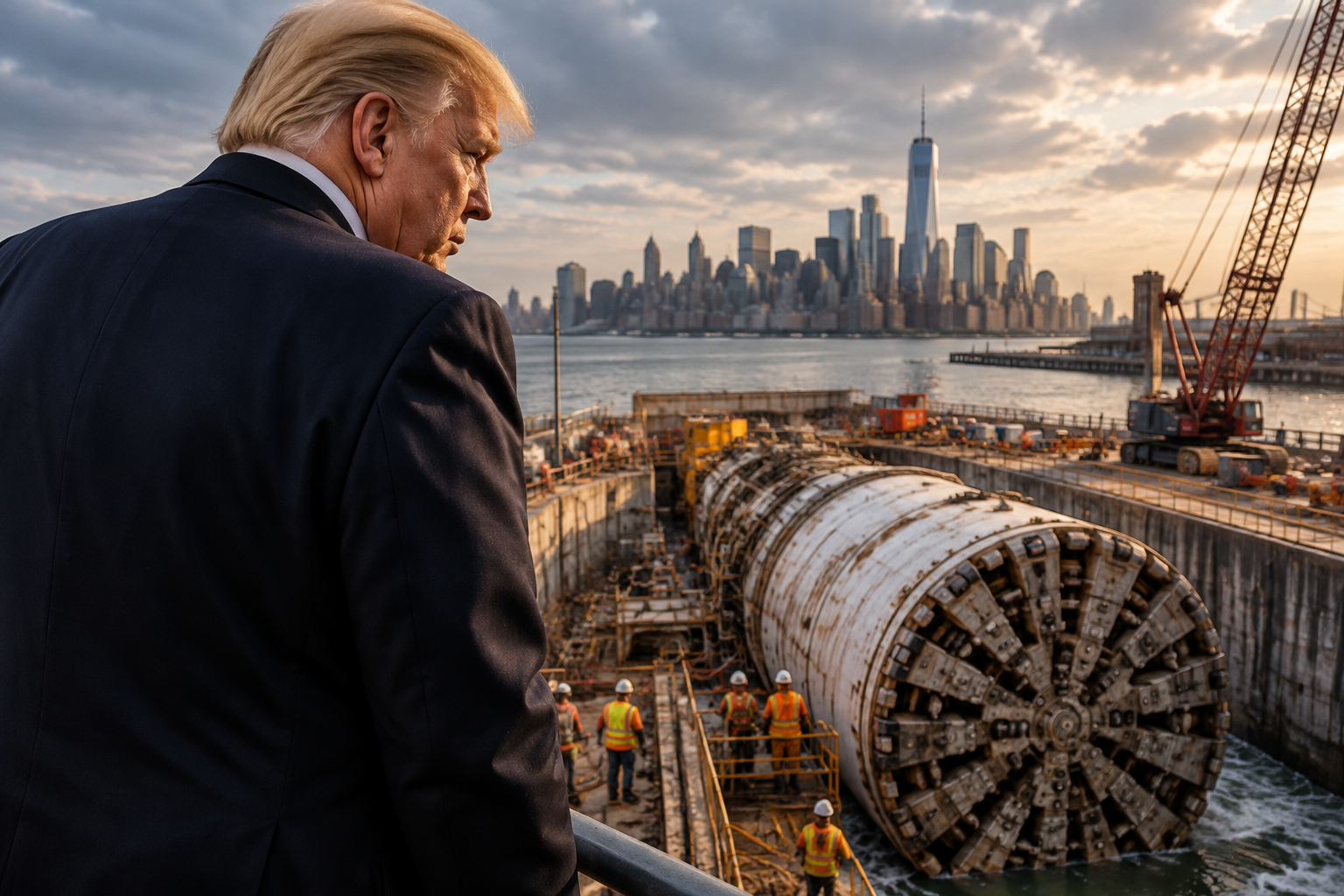
Wendover Productions presented Amtrak's quiet progress as a strategy for surviving hostile politics. By the time the video appeared, the Trump administration had already frozen federal funding for one of the most important projects in the story.
That is not an unfortunate coincidence discovered months later. It is a contradiction at the center of the argument.
On October 17, 2025, Wendover Productions published Amtrak's Subtle, Surprising Success, an examination of how America's passenger railroad was improving through modest service expansions, newer trains, and long-overdue infrastructure investment.
The film's most consequential argument concerned politics. Ambitious new railway projects, it suggested, attract opposition, while smaller improvements and construction already underway can proceed without becoming political targets.
The narrator described these projects as falling "under the radar and thus are being left alone."
But on September 30, 2025, the Department of Transportation had already notified the Gateway Development Commission that federal disbursements for the Hudson Tunnel Project were being suspended. The next day, all federal funding for the project stopped.
The political threat Wendover described as something Amtrak might avoid had arrived 17 days before the video was published.
The $16 Billion Exception That Destroys the Rule
The Hudson Tunnel Project is not an obscure investment.
It is a $16.04 billion undertaking to construct a new rail tunnel beneath the Hudson River between New Jersey and Manhattan and rehabilitate the existing North River Tunnel.
That existing tunnel opened in 1910. It carries roughly 200,000 passengers daily and remains a critical connection for Amtrak and New Jersey Transit. Major failures could disrupt one of America's most economically important transportation corridors.
Wendover recognized its importance.
The film presented progress on the Gateway Program, including the Hudson Tunnel Project, as evidence that Amtrak was finally overcoming obstacles that had frustrated passenger rail development for decades.
The analysis was persuasive until it moved from describing construction progress to predicting political protection.
The narrator proposed that smaller projects, additional services, and established construction efforts might survive by attracting less attention than politically controversial high-speed railway proposals.
Yet the Hudson Tunnel was both an established construction project and an obvious political target.
On October 1, 2025, Gateway Development Commission CEO Thomas Prendergast publicly acknowledged the federal funding pause. News organizations, including Reuters and The Washington Post, reported the confrontation that same day.
It was not a hidden development.
The federal government had frozen funding for a project that Wendover was presenting as evidence of a relatively secure future for American passenger rail.
The distinction matters. Wendover's examples of adding train departures are substantially different from building a multibillion-dollar tunnel. The video treated both as components of a wider strategy of incremental progress.
But increasing an existing route's frequency and replacing a century-old tunnel have profoundly different financial and political requirements.
One can proceed through modest operational adjustments. The other depends on years of federal commitments, state cooperation, major contractors, and uninterrupted access to capital.
Grouping them together made the strategy appear more durable than its largest investments actually were.
The Administration Did Not Merely Threaten the Project
The Trump administration initially justified the funding suspension as a review of compliance with federal nondiscrimination requirements.
The Department of Transportation had changed rules governing its Disadvantaged Business Enterprise program, which addresses participation by qualifying smaller businesses in federally funded transportation contracts.
A legitimate compliance review would not, by itself, establish political retaliation.
But the record goes considerably further.
On October 7, 2025, the department requested information about the Gateway Development Commission's contracting practices.
The commission responded on October 21. On December 1, federal officials identified additional concerns and indicated funding could resume if the commission supplied the requested certification.
Gateway complied on December 8 and followed up on January 8, 2026.
The funding remained frozen.
Meanwhile, President Trump publicly described the project in explicitly political terms.
In an October 17, 2025, Fox Business interview cited by a federal court, he said:
"The project is gonna be dead. It's just pretty much dead right now."
The date is remarkable.
On the very day Wendover published its assessment of Amtrak's political resilience, the president was publicly describing the possible destruction of one of its central infrastructure projects.
That does not prove the video's creators knew about the interview or deliberately omitted the funding dispute. The production may have been substantially finished before the suspension.
It does mean the argument was already contradicted by publicly available facts when the finished work appeared.
By June 2026, the legal record had become even more damaging.
Federal District Judge Jeannette Vargas ruled that the suspension of Gateway's grants violated federal regulations.
The government had withheld payments without first establishing that the commission had violated applicable requirements or providing the appeal process required by those regulations.
The judge found the suspension unlawful and ordered it set aside.
The ruling addressed the federal grants; it did not resolve every claim involving the project's separate federal loan agreements.
The administration had a legitimate interest in enforcing contracting laws. It did not have unlimited authority to interrupt previously awarded grants while deciding whether a violation existed.
That distinction was decisive in court.
What Four Months Without Federal Payments Actually Cost
The financial consequences were more immediate than a disagreement over transportation policy.
Approximately $12 billion of the Hudson Tunnel Project's budget depended on federal grants.
The remaining financing included federal loans backed by repayment commitments from New York, New Jersey, and regional partners.
Those commitments were supposed to provide the financial certainty necessary for construction.
Instead, Gateway spent four months using available cash and credit to keep contractors working while federal payments were withheld.
By January 27, 2026, the commission announced that its available funding was nearly exhausted.
Construction would have to stop on February 6 unless the federal government resumed payments.
The commission had already invested more than $1 billion in construction.
Tunnel-boring machines had been procured. Access shafts, bridges, and other preparatory works were underway.
These were not conceptual plans that could simply be postponed without immediate consequences.
They were active construction sites.
When work stopped on February 6, nearly 1,000 jobs were affected.
Gateway's litigation described potential shutdown-related expenditures of $15 million to $20 million per month to secure unfinished sites, manage equipment, and maintain safety.
Those figures represented estimated costs associated with a prolonged suspension, not a verified final bill for the interruption.
The distinction is important because the project did eventually recover.
Nevertheless, the government had withheld approximately $205 million in requested payments, and the commission had been forced to finance work that federal agreements were intended to support.
The political dispute had become a construction problem, a financing problem, and an employment problem.
A project does not have to be permanently canceled for political interference to cause material harm.
The court subsequently recorded increased legal and administrative expenses, reliance on credit, and additional time required to remobilize construction sites.
Those are tangible costs of uncertainty, even when the underlying investment survives.
Federal Commitments Were Not the Protection Wendover Assumed
Wendover correctly identified the bipartisan infrastructure legislation enacted under President Biden as a foundation for major Amtrak improvements.
It also observed that the Trump administration was claiming credit for projects reaching visible milestones during its second term.
The film suggested that this political credit-taking might help protect existing investments.
There is a plausible argument here: an administration may prefer celebrating a completed bridge or new train to explaining why it canceled construction.
But the Hudson Tunnel dispute demonstrates the limits of that reasoning.
A government can claim credit for some railway improvements while withholding funds from others.
It can celebrate a new train and challenge an older funding agreement.
It can favor the Northeast Corridor generally while pursuing a confrontation over a specific project.
Indeed, the Department of Transportation announced a $4.7 billion Northeast Corridor investment initiative in April 2026, including opportunities involving New York Penn Station and Washington Union Station.
Meanwhile, Amtrak continued working with federal officials on Baltimore's Frederick Douglass Tunnel, with an expected opening in 2036.
These developments undermine any simple claim that the Trump administration uniformly opposed passenger rail.
They also undermine Wendover's simpler implication that established railway investments were escaping political scrutiny.
The real distinction is not necessarily between large and small projects, or between new proposals and existing construction.
It is between projects an administration chooses to support and projects it chooses to challenge.
That distinction makes Amtrak's future considerably less predictable.
Political discretion cannot be eliminated by presenting infrastructure improvements as routine maintenance or incremental progress.
A railway may manage construction efficiently, meet its obligations, and secure funding agreements, yet still face a government decision capable of interrupting its work.
The Hudson Tunnel case exposed precisely that vulnerability.
Ridership Records Do Not Resolve the Financial Question
Wendover's examination of Amtrak's operating performance deserves a separate challenge.
The film highlighted the extraordinary success of the Borealis service between Chicago and St. Paul, the expansion of Cascades departures, and increased Northeast Corridor capacity.
These achievements were real.
Amtrak recorded 32.8 million passenger trips in fiscal 2024, a 15% increase over the previous year.
The company also reported an adjusted operating loss of approximately $705 million.
That loss does not establish that the additional trains were poor investments. Nor does Amtrak's public-service mission require every route to recover its costs through ticket sales.
But ridership alone cannot establish financial efficiency.
An additional train can attract substantial demand while requiring ongoing operating subsidies. A route can be socially valuable without being commercially self-supporting.
Determining whether expansion represents good public investment requires more than counting passengers.
It requires examining operating costs, revenue, subsidies, capital requirements, reliability, and the benefits passengers receive.
Wendover's argument that additional departures often require comparatively little beyond rolling stock and staffing is credible in certain circumstances.
Its weakness lies in leaving the reader without a clear assessment of what those additions cost.
Amtrak's subsequent financial results illustrate why the distinction matters.
Fiscal 2025 brought another passenger record: 34.5 million trips, an increase of 5.1%.
Adjusted operating losses improved to approximately $598 million, while capital investment reached $5.5 billion.
These are substantial improvements in performance.
They are not evidence that railway expansion is inexpensive.
The proper measure of Amtrak's success is not whether every passenger pays the full cost of a publicly supported transportation system.
It is whether public expenditure produces transportation benefits sufficiently valuable to justify the commitment.
Wendover explains convincingly why Amtrak should not be judged exclusively by profitability.
It does less to establish whether the particular improvements it celebrates represent the best available use of public money.
The Tunnel Survived. That Does Not Vindicate the Prediction.
The strongest defense of Wendover's argument is what happened after the funding dispute.
On February 6, 2026, a federal judge issued emergency relief against the suspension.
After further proceedings, Gateway received approximately $235 million in federal payments during February.
Construction began resuming during the week of February 23.
On June 29, Judge Vargas issued her decision setting aside the unlawful grant suspension.
By October 2026, the project had achieved another major milestone.
On October 8, the Gateway Development Commission announced that its first tunnel-boring machine had begun excavation in New Jersey.
The commission described the beginning of excavation as on schedule.
This matters.
The funding freeze did not permanently destroy the project. The publicly available record does not establish that the entire tunnel will be completed late or by how much its final cost will increase because of the dispute.
It would be misleading to claim otherwise.
Amtrak's own passenger performance also continued improving, just as Wendover anticipated.
Those facts preserve much of the video's original case.
Amtrak can improve within severe constraints. Additional departures can attract passengers. Long-awaited infrastructure investments can advance even through political confrontation.
But the Hudson Tunnel's survival required legal intervention, continued financing, and efforts to restore federal cooperation.
The project was not protected by its obscurity.
It was saved from an unlawful funding suspension through litigation and the subsequent restoration of payments.
That is a fundamentally different account of institutional resilience.
It also leaves an uncomfortable question.
If a project of this importance, with substantial prior investment and signed funding agreements, could be brought to a temporary halt, what protection exists for less prominent projects with weaker political backing or fewer resources to sustain litigation?
The Hudson Tunnel case does not answer that question for every railway investment.
It makes the question impossible to dismiss.
The Verdict: Incremental Progress Is Not Political Immunity
Wendover Productions produced a thoughtful account of Amtrak's operational improvements and then stretched those achievements into an unreliable theory of political survival.
The problem is not its praise for Borealis, its recognition of rising ridership, or its account of overdue infrastructure replacement.
The problem is the suggestion that proceeding quietly could shelter essential railway investments from hostile political decisions.
The Hudson Tunnel was already under attack when that argument reached viewers.
Within months, the dispute had interrupted construction, affected nearly 1,000 jobs, and required federal courts to intervene.
A year later, the project was digging again.
That recovery is encouraging. It does not erase the vulnerability that made intervention necessary.
Amtrak's greatest obstacle is not simply the difficulty of building better railways. It is the political uncertainty surrounding the money required to build them.
A transportation system cannot reliably plan decades into the future when billions of dollars in previously committed funding can become the subject of an executive confrontation.
New trains and additional departures matter. So do infrastructure programs that continue across changes in government.
But the ability to survive political interference should not be confused with protection from it.
Wendover called the strategy "radical incrementalism."
The Hudson Tunnel supplied the missing qualification.
America can improve its railway one project at a time.
It can also threaten years of progress with a single funding decision.
References
-
Wendover Productions — Amtrak's Subtle, Surprising Success (October 17, 2025).
Original video
The original work establishes the arguments concerning incremental expansion, political resilience, and the Gateway Program. -
Gateway Development Commission — Statement from Thomas Prendergast (October 1, 2025).
Official statement
Confirms that Gateway publicly acknowledged the federal funding suspension more than two weeks before Wendover's video appeared. -
U.S. District Court, Southern District of New York — State of New Jersey v. U.S. Department of Transportation, Opinion and Order (June 29, 2026).
Read the ruling
Establishes the suspension's chronology, the administration's stated reasons, its procedural violations, the resulting disruption, and the court's decision. -
Gateway Development Commission — Construction Will Pause if Federal Funding Is Not Restored (January 27, 2026).
Official announcement
Documents the project's funding structure, exhausted financial resources, and risks to employment and construction. -
Construction Dive — Gateway Funding Appeal Deadline Passes, Money Unblocked for Now (February 10, updated February 13, 2026).
Read the report
Reports the approximately $205 million withheld and the estimated monthly costs of maintaining suspended construction sites. -
Gateway Development Commission — Construction Resumes (February 24, 2026).
Official construction update
Confirms the February 6 suspension, restoration of overdue payments, and resumption of construction affecting nearly 1,000 jobs. -
Gateway Development Commission — First Hudson Tunnel Project Tunnel Boring Machine Begins Mining (October 8, 2026).
Official announcement
Establishes that excavation began on schedule despite the earlier funding interruption, limiting claims of permanent project failure. -
Amtrak — Amtrak Sets All-Time Ridership Record in Fiscal Year 2024 (December 3, 2024).
Official financial and ridership announcement
Provides the passenger, revenue, operating-loss, and investment figures underlying the video's assessment of Amtrak's performance. -
Amtrak — Amtrak: A Year of Records (November 18, 2025).
Fiscal 2025 results
Confirms subsequent improvements in ridership and financial performance, providing important evidence against exaggerating Amtrak's difficulties. -
Federal Railroad Administration — Secretary Duffy Announces Northeast Corridor Investment (April 21, 2026).
Federal announcement
Documents the administration's announced $4.7 billion rail investment initiative, demonstrating that its treatment of passenger rail was not uniformly hostile. -
Amtrak — B&P Tunnel Replacement Program Update (July 28, 2026).
Official project update
Confirms continuing federal cooperation on the Frederick Douglass Tunnel and an anticipated 2036 opening.