California’s Water Crisis: Wendover’s Numbers Tell Only Half the Story
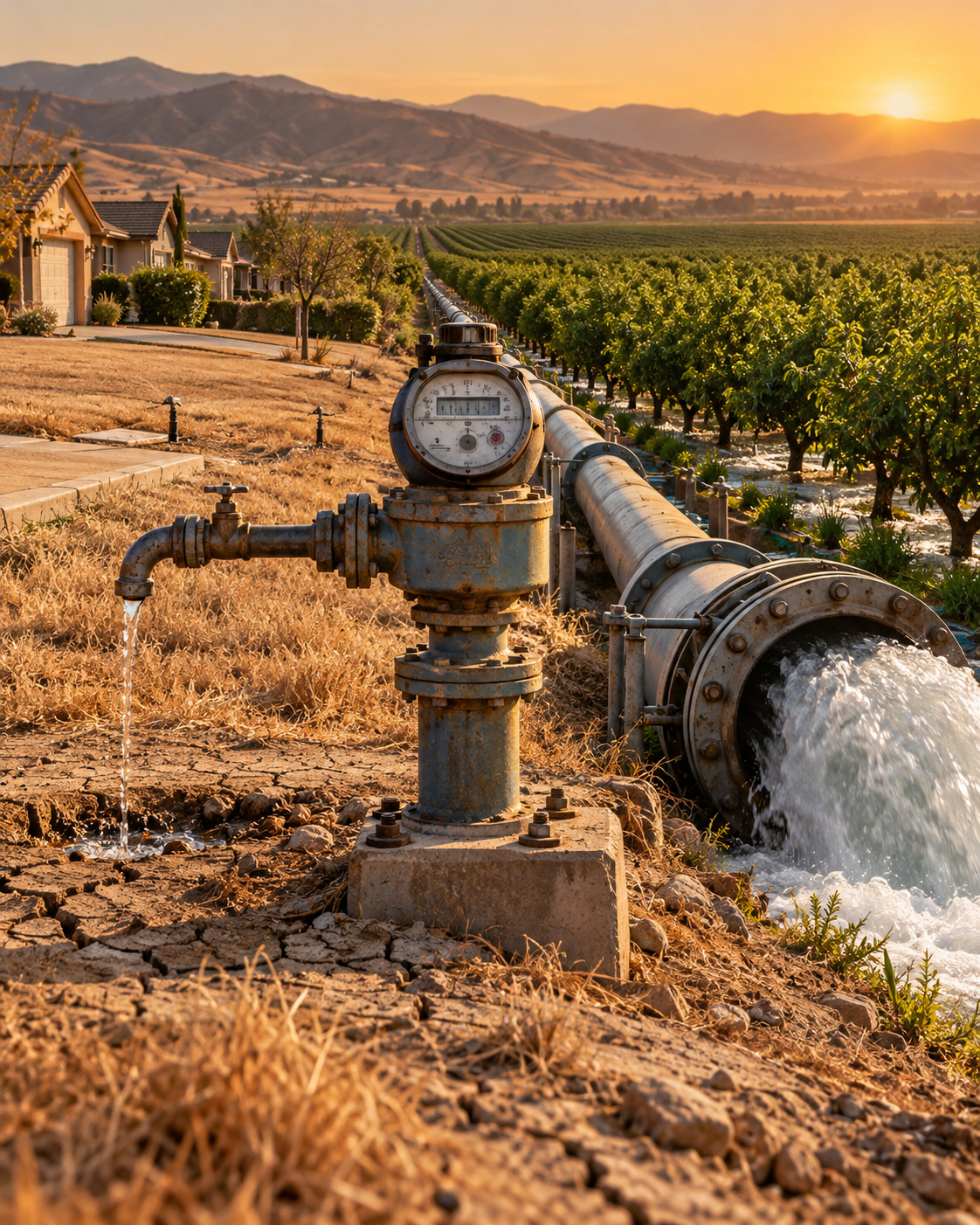
Wendover Productions wants to explain California’s water crisis. Instead, it demonstrates how easily accurate statistics can produce a misleading argument when the details that give those statistics meaning are left out.
In its March 10, 2026 video, California's Water Problem, Wendover takes viewers through the extraordinary engineering that supplies Southern California, the state's century-old water-rights system, and the enormous agricultural holdings of billionaire Stewart and Lynda Resnick.
The central argument is that California has engineered its way around water scarcity but failed to distribute that water sensibly. Farmers possess powerful historical rights, agribusinesses control important reserves, and growing cities must compete for what remains.
There is considerable truth in that account. But three of the video's most consequential claims become substantially less convincing when examined against the underlying research.
Agriculture does not consume 80% of all California's water. California has not physically promised to deliver five times the water it possesses in the straightforward sense the video implies. And the Resnicks' substantial interest in the Kern Water Bank is not equivalent to privately owning 57% of an enormous, permanently filled reservoir.
These distinctions are not technicalities. They change how the problem should be understood.
1. The 80% Water Claim Leaves Out Half the Picture
Wendover presents an extraordinary contrast: agriculture accounts for 80% of California's water use while contributing only 2.5% of its economy.
The implication is clear. An economically small industry commands an overwhelmingly large share of a scarce resource.
There is a problem with that comparison.
According to the California Natural Resources Agency's water-balance figures for 1998–2022, the state's average water distribution was approximately:
- 42% agriculture
- 11% cities and communities
- 47% environmental uses
The familiar 80% figure measures agriculture's share of water used by farms, homes, and businesses. It excludes water allocated to environmental purposes.
California's Department of Water Resources and the Public Policy Institute of California make this distinction explicit.
Wendover does not.
The difference matters because environmental water is not simply an unused reserve waiting to be redirected to another customer.
Rivers require flows to support fish and wildlife. The Sacramento–San Joaquin Delta needs freshwater to help prevent saltwater intrusion. Some environmental flows also protect water quality for the farms and communities that depend on those systems.
Not every gallon assigned to an environmental purpose can be reassigned without consequences.
Nor does all water withdrawn for a particular use disappear permanently. Some returns to rivers or groundwater, where it can be used again.
A serious comparison must distinguish water diverted, water actually consumed, and water required to maintain functioning ecosystems.
Wendover's percentage does none of that work.
A Percentage Is Not an Economic Argument
The companion claim—that agriculture contributes only 2.5% of California's economy—is similarly incomplete.
Even accepting that figure, comparing an industry's share of state GDP with its share of developed water use does not establish whether its water is being used efficiently.
GDP measures economic value added. Water withdrawals measure physical resource use. The two percentages do not share a denominator, and their ratio is not a measure of waste.
The Public Policy Institute of California reported in April 2023 that California agriculture produced more than 400 commodities, generated over $50 billion in annual revenue, and employed more than 420,000 people.
Its contribution also varies dramatically by geography. Agriculture represented approximately 14% of the San Joaquin Valley's regional GDP in 2019, compared with about 2% statewide.
Statewide GDP percentages obscure that local dependence.
None of this establishes that agricultural water allocations are fair.
It establishes that deciding whether to move water away from agriculture requires a more serious calculation than putting 80 beside 2.5.
A better investigation would compare the economic return on water consumed by different crops, the environmental consequences of production, the employment supported, and the realistic alternatives available to farmers.
That would expose genuinely inefficient water use without suggesting that agriculture's modest share of an enormous state economy settles the question.
2. California's Fivefold Water Deficit Is Not What It Sounds Like
Wendover's most arresting statistic comes from a 2014 study by researchers Theodore Grantham and Joshua Viers.
The video reports approximately 370 million acre-feet in California water-rights allocations against roughly 70 million acre-feet of annual surface-water availability.
That comparison comes from real research.
But Wendover leaves out the qualifications that make the research intelligible.
The study, 100 Years of California's Water Rights System: Patterns, Trends and Uncertainty, examined the recorded maximum volumes associated with water rights.
These are often described as their face values.
A maximum entitlement is not the same thing as actual annual consumption.
The researchers explicitly warned that the amount authorized under a permit can substantially exceed the amount used.
They also identified another complication: water can be diverted, returned to a river, and subsequently used by someone downstream.
Adding the associated water-rights volumes can therefore count the same physical water more than once.
The Hydropower Detail Wendover Needed to Explain
The study contains an especially important finding.
Hydropower represented approximately 68% of the recorded appropriative water-rights allocation volume, even though only about 3% of the applications carried that designation.
Hydroelectric generation is principally a nonconsumptive use: water passes through generating equipment and remains available for downstream purposes.
The researchers therefore excluded rights used exclusively for hydropower when making important comparisons of consumptive demands.
They also found that more than 80% of the allocated water-rights volume was held by federal, state, municipal, and other public entities.
These details profoundly change the interpretation of California's enormous recorded allocations.
The state has not simply promised five times its water supply to farmers, businesses, and households that will each consume their full allotment.
Much of the recorded volume reflects maximum legal claims, public infrastructure operations, and uses that do not permanently remove water from the system.
This does not invalidate the study's conclusions.
Even after accounting for nonconsumptive hydropower uses, the researchers found serious over-allocation in major watersheds. Their analysis identified cumulative allocations in the Sacramento–San Joaquin Delta system amounting to approximately three times its average natural outflow.
The problem is real.
But the study's message is more precise than the video's presentation: California has an inadequate accounting and allocation system, not a demonstrable annual consumption deficit of 300 million acre-feet.
A document intended to expose uncertainty should not be converted into a figure that conceals it.
3. The Kern Water Bank Is Not Simply a Billionaire's Private Reservoir
Wendover's investigation becomes most personal when it turns to the Resnick family.
Their Wonderful Company controls major agricultural brands, including Wonderful Pistachios, POM, and Halos.
The video describes the Kern Water Bank, an underground storage project with approximately 1.5 million acre-feet of accessible capacity, and reports that the Resnicks control 57% of it.
That majority interest is supported by outside reporting.
Through Westside Mutual Water Company, the family's business interests have a substantial stake in the project.
But the distinction between controlling an interest in water-bank capacity and owning the water itself matters enormously.
The Kern Water Bank Authority is a California public agency organized as a joint powers authority.
Its participating entities include water districts, a water agency, and Westside Mutual Water Company.
The authority operates the project for its participants, which include agricultural users and communities around Bakersfield.
Its governing structure and operating records are publicly documented.
This does not eliminate the Resnicks' influence.
A dominant commercial participant can still exercise enormous practical power within a publicly administered arrangement.
But it makes the video's suggestion of a straightforward transfer of public water into the personal ownership of one family unnecessarily simplistic.
Storage Capacity Is Not Water Ownership
The project's estimated 1.5 million acre-feet is accessible storage capacity, not a fixed amount of water that belongs to the Resnicks.
Water is recharged into the groundwater basin when supplies permit and recovered when needed.
Participants bear costs associated with acquiring, storing, and extracting their water.
The Kern Water Bank Authority reports that its 85 recovery wells could extract approximately 240,000 acre-feet during a ten-month recovery program, with recovery potentially declining during successive years.
That is a substantially different figure from the bank's total storage capacity.
The distinction matters because a large underground reserve cannot necessarily deliver its entire stored volume on demand.
A meaningful assessment of the Resnicks' water power would establish their actual balances, annual withdrawals, contractual rights, operating restrictions, and sales.
A percentage of theoretical storage capacity cannot substitute for those figures.
4. The Monterey Agreement Has a History the Video Barely Explains
Wendover describes the 1994 Monterey Amendments as a controversial arrangement that transferred the Kern Water Bank into private hands.
The episode correctly identifies two consequential changes: the transfer of the project and the elimination of an urban preference in State Water Project deliveries during shortages.
But the underlying transaction was more complicated.
The Kern Water Bank Authority reports that the participating entities surrendered 45,000 acre-feet of annual State Water Project contractual entitlement in exchange for the property.
Those entitlements were permanently retired.
The authority valued them at approximately $45 million at the time of the 1996 transfer and reports subsequent investments of roughly $70 million in project infrastructure.
Its account also acknowledges public grants and loans among the project's funding sources.
Those details do not prove the exchange was fair.
They establish that the project was not simply handed over without consideration.
Nor was the property already operating as a completed state water bank.
California's Department of Water Resources had acquired the site in 1988 but abandoned its attempt to develop the project after encountering financial, legal, environmental, and institutional difficulties.
These circumstances help explain why the state negotiated the transfer.
They also create an obvious question that Wendover does not answer:
What was the economic value of the land and its future storage opportunities compared with the rights and financial obligations surrendered by the participants?
Without that comparison, declaring the transaction an extraordinary private windfall is a conclusion in search of a valuation.
The Courts Examined This Agreement for Decades
The Monterey Amendments generated extensive litigation, including challenges to environmental reviews and the Kern Water Bank transfer.
In 2021, the California Court of Appeal decided Central Delta Water Agency v. Department of Water Resources, a case involving the amendments and the project's environmental impacts.
The litigation had exposed genuine deficiencies in earlier environmental analysis, requiring additional review.
But the appellate court ultimately upheld the relevant judgments, including the rejection of renewed challenges to the revised environmental impact report. Challenges to the validity of the transfer were also barred by filing deadlines.
The California Supreme Court declined review in January 2022.
A judicial ruling is not proof that a transaction was economically fair.
A dismissal based on filing deadlines certainly is not a moral endorsement.
Still, the legal history matters.
Wendover presents the transfer largely through its controversial origins and consequences, while giving viewers little understanding of the subsequent judicial scrutiny.
That omission leaves the audience with a less complete picture of what has actually been challenged, decided, and left unresolved.
5. The Courts Also Examined the Link Between the Water Bank and Agricultural Expansion
Wendover argues that the Kern Water Bank enabled the Wonderful agricultural empire to expand into increasingly water-intensive crops.
The basic economic logic is plausible.
Reliable access to stored water makes permanent orchards more attractive because trees require continuing irrigation even during drought.
But the extent to which the bank itself caused agricultural expansion has been contested.
The 2021 appellate opinion discusses this exact issue.
Environmental challengers argued that the bank facilitated large-scale conversion from annual crops to permanent orchards.
California's Department of Water Resources responded that the shift had already been occurring across the state, driven principally by crop prices, agricultural economics, and other available water-storage options.
The revised environmental review acknowledged that the bank could contribute to crop conversion. The court nevertheless found substantial evidence supporting the agency's conclusion that the bank was not the primary cause of the broader trend.
That finding does not establish that the bank played no role.
It does demonstrate why agricultural expansion cannot simply be attributed to one family's acquisition of water-storage interests.
The larger transformation is more revealing.
According to the Public Policy Institute of California, perennial crops increased from 22% of the state's irrigated acreage in 2000 to 46% in 2018.
These crops can generate higher returns, but permanent orchards make it harder for farmers to reduce water consumption during drought.
Annual crops can sometimes be left unplanted. Mature almond and pistachio trees cannot be abandoned for a season without risking a much larger investment.
This creates a structural commitment to future water consumption that extends far beyond one company.
The more consequential investigation is not simply who owns a particular water bank.
It is how California's agricultural economy has become increasingly dependent on crops that cannot easily survive interruptions in water supply.
6. California's Water Law Is Not Quite the Agricultural Entitlement System Presented
Wendover also makes a broad argument about prior appropriation, the historical system under which older water rights generally take precedence over newer ones.
Its explanation of seniority is substantially correct.
But the implication that agricultural claims inevitably outrank municipal needs is incomplete.
California Water Code Section 106 explicitly identifies domestic water use as the state's highest use, followed by irrigation.
Section 106.3 separately recognizes access to safe, clean, affordable, and accessible water for basic human needs as state policy.
These provisions do not automatically cancel established water rights. They do, however, establish that California's legal framework recognizes priorities beyond the age of a claim.
The state also has authority to restrict water diversions during drought.
In 2021, regulators warned that even some holders of historically senior rights might face restrictions as shortages worsened.
The State Water Resources Control Board explicitly recognizes that more senior users can be required to stop diverting when supplies become sufficiently scarce.
Wendover's contrast between powerful agricultural rights and vulnerable cities contains an important historical truth.
But California's actual legal system is not a simple contest in which the earliest claimant always receives water regardless of its intended use.
That distinction becomes especially important when the video approaches its final question: whether water should serve people or plants.
California law already recognizes domestic needs as particularly important. The difficult questions concern implementation, existing rights, environmental protection, and the costs of reallocating water.
The law is complicated because those competing interests are real, not because the state has never contemplated them.
The Verdict: A Convincing Story Built on Incomplete Comparisons
Wendover's video does not invent California's water problems.
Its aqueduct history is substantial. Its account of competing water interests addresses real conflicts. Its concerns about concentrated agricultural power deserve scrutiny.
The problem is the distance between the facts presented and the conclusions readers are encouraged to draw.
Agriculture's 80% share becomes more provocative when environmental water is excluded without explanation.
Fivefold water-rights over-allocation becomes more frightening when maximum legal claims are treated as though they represent water actually consumed.
The Resnicks' majority interest becomes more absolute when storage capacity, recoverable water, contractual entitlements, and public administration are compressed into the language of private ownership.
And the Monterey transfer becomes easier to condemn when the consideration exchanged, infrastructure investments, and decades of litigation receive little attention.
The underlying evidence supports serious questions about agricultural consumption, water rights, and concentrated economic influence.
It does not support every implication Wendover draws from those questions.
California's difficult choices will not disappear when the statistics are corrected. Agriculture still consumes enormous quantities of water. Permanent crops still create inflexible demands. Powerful businesses still possess advantages in obtaining and managing scarce resources.
But understanding those problems requires knowing precisely how much water is available, who can use it, who pays for access, and what happens when existing allocations change.
Those are not minor details surrounding California's water crisis.
They are the crisis.
Wendover has produced a compelling account of the conflict.
It has not adequately explained the accounting.
References
1. California's Water Problem — Wendover Productions, March 10, 2026.
Watch the original video
The primary work examined, including its claims about water allocations, agriculture's economic contribution, the Resnick family, and the Monterey Amendments.
2. 100 Years of California's Water Rights System: Patterns, Trends and Uncertainty — Theodore E. Grantham and Joshua H. Viers, Environmental Research Letters, August 19, 2014.
Read the original research
Establishes the scale of recorded water-rights allocations while explicitly distinguishing maximum entitlements from actual withdrawals and identifying the substantial role of nonconsumptive hydropower. The figures describe the historical dataset analyzed, not a current audit of every California entitlement.
3. Water Plan Data and Tools — California Natural Resources Agency, California Water Plan.
View the official water-balance figures
Reports average statewide water distribution for 1998–2022, distinguishing agricultural, urban, and environmental uses.
4. Water Use in California — Jeffrey Mount, Ellen Hanak, and Caitlin Peterson, Public Policy Institute of California, April 2023.
Read the water-use fact sheet
Explains the difference between agriculture's share of all statewide water and its share of water used by farms, homes, and businesses.
5. Water Use in California's Agriculture — Caitlin Peterson, Alvar Escriva-Bou, Josué Medellín-Azuara, and Spencer Cole, Public Policy Institute of California, April 2023.
Read the agricultural analysis
Documents agricultural revenues, employment, regional economic importance, water consumption, and the expansion of permanent crops.
6. Background & Key Dates — Kern Water Bank Authority, accessed October 2026.
Read the project's history
Provides the authority's account of the Monterey negotiations, the retirement of State Water Project entitlements, subsequent investments, and litigation. As an account from the operating authority, its interpretations of the transaction's fairness warrant independent scrutiny.
7. Governance and FAQs — Kern Water Bank Authority, accessed October 2026.
Governance records · Operating and storage information
Identify the bank's public-agency structure, participating entities, accessible storage capacity, operating limitations, and development costs.
8. Central Delta Water Agency v. Department of Water Resources — California Court of Appeal, September 22, 2021.
Read the appellate decision
Documents the Monterey Amendments' legal history, environmental-review disputes, and competing arguments about whether the Kern Water Bank caused agricultural expansion.
9. California Water Code Sections 106 and 106.3 — State of California.
Section 106 · Section 106.3
Establish California's statutory priority for domestic use and its policy recognizing access to water for essential human needs.
10. Water Board's Role in Drought — California State Water Resources Control Board.
Read the regulatory guidance
Explains how water-rights priority governs drought restrictions while confirming that senior claims may also face curtailment.
11. Does a Billionaire Couple Own Almost All the Water in California? — Caleb McCullough, PolitiFact, January 14, 2025.
Read the ownership fact-check
Provides independent reporting on the Resnicks' Kern Water Bank interest and distinguishes their substantial contractual position from ownership of California's overall water supply.