Wendover's Hawaii Documentary Blames the Ships—But Never Calculates the Grocery Bill
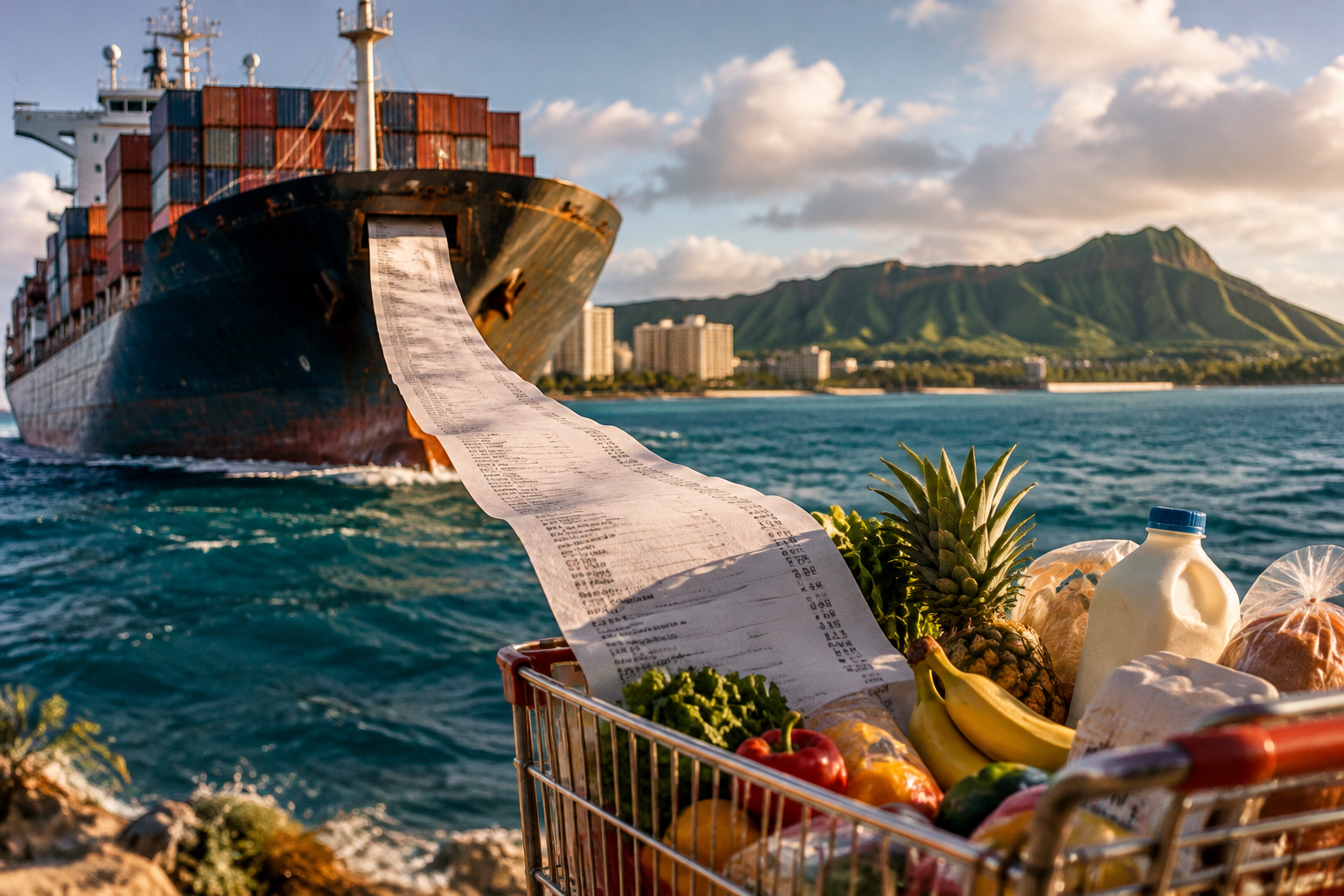
Wendover Productions makes a persuasive case that Hawaii's shipping system is expensive, concentrated and vulnerable. But its central economic argument has a serious weakness: the documentary never establishes how much of Hawaii's grocery bill is actually caused by the Jones Act and shipping monopolies.
It places expensive cargo vessels, a $1,412.89 inter-island container charge and higher supermarket prices into one compelling narrative. Yet it never calculates the connection between them. A ship's operating costs are not a grocery-price calculation, and a comparison between two supermarkets cannot establish which part of the difference comes from transportation, labor, land, refrigeration, wholesale distribution or retail margins.
I am not arguing that the Jones Act is harmless. Independent economic research supports the argument that it restricts domestic shipping and raises consumer prices. The problem is that Wendover takes a real economic disadvantage and presents a much broader explanation without establishing its actual contribution to Hawaii's food costs.
ScienceDirect+1
The missing calculation: what does the Jones Act actually cost consumers?
The strongest independent study I found is William Olney's 2020 paper, Cabotage Sabotage? The Curious Case of the Jones Act, published in the Journal of International Economics. It finds that declining Jones Act shipping capacity reduced domestic waterborne trade, particularly in coastal states, and increased consumer prices. But it does not calculate the Act's contribution to Hawaii's grocery prices.
ScienceDirect+1
There is a Hawaii-specific attempt worth examining. A 2020 Grassroot Institute report commissioned from John Dunham & Associates estimated the additional annual cost of groceries and restaurant meals for an average family. Its own household table produces estimates ranging from approximately $119 to $249 annually across four scenarios. The frequently cited $248 figure is the highest scenario, not a demonstrated average household bill.
grassrootinstitute.org
The limitations matter. The report uses national average household spending that it acknowledges is not adjusted for Hawaii's cost of living, assumes production patterns remain fixed, and assumes sufficient shipping capacity exists without additional price effects when demand changes. These are modelling assumptions, not observations of what families actually pay.
grassrootinstitute.org+2
Wendover could have examined this evidence and explained its uncertainty. Instead, it moves directly from the cost of operating American ships to the prices of beef, cabbage, lemons and eggs.
The USDA's Economic Research Service identifies transportation, retail overhead such as labor and rent, and differences in consumer purchasing patterns as factors behind regional grocery-price differences. Honolulu's grocery-price inflation averaged 3.1% annually over 2015–2024, compared with 2.6% nationally. A comparison between two Whole Foods locations cannot separate these different costs.
Economic Research Service
The food-import story is more complicated than 95%
Wendover states that Hawaii imports approximately 95% of its food. Hawaii's own 2020 Ocean Resources Management Plan instead uses an estimate of 85–90%, based on earlier state agricultural data. A peer-reviewed 2013 study by Matthew Loke and PingSun Leung calculated that 88.4% of food available for consumption came from imports in 2010. The documentary does not explain the difference or establish the methodology behind its higher figure.
planning.hawaii.gov+1
There is another important distinction. The 2010 study estimated that 81% of Hawaii's total food supply originated in the continental United States, 6% came from foreign countries, and 13% came from local production. The Jones Act applies to domestic maritime transportation between American ports, not direct imports from foreign ports. Consequently, the percentage of food imported is not automatically the percentage exposed to Jones Act restrictions.
Springer Nature Link+1
The more serious omission is economic.
Hawaii's own government identifies economic efficiency as the main driver of food imports:
“the cost to produce food locally exceeds the cost of producing and transporting food from elsewhere”
That is the state's 2020 Ocean Resources Management Plan speaking, not a shipping-industry lobbyist. It means that even if shipping became cheaper, local farmers would still face competition from producers who can grow and distribute food more economically.
planning.hawaii.gov
Wendover acknowledges high local labor costs near the end of the documentary. But it does not investigate how much of the price difference comes from those costs, how much comes from transportation, or whether reducing shipping costs would actually make local agriculture competitive.
There is also a basic measurement problem. A University of Hawaii at Hilo study for Hawaii County reported that the state had abandoned its historical monitoring of local agricultural production and food imports in 2008. The researchers described the difficulty of obtaining accurate figures through Hawaii's complicated distribution system. The 2013 statewide study reached similar conclusions about the limitations of available data.
records.hawaiicounty.gov+1
Presenting 95% as a precise, settled figure while failing to explain those measurement problems is poor economic reporting.
The plantation explanation is too neat
Wendover traces Hawaii's food dependence through European contact, the Great Māhele, plantation expansion and the eventual rise of tourism.
The broad historical changes are real. Plantation agriculture transformed land use, displaced traditional food systems and concentrated production around sugarcane and pineapple.
But the timeline is more complicated than the documentary suggests.
A 2012 University of Hawaii at Hilo study of Hawaii Island describes the plantation era as relatively food self-reliant, with an expanding range of food crops supporting a growing and increasingly diverse population. It identifies the introduction of refrigerated shipping containers after World War II as an important development that opened the market to fresh, mass-produced food from around the world. It also identifies changing consumer demand for foods unlikely to be produced locally.
records.hawaiicounty.gov
This is not proof that plantations preserved the traditional Hawaiian food system. The study concerns Hawaii Island rather than the entire state. But it demonstrates that the transition from local production to import dependence was not simply a single historical event caused by plantation monoculture.
The distinction matters. Land displacement explains lost agricultural capacity. Postwar shipping technology, changing diets, population growth, labor costs and commercial economics help explain why that capacity was not rebuilt.
Wendover needs all those explanations to tell the story accurately.
The Maui farming example is not what the documentary claims
The documentary presents the redevelopment of former sugarcane land as evidence that Hawaii is returning to local food production.
Its flagship example is the 41,000-acre former Hawaiian Commercial & Sugar Company property on Maui.
The 2018 transaction was worth approximately $261.6 million. The buyer, Mahi Pono, was a joint venture between California-based Pomona Farming and Canada's Public Sector Pension Investment Board.
PSP Investments+1
There is a more direct problem with the documentary's description. Wendover says the crops are grown:
“not for export”
But the original announcement of the acquisition explicitly described a farming plan involving food crops for both local consumption and export.
prnewswire.com
That is not a minor distinction.
Mahi Pono can contribute valuable local food production while operating as a large commercial investment with international ownership and export ambitions. Local production is not automatically local ownership, local control or food sovereignty.
The documentary treats these concepts as if they naturally lead to one another.
They do not.
And although the company supplies produce to Hawaiian retailers, the documentary provides no production figures establishing how much of Hawaii's total food demand it actually satisfies.
A successful agricultural project is not yet evidence of a restored food system.
A Census statistic is not proof of an affordability-driven exodus
The documentary connects Hawaii's cost-of-living crisis with the departure of Native Hawaiians, stating that they are:
“packing up and leaving the state en masse”
It then uses the 2020 Census finding that a majority of Native Hawaiians live outside Hawaii.
The underlying population distribution is real. But the interpretation goes further than the evidence.
Hawaii's 2024 State Data Book provides the relevant comparison, using the Native Hawaiian population counted as that race alone or in combination with another race:
Residence 2010 2020 Change Hawaii 289,970 317,497 +9.5% Other states 237,107 362,893 +53.1%The mainland population grew much faster, and by 2020 the majority lived outside Hawaii. But the number living in Hawaii also increased. These figures describe population distribution, not the movement of individual households or their reasons for relocating.
files.hawaii.gov
The affordability crisis is real. The documentary's own estimate that 44% of households struggle to afford basic necessities deserves attention.
But a Census population count cannot establish that housing costs or food prices caused the mainland diaspora. That requires migration research and evidence about why people leave.
The distinction matters particularly when discussing an Indigenous population with a long-established mainland diaspora. Turning that history into a recent affordability-driven exodus without demonstrating the connection is irresponsible.
The sponsor's blind spot is not a fact-check
The documentary's closing Ground News sponsorship deserves one additional qualification.
The creator describes the platform's blind-spot feature as a way to identify neglected stories and find sources he can trust.
Ground News itself explains that its bias and factuality ratings apply to entire publications, not individual articles. Its Blindspot feature identifies disproportionate coverage across political categories. It does not independently establish whether a particular article is accurate or whether a particular source is trustworthy on a particular subject.
Ground News
That distinction is especially important when the creator uses the platform's coverage comparison to characterize right-leaning media as practically silent on the Lahaina disaster.
A coverage imbalance is not evidence of the quality, completeness or accuracy of the reporting that exists.
The sponsorship is disclosed, and there is no evidence that Ground News influenced the documentary's editorial conclusions. But the endorsement goes further than the product's own methodology justifies.
The real problem is bigger than the Jones Act
There is one final development that makes the documentary's treatment of Young Brothers particularly incomplete.
In August 2020, Hawaii's Public Utilities Commission approved the company's emergency 46% rate increase. It also required restoration of its full pre-COVID sailing schedule, an independent financial and management audit, a customer-service plan and advance notice before any discontinuation of regulated service. This was not simply the state agreeing to an unconditional price increase.
Public Utilities Commission
Five years later, the regulatory record became considerably more troubling.
In November 2025, the PUC approved another 25.75% increase, effective January 1, 2026, because the company was operating at a net loss, falling behind on vendor payments and in default with lenders.
But the Commission also described the causes of its financial decline as substantially self-inflicted. It rejected Young Brothers' request for automatic inflation-based rate increases, warning that such a mechanism could conceal operational inefficiencies and make customers pay for management failures.
It ordered an independent overseer, business-plan monitoring, labor-cost reviews and changes to address cross-subsidies between cargo classes.
Public Utilities Commission
Then came an even more revealing discovery.
In May 2026, Honolulu Civil Beat reported that Young Brothers had withheld more than $26 million in state wharfage fees collected on behalf of Hawaii and used the money to cover its own operating expenses. The company still owed approximately $30 million, including penalties and interest.
The state consumer advocate also cited Public Utilities Commission documents showing that Young Brothers had made multiple discretionary dividend payments to its parent company, Foss Maritime, despite its deteriorating financial position and foreseeable capital expenditures and debt obligations.
Honolulu Civil Beat
Young Brothers says its losses also reflect genuine public-service obligations. It reports annual losses of $7 million on the Molokai-Lanai route and $25 million on less-than-container-load services. Its vessels must continue serving smaller communities even when cargo volumes are insufficient to make those journeys profitable.
Honolulu Civil Beat
That is an important qualification. The problem is not simply that a monopoly exists. It is that Hawaii depends on an essential carrier whose management, costs, public-service obligations and financial oversight have become deeply entangled.
The politics have become even more complicated.
In May 2026, Governor Josh Green signed Act 16, requiring an automatic water-carrier rate-adjustment mechanism capped at 5% annually through June 2029. Young Brothers implemented a further 3% increase on July 1, 2026, following its January increase.
data.capitol.hawaii.gov+1
Meanwhile, missed shipments to Molokai and Lanai left grocery shelves empty in June. Senator Lynn DeCoite reported that an icebox she purchased on Maui, for which she paid $400 in shipping, remained undelivered for four weeks. Young Brothers attributed the disruptions to dangerous ocean conditions and unexpected tug repairs.
Hawaii Journalism Initiative
This is the story Wendover should have investigated more deeply: not simply why inter-island shipping costs so much, but why a critical public-service carrier can repeatedly receive substantial rate increases while struggling with financial management and reliable delivery.
The people who depend on that service pay either way.
Closing verdict
Wendover has produced a compelling explanation of Hawaii's geography and shipping infrastructure. But a compelling explanation is not necessarily a complete economic investigation.
The Jones Act imposes real costs. Young Brothers is a critical inter-island chokepoint. Plantation agriculture changed Hawaii's relationship with its land, and the islands remain dangerously dependent on external food supplies.
None of that establishes how much of today's grocery-price premium is attributable to shipping restrictions.
The documentary also compresses the history of food production, misrepresents the export ambitions of its flagship agricultural example, and turns a Census population distribution into an explanation of migration that the data cannot establish.
The real story is more difficult: Hawaii's food system is caught between expensive domestic shipping, high local production costs, concentrated distribution, corporate ownership, weak agricultural measurement and political decisions that repeatedly transfer financial risk to consumers.
The Jones Act deserves scrutiny. Young Brothers deserves scrutiny. Hawaii's agricultural policy deserves scrutiny. But none should receive a convenient explanation that substitutes a dramatic shipping story for an actual accounting.
A map of the ships is not an audit of the grocery bill.
References
1. Hawaii's Logistics Problem — Wendover Productions. Original documentary examined in this critique.
2. Cabotage Sabotage? The Curious Case of the Jones Act — William W. Olney, Journal of International Economics, November 2020. Peer-reviewed evidence that the Jones Act restricts domestic waterborne trade and raises consumer prices.
3. Quantifying the Cost of the Jones Act to Hawaii — Grassroot Institute of Hawaii, July 2020. Provides Hawaii-specific economic modelling and household cost estimates, alongside important assumptions.
4. Hawaii Ocean Resources Management Plan — State of Hawaii, Office of Planning, 2020. Establishes the state's 85–90% food-import estimate and identifies economic efficiency as the principal driver of food imports.
5. Hawai‘i's Food Consumption and Supply Sources: Benchmark Estimates and Measurement Issues — Matthew K. Loke and PingSun Leung, Agricultural and Food Economics, August 2013. Provides the 2010 food-import benchmark and explains the difficulties of measuring Hawaii's food supply.
6. Retail Food Price Changes Vary by U.S. Metro Areas — USDA Economic Research Service, April 16, 2025. Demonstrates how labor, rent, consumer preferences and other local conditions affect grocery-price inflation.
7. Hawaii County Food Self-Sufficiency Baseline Study — University of Hawaii at Hilo and Hawaii County, 2012. Documents the historical food economy, postwar refrigerated shipping and the state's agricultural data limitations.
8. Mahi Pono Purchase of Former HC&S Lands — Public Sector Pension Investment Board, December 20, 2018. Establishes the joint venture's ownership and the acquisition of approximately 41,000 acres.
9. A&B Agreement with Mahi Pono Launches New Era of Agriculture on Maui — Alexander & Baldwin, December 2018. Confirms that the agricultural plan included both local consumption and export.
10. PUC Approves Young Brothers' Emergency Rate Increase — Hawaii Public Utilities Commission, August 17, 2020. Documents the 46% increase and the conditions imposed on the company.
11. Young Brothers Rate Case: Decision and Order Fact Sheet — Hawaii Public Utilities Commission, November 17, 2025. Documents financial distress, management concerns, the 25.75% increase and the rejection of automatic rate adjustments.
12. Young Brothers Held On To $26M In State Money To Cover Its Costs — Honolulu Civil Beat, May 2026. Reports unpaid state wharfage fees, payments to the parent company and the consumer advocate's concerns about management decisions.
13. Hawaii Senate Bill 2694 — Act 16 — Hawaii State Legislature, approved May 19, 2026. Establishes the statutory automatic water-carrier rate-adjustment mechanism.
14. Young Brothers' Rate Increase Begins July 1 — Hawaii Journalism Initiative, July 1, 2026. Documents the additional rate increase, outstanding state fees and recent service disruptions affecting Molokai and Lanai.
15. State of Hawaii Data Book 2024, Table 1.37 — Hawaii Department of Business, Economic Development & Tourism, August 2025. Provides the 2010 and 2020 Census counts of Native Hawaiians living in Hawaii and other states.
16. Ground News Rating System and Methodology — Ground News, accessed October 2026. Explains that bias and factuality ratings apply to publications, while Blindspot identifies disproportionate political coverage rather than independently verifying individual articles.