Glenwood Caverns' Underground Shelter Plan Has a Serious Evidence Problem
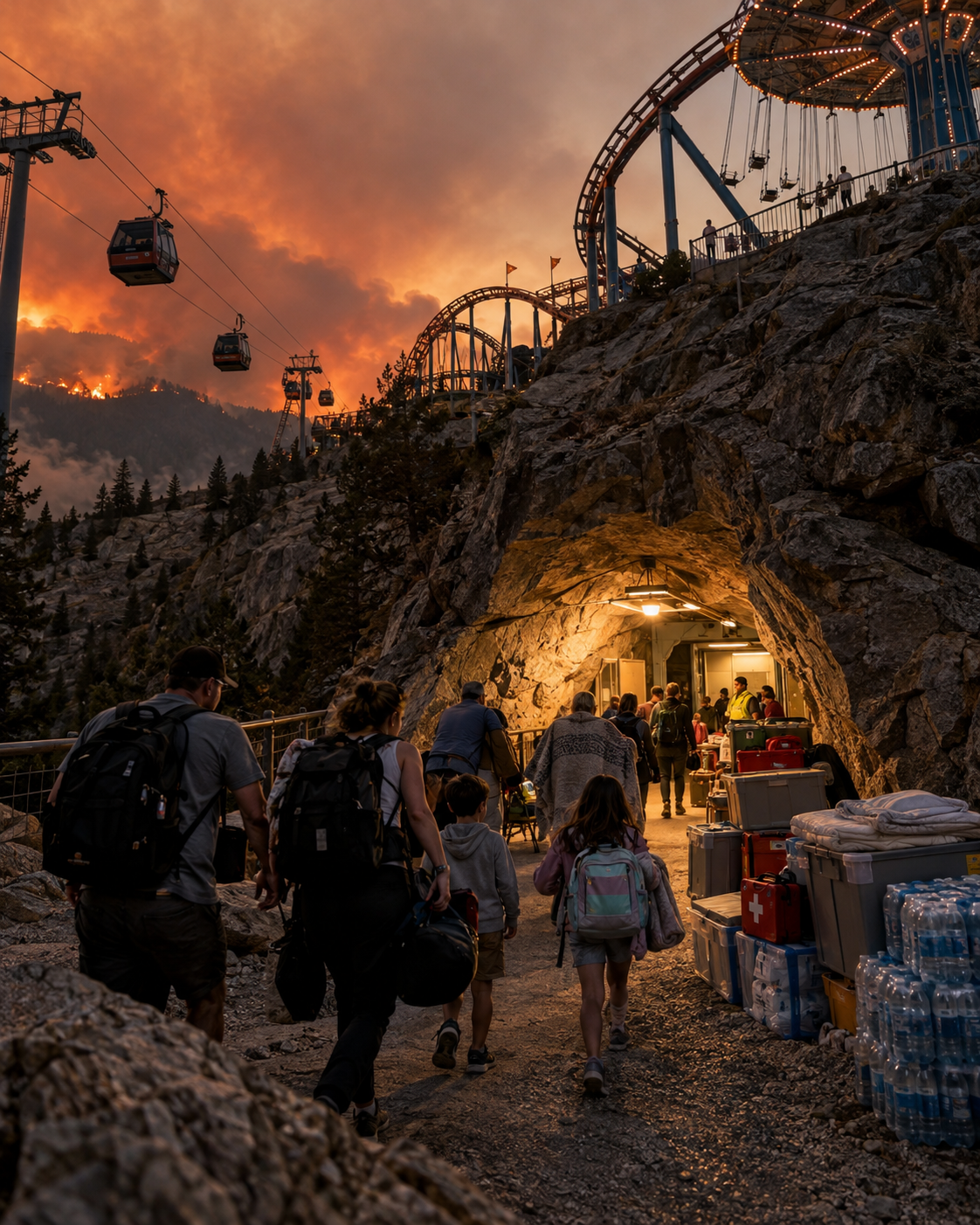
Wendover Productions presents Glenwood Caverns Adventure Park as an impressive example of how an amusement park manages risk. Its most consequential safety story, however, deserves considerably more scrutiny: the claim that thousands of visitors can shelter inside its caves when wildfire makes evacuation dangerous.
The problem is not that underground shelter is necessarily a bad idea. It is that the video moves from evidence that caves provided clean air to firefighters to a much larger claim about protecting an entire amusement-park population. Those are very different demonstrations.
The 2020 wildfire did not demonstrate a mass evacuation shelter
The video invokes the 2020 Grizzly Creek Fire as evidence that the caves remained smoke-free despite intolerable conditions outside. It then describes emergency supplies positioned in both cave-tour areas, including water, snacks, blankets, first-aid equipment and basic sanitation materials.
But the park's own August 26, 2020 account describes a different sequence of events: the park closed on August 13 for fire mitigation and reopened on August 28. Firefighters received private cave tours and around-the-clock access to the visitor center for water and restrooms. The park's own account of the Grizzly Creek Fire.
That establishes that the caves offered firefighters a clean-air respite. It does not establish that thousands of paying visitors were sheltered underground during an active wildfire, or that the caves were tested as a mass-casualty refuge.
The distinction matters. Protecting a limited number of firefighters during a controlled visit is not the same operation as moving an amusement park's entire population underground during an advancing wildfire.
The access problem was documented twenty years before the video
There is an important historical record Wendover does not examine. A June 2004 Garfield County planning review included a warning from the Glenwood Springs Fire Protection District that the park's mountain location created unusual emergency-response difficulties.
The department described the Transfer Trail as unsuitable for rapid emergency-vehicle access, potentially unusable during three seasons, and too slow for reliable emergency response even when passable. It identified the gondola as the quickest way for responders to reach the mountain, while warning that high winds, electrical storms and other extreme weather could shut it down.
The department specifically required expanded emergency-response plans developed in cooperation with the fire department. It also recommended improving dirt roads for emergency vehicles and staging medical and firefighting equipment on the mountain. Garfield County's 2004 planning and fire-department review.
This is not proof that the park failed to address those requirements. It is proof that the access problem was recognized long before the video, making the absence of any examination of the subsequent safety arrangements particularly conspicuous.
The same planning record assumed a peak upper-site occupancy of 450 visitors for its 2004 parking analysis. That figure is historical, not a current attendance limit, but it makes Wendover's casual reference to sheltering thousands particularly deserving of verification.
The video also omits a fatality on the underground drop ride
The more serious omission concerns the attraction the video identifies as Crystal Tower, originally the Haunted Mine Drop.
On September 5, 2021, six-year-old Wongel Estifanos died after falling approximately 110 feet on that ride. Colorado's Division of Oil and Public Safety investigated and published its findings in September 2021, almost three years before Wendover's August 2024 video.
The investigation found that Wongel was sitting on top of two locked seatbelts rather than wearing them. The ride's monitoring system displayed a warning, but operators failed to understand and resolve it; one manually reset the restraint system, allowing the ride to dispatch.
Colorado Labor Department+2
The investigation identified several contributing failures:
- Operators failed to prepare the seatbelts between ride cycles.
- Both operators failed to follow the manufacturer's restraint-checking procedures.
- Training did not adequately cover the ride's risks or control-panel warnings.
- The operating manual lacked clear instructions for responding to system errors.
- Two operators sharing responsibility during the cycle distracted from passenger safety.
The state concluded that the fatality resulted from multiple operator errors, inadequate training and missing procedures. Importantly, investigators found that the ride itself functioned according to its technical specifications. This was not simply a broken machine; it was a failure of the people and procedures responsible for operating it safely.
Colorado Labor Department+2
There was also an earlier warning. The state report documented an August 2019 complaint from a passenger who said operators nearly dispatched the Haunted Mine Drop while the passenger was sitting on the seatbelts rather than wearing them. The passenger had to insist before an operator corrected the problem.
Colorado Labor Department
Wendover's video discusses the underground ride's uniqueness, then devotes considerable attention to safety engineering, inspections and multiple protective layers. It never tells viewers that a child had died on that attraction or that state investigators had already documented serious failures in its operating procedures.
That omission matters enormously. The investigation was public in 2021. This was not information that emerged after the video.
The park did make substantial changes after the death
There is an important qualification: the current Crystal Tower is not simply the original ride operating unchanged.
In April 2022, the park announced a major overhaul. Changes included a redesigned loading area, computer-monitored retractable shoulder and lap restraints, and an enclosed passenger carriage. Operators also received additional training across the park's rides. The attraction reopened under the Crystal Tower name in 2023.
CBS Colorado
These changes are relevant evidence of corrective action. The fatal accident does not establish that the redesigned attraction remains unsafe.
But it makes the video's omission harder to defend. The history of Crystal Tower is not simply a story about an unusual underground ride. It is also a story about a fatal failure, an official investigation and a substantial redesign intended to prevent another death.
A video explaining how amusement parks work should not separate the engineering improvements from the incident that made them necessary.
The cave refuge is a contingency, not demonstrated capacity
The transcript says the park has positioned emergency supplies in both cave-tour areas: food, water, first aid, space blankets, tourniquets and materials for temporary sanitation.
Those are sensible preparations. But the video supplies no figures for the refuge's maximum occupancy, duration of support, air-quality monitoring, ventilation, medical arrangements or time required to move visitors underground.
The park's published cave-tour specifications provide useful context. Fairy Cave tours are limited to 20 people and King's Row tours to 25; King's Row involves 120 stairs, and the park advises against cave tours for people with heart or respiratory problems. These are ordinary tour restrictions, not emergency shelter capacity limits, but they make accessibility and crowd-management questions unavoidable.
Glenwood Caverns Adventure Park+1
The historical planning record provides another useful number. A 2004 county parking analysis assumed peak upper-site occupancy of 450 visitors. That is neither a current attendance figure nor a shelter limit, but it illustrates why an updated occupancy assessment is essential before making claims about sheltering thousands.
records.garfield-county.com
The emergency access problem is older than the amusement park's latest safety story
Garfield County's 2022 Community Wildfire Protection Plan warns that mountainous areas often have very few transportation corridors and that effective evacuation requires multiple routes. Its Glenwood Springs Fire Protection District section describes continuing work on evacuation routes in parts of the area with limited access. This is regional context, not a finding that the amusement park lacks an evacuation plan.
garfieldcountyco.gov
There is also evidence of an alternative to the gondola. The 2004 special-use permit allowed buses and vans to transport guests along the Transfer Trail when weather prevented tram operation, and required snow clearance on half the road's width for emergency access. It also required basic medical and firefighting equipment to be staged on the mountain.
records.garfield-county.com+1
So the video is not inventing the existence of an alternative road. The unanswered questions concern its actual emergency performance: how many buses are available, how quickly they can move visitors, whether the road remains passable during a wildfire, and how the park coordinates the decision with emergency authorities.
The distinction between having a contingency and demonstrating that it works is the entire point of emergency planning.
The consequences became much larger after publication
In September 2025, a Colorado jury awarded Wongel Estifanos's family $205 million, including $123 million in punitive damages. The jury found the park's parent company and ride manufacturer liable.
Colorado Public Radio
In February 2026, the court-reduced judgment stood at $116 million and Glenwood Caverns Holdings filed for Chapter 11 bankruptcy. The company said it intended to appeal and maintained that the park would continue operating normally.
Colorado Public Radio
These later developments cannot fairly be treated as information Wendover should have predicted in 2024. But the underlying fatality and the state's investigation were already public.
The video had an opportunity to explain how the park responded to an actual, documented failure of its safety systems. Instead, viewers received a detailed explanation of how those systems are supposed to work.
Closing verdict
Wendover explains how Glenwood Caverns attracts visitors, distributes crowds and engineers exciting rides. Its treatment of safety is considerably less convincing.
The cave refuge is presented without the evidence needed to establish its capacity or effectiveness. More seriously, the video discusses the underground drop attraction and then explains the park's layered safety procedures without disclosing the publicly documented death of a six-year-old girl on the attraction's predecessor.
The park subsequently redesigned that ride, but the history matters. So do the operational failures identified by investigators and the earlier warning from a passenger.
A safety system should be judged by what happens when it fails, not merely by how impressive its components look.
The video explains the theory of amusement-park safety. It avoids the most consequential evidence needed to examine that theory at Glenwood Caverns.
References
1. How an Amusement Park Works — Wendover Productions, August 22, 2024. Original video and primary subject of this critique.
2. Accident Investigation Report: Haunted Mine Drop — Colorado Division of Oil and Public Safety, September 2021. Establishes the fatal operational failures, inadequate training, missing procedures and earlier passenger complaint.
3. Glenwood Caverns Special Use Permit — Public Hearing Exhibits — Garfield County, June 2004. Documents the fire department's access concerns, emergency equipment requirements, alternative road arrangements and historical visitor-occupancy assumptions.
4. Adventure Park Reopens After Closure for Fire Mitigation — Glenwood Caverns Adventure Park, August 26, 2020. Establishes that the park closed during the Grizzly Creek Fire and provided private cave tours and facilities to firefighters, rather than documenting a mass visitor shelter exercise.
5. Garfield County Community Wildfire Protection Plan — Garfield County, 2022. Explains the regional difficulties of evacuating mountainous areas with limited transportation corridors; it does not independently assess the park.
6. Cave Tours — Glenwood Caverns Adventure Park, current official information. Provides published tour capacities, accessibility considerations and visitor restrictions, not emergency shelter occupancy figures.
7. Changes Planned to Haunted Mine Ride After 6-Year-Old's Death — CBS Colorado, April 22, 2022. Documents the park's redesigned restraints, enclosed carriage, revised loading area and additional operator training.
8. Family of 6-Year-Old Girl Killed on Glenwood Caverns Ride Awarded $205 Million — Colorado Public Radio, September 24, 2025. Reports the subsequent jury verdict and findings against the park's parent company and ride manufacturer.
9. Glenwood Caverns Files for Bankruptcy Following $205 Million Judgment — Colorado Public Radio, February 10, 2026. Documents the reduced $116 million judgment, Chapter 11 filing and the company's intention to appeal.