Formula 1's Boom Is Real. Wendover's Accounting Is Not.
Wendover Productions tells a compelling story about Formula 1's commercial resurrection. Liberty Media recognised that people could become fans of drivers, personalities and rivalries even when the racing itself was predictable. That insight was real, and the American audience grew substantially.
But the video makes three important mistakes: it treats a permanent Las Vegas property as an expense for one race, understates the actual valuation of Liberty's acquisition, and gives an incomplete explanation for Formula 1's earlier audience collapse. These are not reasons to dismiss the transformation. They are reasons to demand a more accurate account of how it happened.
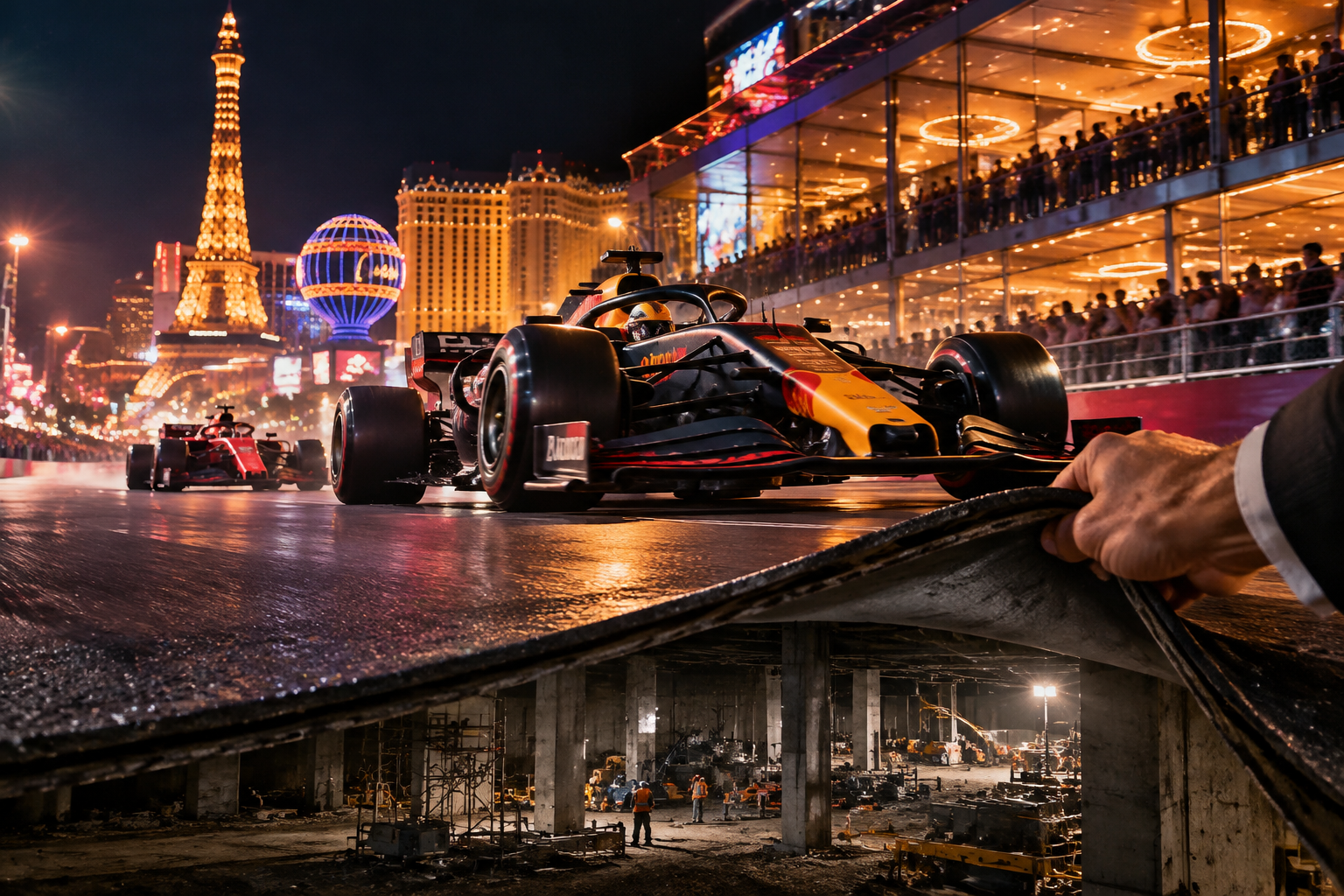
The Las Vegas investment was not a one-race expense
The video describes more than $500 million spent developing the Las Vegas circuit and compares that investment with Allegiant Stadium's construction cost, divided by the Raiders' eight annual home games. Its conclusion is that Formula 1 spent at least twice as much on facilities for its annual event.
That comparison is financially misleading.
The Las Vegas development includes a permanent 39-acre property and a four-storey, 300,000-square-foot building. The facility accommodates the teams and an 8,000-person Paddock Club, but its purpose extends well beyond race weekend. Liberty Media planned to turn it into Formula 1's American headquarters, with year-round merchandise, karting and entertainment experiences.
Formula 1®+1
This is not merely an intention that disappeared after the inaugural race. Liberty's 2025 SEC filing identifies revenue from the Grand Prix Plaza's karting, activations and corporate events as part of Formula 1's ongoing business.
SEC+1
Even the road improvements have a longer useful life. Formula 1's own account says nearly four miles of streets were repaved and that the new asphalt was expected to last six years.
Formula 1®
The video acknowledges that Allegiant Stadium also hosts concerts, college football and wrestling, but deliberately excludes those activities when calculating its cost per Raiders game. It then makes the equivalent mistake in the opposite direction: it treats the Las Vegas property as though its only purpose were one annual race.
A capital investment is not the same thing as an annual operating expense. To compare these projects properly, one would need their useful lives, depreciation, residual values, additional uses and operating revenues. Dividing the entire construction cost by one year's event count does not establish what an individual event actually costs.
The distinction matters because Formula 1 is building an enduring commercial property, not burning half a billion dollars every November.
The $4.4 billion acquisition was actually an $8 billion transaction
The video says Liberty Media purchased Formula 1 for $4.4 billion in 2016. That figure is real, but it is the equity value, not the enterprise value of the business.
Liberty's own September 2016 acquisition announcement valued Formula 1 at approximately $8 billion in enterprise value and $4.4 billion in equity value. The difference reflected approximately $4.1 billion in existing debt and $700 million in cash.
Liberty Media Corporation+1
This distinction matters. The video presents the smaller figure as the price of acquiring the business without explaining the substantial debt attached to it. A reader comparing Liberty's investment with subsequent financial performance deserves the full transaction valuation, not just its equity component.
Formula 1's audience decline had another major cause: television access
The video calls Formula 1 in the mid-2010s "unequivocally and objectively just plain boring." Its evidence is persuasive on competitive imbalance: Mercedes won 16 of 19 races in 2015, and Hamilton led the championship throughout the season.
But that establishes that the racing was dominated. It does not establish that boredom was the largest cause of the audience collapse.
There was another major development: Formula 1 was moving live coverage away from free-to-air television and behind subscription paywalls.
BBC Sport documented the consequences in January 2018. In Britain, the average audience was 3.1 million in the BBC's final year of coverage in 2015, 1.9 million on Channel 4 in 2017 and 652,000 on Sky that year. The BBC also reported that Sky would become the exclusive live broadcaster from 2019, apart from the British Grand Prix, and projected an approximately 80% reduction in the UK audience over four years.
BBC Sport
Italy faced a similar change. Of 21 races, only four were scheduled for live coverage on Sky's free-to-air channel TV8; the remaining 17 were behind Sky's subscription paywall.
BBC Sport
This was not a minor technical detail. It changed who could watch the sport without paying for another television subscription.
Formula 1's own 2016 SEC filing identified 12 free-to-air broadcasting agreements, nine pay-television agreements and 27 agreements covering both arrangements. Broadcasting rights already accounted for 32.3% of its revenue in 2015.
SEC
There was a commercial incentive to pursue more valuable television contracts, even if doing so reduced audience reach. BBC Sport explicitly described that trade-off: pay television could increase revenue while making the sport less accessible and reducing the audience available to sponsors.
The decline was not necessarily caused primarily by television distribution. Competitive dominance undoubtedly mattered, and the UK figures cannot explain every international market. But the video cannot reasonably declare boredom the largest explanation without examining a documented distribution change affecting major markets.
It turns a complicated commercial decision into a simpler story about bad racing.
Drive to Survive helped. It did not explain everything.
The video also gets an important date wrong. Drive to Survive did not debut in 2018. Formula 1 and Netflix announced its release on February 20, 2019, with the first season launching on March 8, 2019.
Formula 1®
More importantly, there is independent evidence that the series genuinely converted viewers.
In May 2022, Nielsen published an analysis identifying more than 360,000 American viewers who had not watched the final three race weekends of the 2021 season but subsequently watched Formula 1 racing after first watching Drive to Survive. They represented approximately 2.3% of the nearly 16 million people in Nielsen's selected viewing cohort.
Nielsen
That is meaningful evidence in the series' favour. It would be wrong to dismiss the documentary as merely entertainment for people who already followed the championship.
But Nielsen's research was observational, not a controlled experiment. It established a sequence of viewing behaviour, not how many people would have become fans without the series or how much of Formula 1's overall growth it independently caused.
The video does not adequately separate that contribution from another important commercial development: ESPN's growing investment in American Formula 1 coverage.
Formula 1 returned to ESPN in 2018. The network's average audience increased from 554,000 viewers per race in 2018 to 672,000 in 2019, before falling to 608,000 in the pandemic-affected 2020 season. It then rose sharply to 948,000 in 2021 and 1.21 million in 2022.
ESPN Press Room
ESPN also provided commercial-free race coverage and substantial promotional support, including studio programming, cross-promotion and coverage from American race venues.
The financial value of the broadcasting relationship changed dramatically. ESPN's original 2019 agreement was worth approximately $5 million annually for 2020–2022. Its subsequent renewal was reportedly worth $75–90 million annually, with Amazon having submitted a competing bid of approximately $100 million.
Sports Business Journal+1
That is a much larger commercial story than simply persuading people to watch a Netflix documentary. Liberty was developing an audience, expanding distribution, attracting competing broadcasters and increasing the value of the rights it controlled.
The video recognises ESPN's importance, but does not sufficiently distinguish the effects of the broadcaster's investment, the documentary and the championship itself.
The financial results reveal a much bigger business transformation
Formula 1's financial statements provide a better measure of Liberty Media's success than social media posts or attendance figures alone.
In 2022, F1 generated $2.573 billion in revenue and $239 million in operating income. In 2023, revenue reached $3.222 billion, an increase of 25%, while operating income rose to $392 million, an increase of 64%.
SEC+1
That is substantial commercial growth. But the annual accounts identify several different sources:
- Race promotion: 29.3% of 2023 revenue, including fees from race promoters and ticketing from Las Vegas.
- Media rights: 32.2%, including television agreements and F1 TV subscriptions.
- Sponsorship: 18%, including new sponsors, existing partners and Las Vegas event sponsorship.
- Other revenue: Hospitality, freight, Paddock Club operations, F1 Academy and other commercial activities.
The 2023 filing specifically attributes increased race promotion revenue to Las Vegas ticket sales, contractual fee increases and the mix of races held. Media rights grew through contractual increases and F1 TV subscriptions, while sponsorship benefited from new and existing partners. Hospitality revenue also increased.
SEC+1
The cost side is equally important. Formula 1's cost of revenue increased by $506 million in 2023. Other costs increased by $448 million, primarily because of Las Vegas event operations, hospitality and related expenses, alongside inflation.
SEC
These figures demonstrate why attendance alone cannot establish the financial success of an expensive event. The annual report does not provide a standalone Las Vegas Grand Prix profit-and-loss statement.
Nor does the subsequent business depend exclusively on the race. Liberty's 2025 filing reports total Formula 1 revenue of $3.873 billion and explicitly identifies Grand Prix Plaza operations, including karting, corporate events and other activations, as revenue-generating activities.
SEC+1
The actual transformation was a combination of media rights, sponsorship, event promotion, premium hospitality, subscriptions and permanent commercial assets. The video describes much of this activity, but never brings the different revenue streams together to establish their relative contribution.
The audience story deserves an update
The video observes that American television audiences stagnated after 2022. That was a reasonable description of the 2023–2024 figures: both seasons averaged approximately 1.1 million viewers per race on ESPN, compared with 1.21 million in 2022.
However, ESPN's final Formula 1 season in 2025 averaged 1.3 million viewers per race, setting a new reported record. ESPN reported growth of 135% compared with its 2018 average of 554,000.
ESPN Press Room
The earlier plateau was therefore not a permanent ceiling. Formula 1 continued expanding its American television audience, although the precise contribution of documentaries, competitive racing, broadcasting and promotion remains difficult to isolate.
That distinction matters. A successful commercial strategy deserves recognition, but a convincing explanation of its success requires more than placing several positive developments in chronological order.
The verdict: a genuine success story, told too neatly
Wendover's strongest argument survives scrutiny: Formula 1 learned to sell the people behind the racing, not merely the competition itself. Hamilton, Ricciardo, Steiner and the wider cast of personalities helped turn a technically complicated sport into accessible entertainment.
But the evidence does not justify reducing the transformation to that insight.
The earlier decline involved competitive dominance, television distribution and changing access to the sport. The recovery involved Netflix, ESPN, new broadcasting agreements, additional races, sponsorship, hospitality and substantial investment in permanent facilities.
Even the most dramatic financial example in the video is poorly framed. The Las Vegas development was an investment in a long-term commercial property, not a half-billion-dollar bill for 90 minutes of entertainment.
I would preserve the central insight that personalities can make audiences care about a sport beyond its results. I would reject the suggestion that this alone explains Formula 1's commercial transformation.
The boom is real. The accounting and causal explanation deserve considerably more scrutiny.
References
Original work
- How F1 Exploded — Wendover Productions. Original video and primary transcript examined.
Supporting evidence
1. Liberty Media Corporation Agrees to Acquire Formula One — Liberty Media, September 7, 2016. Establishes the distinction between the $8 billion enterprise valuation and $4.4 billion equity valuation.
2. F1 & TV rights – what does the future hold? — BBC Sport, January 25, 2018. Documents the move toward subscription broadcasting and its consequences for British and Italian audience access.
3. Formula 1 and Netflix put Drive to Survive on pole position — Formula 1, February 20, 2019. Establishes the documentary's actual launch date.
4. Driven to watch: How a sports docuseries drove U.S. fans to Formula 1 — Nielsen, May 2022. Provides measured evidence of viewers moving from the documentary to live racing, while its observational methodology limits causal conclusions.
5. F1 renews with ESPN for U.S. media rights through 2025 — Sports Business Journal, June 24, 2022. Documents the increase in ESPN's rights fees and competing broadcaster interest.
6. F1 set to transition Vegas paddock building into permanent U.S. HQ — Sports Business Journal, November 29, 2023. Establishes the building's permanent headquarters and year-round commercial plans.
7. We're creating a new legacy: The mind-boggling logistics behind the creation of the Las Vegas Grand Prix — Formula 1, 2023. Documents the permanent pit building, hospitality capacity and expected lifespan of the resurfaced roads.
8. Liberty Media Corporation 2023 Form 10-K — U.S. Securities and Exchange Commission, 2024. Provides audited business results, revenue composition and the costs associated with the inaugural Las Vegas event.
9. Liberty Media Corporation 2025 Form 10-K — U.S. Securities and Exchange Commission, 2026. Establishes the continuing commercial operations of Grand Prix Plaza and Formula 1's subsequent financial performance.
10. ESPN finishes final Formula 1 season with all-time viewership record — ESPN Press Room, December 10, 2025. Provides the latest reported American television audience figures and the progression since 2018.