Wendover's Red Bull Story Counts the Victories. It Leaves the Risks Off the Scoreboard.
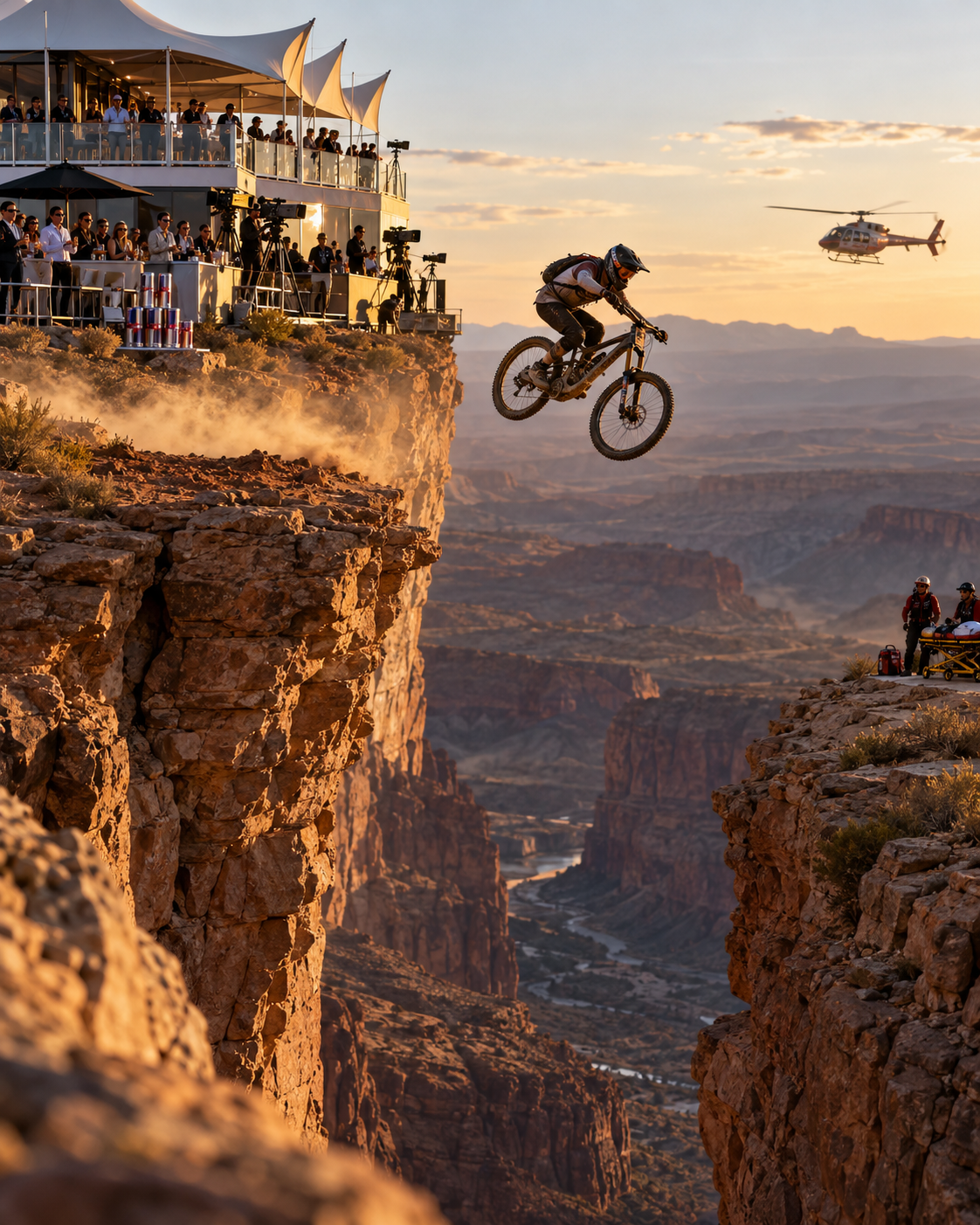
Wendover Productions' How Red Bull Built Its Empire presents an extraordinary corporate success story: a beverage company enters neglected sports, finances competitions, attracts elite athletes and eventually becomes an institution. The problem is that the video turns commercial influence into a story of public benefit without properly investigating who governs these sports, who actually organizes the competitions, and who pays when the spectacle goes wrong.
Red Bull's contribution is real. The account of its influence, however, is incomplete in ways that matter.
Red Bull is not the governing body
The video makes a sweeping claim about niche sports: they lack governing institutions, competition is fragmented, and Red Bull arrives with enough money to establish the standards everyone else follows.
That is an attractive story. It is also an oversimplification.
Freeride mountain biking already has a formal governing organization: the Freeride Mountain Bike Association (FMBA), founded in 2010 and registered as a nonprofit in Munich. It administers the FMB World Tour, licenses athletes, establishes competition categories, maintains rankings and regulates sanctioned competitions.
fmbworldtour.com+1
Red Bull Rampage itself was once part of that institutional structure. In 2015, the FMB World Tour officially described Rampage as the finale of its Diamond Series. But the FMBA, not Red Bull, administered the tour and its championship rankings. The published 2026 FMB calendar includes Red Bull District Ride but does not list Rampage.
fmbworldtour.com+1
The distinction matters. Red Bull helped create an important competition. That does not establish that it governs the sport.
The FMBA's March 2026 rulebook provides a useful comparison. Its framework includes:
- Athlete representatives elected by competitors.
- A judging structure with conflict-of-interest safeguards.
- Event juries involving sporting directors, athlete representatives and head judges.
- Course-safety reviews and emergency procedures.
- Requirements for event liability insurance and athlete medical and accident insurance.
- The authority to reject competition results or withdraw event accreditation when organizers violate its regulations.
These are actual institutional mechanisms, not simply the influence of an impressive television production. They apply to FMBA-sanctioned competitions, not automatically to every Red Bull event.
Amazon Web Services, Inc.+4
There is another important qualification: the FMBA itself operates Red Bull-branded Rookie standings. That establishes a commercial relationship between the brand and the governing structure, although it does not establish that Red Bull controls the association. The relationship deserves examination rather than being conveniently left out.
s3.us-west-2.amazonaws.com+1
The video takes a complicated sporting ecosystem and gives its most visible commercial participant almost all the credit.
Who actually organizes Red Bull Rampage?
The corporate attribution is also too simple.
Red Bull Rampage is produced by H5 Events, Inc., a separate event-production and sports-marketing company. H5 describes Red Bull Energy Drink as one of its major clients and lists Rampage among its projects.
www.h5events.com+1
H5's founder, Todd Barber, says he was instrumental in creating Rampage in 2001. He was also one of the founding members of the Freeride Mountain Bike World Tour in 2010 and served as its president for the first six years.
www.h5events.com+1
This is a particularly revealing relationship: the person behind the event that helped establish Red Bull's reputation in freeride mountain biking also helped establish the organization responsible for the sport's formal competition structure.
The distinction is not academic. The US Bureau of Land Management identified H5 Events, not Red Bull GmbH, as the applicant for the 2026 Special Recreation Permit to hold Rampage on public land near Virgin, Utah.
Bureau of Land Management+1
Red Bull supplies the commercial brand and enormous promotional platform. H5 has a documented event-production role. The BLM controls access to the relevant public land.
The available records do not establish the complete contractual division of authority between Red Bull and H5. They do establish that the video collapses several different responsibilities into one corporate success story.
Who selects the athletes? Who controls the competition? Who determines safety requirements? Who carries the insurance? These questions cannot be answered simply by putting a Red Bull logo on the mountain.
The athletes are carrying risks the video never calculates
The most consequential omission is the human cost of the sporting spectacle.
The video describes Red Bull as a “legitimate force for good” because its money has improved opportunities for athletes in smaller sports. It highlights training facilities, nutritionists, coaches, financial support and major competitions. But it never seriously investigates the injuries and financial exposure that accompany the performances generating this marketing value.
That omission is particularly difficult to defend because the evidence was already available when the video appeared on February 24, 2026.
Red Bull Rampage 2025, held the previous October, produced an extraordinary injury record. Mountain-bike publication Singletracks counted at least eight competitors suffering serious injuries during practice or competition: three men and five women. Five of the 12 women entered were injured during practice and unable to compete. Pinkbike separately reported that three riders were airlifted from the venue.
Singletracks Mountain Bike News+2
The medical response was praised. Pinkbike described highly trained medical teams performing difficult rescues, including helicopter extractions from exposed mountain terrain. That matters: the evidence does not support claiming that organizers simply ignored emergency preparedness. But excellent emergency treatment is not the same thing as preventing injuries.
Pinkbike
The more revealing evidence comes from Tarek Rasouli, a founding member of the Freeride Mountain Bike Association and a longtime figure in the sport.
In an October 2025 interview with Pinkbike, Rasouli explained that Rampage athletes must arrange their own insurance.
“Every athlete has to have their own insurance.”
He also argued that the event itself could not insure competitors because of a potential conflict of interest if a claim went to trial.
Pinkbike
This is an important distinction. The people performing the extraordinary physical feats are responsible for securing their own medical and accident coverage. Rasouli also explained that fundraising after a serious injury helps pay for rehabilitation, adaptive equipment and the enormous expenses that continue after hospital treatment.
He did not accuse Red Bull of abandoning injured athletes. In fact, he said Red Bull had supported his own recovery and expected the company and other sponsors to support injured competitor Adolf Silva. The criticism is not that support never exists. It is that the video's celebration of athlete support never examines who bears the financial risk when the sporting investment goes wrong.
Pinkbike
There is a second problem: the competition itself creates powerful incentives.
Rasouli described Rampage as a single annual opportunity, with no equivalent series of regular competitions for riders to establish themselves.
“It's like the Super Bowl, without any playoffs. There's no other event for them.”
He explained that competitors desperately want invitations, know they may have to wait another year for another opportunity, and consequently push themselves extremely hard. He suggested introducing several additional competitions and narrowing the differences between prize payouts to reduce some of that pressure.
Pinkbike
This is more interesting than the video's simple story of corporate generosity. Red Bull creates a highly desirable platform. Athletes compete for access to it. The scarcity of that access can intensify the pressure to deliver spectacular performances.
The athletes are not being forced to participate. Cam Zink has publicly acknowledged that competitors understand the risks, and Hannah Bergemann described competing as a dream come true. But voluntary participation does not eliminate the commercial incentives surrounding the competition.
Pinkbike
The FMBA's own rules illustrate what a more formal risk framework can look like. Its sanctioned events require athletes to carry medical and accident insurance, while event organizers must maintain at least $5 million in general liability insurance. The rules also require athlete representatives, medical personnel and safety arrangements. These provisions govern FMBA-sanctioned events; they should not automatically be attributed to Rampage, which is absent from the published 2026 FMB calendar.
s3.us-west-2.amazonaws.com+2
There is also counterevidence worth acknowledging. In October 2026, H5's Todd Barber explained that the men's Rampage final was cancelled because of dangerous weather. He said organizers consulted athlete representatives and a professional forecaster before making the decision, with strong winds, rain and lightning threatening competitors, spectators and staff. That was a genuine safety intervention.
Pinkbike
But the larger question remains unanswered: what standards govern the risks athletes are encouraged to take, what financial protection exists after catastrophic injuries, and how do judging and prize structures affect their decisions?
The video celebrates the spectacle without examining its economic and human costs.
Red Bull is not the only institution in cliff diving
The narrator describes Red Bull's Cliff Diving World Series as the definitive world championship for the sport.
That description needs qualification.
Red Bull operates a prominent international competition with its own rankings, prize structure and judging system. Its published rules describe 12 male and 12 female competitors at each stop, with five judges selected from a pool of approximately 12 members according to geographical location and availability.
Red Bull
But international high diving also has a separate institutional structure under World Aquatics.
World Aquatics operates its own High Diving World Cup, with three scheduled stops in 2026. Its February 2026 regulations establish formal competition rules, including approved dives, judging, athlete eligibility, safety requirements and appeals.
World Aquatics Official+1
The differences are important. World Aquatics specifies platforms of 27 metres for men and 20 metres for women. Red Bull's published cliff-diving format uses 27 metres for men and 21 metres for women. These are related but separately organized competition structures.
resources.fina.org+1
World Aquatics also requires athletes to demonstrate safely performed dives before receiving approval to compete. Its technical committee can exclude athletes based on observations during training or competition, including for safety reasons.
resources.fina.org
Crucially, World Aquatics explicitly states that its high-diving rules do not automatically apply to competitions outside its own events unless their organizers adopt them. This means we cannot simply assume that Red Bull's private series follows those safeguards. Equally, we cannot assume it lacks equivalent safeguards without examining its own regulations.
resources.fina.org
The Red Bull series may be the dominant commercial platform in its particular discipline. But calling it the definitive world championship without explaining the parallel international structure turns a brand's competitive prominence into an institutional claim.
The public information about Red Bull's judging arrangements also deserves more scrutiny. Knowing that judges are selected from a pool according to availability and geography is useful, but viewers are not given a full explanation of the appointment process, conflict-of-interest safeguards or appeals arrangements in the published FAQ.
That is not evidence of biased judging. It is a reason not to confuse a professionally produced competition with a fully transparent governing institution.
Even the opening financial arithmetic deserves scrutiny
The video opens with a memorable claim: a $3 can costs just 9 cents to manufacture, while approximately $1 goes toward marketing.
The problem is not that Red Bull spends heavily on marketing. It demonstrably does. The problem is that the video offers no calculation explaining how its retail-price figures relate to the company's actual expenditure.
Red Bull's 2023 financial reporting, available before the video was published, showed a marketing budget of approximately €2.48 billion. The company sold 12.138 billion cans that year. That works out to roughly €0.20 in marketing expenditure per can.
salzburg.ORF.at+1
The later 2025 figures put marketing expenditure at approximately €3.15 billion against 13.969 billion cans sold, or about €0.23 per can. Red Bull's reported group turnover was €12.196 billion, equivalent to approximately €0.87 per can.
trend.at+1
These are company-wide averages, not an audited breakdown of the cost of marketing an individual beverage. Nevertheless, they do not substantiate the video's simple assertion that $1 of every $3 retail sale goes toward marketing.
A retail price is not the same as the manufacturer's revenue. Taxes, retailers, distributors and other costs sit between the consumer's payment and the money received by Red Bull.
The 9-cent manufacturing estimate also appears without a source or cost breakdown. We are not told whether it covers only the liquid, or how packaging, contract manufacturing and other production expenses are treated.
The opening figures make an effective story. They are not sufficiently documented to support the certainty with which they are presented.
The verdict: a corporate success story is not an investigation of corporate power
Wendover has constructed a compelling account of how Red Bull turned an energy drink into a global marketing institution.
But it repeatedly confuses influence with authority, sponsorship with governance, and investment with public benefit.
The actual sporting ecosystem is more complicated. The FMBA establishes formal competition structures. H5 Events provides event-production expertise. Public authorities regulate access to land. Athletes take substantial physical risks, often while arranging their own insurance. World Aquatics operates a separate international high-diving structure.
Red Bull is enormously influential within that system. That makes accountability more important, not less.
The company deserves neither automatic condemnation nor automatic credit for everything that happens under its branding. Its contributions to athletic development do not answer questions about who controls competition standards, who protects competitors, or who carries the financial consequences of injury.
The video spends considerable time explaining how Red Bull learned to manufacture spectacular moments that people want to watch.
It spends almost none examining the people who risk their bodies to manufacture those moments.
That is the missing story. Red Bull's empire is not merely a marketing achievement. It is an exercise in commercial power over sporting institutions, and that power deserves considerably more scrutiny than Wendover gives it.
References
1. How Red Bull Built Its Empire — Wendover Productions, February 24, 2026. The original video and the claims examined in this critique.
2. About the Freeride Mountain Bike Association — FMBA, official website. Establishes the association's nonprofit status, governing role and administration of the FMB World Tour.
3. FMB World Tour Rule Book, Version 6.4 — Freeride Mountain Bike Association, March 2026. Documents athlete representation, judging, conflict safeguards, insurance, medical requirements and event oversight.
4. FMB World Tour Calendar — FMBA, 2026. Shows the officially listed competitions and the absence of Rampage from the published calendar.
5. The 10th Edition of Red Bull Rampage — FMB World Tour, June 11, 2015. Confirms Rampage's historical position as the Diamond Series finale.
6. H5 Events — H5 Events, company website. Identifies Red Bull as a major client and documents Todd Barber's role in creating Rampage and founding the FMB World Tour.
7. BLM Seeks Input on Proposed Red Bull Mountain Bike Competition Near Virgin — Bureau of Land Management, June 26, 2026. Identifies H5 Events as the applicant for the Rampage public-land permit.
8. 8 Mountain Bikers Brutally Injured During Red Bull Rampage 2025 — Singletracks, October 21, 2025, updated October 22. Documents the publication's tally of at least eight seriously injured competitors.
9. 5 Things We Learned From the 2025 Red Bull Rampage — Pinkbike, October 22, 2025. Documents the three helicopter evacuations and the emergency medical response.
10. Does Red Bull Rampage Need to Change? An Interview With Tarek Rasouli — Pinkbike, October 31, 2025. Provides an experienced insider's account of athlete insurance, competition scarcity, performance pressure and possible changes to the event.
11. Safety First: Todd Barber Addresses Backlash Over 2026 Red Bull Rampage Cancellation — Pinkbike, October 13, 2026. Provides the event founder's explanation of the weather-related cancellation and athlete-safety decisions.
12. Red Bull Cliff Diving World Series FAQ — Red Bull, official event information. Documents the competition format, scoring and judge-selection arrangements.
13. World Aquatics Competition Regulations — World Aquatics, February 2026. Establishes the separate high-diving regulatory framework, safe-to-compete requirements and competition oversight.
14. World Aquatics High Diving World Cup 2026 — World Aquatics, 2026. Documents the separate international high-diving competition circuit.
15. New Record: More Money for Marketing Than Ever — trend, October 9, 2026. Reports Red Bull's 2025 marketing expenditure and its approximate marketing cost per can.
16. Red Bull Company Profile — Red Bull, official company information. Provides the company's reported 2025 turnover and can-sales figures used to check the marketing arithmetic.