Wendover Says Storage Is Killing American Towns. Carbondale's Records Tell a Different Story.
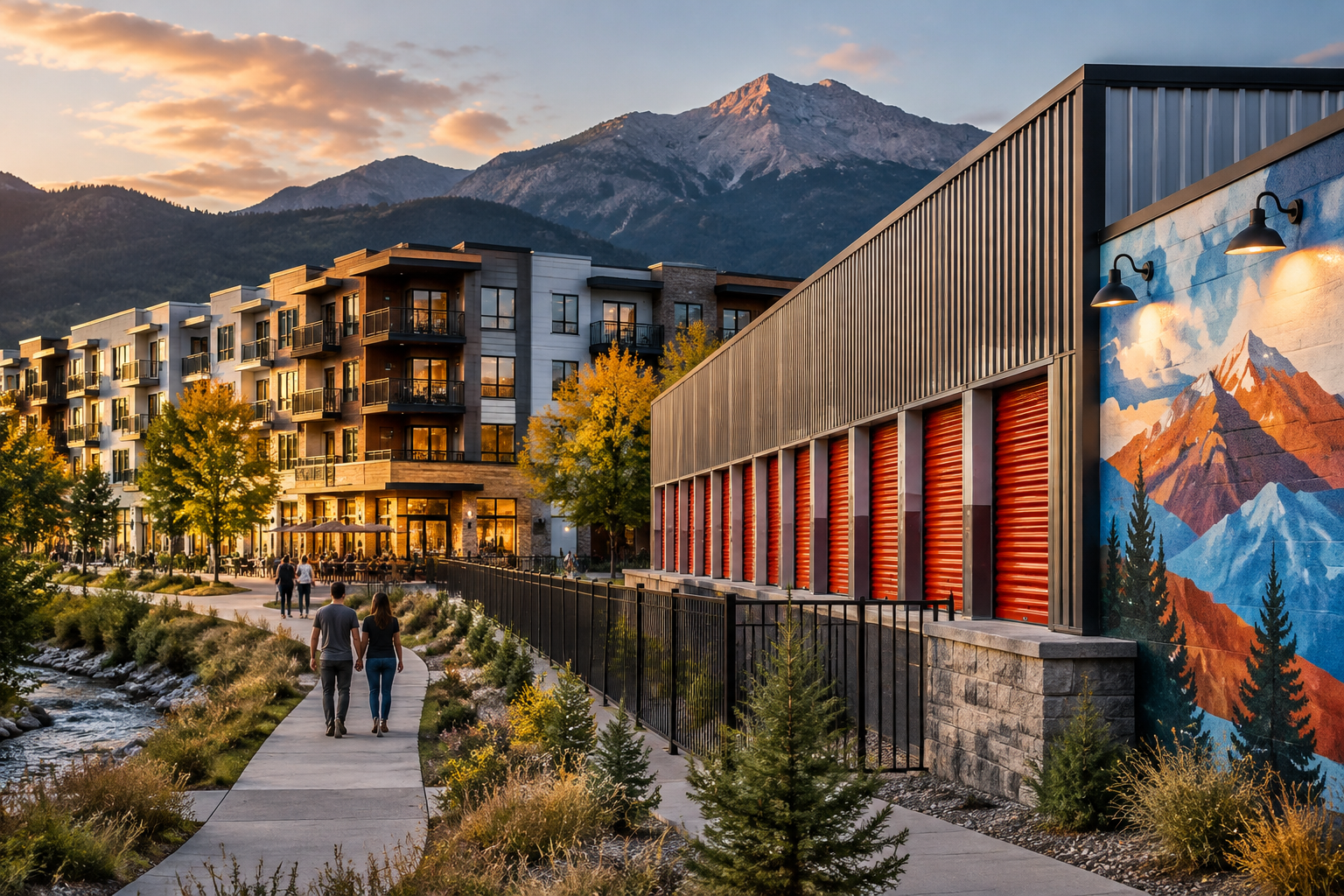
The Colorado town at the center of Wendover Productions' indictment of self-storage also approved 76 apartments, 15 affordable homes, and more than 10,000 square feet of commercial space alongside one of the storage expansions the video criticizes. That is not a minor detail. It changes the story.
In How Self Storage Consumed America, published November 12, 2025, Wendover Productions presents a persuasive account of a remarkable American business. Storage facilities are comparatively inexpensive to operate, customers tend to stay, and the industry has spread into communities that seem far too small to support so many competing businesses.
The economic explanation is useful. The trouble begins when the video turns that explanation into an indictment of American development.
Self-storage buildings, Wendover argues, interfere with neighborhood growth, contribute little employment, and prevent land from becoming something more valuable to the community.
Carbondale, Colorado, is offered as the illustration: a mountain town with fewer than 7,000 residents, six storage operators within minutes of one another, and new facilities appearing as the town expands.
Wendover portrays these buildings as obstacles to a better urban future.
But the town's own planning records tell a more complicated story—one involving new homes, affordable housing, commercial redevelopment, and public infrastructure that the video leaves largely unexplored.
The strongest objection to Wendover's conclusion is not that storage buildings are beautiful, or even desirable. It is that the video repeatedly assumes an alternative use of the land would be better without establishing what that alternative was, whether anyone could finance it, or what the actual projects delivered.
1. The Storage Expansion Came With 76 Apartments
Consider Sopris Self Storage, one of the first facilities introduced in the video.
Wendover describes its major expansion, completed in 2023, as part of Carbondale's extraordinary proliferation of storage units. The facility is convenient, substantial, and located near downtown.
Later, the narrator argues that buildings like these interfere with the evolution of neighborhoods into more productive commercial and residential districts.
What viewers are not told is that the Sopris expansion was part of a larger redevelopment that included precisely the kinds of buildings Wendover wants American towns to encourage.
In July 2020, Carbondale's Board of Trustees considered a rezoning application involving the Sopris Shopping Center and the adjoining storage property.
The proposal called for replacing the shopping center with a mixed-use development containing 76 rental apartments and approximately 10,100 square feet of commercial space, while adding another storage building beside the existing facilities.
The residential proposal included 15 apartments subject to affordable-housing restrictions.
The town's planning staff examined the arrangement, and its Planning Commission recommended the rezoning by a 6–1 vote.
This was not an abstract possibility.
In February 2021, the local newspaper The Sopris Sun reported that Carbondale's trustees had approved the major site plan. The authorized project included 76 rental apartments, 10,370 square feet of commercial space, and a new 68,000-square-foot climate-controlled storage facility.
By June 2023, the newspaper was reporting on the apartments at Hayden's Place, which had replaced the former shopping center, alongside the completed storage expansion.
The Garfield County Housing Authority independently lists 15 deed-restricted affordable apartments at Hayden Place II, 900 Highway 133. These are studio units serving households within the town's specified income categories.
Here is the picture Wendover should have presented.
A property containing an aging shopping center and existing storage buildings was redeveloped into a combination of housing, retail, and expanded storage.
The storage did not prevent the development of those 76 apartments. Both were included in the same approved project.
That does not establish that the resulting land-use mix was optimal. Perhaps reducing the storage component would have permitted additional housing.
But that is a proposition requiring evidence, not a conclusion established by pointing a camera at a large building.
There was a genuine trade-off worth investigating.
The original shopping center had approximately 29,896 square feet of commercial space. The replacement development offered 10,370 square feet—a reduction of roughly 19,500 square feet.
In June 2023, approximately 7,500 square feet of the new commercial space was still available to lease.
Why was so much commercial space removed? Would more shops have been commercially viable? Did storage revenue make the housing development financially attractive, or did storage consume land that could have supported more apartments?
Those are consequential questions.
Wendover does not answer them.
Instead, a redevelopment that combined housing, retail, and storage becomes part of a broader story about storage preventing housing and retail.
The omitted context matters more than the building's appearance.
2. A $1.32 Million Building That Was Actually Much Larger
Wendover's construction-cost argument deserves equally close attention.
The video describes self-storage as exceptionally cheap to build, estimating a range of $30–$70 per square foot.
To illustrate, the narrator considers the 375-unit addition at Sopris Self Storage.
Assuming each unit averages 10 by 5 feet, the calculation produces 18,750 square feet.
At $70 per square foot, Wendover arrives at an estimated construction cost of approximately $1.32 million.
It is presented as a rough illustration, not an audited construction bill. The video also acknowledges that its estimate excludes land.
Those qualifications are important.
But the calculation contains another problem.
The actual expansion was reported locally as a 68,000-square-foot building containing 375 units.
That is more than 3.6 times the area used in Wendover's estimate.
The problem is the distinction between rentable unit space and the floor area of an entire building.
A multistory, climate-controlled storage facility does not consist entirely of rentable lockers. It needs corridors, elevators, stairs, circulation areas, mechanical systems, and structural space.
Wendover's hypothetical 50-square-foot units account for only about 28% of the reported building area.
If we apply the video's own $70-per-square-foot assumption to all 68,000 square feet, the estimated construction cost becomes $4.76 million.
That is approximately $3.45 million more than the figure viewers hear.
Neither estimate establishes the actual construction cost. The original $1.32 million is based on hypothetical unit sizes, while $4.76 million is simply the result of applying the same assumed rate to the reported building area.
But that is precisely why the original estimate should not be mistaken for a credible valuation of the completed project.
There is another complication.
Storable, a self-storage industry software and services company, cites construction estimates of $90–$120 per square foot for multistory facilities, excluding land and site improvements.
At those rates, a 68,000-square-foot project would imply approximately $6.12 million to $8.16 million in construction costs. These are illustrative comparisons, not evidence of what the Sopris developer actually paid.
More recent figures underscore why definitions matter.
Public Storage reported completing $408.9 million in development and expansion projects during 2025, adding approximately 2.1 million net rentable square feet.
That works out to roughly $195 per net rentable square foot of completed development and expansion.
The figure cannot be directly compared with Wendover's construction-only estimate because the cost categories and area definitions differ. It does, however, demonstrate that actual development expenditures require more careful treatment than multiplying assumed unit dimensions by a generic construction rate.
Wendover subsequently compares its estimated storage-building cost with the reported $19 million cost of a nearby apartment project.
The apartment development is described as providing 52,000 square feet of residential space.
It is certainly plausible that apartments cost substantially more to build than lockers. They need kitchens, bathrooms, plumbing, windows, ventilation, and the infrastructure required for permanent human occupation.
But comparing the full reported cost of housing with a simplified storage estimate based on hypothetical rentable space makes the difference appear more precise than the underlying evidence permits.
The real question is not whether a steel locker costs less to construct than an apartment.
It is whether the return on a particular property, including its costs and community benefits, justifies using the land for storage instead of something else.
A convincing comparison would examine actual development budgets, land costs, operating revenues, tax contributions, and feasible alternatives.
Wendover supplies an appealing illustration.
It does not supply that comparison.
3. The Public Artwork Was Not Simply Camouflage
The video repeatedly draws attention to the appearance of storage buildings.
They are fenced, blank, hidden in industrial corners, or disguised with local art.
In Carbondale, Wendover describes a large new storage facility near an electrical substation and suggests that surrounding artwork does little to improve its contribution to community life.
There is a legitimate aesthetic criticism here. A building decorated with murals does not automatically become good urban design.
But the town's official records establish that the artwork was part of a broader public-improvement agreement.
In September 2024, Carbondale's planning and public works departments documented the completion of improvements associated with the Central Self Storage development.
The project involved a 2.6-acre parcel annexed into town and approved for an indoor storage facility.
Under the development agreement, the owner was required to provide improvements that went beyond routine utilities and vehicle access.
They included a lighted public trail along Highway 133, connections between the trail and the storage property, surfaces for murals, spaces for sculptures, and lighting for public art.
The town's records describe an art walk designed to allow public access to the artwork.
The improvements were secured through a letter of credit of approximately $324,109, which the town was preparing to reduce after accepting the completed work. That amount represents financial security for the improvements, not their verified construction cost.
These facts do not prove the development generated more public benefit than another possible use of the land.
A public trail is not a substitute for affordable housing.
But the distinction between a private building hiding behind art and a developer providing required public infrastructure is meaningful.
One is decoration intended to conceal an unattractive structure.
The other is an arrangement through which a municipality obtains physical public improvements in exchange for development rights.
In this case, the records describe the latter.
Wendover's framing largely passes over the economic and civic relationship between the developer and the town.
It is difficult to evaluate the public consequences of a development while omitting the public improvements associated with its approval.
4. Denver's Restrictions Are Real. Their Results Are Not Established.
Wendover makes one of its stronger arguments when discussing Denver.
In 2018, the city amended its zoning rules to restrict new mini-storage facilities near rail-transit stations.
The concern was understandable.
Land close to public transportation is valuable precisely because people can use it to live, work, shop, and move around without depending entirely on cars.
A building visited occasionally by customers retrieving furniture contributes much less to those objectives than a busy residential or commercial development.
Denver's official zoning interpretation, issued in January 2019, confirms the policy.
The rules prohibit new mini-storage facilities in specified districts within one-quarter mile of rail platforms, with additional restrictions affecting industrial districts. The city explained that it wanted to protect land near transit stations for more active uses.
That is a defensible planning judgment.
But a zoning decision is not evidence that every prohibited storage proposal would otherwise have displaced a feasible apartment building, shop, or office.
It establishes what the government preferred.
It does not establish what developers would actually have built.
There is a further consequence that Wendover does not investigate.
In August 2019, Denverite reported that Greenbox Self Storage had sued Denver after the city blocked its proposed facility at 4700 East Evans Avenue.
The company alleged that Denver had applied newly adopted restrictions to an application submitted under earlier rules. Greenbox sought to overturn the zoning decision and recover alleged lost profits.
Those were allegations, not judicial findings, and the reporting did not establish the lawsuit's eventual outcome.
Nevertheless, the dispute demonstrates that storage restrictions involve real financial interests and potential legal costs.
What happened to the contested parcel? Was it subsequently developed for housing or another active use? Did the restriction produce the result planners wanted?
Without that information, the case establishes a policy conflict rather than an accomplished urban improvement.
A prohibition can protect valuable land from undesirable development.
It can also leave a property unused if no alternative project is commercially feasible.
The distinction matters because an empty lot is not automatically a better public outcome than a functioning business.
And an effective restriction should ultimately be judged by what it produces, not merely by what it prevents.
5. Denver Itself Helped Finance a Storage-Led Redevelopment
There is a particularly instructive counterexample in Denver's own redevelopment history.
The Denver Urban Renewal Authority documents a project called Lowry Hangar 2.
The site contained a historic military aircraft hangar that had remained vacant for more than 15 years.
Its size and structural characteristics made redevelopment difficult.
Rather than eliminating storage from the property, the redevelopment team proposed using part of the historic structure for self-storage while developing surrounding retail and restaurant space.
The project combined historic preservation with commercial activity.
According to the authority, it involved approximately $21.7 million in total development costs and $2 million in public reimbursement through tax-increment financing.
The resulting development included self-storage, retail and office space, and a dining district with approximately 35,000 square feet of commercial activity.
The authority reports that the financial obligation was paid off six years early, in 2014.
This is not proof that self-storage is generally beneficial to cities.
It is proof that the relationship is more complicated than Wendover's conclusion allows.
In one Denver neighborhood, officials sought to prevent storage from occupying valuable land near transit.
Elsewhere in the same city, a public redevelopment authority supported a project in which storage formed part of the strategy for rehabilitating an otherwise difficult historic property.
Both decisions can be rational.
They address different sites, different constraints, and different development opportunities.
That is how land-use planning is supposed to work.
The quality of the outcome depends on the property, surrounding neighborhood, feasible alternatives, and terms of the development.
A storage facility may represent a serious missed opportunity beside a train station.
It may also help make an otherwise uneconomic redevelopment possible.
Neither conclusion can be established simply by identifying the building's business model.
6. The Question Wendover Never Properly Answers
Wendover's strongest economic observations survive scrutiny.
Self-storage can be comparatively inexpensive to operate.
Its customers face real inconvenience when moving out.
Household disruption creates demand even during periods of economic difficulty.
Storage buildings generally generate fewer jobs and less pedestrian activity than many alternative commercial uses.
And cities are entitled to decide that some locations should be reserved for more active development.
But none of those observations establishes that America's storage expansion has been broadly harmful to the communities accommodating it.
That requires a different investigation.
The relevant comparison is not between an unattractive storage building and an imaginary neighborhood full of apartments, cafés, and pedestrian activity.
It is between the actual storage development and the alternatives that could realistically have been built on the same property, under the same economic and legal conditions.
Carbondale makes the distinction impossible to ignore.
The town approved a redevelopment that combined 76 apartments, affordable housing, commercial space, and a substantial storage expansion.
The wider project also reduced the amount of commercial space previously occupying the site.
Those are measurable outcomes involving genuine competing interests.
Which part of the project made the other parts financially possible? Could the town have obtained more housing by restricting storage? Did it sacrifice commercial opportunities, or replace older retail space that no longer matched demand?
The documents examined here do not establish definitive answers.
But they establish something important about Wendover's argument.
The video presents the growth of storage as an obstacle to urban development while giving insufficient attention to cases in which storage and urban development occurred together.
Its construction example understates the reported building area used for the comparison.
Its discussion of artwork overlooks negotiated public improvements.
Its account of Denver treats planning restrictions as persuasive evidence of the problem without measuring their ultimate effects.
And its sweeping conclusion depends on a counterfactual that remains largely untested: that substantially better uses of the land were available and would have been developed without storage.
That is the central failure of How Self Storage Consumed America.
The documentary explains why Americans have built so many storage facilities. It does not establish that those facilities generally prevented something better from being built.
In Carbondale, one of its principal examples, the public record is particularly revealing.
The expansion of storage happened alongside the construction of homes.
Some of those homes were set aside as affordable housing.
Wendover's story would have been stronger had it confronted those facts and investigated the actual development trade-offs.
Instead, the audience receives an argument about what storage buildings supposedly prevent, without being told enough about what the featured developments actually produced.
A town should not surrender valuable land to storage simply because a developer can make money from it.
But neither should a documentary condemn that decision without understanding what the town received in return.
The distinction is not complicated.
Count the homes. Count the businesses. Count the public improvements. Then establish what the alternatives would have delivered.
Only then can we determine whether storage consumed the community—or helped finance part of its growth.
References
1. Original work — How Self Storage Consumed America. Wendover Productions, November 12, 2025.
Watch the original video
The primary source for the economic claims, construction-cost illustration, Carbondale examples, and argument about storage's urban consequences.
2. Carbondale Board of Trustees Meeting Packet. Town of Carbondale, July 14, 2020.
Official municipal records
Documents the Sopris redevelopment proposal, its proposed 76 apartments, commercial space, storage expansion, affordable-housing requirements, and planning review.
3. Subdivision and Redevelopment Approved. Raleigh Burleigh, The Sopris Sun, February 10, 2021.
Read the local reporting
Confirms municipal approval of the mixed-use redevelopment combining apartments, retail, and a 68,000-square-foot storage facility.
4. Commercial Inventory in High Demand in 2023. Raleigh Burleigh, The Sopris Sun, June 28, 2023.
Read the commercial-property report
Documents the completed 375-unit storage expansion, the residential redevelopment, and the reduction and vacancy of commercial space.
5. Deed Restricted Rentals. Garfield County Housing Authority, undated; accessed October 2026.
View the housing authority's records
Independently identifies 15 deed-restricted affordable apartments at Hayden Place II, 900 Highway 133, Carbondale.
6. Public Infrastructure Acceptance and LOC Reduction—Central Self Storage. Town of Carbondale, September 10, 2024.
Read the official town memorandum
Documents the trail, public-art requirements, completed infrastructure improvements, and financial security associated with a separate storage development.
7. How Much Does It Cost to Build a Self-Storage Facility?. Storable, undated.
Read the construction-cost guide
Provides industry construction-cost ranges that distinguish multistory facilities from simpler buildings and exclude land and site improvements.
8. Public Storage Reports Fourth Quarter and Full Year 2025 Results. Public Storage, February 2026.
Read the company's financial results
Reports $408.9 million in completed development and expansion expenditures for approximately 2.1 million net rentable square feet, providing a separately defined real-world cost comparison.
9. Written Code Interpretation—Applicability of Use Limitations for Mini-Storage Facilities. City and County of Denver, January 22, 2019.
Read Denver's zoning interpretation
Confirms Denver's 2018 restrictions near rail stations and explains the city's preference for higher-density residential and employment uses.
10. Self-Storage Company Sues Denver, Which Banned the Big Boxes That Store Little Boxes Near RTD Stations. David Sachs, Denverite, August 9, 2019.
Read the lawsuit reporting
Documents Greenbox's legal challenge and the city's stated planning rationale; it does not establish the merits or final outcome of the litigation.
11. Lowry Hangar 2. Denver Urban Renewal Authority, undated.
View the official redevelopment record
Documents a publicly supported redevelopment combining self-storage, historic preservation, restaurants, retail, and offices, demonstrating that storage can form part of a mixed-use revitalization project.