The D-Day Trap: Why Wendover's Picture of a Chinese Invasion Is Too Narrow
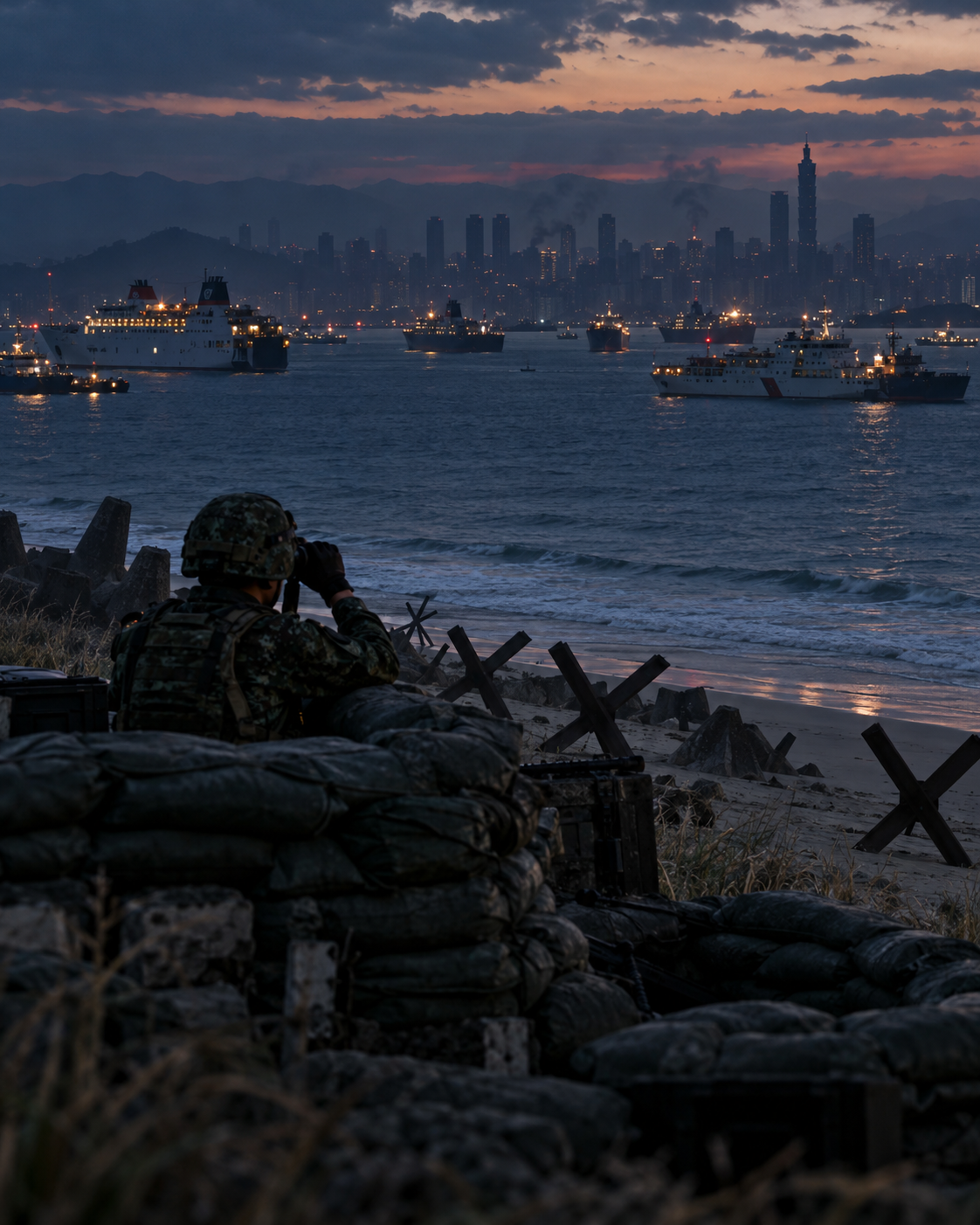
Wendover Productions makes a persuasive case that Taiwan would be extraordinarily difficult to conquer through a conventional amphibious invasion. But it gives readers an incomplete picture of the threat: China does not have to begin with a Normandy-style landing, and Taiwan does not get to choose the kind of conflict it faces.
The distinction matters. A military strategy built around surviving an invasion is not necessarily a strategy for surviving coercion, blockade, or a campaign designed to cripple the island before troops ever reach its beaches.
The war may start before the landing craft
Wendover says the 160-kilometer crossing gives Taiwan an eight-to-ten-hour head start. But that measures the time ships spend crossing the strait, not the time Taiwan has to prepare for war.
The video describes Taiwanese aircraft attacking Chinese vessels during those hours. It does not adequately examine what happens if the crossing is preceded by coordinated attacks on Taiwan itself.
Taiwan's own 2025 National Defense Report describes a Chinese campaign combining cyberattacks, electronic warfare, missile strikes, maritime blockades, and amphibious operations. It specifically identifies command systems, military logistics, communications, commercial activity, and civilian infrastructure as potential cyber targets. Chinese missiles can reach military targets and critical civilian infrastructure throughout Taiwan.
Ministry of National Defense Taiwan+1
That changes the meaning of the supposed eight-hour advantage. Taiwanese aircraft might have an opportunity to attack the invasion fleet, but their ability to coordinate, communicate, operate from airbases, and mobilize ground forces could already be under attack.
There is another vulnerability the video misses. Taiwan relies on 24 undersea cables for more than 99% of its internet traffic and external communications, according to the U.S.-China Economic and Security Review Commission. Its 2025 report documents suspected Chinese-linked cable sabotage and research into equipment designed to sever deep-sea cables.
USCC
A mountain bunker can protect a president from explosions. It cannot, by itself, preserve the communications network needed to govern a country at war.
The video treats the arrival of Chinese landing craft as the decisive beginning of the conflict. Taiwan's own military planning describes a much broader opening campaign.
Fourteen beaches are not a permanent ceiling
Wendover states:
"Analysts believe they have the number down to just 14."
That number has a specific history. It comes from military analyst Ian Easton's identification of 14 potential landing beaches in his 2017 book The Chinese Invasion Threat.
But there is an important qualification missing from the video: in 2023, the Taipei Times reported that Taiwan's armed forces recognized the vulnerability of potential landing sites but disagreed with Easton's assessment of their locations and number. This is not an agreed official inventory of every possible landing location.
Taipei Times
Worse for the video's argument, China's landing capabilities have continued evolving.
Wendover does mention floating barges that could serve as temporary piers. However, it primarily presents them as a way for large ships to unload after capturing a permanent port.
A March 2025 study by the U.S. Naval War College's China Maritime Studies Institute documented a more ambitious development: China's new Shuiqiao-class landing barges.
Three of these self-propelled vessels can connect to form an approximately 820-meter temporary pier. Their purpose is to support the movement of equipment and supplies directly onto unimproved coastlines, damaged ports, blocked ports, and potentially across seawalls onto coastal roads.
digital-commons.usnwc.edu+1
The system is not invulnerable. The Naval War College researchers specifically warn that unloading large quantities of equipment could create new logistical bottlenecks once vehicles reach Taiwan's restricted and contested terrain.
But it changes the landing problem. China is developing ways to reduce its dependence on established ports and conventional landing facilities.
More revealing evidence came from Reuters in November 2025.
Its visual investigation used satellite imagery and vessel-tracking data to examine Chinese civilian shipping exercises during the summer of 2025. Researchers identified 12 civilian vessels participating in one exercise: six roll-on/roll-off ferries and six deck-cargo ships.
Satellite imagery showed a cargo vessel using its own ramp to unload vehicles directly onto a beach. Reuters counted at least 330 vehicles on or near the shore during the exercise, although it could not establish that every vehicle had been unloaded by the participating ships.
The investigation also documented smaller craft and temporary pier equipment. Taiwanese and American military experts interviewed by Reuters said these civilian vessels could expand China's ability to conduct landings at multiple locations.
Reuters
This is important because the traditional calculation assumes that Taiwan can concentrate its defenses around a limited number of likely landing sites.
A larger, more distributed civilian shipping force could complicate that calculation.
There are substantial qualifications. Civilian cargo ships are vulnerable to weapons, and a successful exercise does not demonstrate that the same operation could survive Taiwanese missile attacks. A Taiwanese defense official also suggested that publicizing these exercises could serve psychological warfare purposes.
Those objections matter. But they do not make the developments irrelevant.
The 14-beach estimate describes a geographical problem. It does not establish a permanent limit on China's ability to create landing and supply points.
China can squeeze Taiwan without storming a beach
Perhaps the largest omission is the possibility that Beijing could attempt to force Taiwan into submission without launching a conventional invasion.
CSIS examined this possibility in its June 2024 report, How China Could Quarantine Taiwan.
A quarantine would be led primarily by China's Coast Guard and maritime law-enforcement agencies rather than by the PLA conducting an overt military blockade. China could impose new inspection requirements, board vessels, restrict selected shipments, and pressure international shipping companies to comply with its rules.
The objective would be to demonstrate Chinese control over Taiwan's maritime and air commerce without immediately declaring war.
CSIS assessed this approach as more feasible and more likely in the near term than a full invasion or military blockade.
CSIS+1
The disparity between the maritime forces is considerable.
CSIS's 2024 estimates placed China's Coast Guard at more than 150 oceangoing vessels and over 400 smaller vessels. Taiwan's Coast Guard had approximately 10 oceangoing vessels and 160 smaller vessels.
This is not a conventional military comparison. It is a problem of maintaining control over maritime traffic against a much larger law-enforcement and paramilitary force.
CSIS
Nor is this merely hypothetical activity.
A May 2026 CSIS study found that the daily average of distinct Chinese Coast Guard vessels entering Taiwan's near waters increased by more than 500% between January 2020 and December 2025. Incursions into Taiwan's second maritime security ring also increased more than fourfold on average.
CSIS
The consequences could be substantial because Taiwan depends heavily on maritime imports.
CSIS estimated in its 2024 blockade analysis that Taiwan imported approximately 97% of its energy and 70% of its food. In 2022, approximately 57% of its maritime trade entered through the Port of Kaohsiung, near its largest liquefied natural gas import terminal.
CSIS Features
China would not necessarily need to sink Taiwanese warships or capture a single beach to create serious economic pressure.
A sustained disruption to energy imports could progressively undermine electricity generation and commercial activity. The resulting pressure would affect ordinary households, businesses, communications, and the military's ability to sustain operations.
This is precisely the kind of vulnerability that a beach-defense map cannot explain.
To be clear, a blockade is not an easy alternative for Beijing. CSIS conducted 26 blockade wargames in 2025 and concluded that China could inflict serious hardship, particularly through attacks on Taiwan's energy sector, but that a blockade would carry substantial risks of escalation into a larger war.
CSIS
That qualification strengthens rather than weakens the criticism. The important question is not whether China has an effortless alternative. It is whether Taiwan can withstand the different forms of pressure that may precede or accompany an invasion.
Taiwan's own 2025 defense report explicitly describes Chinese exercises simulating blockades of its waterways and energy imports, alongside missile strikes and Coast Guard operations.
Ministry of National Defense Taiwan+1
Wendover spends considerable time explaining how Taiwan intends to manufacture drones domestically because external supplies could disappear during a war. Yet it gives much less attention to the wider dependence of the island on imported energy, food, and maritime commerce.
Taiwan's surrounding waters are both its greatest geographical defense and one of its greatest economic vulnerabilities.
The bunker is not the country
The video devotes considerable attention to Taiwan's underground Heng Shan Command Center, Jiashan's protected aircraft hangars, runway repairs, and emergency highway airbases.
These are important military assets. But their existence does not establish that Taiwan can sustain an entire national defense under prolonged attack.
A July 2025 Congressional Research Service assessment identified several problems that the video does not adequately address:
- Taiwan's military struggles to recruit, train, and retain personnel.
- Some observers consider its civil-defense preparedness insufficient.
- Its energy, food, water, communications, and other critical infrastructure remain vulnerable to external disruption.
- The willingness and ability of Taiwanese society to endure the economic and human costs of a prolonged conflict remain uncertain.
Every CRS Report
These are not minor administrative concerns.
A protected command center is useful only if the military can communicate with its forces, move supplies, repair infrastructure, treat casualties, and maintain public order.
Taiwan recognizes this problem. Its 2025 National Defense Report describes the Whole-of-Society Defense Resilience Committee, established in June 2024, and the integration of civilian resources into national defense planning.
Taiwan also introduced Exercise URBAN RESILIENCE in 2025, combining air-defense exercises, national mobilization, emergency response, cybersecurity, shelter preparation, and critical-infrastructure protection across local governments.
Ministry of National Defense Taiwan
But the existence of these programs does not prove that the country can withstand the disruption of a prolonged blockade or coordinated missile and cyber campaign.
The distinction is important: preserving military infrastructure and preserving a functioning society are different achievements.
Wendover explains where Taiwan's president could survive an attack. It does not establish whether the country surrounding that bunker could continue functioning.
The troop numbers create more certainty than the evidence warrants
Wendover estimates that China would need 400,000–500,000 personnel to have a realistic chance of conquering Taiwan, and that assembling this force would require approximately a month.
The transcript does not identify the analysts behind this estimate or explain precisely what the number represents.
That matters because the force needed for an initial landing is not the same as the total force needed to conquer and occupy an island.
Reuters interviewed Taiwanese and American military experts who estimated that China's dedicated military ships and landing craft could transport approximately 20,000 troops in an initial wave. The experts estimated that 300,000 to one million or more personnel could ultimately be needed to subdue Taiwan. Civilian shipping would provide additional transportation and logistical capacity.
Reuters
These figures describe different stages of a campaign. They should not be collapsed into one number and treated as a single force that must all be assembled before the first landing.
The assumption of a clearly visible month-long buildup also deserves more scrutiny.
Major Thomas L. Haydock, writing for the Association of the United States Army in 2024, argued that China would almost certainly employ deception in a Taiwan invasion. He examined how military exercises, misleading signals, and simultaneous movements could conceal preparations and complicate the defender's ability to identify the actual attack.
His paper specifically discusses the possibility that normal exercises could provide cover for preparations.
AUSA
The Congressional Research Service makes a similar point: the normalization of Chinese military activity around Taiwan could make it harder for Taipei to distinguish routine operations from preparations for an attack.
Every CRS Report
A large invasion force may be difficult to conceal completely. But detecting military movement is not the same as knowing when the attack will begin, which locations will be targeted, or whether mobilization can happen before communications and infrastructure are disrupted.
Wendover treats the buildup as a relatively straightforward warning mechanism. The actual problem is considerably more complicated.
The verdict: Taiwan must survive the campaign, not just the landing
Wendover's central geographical argument is valid within its limits. Taiwan's coastline, weather, mountains, and defensive weapons create serious obstacles for a conventional amphibious invasion.
But the video gives that one part of the conflict too much explanatory power.
It does not adequately connect the landing threat to China's broader capabilities in cyberwarfare, electronic warfare, missile strikes, maritime coercion, civilian shipping, and blockade operations.
It also leaves important questions about Taiwan's energy security, communications, civil defense, personnel, and ability to maintain a functioning society under sustained attack.
The most revealing evidence comes from Taiwan itself. Its own 2025 defense report describes an integrated threat involving blockades, cyberattacks, electronic warfare, missile strikes, psychological operations, and amphibious landings.
That is a considerably larger problem than defending 14 beaches.
Taiwan might successfully destroy an approaching invasion fleet and still face a devastating national crisis. It might preserve its aircraft and underground command center while losing access to essential supplies and communications. It might detect an invasion buildup without being able to identify the moment when military exercises become an actual attack.
Wendover has explained how difficult it would be for China to land on Taiwan. It has not established how Taiwan would survive the wider campaign designed to make that landing possible—or make it unnecessary.
A map of the beaches is useful. Mistaking it for a map of the war is not.
References
1. Original work: How Taiwan is Preparing to Get Invaded — Wendover Productions — August 8, 2026. The video and primary subject of this critique.
2. Official Taiwanese defense assessment: ROC National Defense Report 2025 — Ministry of National Defense — Taiwan's own account of Chinese blockade, missile, cyber, electronic-warfare, and amphibious capabilities, alongside its national resilience preparations.
3. U.S. Congressional Research Service: Taiwan: Defense and Military Issues — July 25, 2025. Documents alternative Chinese military campaigns, Taiwan's personnel and civil-defense challenges, and the distinction between the 2027 readiness goal and an invasion decision.
4. CSIS: How China Could Quarantine Taiwan: Mapping Out Two Possible Scenarios — June 5, 2024. Explains how China's Coast Guard and maritime law-enforcement agencies could pressure Taiwan without launching an outright invasion.
5. CSIS: How China Could Blockade Taiwan — August 22, 2024. Provides figures on Taiwan's energy and food import dependence and explains the military and economic mechanics of a blockade.
6. CSIS: The Geometry of Coercion: Tracking the PRC's Maritime and Air Pressure on Taiwan — May 5, 2026. Provides measured evidence of the increase in Chinese Coast Guard and military activity around Taiwan between 2020 and 2025.
7. Taipei Times: Drills to Practice 'Red Beach' Defense — May 13, 2023. Establishes that Taiwan's armed forces disputed Ian Easton's assessment of the locations and number of potential landing beaches.
8. U.S. Naval War College, China Maritime Studies Institute: Bridges Over Troubled Waters: Shuiqiao-Class Landing Barges in PLA Navy Amphibious Operations — March 20, 2025. Documents China's relocatable landing-pier development, its potential logistical benefits, and the limitations of the new system.
9. Reuters: China's Shadow Navy Trains to Take Taiwan — November 20, 2025. Uses satellite imagery and ship-tracking data to document civilian cargo vessels and ferries practicing beach landings and unloading vehicles.
10. U.S.-China Economic and Security Review Commission: 2025 Annual Report to Congress — November 18, 2025. Documents Chinese mobile-pier developments, civilian shipping capabilities, and Taiwan's undersea communications vulnerabilities.
11. Association of the United States Army: Defeating Deception: Outthinking Chinese Deception in a Taiwan Invasion — July 31, 2024. Examines how Chinese deception and military exercises could complicate Taiwan's ability to identify an impending invasion.
12. CSIS: Lights Out? Wargaming a Chinese Blockade of Taiwan — July 31, 2025. Presents 26 blockade wargames and demonstrates both Taiwan's energy vulnerabilities and the substantial escalation risks facing China.