How the Channel Tunnel Works
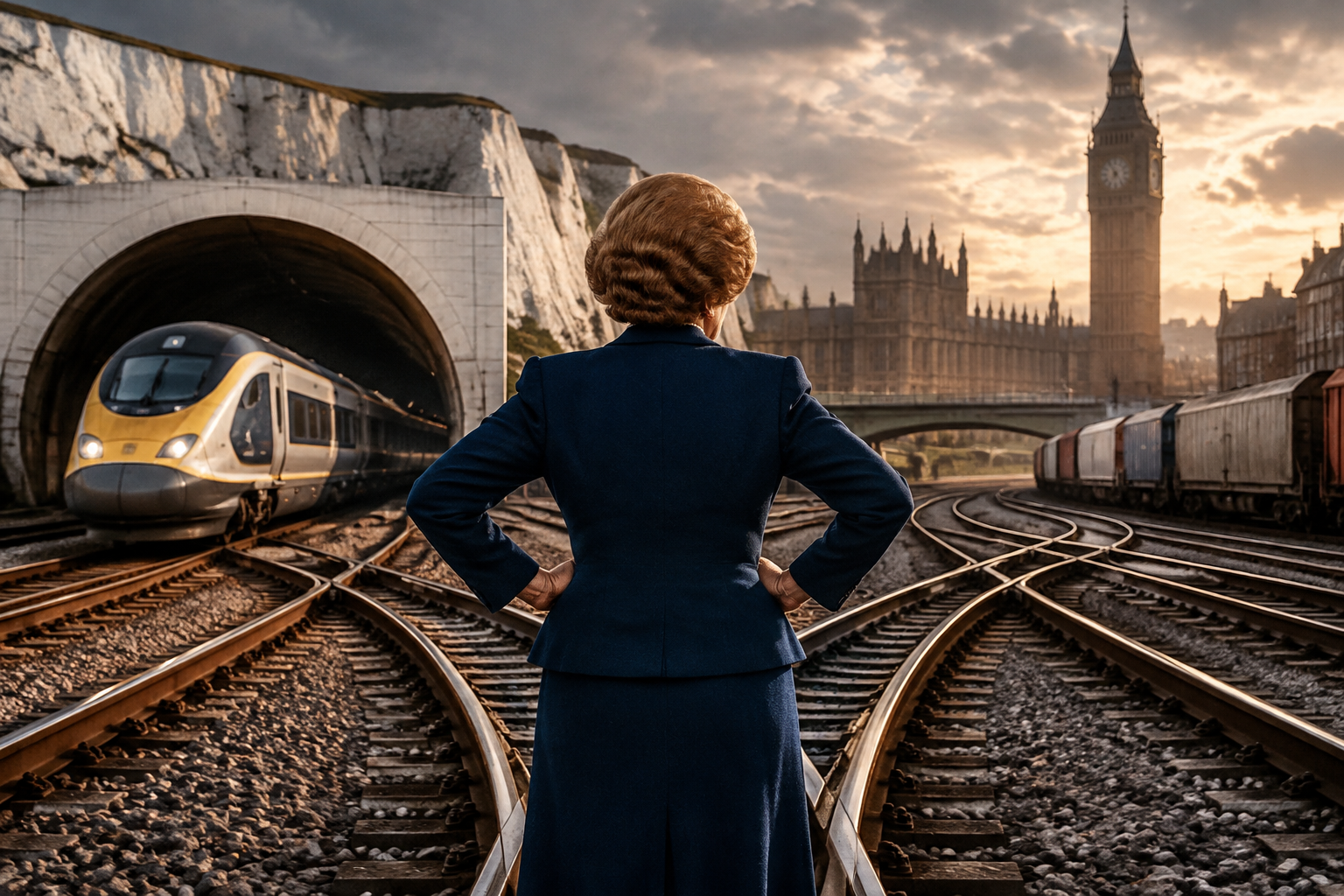
The strongest finding so far is that the video needs to distinguish three separate businesses and financial arrangements: Eurotunnel, which built and operates the tunnel; Eurostar, which operates passenger trains; and London & Continental Railways (LCR), which was responsible for Britain's high-speed rail connection.
That distinction matters. The original tunnel was legally required to be privately financed, but LCR's separate high-speed railway project ultimately required substantial taxpayer support and was nationalised in 2008. Treating these as one continuous private-financing failure obscures who made which decisions and who ultimately paid.
Legislation.gov.uk+2
Wendover Blames Thatcher for the Channel Tunnel. The Contracts Tell a More Complicated Story.
Wendover Productions has identified genuine failures in the Channel Tunnel's development: regional passenger services never launched, conventional freight rail collapsed, and Britain abandoned a connection between its two high-speed railway networks.
But its central accusation—that Margaret Thatcher's insistence on private financing effectively doomed the tunnel—is too convenient.
The video turns three separate businesses into one political morality tale: the privately financed Channel Tunnel, the Eurostar passenger service, and the Channel Tunnel Rail Link (HS1). They had different owners, financing arrangements, contractual obligations and financial outcomes.
That distinction is not academic. It changes who made the decisions, who received public money, who absorbed the losses, and who was actually responsible for the missing trains.
1. The tunnel was privately financed. Its railway was rescued with public money.
The original financing arrangement was genuinely unusual. Section 2 of the Channel Tunnel Act 1987 prohibited British ministers and government departments from providing direct funding or financial guarantees to the tunnel concessionaires. The 1986 concession agreement envisaged raising the necessary capital through international financial markets. On this narrow point, Wendover is correct.
Legislation.gov.uk+1
But the Channel Tunnel was not the same project as the railway connecting it to London.
In 1996, London & Continental Railways (LCR), a private consortium, received the contract to construct HS1 and operate Britain's portion of Eurostar. The government had already agreed to provide £1.73 billion in grants. LCR expected to raise additional private finance against future Eurostar revenues.
Those revenues disappointed. By 1997, passenger numbers were substantially below forecasts, and LCR could not raise the required private financing.
The government subsequently restructured the agreement. It guaranteed most of LCR's borrowing, supported approximately £4 billion in government-guaranteed bonds, and arranged additional taxpayer lending. The National Audit Office warned that the private shareholders retained an economic interest while avoiding the full financial consequences of the project's near-collapse. The taxpayer faced further exposure estimated at £360 million.
Twenty-Second Report+1
LCR was eventually nationalised in 2008.
The government's subsequent sale of its 40% Eurostar stake in 2015 generated £585.1 million, with another £172 million received through redemption of its preference share. Yet the National Audit Office estimated that taxpayers' total investment in Eurostar and its predecessors, including written-off losses, amounted to approximately £3 billion.
Committee of Public Accounts
This is the financial history missing from Wendover's sweeping conclusion.
The tunnel concession was privately financed. The high-speed railway was a public-private project that eventually required substantial public support.
The government did not simply refuse to enable the tunnel. It spent billions supporting the surrounding railway infrastructure and passenger business. It just failed to secure the national transport benefits originally promised.
2. Regional Eurostar failed because Parliament never secured an enforceable service obligation.
Wendover correctly identifies a major institutional failure: regional Eurostar services were promised, expensive trains were purchased, and the services never materialised.
But its explanation for the missing legal obligation is incomplete.
Section 40 of the Channel Tunnel Act 1987 required British Rail to prepare a plan for international services serving different parts of Britain. It did not impose a direct obligation to operate those services.
In a 1999 parliamentary debate, this distinction was stated explicitly:
"There is no legal obligation for Eurostar (UK) Ltd. to run regional Eurostars."
The speaker explained that Section 40 simply required British Rail to prepare a plan.
UK Parliament API+1
This matters because the legal weakness existed in the original legislation, before railway privatization.
Parliament had been given assurances about regional benefits, and the Environment, Transport and Regional Affairs Committee subsequently concluded:
"The regions have been cheated."
The committee documented £180 million spent on seven regional Eurostar trainsets, approximately £140 million spent clearing railway routes, and £109 million paid by the government to terminate the Nightstar rolling-stock arrangements.
Fifth Report
The video describes the subsequent privatization but misses an especially revealing part of the parliamentary investigation.
The operator's financial incentives and the questionable feasibility study
In 1998, management of the Eurostar business was transferred to Inter-Capital and Regional Rail, a consortium involving British Airways, National Express, SNCF and SNCB.
LCR remained under an obligation to provide infrastructure for regional Eurostar services, but the operating company was contractually required to maximise cash flow and pursue profitable uses of the regional trains.
The parliamentary committee questioned the credibility of a feasibility study commissioned by Inter-Capital and Regional Rail.
Its concerns included:
- British Airways had acquired a stake in the consortium.
- The consortium had already decided to promote a Heathrow–Paris service.
- It was subsequently asked to assess the wider regional Eurostar market.
- Its study did not consider Virgin's alternative proposals.
The committee specifically questioned whether British Airways' commercial interests might influence decisions at the expense of wider regional services.
Fifth Report+1
There was another option.
Virgin offered to operate regional Eurostar services at its own risk, with approximately £10 million of initial capital, and projected profitability after three years. Its proposed network included Glasgow, Manchester, Birmingham and Watford.
The parliamentary committee did not accept Virgin's optimistic financial projections without further examination. It recommended an independent assessment of the proposal.
The subsequent Arthur D. Little review, published in February 2000, found no positive economic business case for any of four proposed direct regional services to Paris. By 2005, the Strategic Rail Authority considered the demand outlook even worse.
Fifth Report+2
The broken promise was real. But the evidence points to more than a private company abandoning an otherwise viable service.
Britain failed to make its regional commitments enforceable, purchased expensive trains before establishing a reliable commercial case, separated infrastructure provision from train operations, and failed to resolve competing institutional interests.
That is a more complicated failure of government than the video acknowledges.
3. The freight guarantee was not a free-train coupon.
Wendover explains the early growth of freight traffic through minimum usage charges. Its argument is that national rail operators had already committed to paying for a certain level of tunnel usage, so they could operate additional freight trains without meaningful additional costs.
When the guarantees expired, the economics supposedly changed overnight, with individual trains facing approximately $6,000 in tunnel charges.
There is an important omission.
A 2005 House of Lords investigation described the actual charging arrangement as three separate components:
- Variable tolls based on the volume and type of traffic.
- Contributions towards Eurotunnel's operating costs.
- A Minimum Usage Charge (MUC), guaranteeing Eurotunnel a minimum level of revenue.
The MUC was a revenue guarantee for the tunnel operator, not a quota of free train journeys. Variable tolls and operating-cost contributions still existed.
UK Parliament
More importantly, the government continued paying the British portion of these charges.
The House of Lords found that freight-related charges amounted to approximately £26 million annually until November 2006. After the minimum usage component expired, approximately £17 million annually would remain at contemporary traffic levels.
British Railways Board, effectively through the Strategic Rail Authority, was paying these charges rather than recovering them from the freight operator. That arrangement gave EWS access to the tunnel without charge until April 2005, and the government sought an extension of the funding arrangement through November 2006.
UK Parliament
This was effectively a government-backed revenue guarantee for the tunnel, despite the original prohibition on direct government financing.
The House of Lords also found that, in January 2005, only five or six freight trains in each direction used the tunnel daily, despite 35 available freight paths in each direction between the tunnel and London. Access charges were considered excessive by other prospective operators.
UK Parliament
The Sangatte disruption was genuine. Contemporary reporting documented the reduction of freight traffic from approximately 25 trains daily to five or six by late 2001, following repeated incursions into the Frethun freight yard and lengthy security searches.
The Guardian
But the longer-term freight failure involved much more than the expiration of a subsidy.
It involved the structure of the usage contract, government-supported charges, unreliable international operations, limited competition and the difficulty of making rail freight commercially competitive.
The video identifies several of these problems but simplifies the financial mechanism that connected them.
4. The HS2 connection was not simply two kilometres of missing track.
One of Wendover's strongest visual arguments is also one of its most misleading.
The video states:
"All that was needed was a 1.2-mi or 2-km long track to connect HS2 with HS1."
The geographical distance is not the same thing as the cost or complexity of constructing an operational railway.
The proposed connection ran through Camden and required substantial engineering work. A 2015 Department for Transport review estimated construction costs of approximately £610 million in 2011 prices for the preferred surface-and-tunnel arrangement.
That design offered capacity for only three trains per hour in each direction. It also carried substantial construction impacts for local communities and existing passenger and freight services. The government concluded that it did not represent good value for money.
More extensive tunnel alternatives were considerably more expensive, with some estimates reaching several billion pounds.
assets.publishing.service.gov.uk
GOV.UK
There was another complication: international trains cannot simply operate like ordinary domestic services.
Security advice indicated that domestic and international passengers could not be mixed on the same trains. Dedicated immigration and customs facilities would therefore be required at stations where passengers boarded international services.
Those services would also consume additional paths on HS2, reducing capacity for domestic passengers. The proposed connection consequently offered relatively low-frequency international services rather than the seamless national network suggested by the video.
assets.publishing.service.gov.uk
GOV.UK
The same government study identified a practical alternative: passengers could transfer between Euston and St Pancras using an approximately 750-metre walking route, taking around ten minutes, or use the Underground.
The government also examined ways of preserving the possibility of a future direct connection.
None of this proves that abandoning the link was the correct decision. But it decisively undermines the claim that Britain merely needed to build two kilometres of track and chose not to.
The link was rejected after a documented engineering, capacity and value-for-money assessment. That is a government decision worth criticising, but it is not proof that private ownership alone destroyed Britain's ability to think strategically.
5. The tunnel was a poor investment. It was not a failed transport connection.
The video repeatedly moves between two different questions:
- Did the original investment deliver an adequate financial return?
- Did the tunnel become a significant transport connection between Britain and Europe?
The answers are not the same.
A 2018 study by Ricard Anguera Camós examined the tunnel's first 20 years of operation.
By 2014, the tunnel accounted for approximately 57% of the total cross-Channel passenger market. Its vehicle shuttle captured approximately 40–45% of unitised freight, with ferries carrying the remaining majority.
The tunnel had become the dominant passenger crossing option, not merely an insignificant alternative to ferries.
OpenEdition Journals
But the financial investment was considerably less successful.
The study calculated:
- A negative £9.9 billion net present value from the wider UK project perspective over the first 20 years.
- An estimated internal rate of return of approximately -0.22% for the original tunnel investment, using a 12% private-sector required return.
- A 2007 financial restructuring involving the write-off of approximately £3.34 billion in debt, leaving original shareholders with only around 13% of the equity.
These are devastating financial results.
However, the same study found that following restructuring, Eurotunnel stabilised, generated sufficient operating profits to service its remaining debt, and paid dividends from 2009 onward.
OpenEdition Journals+1
The distinction matters even more today.
Getlink's 2025 results reported:
- Eurotunnel revenue of €1.198 billion.
- Eurotunnel EBITDA of €667 million.
- Approximately 11.8 million high-speed rail passengers using the tunnel.
- Approximately 2.23 million passenger vehicles using its shuttle.
- Approximately 1.16 million trucks using its freight shuttle.
Conventional through-rail freight was much weaker, with just 1,102 trains using the tunnel during the year, approximately three daily.
Newsroom Getlink+1
This is the distinction Wendover needs to make.
The original tunnel was a disastrous investment for its initial shareholders. The operating business subsequently became profitable and serves millions of passengers and vehicles.
Conventional rail freight and regional passenger connectivity remain serious failures. But they do not establish that the entire tunnel is a failed transport asset.
The video uses the weakest part of the system to pronounce judgment on the whole.
6. The competition story is already moving beyond the original train constraints.
Wendover identifies Temple Mills Depot, rolling-stock requirements and tunnel safety rules as major obstacles to competition.
That analysis is substantially justified.
However, the position has advanced.
In August 2026, the Office of Rail and Road approved a framework track-access agreement allowing Virgin Trains to plan up to 20 daily return services between London and Paris, Brussels or Amsterdam from October 2030. Further approvals and access arrangements remain necessary.
Office of Rail and Road
On 9 October 2026, Virgin and Alstom signed agreements covering 12 Avelia Stream high-speed trains and associated maintenance.
The train supply agreement remains conditional on regulatory approval and financial close, and the trains still require the necessary Channel Tunnel authorisations.
Alstom
This is not proof that competition has arrived. But it demonstrates that the rolling-stock problem is being addressed with a new generation of trains rather than being permanently confined to existing Class 374 equipment.
The video's 2030 prediction remains a target, not a guaranteed launch.
Closing verdict
Wendover has a legitimate case against Britain's failure to deliver the Channel Tunnel's wider ambitions.
The regional promises were broken. Freight rail never achieved its potential. The HS2 connection was abandoned. The original tunnel investment produced catastrophic returns for its shareholders.
But the video does not establish that Thatcher's private-financing condition caused all these outcomes.
The evidence shows something more revealing:
- The original tunnel was privately financed and its investors absorbed enormous losses.
- The separate high-speed railway required public grants, government guarantees and eventual nationalisation.
- Regional passenger services were never protected by an enforceable statutory obligation.
- The government-supported freight charging arrangement was more complicated than a simple subsidy that expired.
- The HS2 connection was abandoned after a detailed assessment identified substantial engineering, capacity and economic problems.
- The tunnel subsequently became a profitable operating business and captured a substantial share of cross-Channel passenger traffic.
I would not let the central argument stand in its current form.
The real indictment is not that Thatcher privatized a tunnel and thereby doomed it. It is that successive British governments made national promises without securing enforceable commitments, funded projects without resolving their commercial and operational dependencies, and repeatedly abandoned the connections needed to make the wider system work.
Britain built the tunnel. It failed to build the national transport system that Parliament was promised. That failure deserves criticism, but it deserves an accurate explanation.
References
1. How the Channel Tunnel Works — Wendover Productions, original video. The work examined in this critique.
2. Channel Tunnel Act 1987 — UK Parliament, 1987. Sections 2 and 40 establish the original restrictions on direct government funding and the limited statutory obligation concerning regional services.
3. The Channel Tunnel Rail Link — National Audit Office, 28 March 2001. Documents LCR's failed private-financing plan, taxpayer guarantees and the weaknesses in its original risk allocation.
4. The Sale of Eurostar — House of Commons Committee of Public Accounts, 2016. Establishes the nationalisation history, 2015 sale and estimated £3 billion taxpayer investment in Eurostar and its predecessors.
5. Regional Eurostar Services — House of Commons Environment, Transport and Regional Affairs Committee, 20 January 1999. Documents the broken regional commitments, commercial incentives, British Airways connection, Virgin proposal and expenditure on unused trains.
6. Regional Eurostar Services — UK Parliament, Hansard, 17 February 2000. Records publication of the independent Arthur D. Little feasibility review.
7. Eurostar: Regional Services — UK Parliament, Hansard, 4 February 2005. Confirms that the independent review found no positive economic case for four direct regional service options.
8. Liberalising Rail Freight Movement in the EU — House of Lords European Union Committee, 4 March 2005. Explains the Minimum Usage Charge, government-backed freight payments, access costs and unused tunnel capacity.
9. HS2 Phase One: Review of HS2-HS1 Connectivity and Rail Links to the Continent — Department for Transport and HS2 Ltd, November 2015. Provides the engineering costs, capacity limitations and value-for-money assessment of the proposed connection.
10. The Channel Tunnel Cost Benefit Analysis after 20 years of operations — Ricard Anguera Camós, Revue d’histoire des chemins de fer, 2018. Examines actual market share, the original investment's financial returns, restructuring and subsequent operating performance.
11. Annual Results 2025 — Getlink, 26 February 2026. Provides the latest reported Eurotunnel revenue, EBITDA and financial performance.
12. Green Light for Virgin Trains International Services — Office of Rail and Road, 17 August 2026. Establishes the approved framework for Virgin's proposed international services and the remaining regulatory requirements.
13. Virgin and Alstom Join Forces to Support the Growth of Cross-Channel High-Speed Rail — Alstom, 9 October 2026. Confirms the agreements for 12 proposed Avelia Stream trains and the conditions still attached to the order.