Wendover's Washington DC Investigation Gets the Power Struggle Right — But Misses the Legal Story
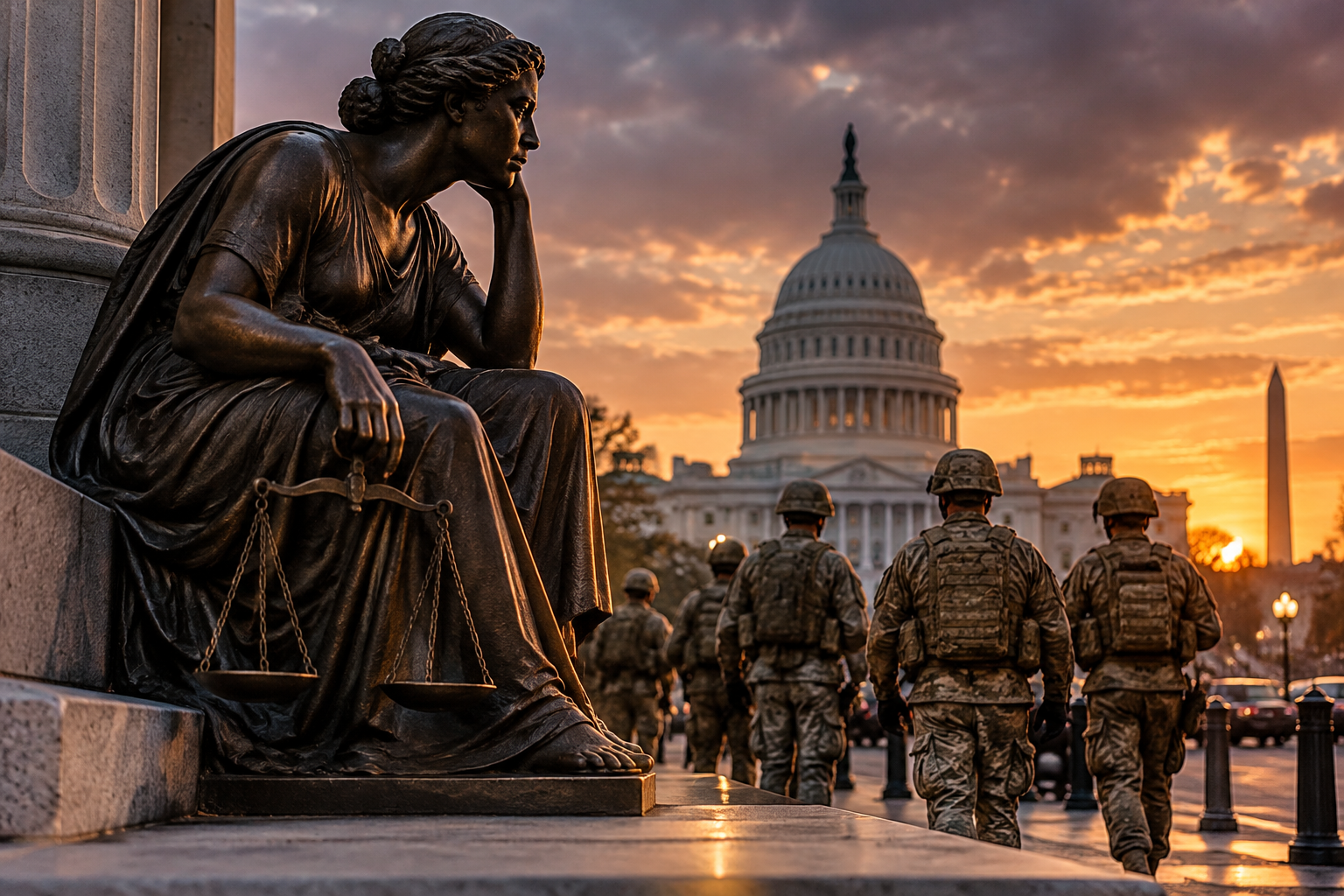
Wendover's central argument is persuasive: Washington's elected government can be overruled by federal politicians whom its residents cannot vote out. But the episode makes a serious mistake when it turns complicated congressional and legal manoeuvres into a relatively simple story of federal interference. The $1.1 billion budget dispute was not merely an accounting glitch, the police takeover did not end with a judicial ruling, and the legality of the National Guard deployment was far from settled.
The $1.1 billion was not simply a forgotten budget update
The video describes Congress as having failed to update a provision in a spending bill, effectively preventing DC from spending approximately $1 billion of its own tax revenue. It acknowledges that the administration called this a mistake but leaves the impression of an unfortunate legislative oversight.
The Congressional Research Service provides a more revealing account. Congress passed the Full-Year Continuing Appropriations Act on March 15, 2025, without extending the provision in the previous two temporary spending bills that had allowed DC to spend at its FY2025 budget levels. The new legislation explicitly required the district to revert to FY2024 spending levels.
Congress.gov+1
That distinction matters. This was not simply a spreadsheet containing an incorrect figure. The House Rules Committee declined to make Delegate Eleanor Holmes Norton's amendment restoring DC's spending authority eligible for consideration. The Senate subsequently passed S.1077 unanimously by voice vote on March 14, but the House received the legislation and left it untouched.
Congress.gov+1
The episode should have investigated that legislative sequence before repeating the language of a glitch. The available record establishes a deliberate legislative outcome, although it does not establish whether the original omission itself was intentional.
The distinction between federal and local money is especially important. The Congressional Budget Office confirmed that the money covered by S.1077 was collected by DC and did not count as federal budget spending; federal law nevertheless required congressional appropriation before the district could use it. The proposed restoration therefore had zero effect on the federal deficit.
Congressional Budget Office
There is also a missing chapter in the history. In 2013, DC voters approved a local budget autonomy amendment by 83%, but its legal standing was challenged; a DC Superior Court upheld it in 2016, while the Government Accountability Office argued that Congress retained ultimate discretion. Congress continued exercising its authority. This was not a new problem discovered in 2025.
Congress.gov
The more interesting story is how Washington repeatedly tried to escape congressional budget control and why those attempts failed. Wendover gives viewers the constitutional background but skips one of the most important attempts at changing the financial relationship.
The National Park Service is not allergic to recreation
The episode claims that sports fields, playgrounds and other active recreational facilities are effectively antithetical to the National Park Service's preservation mandate. That is an overstatement of the agency's actual policy.
The NPS's own management policies explicitly recognize visitor enjoyment, appropriate recreation, public fitness and healthful activities as part of its mission. They require recreation to be compatible with each park's purpose and environmental protection, not prohibited simply because it is recreational.
Policy (U.S. National Park Service)+1
There is a particularly obvious counterexample inside Washington itself. NPS-managed Anacostia Park offers basketball courts, tennis courts, soccer fields and other playing fields. The agency actively advertises these facilities to visitors.
Anacostia Park (U.S. National Park Service)
None of this proves that Lincoln Park should receive a fenced dog park or that every proposed development along the C&O Canal deserves approval. Those decisions require park-specific assessments. But it does undermine the sweeping suggestion that the federal agency simply refuses to provide active recreation.
The real disagreement is about which recreational uses are appropriate in particular historic or environmentally sensitive locations. Wendover turns that distinction into a simplistic conflict between preservation and public enjoyment.
The police takeover was reversed, not judicially defeated
The episode describes Attorney General Pam Bondi attempting to install DEA Administrator Terry Cole as temporary head of the Metropolitan Police Department, followed by a lawsuit that resulted in the Justice Department standing down.
The actual sequence is more revealing.
On August 11, Trump publicly announced that he was placing the Metropolitan Police Department under federal control and named Cole as interim commissioner. On August 14, Bondi issued Order 6370-2025, formally attempting to give Cole the powers and duties of DC's police chief.
oag.dc.gov+1
DC Attorney General Brian Schwalb immediately challenged the order's legality. His August 14 legal opinion explained that Section 740 of the Home Rule Act allowed the president to request police services for federal purposes under emergency conditions, but did not authorize replacing the local police chief, rewriting the department's command structure or controlling ordinary local policing.
oag.dc.gov
The District filed its lawsuit on August 15. That same day, Bondi rescinded her original order and issued Order 6372-2025.
But the replacement was not a complete retreat. It designated Cole as the Attorney General's representative and continued requiring MPD assistance with federal immigration enforcement, locating and detaining people unlawfully present in the United States, providing information to federal agencies, and enforcing local public-space occupancy laws.
GovInfo
The distinction is important: the administration abandoned its attempt to install Cole as emergency police commissioner, but continued asserting authority over specific police activities.
There was also no judicial ruling establishing that the original takeover was unlawful. The District withdrew its request for a temporary restraining order after the original order was rescinded. On September 10, the president's invocation of Section 740 expired. The District subsequently dismissed its lawsuit without prejudice, noting that the federal defendants had not filed an answer or motion for summary judgment.
iptp-production.s3.amazonaws.com
CourtListener.com+1
Wendover's description of the Justice Department standing down is understandable, but incomplete. A federal retreat following litigation is not the same thing as a court establishing a legal precedent. The audience deserves to know the difference.
The National Guard's legality was never settled
This is the episode's most consequential legal weakness.
Wendover concludes that most of the increased federal intervention, apart from the attempted police leadership takeover, is more or less legal under existing law. That conclusion is far too confident.
The National Guard deployment involves a separate legal structure. The troops were operating under Title 32, a hybrid arrangement in which Guard members remain in their respective National Guard command structures while receiving federal funding for their missions. This is different from being federalized under Title 10.
FindLaw
That distinction matters because the president's authority over the DC National Guard is not identical to his authority over National Guard units belonging to individual states.
In September 2025, DC filed another lawsuit specifically challenging the National Guard deployment. It argued that federal officials had exceeded their authority by deploying the district's Guard for local crime-deterrence missions without a request from local civil authorities and by bringing in out-of-state Guard units without the necessary statutory authority.
On November 20, 2025, District Judge Jia Cobb agreed with the District's arguments sufficiently to grant a preliminary injunction. She found that the federal government had exceeded its authority under DC law in deploying the DC Guard for non-military crime-deterrence missions and lacked statutory authority under Title 32 for the out-of-state deployments.
oag.dc.gov
That was not the end of the case. On December 17, 2025, the D.C. Circuit granted the federal government's request for a stay pending appeal. The appellate judges considered the government likely to prevail on its argument that the president possesses special statutory authority over the district's National Guard because Washington is the seat of the federal government.
media.cadc.uscourts.gov+1
Crucially, the appellate court expressly limited that preliminary assessment. It did not decide whether the troops were engaged in prohibited law-enforcement activities under the Posse Comitatus Act or whether federal officials were improperly exercising command over state Guard units.
As of October 14, 2026, the D.C. Circuit had heard oral arguments in the appeal, with the dispute still unresolved.
oag.dc.gov
This is not a minor technical disagreement. It goes directly to the question of how much power the federal government can exercise over an American city's streets without the consent of its elected government.
Wendover tells viewers that the intervention is largely legal. The subsequent litigation demonstrates why that conclusion needed substantially more investigation.
The crime statistics need a more precise explanation
The video is right that Washington experienced a substantial improvement in violent crime before Trump's intervention. But its description of the statistics is imprecise.
The Department of Justice's January 2025 announcement said that the total number of violent crimes in 2024 had fallen 35% from 2023 and reached its lowest level in more than 30 years. It did not establish that every crime rate had reached a 30-year low.
United States Department of Justice
MPD's own annual report recorded 187 homicides in 2024, compared with 274 in 2023. Its reported homicide rate fell from 40 to 27 per 100,000 residents.
mpdc.dc.gov
For context, the Bureau of Justice Statistics estimated the nationwide 2024 homicide victimization rate at 5.1 per 100,000. The national and DC figures use different statistical systems, so they are not a perfect direct comparison, but they illustrate why a declining crime trend does not automatically mean a low level of risk.
Bureau of Justice Statistics+1
Both realities matter. Washington was experiencing a substantial reduction in violent crime, while its homicide problem remained serious.
The episode acknowledges that homicides had risen from their historic low approximately a decade earlier. But it should have done more to distinguish the city's improving trend from its remaining public-safety problems.
That distinction is essential when evaluating whether emergency intervention was justified. A declining crime trend does not establish that no intervention was needed, but neither does a high homicide rate establish that extraordinary federal intervention was necessary.
Verdict
Wendover identifies a genuine democratic problem but does not investigate its most consequential details deeply enough.
The budget episode is presented as a glitch rather than a specific congressional appropriation decision with a documented legislative history. The National Park Service is portrayed as fundamentally opposed to active recreation despite its own policies and facilities. The police takeover is described as a legal confrontation resolved by federal retreat, without explaining that no court decided its merits and that the replacement order preserved significant federal demands.
Most seriously, the video treats the National Guard deployment as broadly lawful when the precise statutory authority was subsequently challenged, rejected at the preliminary-injunction stage and then provisionally accepted by an appellate court pending further review.
These are not arguments against Wendover's central concern about DC's limited self-government. They are reasons the subject deserved more rigorous treatment.
Washington's problem is not simply that Congress can interfere. It is that the legal boundaries of that interference are complicated, contested and consequential. A video explaining how the district works should be particularly careful about those boundaries.
Wendover gives its audience a convincing political narrative. It does not give them the legal and institutional understanding necessary to judge that narrative independently.
References
Original work
1. How the US' Only District Works — Wendover Productions, September 17, 2025. The original argument and claims examined in this critique.
Budget and congressional authority
2. District of Columbia FY2025 Budget Status: In Brief — Congressional Research Service, July 25, 2025. Documents the full-year continuing resolution, the excluded amendment, the Senate-passed funding restoration bill and DC's earlier budget-autonomy dispute.
3. S. 1077, District of Columbia Local Funds Act, 2025 — Congressional Budget Office, March 24, 2025. Establishes that the proposed spending involved locally collected revenue, required congressional appropriation and had no effect on the federal budget.
National Park Service
4. Chapter 8: Use of the Parks — National Park Service. Sets out the actual balance between preservation, visitor enjoyment and appropriate recreation.
5. Sports — Anacostia Park — National Park Service, updated September 9, 2024. Documents existing basketball, tennis and soccer facilities on federally managed parkland in Washington.
Police takeover and legal authority
6. Opinion on the Legal Effect of Order 6370-2025 — DC Office of the Attorney General, August 14, 2025. Explains why DC's attorney general considered Bondi's attempted police takeover unlawful.
7. Attorney General Order No. 6372-2025 — US Department of Justice, August 15, 2025. Establishes what federal demands remained after the original emergency police commissioner order was rescinded.
8. Notice of Voluntary Dismissal, District of Columbia v. Trump — DC Office of the Attorney General, September 25, 2025. Records the rescission, withdrawal of the restraining-order motion, expiration of the emergency authority and absence of a merits judgment.
National Guard litigation
9. District of Columbia v. Trump — Memorandum Opinion — US District Court for DC, November 20, 2025. Explains the statutory grounds on which Judge Cobb found the deployment likely unlawful and granted preliminary relief.
10. D.C. Circuit Order, No. 25-5418 — US Court of Appeals for the DC Circuit, December 17, 2025. Explains why the court stayed the preliminary injunction while expressly reserving other legal questions.
11. Statement Following the National Guard Appeal Hearing — DC Office of the Attorney General, October 14, 2026. Confirms that the appellate hearing took place and the legal challenge remained active.
Crime statistics
12. Violent Crime in D.C. Hits 30 Year Low — US Department of Justice, January 3, 2025. Establishes the 35% reduction in total violent crime and the reported 30-year low.
13. Metropolitan Police Department Annual Report 2024 — Metropolitan Police Department, 2025. Provides the actual homicide counts and per-capita rates used to distinguish crime trends from crime levels.
14. Homicide Victimization in the United States, 2024 — Bureau of Justice Statistics, October 14, 2026. Provides the national homicide-rate estimate and its statistical methodology for contextual comparison.