Wendover’s Okinawa Video Gets the Law Wrong—and Misses the Bigger Accountability Gap
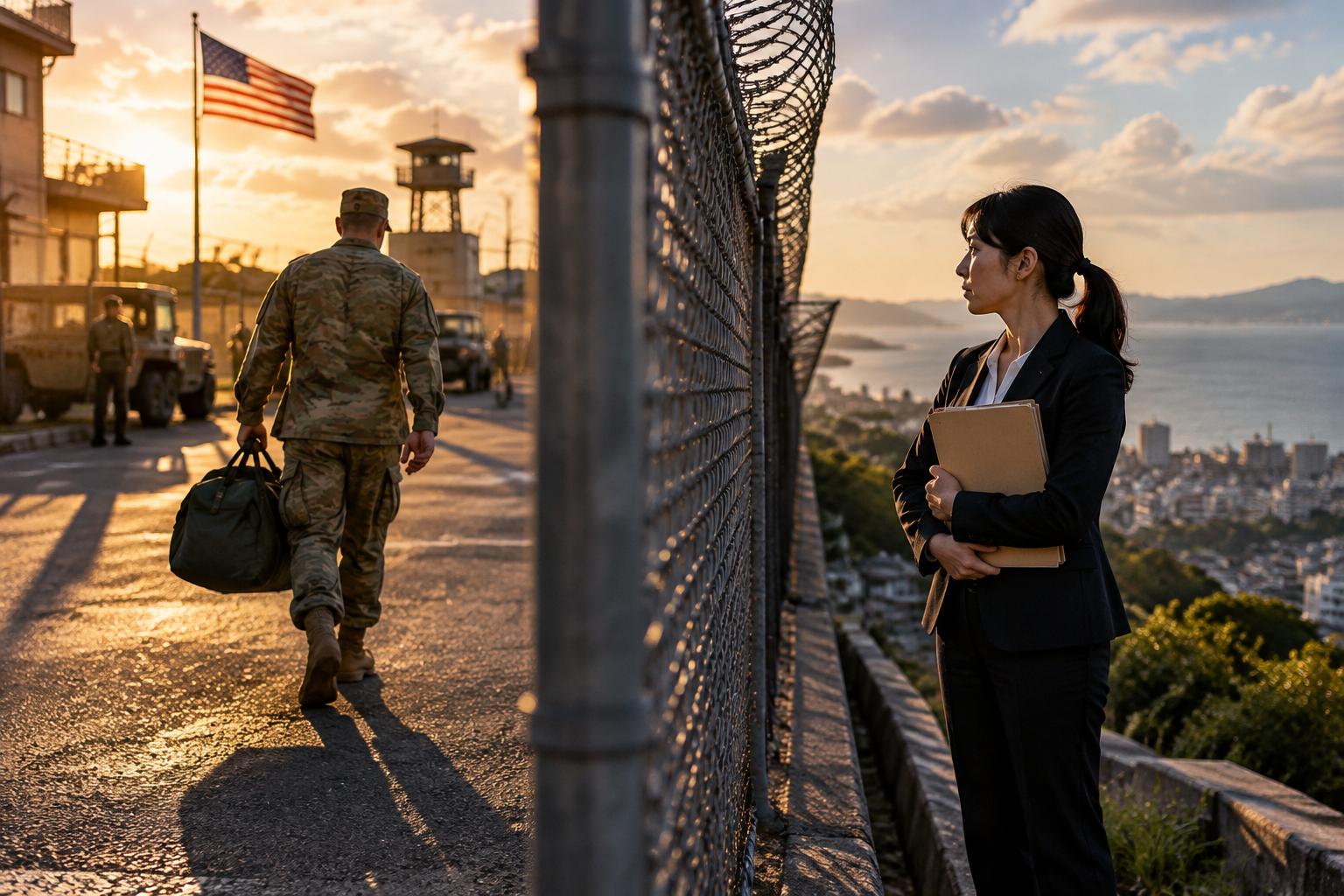
Wendover Productions makes a serious argument about Okinawa: American military personnel benefit from legal arrangements that can make Japanese investigations and prosecutions more difficult. The problem is that the video oversimplifies those arrangements, misstates important parts of the law, and treats a prosecution-rate comparison as stronger evidence of causation than it really is.
There is a more revealing story in the official records. Japan has repeatedly declined to exercise criminal jurisdiction it actually possessed, and its government cannot explain whether those decisions followed a controversial policy dating back to 1953.
That is a much stronger investigation than simply blaming the 1960 Status of Forces Agreement (SOFA).
1. Being on an American base does not automatically give America jurisdiction
The video states:
“For crimes committed on base or on duty, the US has primary jurisdiction.”
That is legally inaccurate.
Article XVII of the Japan–US SOFA establishes that Japan has jurisdiction over American service members, civilian personnel and dependents for offenses committed in Japan that violate Japanese law.
Where both countries have jurisdiction, America receives primary jurisdiction for specific categories:
- Offenses solely against American property or security.
- Offenses solely against another American service member, civilian component member or dependent.
- Offenses arising from acts or omissions performed in official duty.
For other offenses, Japan has primary jurisdiction.
The distinction matters. An American service member committing an off-duty assault against a Japanese civilian on a military installation does not automatically place the case under American primary jurisdiction simply because it happened inside a base.
The treaty's actual test concerns the nature of the offense, its victim and whether it arose from official duty—not simply its geographical location.
Ministry of Foreign Affairs of Japan
There is, however, a genuine legal advantage for American authorities that the video could have investigated more carefully. Under the agreement's interpretation, a certificate from an American commanding officer stating that an offense arose from official duty constitutes sufficient evidence of that fact unless the contrary is proved.
That creates a meaningful obstacle when Japanese authorities dispute whether an incident occurred in the performance of official duty. It deserves scrutiny, but it is not the same thing as America automatically controlling every crime committed inside a base.
Ministry of Foreign Affairs of Japan
2. The custody arrangement is restrictive, but Japan is not powerless to arrest suspects
The video makes another sweeping claim: even when an American service member is apprehended outside a base, Japanese authorities cannot take that person into custody before prosecution.
That is not an accurate description of the rules.
Article XVII(5)(c) establishes that when a suspect is already in American custody, the United States retains custody until Japan formally charges the individual.
But the distinction is important: the provision applies when the suspect is in American hands.
The agreed interpretation of the treaty also addresses situations in which Japanese authorities arrest an American service member. They are generally expected to release the individual to American military custody unless they consider there to be adequate cause and necessity to retain custody. If released under an availability condition, the suspect must be made available to Japanese authorities upon request.
Japan's own 2005 Diplomatic Bluebook explicitly explains that Japanese police can retain an off-duty American suspect whom they have taken into custody. The American custody rule applies when American authorities already hold the suspect.
Ministry of Foreign Affairs of Japan+1
There is nevertheless a genuine asymmetry.
If an American suspect returns to a military installation and comes under American control, Japanese authorities may have to wait for an indictment before receiving custody.
The 1995 Japan–US Joint Committee Agreement created an additional route for earlier transfers in particularly serious murder and rape cases. America agreed to give requests for pre-indictment transfers sympathetic consideration, not automatic approval.
Japan's Foreign Ministry reports that six such requests were made and five resulted in transfers before indictment. One request, involving an attempted rape and property-damage incident in Okinawa in 2002, was refused.
A further agreement in 2004 allowed an American military representative to attend Japanese questioning in qualifying cases.
Ministry of Foreign Affairs of Japan+1
The video is therefore right that American custody creates a significant advantage. But describing the arrangement as an American right to approve or refuse Japanese extradition is misleading. This is a transfer-of-custody arrangement, with specific conditions and exceptions.
The distinction is not academic. A journalist examining unequal legal treatment should explain exactly when Japan can arrest, retain, question and prosecute someone. Wendover collapses those separate questions into one broad claim.
3. The 13% versus 44% comparison needs a proper statistical audit
The video's most persuasive numerical comparison is that American military-related criminal cases had a 13% prosecution rate between 2001 and 2018, compared with 44% nationally.
The underlying figures are real. Taro Kono, writing in March 2020, reproduced the figures as 13.17% and 43.85%, citing Ministry of Justice statistics.
衆議院議員 河野太郎公式サイト
But the comparison requires more care than the video gives it.
The first problem is the population being measured. The underlying American military-related category includes service members, civilian-component employees and dependents. It is not simply a count of uniformed American soldiers.
shugiin.go.jp
The second problem is the denominator.
Kono challenged the comparison on the grounds that ordinary Japanese suspects can receive minor-offense dispositions directly from police without being referred to prosecutors. American military-related cases, he argued, are instead sent to prosecutors, including relatively minor incidents.
Consequently, the two populations can enter the prosecution statistics at different stages of the criminal justice process.
He also argued that some American military-related cases included in the non-prosecution figures involved offenses over which Japan did not possess primary jurisdiction.
His 2018 recalculation is particularly revealing.
2018 general criminal offenses Adjusted prosecution rate Japan nationwide 27.9% US military-related cases 15.9%To calculate these figures, Kono added 60,542 police-level minor-offense dispositions to the national non-prosecution denominator and excluded two American military-related cases over which Japan lacked primary jurisdiction. His calculation used 10 prosecutions and 53 adjusted non-prosecutions for the American-related category.
衆議院議員 河野太郎公式サイト+1
A substantial disparity remained. But it was considerably smaller than the video's headline comparison suggests.
There is an important qualification: Kono's calculation covers 2018 alone. It does not independently recalculate the entire 2001–2018 series, and it does not disprove the longer-term disparity.
It does, however, demonstrate why the original comparison should not be presented as straightforward proof that SOFA protections caused the difference.
The video needed to distinguish cases Japan could not prosecute, cases Japan chose not to prosecute, and cases prosecutors declined for ordinary evidentiary or procedural reasons.
Those are three different explanations. A single percentage cannot tell us which one is responsible.
4. The missing 1953 history is more important than the video acknowledges
There is a significant historical development missing from Wendover's explanation.
The current SOFA dates from 1960, but its criminal-jurisdiction arrangements have an earlier history.
During negotiations over the predecessor Japan–US Administrative Agreement in 1953, a Japanese representative explained that Japan would not normally exercise its primary jurisdiction over American military personnel except in cases considered materially important to Japan.
The American ambassador's confidential diplomatic reporting described this as a Japanese undertaking. American negotiators considered the word normally politically important to Japan, but believed it would make little practical difference to implementation.
The American records also describe arrangements under which local prosecutors' decisions about whether a case was sufficiently important would be referred to Tokyo.
Office of the Historian+1
Japan subsequently disputed the interpretation that this constituted a bilateral secret agreement.
In its official explanation, the Foreign Ministry maintained that the Japanese representative had merely explained Japan's own prosecutorial operating policy. It insisted that no agreement between the two governments had been concluded and that contemporary cases were being decided individually under Japanese law and evidence.
The Japanese government repeated that position in its June 2025 response to a parliamentary question.
The historical record therefore establishes a significant disagreement over the meaning of the 1953 understanding. It does not, by itself, establish that a binding secret treaty exists or that every subsequent non-prosecution resulted from it.
shugiin.go.jp+1
But the question becomes considerably more interesting when that history is compared with what the Japanese government subsequently disclosed.
5. Japan's own government has documented hundreds of decisions not to exercise jurisdiction
JUNE 24, 2025 — HOUSE OF REPRESENTATIVES
In response to a parliamentary question, the Japanese Cabinet acknowledged that prosecutors had dismissed cases involving American military-related personnel on the grounds that Japan would not exercise its primary jurisdiction.
Crucially, these were not simply cases in which America automatically possessed exclusive jurisdiction.
The government's response specifically addressed cases in which Japan held the primary right to exercise jurisdiction but nevertheless chose not to exercise it.
The Cabinet also admitted that it could not determine whether these cases involved offenses that Japan considered materially important under the historical policy statement.
shugiin.go.jp
The government provided an office-by-office breakdown covering 2014 through 2024.
I totalled the annual entries:
- 309 person-count entries involving non-exercise of Japan's primary jurisdiction.
- 194 entries recorded under the Naha District Public Prosecutors Office in Okinawa.
These are sums of the government's annual person counts, not 309 verified unique individuals. The list includes different offenses, including theft, assault, drug violations and traffic offenses; it should not be mistaken for a count of violent crimes alone.
shugiin.go.jp
This is substantially more revealing than simply repeating the 13% prosecution rate.
It establishes that Japanese prosecutors have, in documented cases, declined to exercise jurisdiction they possessed. Yet the government cannot establish whether those decisions involved cases that met its own historically stated threshold of material importance.
That is an extraordinary accountability gap.
The central question should be straightforward:
Who decided not to exercise Japan's primary jurisdiction in these cases, what criteria did they apply, and why can the government not establish whether those decisions complied with its own stated policy?
Wendover never gets there.
Instead, the video leaves viewers with an explanation centred almost entirely on American military authority and the 1960 agreement.
That misses the Japanese government's own role in the decisions that determine whether a case reaches court.
6. The real problem is the combination of American custody and Japanese discretion
None of this absolves the United States.
American authorities retain meaningful control over suspects already in their custody before indictment. The official-duty provisions can complicate jurisdictional disputes. The 1995 transfer arrangement is discretionary, and at least one Japanese request was refused.
Those are legitimate grounds for criticism.
But Japan is not merely a powerless observer. It has primary jurisdiction over many offenses involving American personnel, and its own prosecutors have repeatedly chosen not to exercise that jurisdiction.
The 1953 historical statement, the subsequent disagreement over its legal meaning, and the government's 2014–2024 disclosures deserve much more attention than they receive in the video.
The transcript also discloses a Nebula sponsorship. I found no evidence connecting that commercial relationship to the legal analysis, so it does not justify an allegation of editorial interference.
Verdict
Wendover has identified a genuine problem but has not properly established its explanation.
It confuses the location of an offense with the legal test for jurisdiction, exaggerates the restrictions on Japanese custody, and presents a prosecution-rate comparison without adequately examining how those statistics are constructed.
More importantly, it overlooks the strongest available evidence about Japan's own decisions.
The real accountability problem is not simply that America can retain custody of certain suspects. It is that Japan has repeatedly declined to exercise jurisdiction it possessed, while its government cannot explain whether those decisions complied with the historical standard it says was never a binding agreement.
Okinawa deserves better than a simplified story about an American veto. It deserves to know why its own legal system repeatedly declined to act when it had the authority to do so.
References
1. Okinawa vs the US Military: The Decades-Long Feud — Wendover Productions. Original video and primary source for the claims examined in this critique.
2. Agreement Regarding the Status of United States Armed Forces in Japan — Ministry of Foreign Affairs of Japan, 1960. Article XVII establishes the actual jurisdictional divisions, custody provisions and evidentiary treatment of official-duty certificates.
3. Improving the Operation of Criminal Trial Procedures under SOFA — Ministry of Foreign Affairs of Japan. Documents the six pre-indictment transfer requests, five successful transfers, one refusal and subsequent investigative arrangements.
4. Diplomatic Bluebook 2005: Improving the Operation of Criminal Trial Procedures under SOFA — Ministry of Foreign Affairs of Japan, 2005. Explicitly distinguishes Japanese custody of suspects from American custody before indictment.
5. 米軍の起訴率は低いのか — Is the US Military Prosecution Rate Low? — Taro Kono, March 28, 2020. Provides the 13.17% and 43.85% figures and a competing calculation demonstrating the importance of comparable statistical denominators.
6. Foreign Relations of the United States, 1952–1954, Document 685 — US Department of State, September 10, 1953. Contemporaneous American diplomatic reporting documents the Japanese policy statement and the American negotiators' interpretation of it.
7. Cabinet Answer No. 284: Cases Involving Non-Exercise of Primary Jurisdiction — House of Representatives, Japan, June 24, 2025. The most consequential source: acknowledges non-prosecution decisions despite Japan holding primary jurisdiction, supplies the 2014–2024 breakdown and confirms the government's inability to establish whether the cases met the historical material-importance threshold.
8. The Japan–US Joint Committee Agreement on Criminal Procedures — Ministry of Foreign Affairs of Japan, October 1995. Establishes the actual, limited commitment to consider pre-indictment custody transfers in serious murder and rape cases.