The Cruise Industry's Efficiency Story Has a Very Large Blind Spot
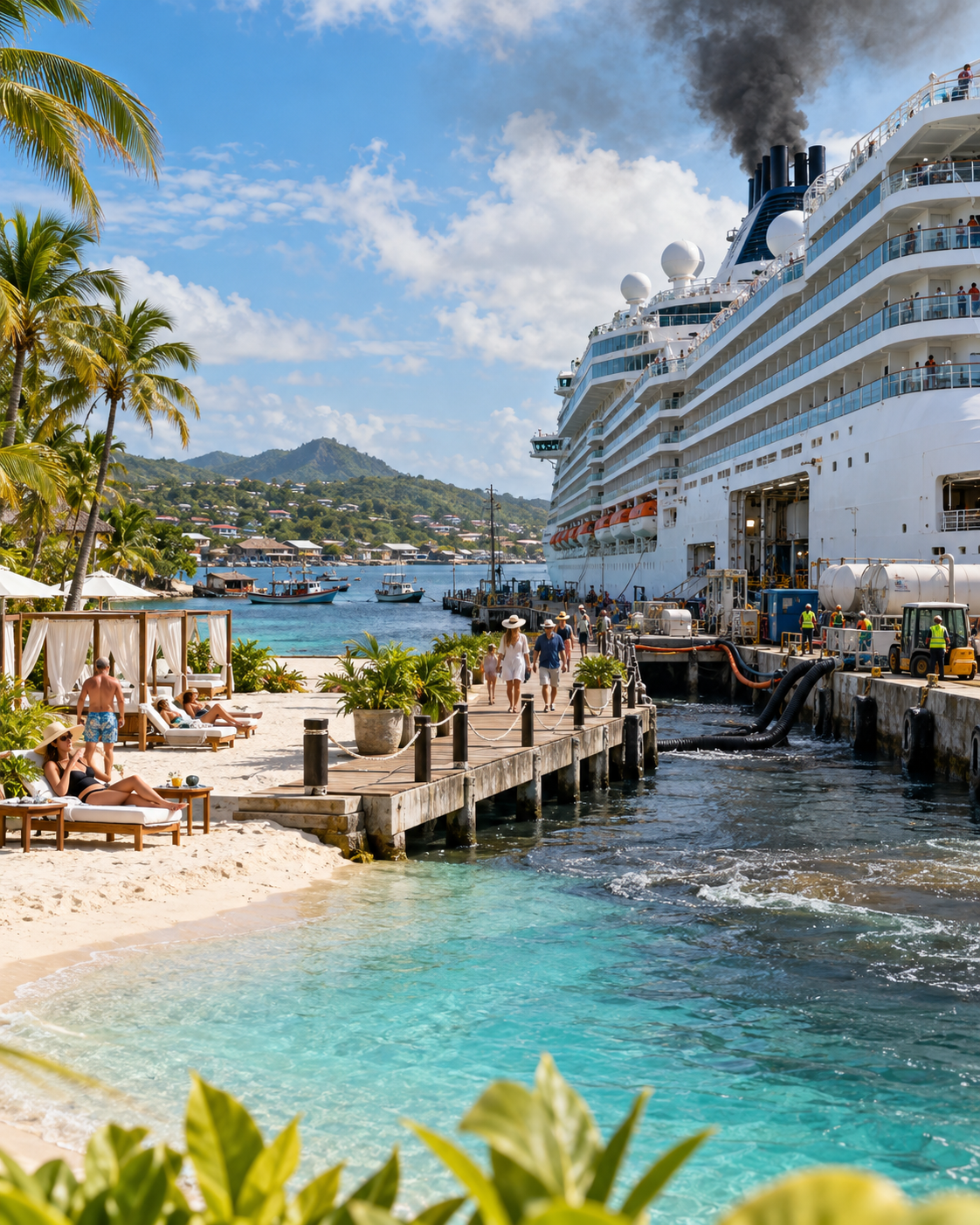
Wendover Productions tells a persuasive story about how cruise companies reinvented themselves: bigger ships, shorter routes, private islands and increasingly elaborate onboard entertainment. Its central argument is that this flexibility helped the industry survive economic crises and become more competitive.
But the video makes a consequential leap when it presents shorter routes as an environmental advantage without establishing whether the industry's total environmental footprint has actually fallen. Saving fuel on an individual journey is not the same as reducing pollution across an expanding fleet. The distinction matters enormously when the industry is building more ships, carrying more passengers and concentrating operations in popular destinations.
Efficiency is real. The environmental verdict is not.
I would not accuse the cruise industry of making no environmental progress. The evidence does not support that.
Carnival's 2025 Sustainability Report says its greenhouse-gas emissions from ship fuel were approximately 15% below their 2011 peak, despite capacity growing nearly 38%. It also reports achieving its 2030 emissions-intensity reduction target five years early, in 2025. These are meaningful improvements.
carnivalcorp.com+1
But Carnival makes an important admission: it cannot currently commit to a prescribed timetable for absolute emissions reductions because low- and zero-carbon fuels are not available at the necessary scale. Its FY2025 report records approximately 9.26 million tonnes of direct greenhouse-gas emissions. Improving emissions per unit of capacity does not eliminate the problem of millions of tonnes of annual pollution.
carnivalcorp.com+1
The industry's own trade association provides another useful comparison. CLIA's summary of European passenger-ship emissions data reports that CO₂ emissions increased 2.16% between 2019 and 2023, while the number of reporting ships increased 15%. Average emissions per ship fell 16%. The category largely covers cruise ships but is not exclusively cruise vessels. The distinction is precisely the one Wendover overlooks: efficiency can improve while total emissions remain higher.
|
The video itself says approximately 60% of cruise fuel goes toward propulsion. Yet it does not follow the remaining energy consumption, including the power required to operate onboard amenities.
That omission matters particularly in the Caribbean. The World Bank's March 2025 report found that fewer than 2% of cruise ports worldwide had shore-power facilities, with none in the Caribbean at the time. Although 46% of CLIA's fleet had shore-power capability, ships visiting those Caribbean ports still faced an infrastructure gap. Ships also frequently run diesel engines while docked to power onboard services.
World Bank+1
The same World Bank report cites an EPA estimate that a 3,000-passenger cruise ship can produce approximately 150,000 gallons of sewage weekly. Caribbean destinations have also had limited capacity to monitor cruise ships' environmental performance. Shortening a voyage does not answer questions about wastewater, air pollution at berth or the infrastructure required to manage these impacts.
World Bank
The LNG question the video misses
Fuel choice complicates the efficiency story further.
Carnival reported that liquefied natural gas (LNG) accounted for approximately 8% of its ship fuel in 2025. LNG can reduce conventional air pollutants and CO₂ emissions, but unburned methane escaping from engines creates an additional climate impact.
carnivalcorp.com
A 2024 peer-reviewed study of an LNG-powered cruise ship found that LNG produced 13–15% lower greenhouse-gas emissions than marine gas oil at high engine loads. However, methane slip increased at lower loads, undermining some of those benefits. The measured operating profile produced a weighted methane-slip rate of 1.7%.
ScienceDirect
The conclusion is not that LNG is necessarily worse. It is that fuel technology, engine performance and actual operating conditions matter. Calling a vessel more efficient without examining its full greenhouse-gas emissions is an incomplete environmental assessment.
Private islands: who actually receives the money?
Wendover makes an unusually revealing observation:
"Rather than passengers spending money in port of call communities, that money's being spent in their extended experience."
This is presented as a competitive advantage. It is also an economic question the video never investigates.
The cruise company controls the ship, the passenger experience, the onboard shops, and increasingly the destination itself. That gives it considerable control over where customers spend their money.
The World Bank's 2025 Rethinking Caribbean Tourism report provides important evidence.
- Cruise passengers typically spend only four to six hours ashore.
- Larger ships offer more onboard entertainment and shopping, reducing the incentive to spend money in local communities.
- Passengers generally contribute less per arrival than overnight tourists.
- Passengers often purchase excursions directly through cruise lines, paying an average of $74.68 compared with $32.40 for locally purchased excursions.
Cruise-line sales channels were the largest channel for shore excursions in most of the Caribbean destinations studied.
World Bank+2
There are exceptions. Royal Caribbean's CocoCay recorded relatively high passenger spending per person. That demonstrates private destinations can generate substantial commercial activity. But it does not establish how much of that activity becomes income for local businesses, workers and governments.
World Bank
The Bahamas provides a revealing example
In 2024, The Bahamas recorded 9.4 million cruise arrivals, representing 83.4% of total tourist arrivals, according to its government.
In its May 2025 budget communication, Prime Minister Philip Davis argued that cruise volumes had grown faster than the sector's direct contribution to government revenue. He specifically highlighted private-island cabana rentals reaching as much as $4,000 per day, with earnings often flowing offshore and providing limited benefit to Bahamian taxpayers.
Office of the Prime Minister
The government subsequently introduced measures addressing customs duties, VAT on imports and services at private destinations, employee work permits and private utilities.
This was not simply a dispute about tourism policy. It was a dispute about whether commercial activity occurring on Bahamian territory was being adequately measured and taxed.
Office of the Prime Minister
The issue continued into 2026.
In its March 4, 2026 mid-year budget statement, the Bahamian government reported that VAT collections from cruise lines and private destinations had increased 164% by the end of 2025 compared with the end of 2024.
The government attributed the improvement to stronger compliance and enforcement. It also disclosed that targeted inspections had identified deficiencies in reporting and accountability, prompting corrective measures and a new digital reporting platform. This does not establish deliberate tax avoidance, but it demonstrates that oversight and revenue collection were genuine problems.
Office of the Prime Minister
This is the economic side of the private-island strategy that the video leaves unexplored.
Carnival's private destinations have a reporting gap
Consider Carnival's Celebration Key, which opened on Grand Bahama in July 2025.
By December, Carnival reported more than one million visitors, over 1,000 permanent local positions and 58 Bahamian-owned businesses operating at the destination. These are meaningful local benefits and should not be dismissed.
Carnival Cruise Line
But Carnival's own 2025 Sustainability Report exposes a significant limitation.
The company reported that its seven owned or operated ports and destinations welcomed 7.4 million guests in 2025. Yet it explicitly stated that environmental and most social performance data for these destinations were excluded from the report's scope.
carnivalcorp.com+1
Think about that distinction.
Carnival can report its fleet's fuel consumption, emissions and operational improvements while operating destinations that receive millions of visitors without including most of those destinations' environmental and social performance in the same sustainability reporting boundary.
This does not prove that those destinations are environmentally irresponsible. It means readers cannot use that report to assess their full environmental and social costs.
The video treats private destinations as an extension of the cruise experience. It never asks for the equivalent environmental and economic accounts of those destinations.
The Caribbean is not an empty backdrop
The World Bank identifies further problems that the video does not address.
Larger ships can overwhelm local transport, public spaces, waste-management facilities and water-treatment infrastructure. Its report specifically describes congestion and pressure on local services in Antigua and Barbuda, where cruise arrivals can bring approximately 15,000 tourists daily. It also identifies risks to coral reefs and seagrass beds.
World Bank
The report describes an additional institutional problem: Caribbean governments often have weak negotiating power against large cruise operators because the industry is concentrated and regional cooperation is limited.
Antigua and Barbuda maintained an environmental passenger tax of $1.50 for years, while attempts to raise it to $2 faced opposition from cruise lines. Barbados eventually increased its passenger tax from $6 to $12 in November 2024 after negotiating the change with operators in advance.
World Bank
These details matter because cruise companies can move ships between destinations. Small island economies cannot as easily replace lost tourism revenue.
The industry's flexibility is a competitive advantage for the operator. For the destination, it can create dependence on a powerful commercial partner.
That is a different story from simply making vacations more convenient.
The verdict: a corporate success story is not a complete industry assessment
Wendover explains the cruise industry's business transformation convincingly. Larger vessels, shorter routes, private islands and increasingly sophisticated onboard entertainment helped companies attract passengers and control more of the vacation experience.
But the video measures success largely through the industry's own objectives: passenger growth, ship utilization, fuel savings and revenue retention.
It does not adequately examine the absolute environmental footprint, pollution at berth, wastewater, the distribution of passenger spending, or the ability of host governments to collect revenue and protect their resources.
The distinction is important. Carnival's environmental improvements are real. Celebration Key's local jobs are real. Neither establishes that the industry's wider economic and environmental model is sustainable.
I find the most revealing part of this story is not that cruise companies learned to build bigger ships. It is that they learned to control more of the customer's spending while operating across destinations that have limited power to negotiate the terms.
The cruise industry has become remarkably efficient at selling its own world. The unanswered question is whether the communities hosting that world receive a fair share of its rewards, and whether the environmental costs are being measured honestly.
Until those questions are answered, calling the industry's expansion a victory is premature.
References
1. The Cruise Industry's Arms Race — Wendover Productions. Original video. Establishes the argument about larger ships, Caribbean concentration, private destinations and operational efficiency.
2. 2025 Sustainability Report — Carnival Corporation, 2026. Provides the company's emissions figures, fuel mix, capacity claims, destination visitor numbers and explicit reporting exclusions.
3. Charting the Future of Sustainable Cruise Travel — Cruise Lines International Association, August 2024. Provides the industry's own interpretation of EU passenger-ship emissions data, including the difference between average efficiency and total emissions.
4. Rethinking Caribbean Tourism: Strategies for a More Sustainable Future — World Bank, March 2025. Documents cruise tourism's economic distribution, environmental pressures, port infrastructure gaps and government negotiating challenges across the Caribbean.
5. Budget 2025/26: Expanding Opportunities Island by Island — Office of the Prime Minister of The Bahamas, May 28, 2025. Provides the government's concerns about private-island revenue, taxation and economic benefits to Bahamians.
6. 2025/2026 Mid-Year Budget Statement — Office of the Prime Minister of The Bahamas, March 4, 2026. Reports the 164% increase in VAT collections from cruise lines and private destinations and identifies compliance and reporting deficiencies.
7. Carnival Welcomes One Millionth Guest at Celebration Key — Carnival Cruise Line, December 18, 2025. Provides the company's reported employment and Bahamian business participation figures, useful counterevidence to claims that private destinations produce no local benefits.
8. Methane Slip and Other Emissions from Newbuild LNG Engine Under Real-World Operation of a State-of-the-Art Cruise Ship — Kuittinen et al., Atmospheric Environment: X, August 2024. Provides onboard measurements showing how LNG's emissions benefits depend on engine load and methane slip.