Wendover's Airline Map Misses How the Networks Shape the Price Game
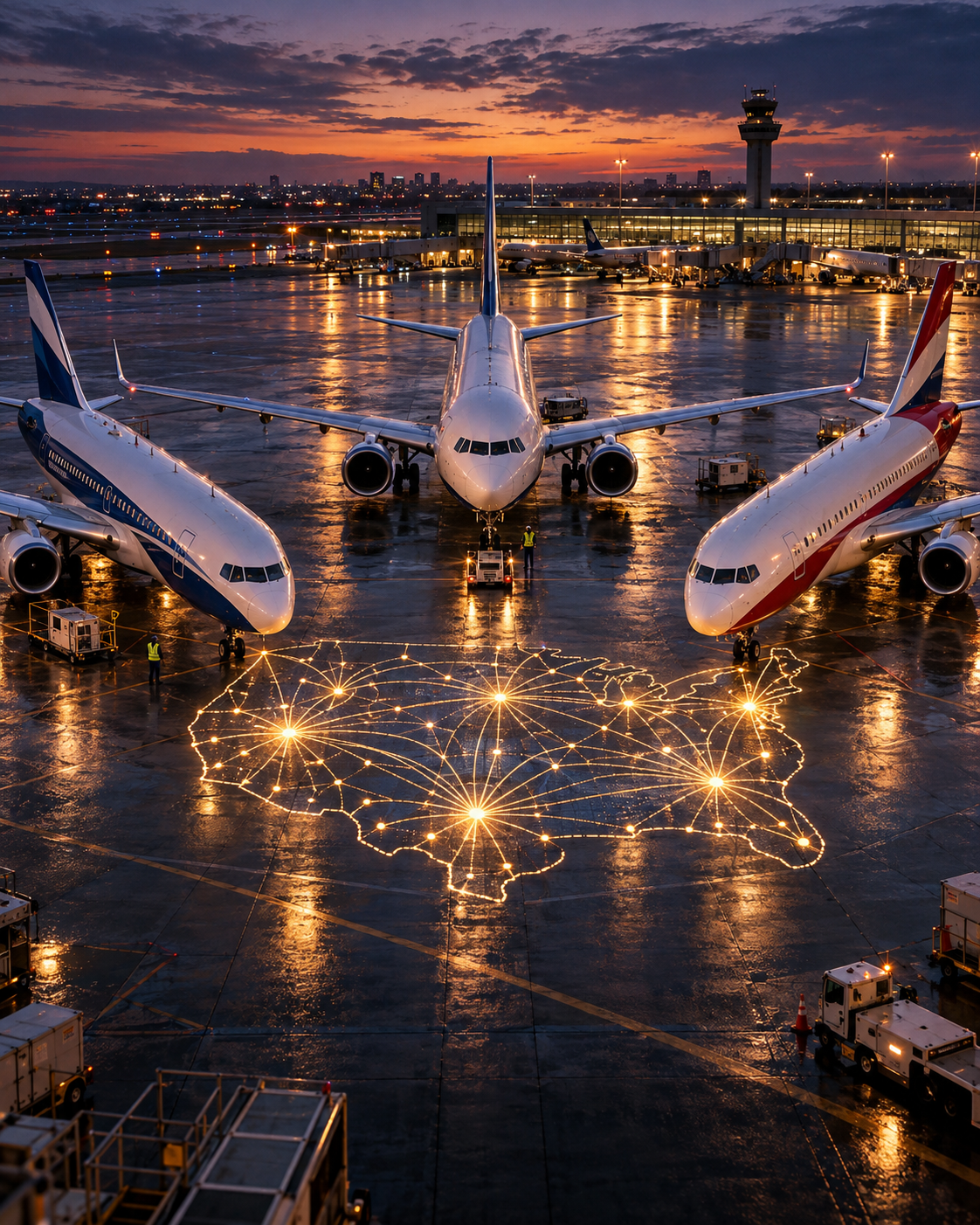
Wendover Productions offers a clean explanation of the Big Three: United, American and Delta sell remarkably similar products, avoid mutually damaging fare wars, and compete instead through their route networks.
The video says, “It's also mutually harmful for the three airlines to compete via price. So they largely don't.” It then identifies network design as the major remaining competitive arena.
That explanation is plausible, but incomplete. Route networks do more than help airlines win customers. They determine how frequently competitors encounter one another, how easily they can monitor each other's prices, and how much retaliation a fare cut might invite elsewhere.
The most important omission is that the same networks that create competitive advantages can also make competition less aggressive. This is not simply a story about three airlines finding different ways to win. It is a story about when they choose not to fight.
Fare matching is real. A price truce is not.
Wendover provides no supporting research for its claim about algorithms standardizing fares. Yet the underlying observation is not baseless.
A 2023 study published in Management Science, by Maxime Cohen and his colleagues, examined airline fare structures across 8,831 itineraries involving 204 airlines worldwide.
The researchers found that airlines matched their initial fares in 96.46% of sampled itineraries. When matching occurred, 91.5% of economy fare classes were also matched.
One example is particularly revealing: American, Delta and United offered the same $168 introductory fare and virtually identical 25-class economy fare ladders on Austin–Seattle flights scheduled for June 22–25, 2020.
This is direct evidence that the three airlines can converge on remarkably similar pricing structures. The researchers also concluded that airlines commonly use almost identical pricing functions to establish the higher fare classes. Study: Managing Airfares Under Competition.
But there is an important distinction Wendover misses.
Matching an initial fare ladder does not mean that airlines maintain identical prices throughout the booking period. Revenue-management algorithms adjust fares as seats sell, demand changes and departure approaches. Better itineraries can become more expensive faster because customers are buying them more readily.
The study specifically identifies this as an opportunity for airlines to differentiate their prices rather than simply follow competitors.
A separate 2022 study by economists Ali Hortaçsu, Aniko Öry and Kevin Williams examined actual daily prices and bookings across 58 competing US airline routes.
Their sample showed an average of 6.4 fare adjustments per flight during the 90-day booking period. More than half of observed prices were identical between competing airlines, and the average difference was less than $10. However, the relative price positions changed over time: one airline could charge more early in the booking period and less closer to departure.
Their economic model found that dynamic pricing increased airline output and revenue but reduced consumer surplus and overall welfare compared with fixed pricing.
The study used data from one anonymized major US airline and its competitors, so it cannot establish how every Big Three market behaves. But it demonstrates that similar fares do not mean pricing competition has stopped. Hortaçsu, Öry and Williams, Dynamic Price Competition: Theory and Evidence from Airline Markets.
There is another distinction worth making. The FTC announced an investigation on October 28, 2026, ordering Delta, United and JetBlue to disclose whether personal information or loyalty-program participation influences individual ticket prices.
That investigation concerns personalized pricing: whether different customers might see different prices for the same product. It is not evidence of collusion or proof that airlines share pricing algorithms. The FTC explicitly describes it as an information-gathering study without a specific law-enforcement purpose.
These are three different practices: matching published fare ladders, dynamically adjusting prices, and potentially personalizing prices for individual customers. Treating them as one algorithmic phenomenon obscures how airline pricing actually works.
The route map can make restraint profitable
Here is where the video's explanation becomes more interesting—and more troubling.
Economists have a name for a situation in which competing companies repeatedly encounter one another across many markets: multimarket contact.
Imagine American and Delta competing on hundreds of routes. If one airline aggressively undercuts the other in a particular market, the other has opportunities to retaliate across the many remaining markets they share.
That possibility can make restraint more profitable than a price war.
This is not merely theoretical.
A 2019 study by Federico Ciliberto, Eddie Watkins and Jonathan Williams, published in the International Journal of Industrial Organization, examined US airline pricing using the Department of Transportation's ticket data from 1993–2016.
The researchers found that a 10% increase in the number of markets shared by two airlines was associated with approximately 3.5–5.3% smaller differences between their fares. Greater market overlap was also associated with less variable pricing.
Codeshare agreements were independently associated with reduced fare variability.
The researchers concluded that these patterns were consistent with collusive pricing behavior. They explicitly cautioned that their statistical tests were not definitive proof of collusion or an illegal agreement.
That distinction matters. An airline does not need to receive an instruction from a competitor to recognize that starting a price war could be commercially damaging.
Study: Collusive Pricing Patterns in the US Airline Industry.
A June 2026 Government Accountability Office report reinforces the significance of this relationship. Its review of seven studies examining the effects of multimarket contact found that all seven associated greater contact with higher fares or reduced service quality.
One particularly strong study estimated that a 30-percentage-point increase in multimarket contact was associated with increases of 6.5–14.5% in the cheapest fares and 3.0–9.7% in the most expensive fares.
Another found that increased contact resulted in airlines reducing service by approximately two to two-and-a-half round trips per week on affected routes.
These findings concern the effects of mergers and changing market overlap; they do not establish that today's three airlines have entered into an agreement. But they demonstrate why the structure of their networks matters to consumers beyond the destinations available. GAO-26-107740.
Even more revealing is a July 2026 study by Huubinh Le and Jules Yimga in Transport Policy.
The researchers examined what they call respect pricing: airlines avoiding aggressive undercutting of a competitor's nonstop service by charging more for their own connecting alternatives.
Their findings show connecting flights priced approximately 6% higher than comparable nonstop alternatives in the markets examined. The restraint was stronger where more legacy carriers competed and at their major hubs.
Their Washington–Miami example illustrates the mechanism. American offers a nonstop flight, while United and Delta can offer connecting itineraries. Rather than undercutting American's nonstop fare with cheaper connections, the authors find pricing consistent with United and Delta respecting American's position.
The authors suggest that American could retaliate in other markets where the airlines' positions are reversed. Because airlines can monitor published fares through industry pricing systems, such retaliation could be relatively swift.
This is precisely the relationship between network design and price competition that Wendover leaves unexplored.
The network is not merely a competitive weapon. It can also create the conditions under which competitors find restraint preferable to undercutting one another.
The missing fourth airline changes the story
Wendover frames the market around three major airlines and contrasts them with smaller competitors such as Spirit and JetBlue.
But Southwest is an important omission from this explanation.
The GAO identifies Southwest alongside American, Delta and United as one of the four largest US domestic airlines. It also finds that lower-cost airlines such as Southwest and Spirit exert more price pressure on network airlines than the network airlines exert on one another.
This is important because the competitive pressure facing United, American and Delta depends partly on the behavior of airlines outside their traditional network model.
A new discussion paper published by the Centre for Economic Policy Research on October 13, 2026, examines 25 years of US airline competition, from 2000 to 2025.
The researchers find that Southwest's historical procompetitive effect was clearly visible during the earlier part of their sample but largely disappeared around 2016. They associate this change with Southwest's strategic reorientation towards behavior more similar to legacy airlines.
They also find that the relationship between overlapping airline networks and fares has changed over time. It is no longer a simple relationship in which more shared routes consistently produce higher fares. The relationship has become nonlinear, and the pandemic appears to have temporarily disrupted tacit pricing restraint on routes without Southwest before the longer-term pattern resumed.
This is a working paper, not a settled conclusion, but it offers an important explanation for why the competitive environment changes as airlines change their strategies.
Carballido Cerqueiro, Carro and Siotis, CEPR Discussion Paper DP22039.
The market has changed further since Wendover published its video on May 1, 2025. Spirit Airlines ceased operations on May 2, 2026, following two bankruptcy filings within a year.
The GAO has also identified a plateau in lower-cost airlines' market-share growth between 2022 and 2024. It reports that network airlines introduced basic economy products in response to lower-cost competition, making it harder for smaller carriers to compete for price-sensitive passengers.
The implication is straightforward: the Big Three's pricing environment is not determined solely by their relationships with one another. It also depends on whether credible outside competitors remain capable of forcing them to lower fares.
International partnerships are more than convenient connections
Wendover explains how United's relationship with Lufthansa, American's relationship with British Airways, and Delta's relationship with Air France and KLM help integrate international networks.
It describes shared revenue, coordinated connections and the advantages of operating as a larger network.
But there is a significant legal dimension missing from this explanation.
These international partnerships can receive antitrust immunity from the US Department of Transportation. That immunity permits participating airlines to coordinate certain activities, including prices and schedules, without violating US antitrust laws.
A 2019 GAO report examined this system and found that DOT had granted antitrust immunity 31 times, with 23 grants then in effect across the three major international airline alliances.
The department evaluates whether consumers are likely to benefit from the cooperation and whether competition would be harmed. These are regulated arrangements, not secret agreements.
The current DOT register, last updated November 18, 2025, lists active immunized arrangements involving American and British Airways, Delta and Air France–KLM, and United and Lufthansa.
This distinction matters. The international networks Wendover describes are not simply independent airlines cooperating to offer more destinations. They include partnerships legally permitted to coordinate prices and schedules.
That is a substantial part of the economics behind their international networks, not a minor administrative detail.
GAO-19-237, International Air Alliances: Greater Transparency Needed on DOT's Efforts to Monitor the Effects of Antitrust Immunity.
US Department of Transportation, Active Antitrust Immunized Alliances.
The verdict: The network is part of the price game
Wendover's comparison of United, American and Delta identifies genuine strategic differences.
United pursues geographic breadth. American concentrates capacity where its hubs provide advantages. Delta relies more heavily on brand, loyalty and operational reliability.
But the video's explanation stops too early.
The airlines do not simply abandon price competition and move to route networks. They match introductory fares, dynamically adjust prices, sometimes restrain themselves where repeated competition makes retaliation credible, and compete aggressively when lower-cost rivals threaten their markets.
Their international partnerships add another layer: legally authorized coordination with foreign airlines.
Most importantly, their route networks determine not only where they can win customers, but also where they repeatedly encounter the same competitors and have incentives to avoid destructive price wars.
The map is not an alternative to the price game. It is part of the machinery that determines how that game is played.
Wendover shows readers where the airlines fly. It does not adequately explain how the structure of those networks can help them decide when not to compete.
That is the more consequential story.
References
1. The Design of Airline Route Networks — Wendover Productions, May 1, 2025. Original video and source of the claims examined.
2. Managing Airfares Under Competition: Insights from a Field Experiment — Maxime C. Cohen et al., Management Science, October 2023. Documents widespread fare-ladder matching, including an identical American, Delta and United example.
3. Dynamic Price Competition: Theory and Evidence from Airline Markets — Ali Hortaçsu, Aniko Öry and Kevin R. Williams, Cowles Foundation Discussion Paper, August 2022. Examines actual airline prices and bookings across 58 competing routes.
4. Collusive Pricing Patterns in the US Airline Industry — Federico Ciliberto, Eddie Watkins and Jonathan W. Williams, International Journal of Industrial Organization, 2019. Measures how overlapping routes and codeshare agreements relate to fare similarity and rigidity.
5. Respect Pricing in the US Airline Industry — Huubinh B. Le and Jules O. Yimga, Transport Policy, July 2026. Finds evidence of pricing restraint between legacy airlines, particularly at their hubs.
6. Airline Competition: Indicators Suggest Increased Competition in the Past Two Decades, but Lower-Cost Airlines Face Challenges — US Government Accountability Office, June 25, 2026. Reviews fare trends, airline mergers, market concentration, lower-cost competition and multimarket contact.
7. Multimarket Contact and the Southwest Effect: Twenty-Five Years of Evolving Rivalry in the US Airline Industry — María Carballido Cerqueiro, Jesús M. Carro and Georges Siotis, CEPR Discussion Paper, October 13, 2026. Examines how Southwest's competitive influence and the relationship between network overlap and fares changed between 2000 and 2025.
8. International Air Alliances: Greater Transparency Needed on DOT's Efforts to Monitor the Effects of Antitrust Immunity — US Government Accountability Office, March 20, 2019. Explains the legal permission for immunized airline partners to coordinate prices and schedules.
9. DOT Aviation Antitrust Immunity Cases — US Department of Transportation, register updated November 18, 2025. Identifies the active immunized airline alliances.
10. FTC Launches Personalized Pricing and Compensation Inquiry — Federal Trade Commission, October 28, 2026. Establishes the scope of the new information-gathering inquiry into personal-data-based pricing.