Southwest Didn't Need Elliott to Invent Its Turnaround. It Needed Elliott to Take the Blame.
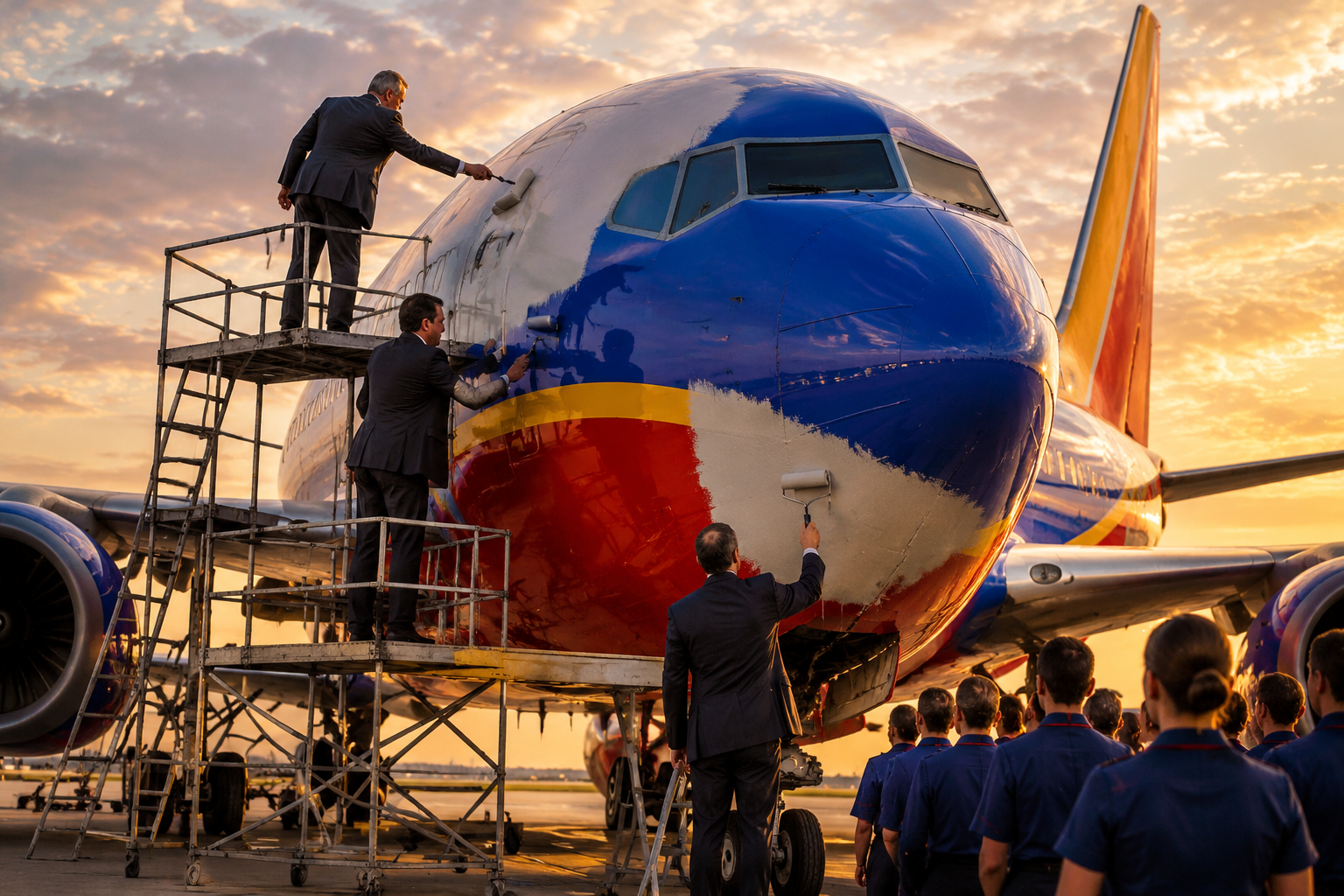
Wendover Productions tells a compelling story about the destruction of Southwest Airlines: an unusually customer-friendly airline, weakened by an operational disaster, falls into the hands of an activist investor that pushes it to abandon its identity.
There is a serious problem with that story. Southwest was already planning to change its business model before Elliott Investment Management arrived. The documentary establishes that Elliott applied pressure and secured influence. It does not establish that Elliott originated the transformation, dictated every unpopular decision, or bears responsibility for the strategic choices Southwest's own executives made.
That distinction matters. An activist investor can accelerate a company's transformation without inventing it. And a management team that voluntarily changes its business model does not become a helpless victim simply because an aggressive shareholder is standing behind it.
The assigned-seating decision predates Elliott
On September 26, 2024, Southwest executives presented their own research at the company's investor day. Their account is inconvenient for Wendover's simple villain narrative.
Management said it had begun extensive customer research in September 2023, nine months before Elliott publicly launched its campaign. The airline had consulted more than 40,000 customers, including existing passengers and customers of competing carriers.
The results were striking: 80% of Southwest customers preferred assigned seating, as did 86% of other airlines' customers. Among former Southwest customers, the seating and boarding process was the leading reason they had not returned. Southwest's September 2024 investor-day transcript.
That does not prove Elliott had no influence. The airline announced its assigned-seating initiative on July 25, 2024, after Elliott's June campaign began. But it establishes something important: Southwest's management had independently identified the problem and commissioned the research before Elliott appeared.
The distinction is not academic. A company investigating a change before an activist arrives is not the same as a company being ordered to make that change by an activist.
Southwest's executives also presented assigned seating as a commercial decision based on customer preferences, longer journeys and opportunities to sell premium seats. They were not describing themselves as unwilling participants in Elliott's experiment.
Wendover should have examined that evidence before turning a complicated corporate transformation into a story of institutional capture.
Elliott did want change. That is not the same as controlling every decision.
There is no reason to pretend Elliott was an innocent shareholder. Its August 2024 SEC filing included an extensive presentation attacking Southwest's management and commercial strategy.
Elliott said it had spent 18 months researching the airline, conducted more than 130 conversations with former employees and industry executives, and commissioned a consumer study involving 2,000 respondents. Its recommendations included replacing the CEO, refreshing the board and conducting a comprehensive review of the airline's strategy, costs, technology and operations.
www.southwestairlinesinvestorrelations.com
Southwest Airlines Co.+1
It also explicitly highlighted the policies Southwest had historically refused to abandon. Its presentation compared the airline with Delta, United and American on assigned seating, premium products, basic economy and checked-bag fees. It even quoted an analyst arguing that free baggage might need reconsideration.
That is real pressure. Elliott wanted Southwest to reconsider precisely the commercial practices that had made it distinctive.
But Wendover collapses two different things into one: Elliott's demand for a strategic review and Southwest's subsequent decisions about what to change. The distinction matters because the investor's published proposal was not a detailed instruction to impose every fee, redesign every seat or remove every employment guarantee.
Elliott demanded a different management and a different strategic process. Southwest's executives still had to choose and execute the policies.
The boardroom settlement also deserves more precision. On October 23, 2024, Elliott withdrew its request for a special shareholder meeting in exchange for five directors: David Cush, Sarah Feinberg, David Grissen, Gregg Saretsky and Patricia Watson. They joined a 15-member board, with Elliott-backed directors also guaranteed at least one-third representation on each board committee. Gregg Saretsky became chair of the Finance Committee.
Southwest Airlines Co. (LUV)+1
That was substantial influence, not outright control. Bob Jordan remained CEO, the other directors remained in place, and the agreement required the new directors to follow the same corporate governance rules and fiduciary obligations as their colleagues.
Southwest had negotiated away some independence to avoid a shareholder fight. Elliott had won a meaningful position inside the boardroom. Neither fact establishes that Elliott personally dictated every subsequent operating decision.
The baggage decision is where the story gets uncomfortable
Southwest's September 2024 investor presentation contains one of the most revealing contradictions in this entire episode.
Executives described free checked baggage as one of the airline's strongest competitive advantages. They commissioned a separate study examining different ways of charging customers for baggage, including removing free bags from the cheapest fare.
The results were not encouraging. Management said every scenario tested was value-destructive because the expected loss of customers outweighed the additional baggage revenue. One scenario was projected to produce approximately $300 million less revenue.
Transcript
This was not Elliott defending the old Southwest. It was Southwest's own management defending it.
Then, on March 11, 2025, Bob Jordan announced that most passengers would have to pay for their first and second checked bags. The airline retained free baggage for selected loyalty members, eligible credit-card holders and customers purchasing its highest fare. It also introduced a Basic fare and changed flight-credit expiration rules.
Southwest Airlines Co.
The reversal deserves serious scrutiny. Why did a policy that management had recently described as financially valuable become expendable?
There is a possible explanation: the 2025 structure was not identical to the earlier scenario. It combined baggage fees with new fare categories and exemptions designed to encourage customers to buy more expensive products. Southwest subsequently reported that initial baggage-fee revenue exceeded expectations.
Southwest Airlines Co.
That is a legitimate commercial argument. But it is also an important management decision, not proof that Elliott personally ordered the change.
The documentary misses the most interesting question: What changed in Southwest's financial calculations between September 2024 and March 2025?
An investor can demand better returns. Management must explain why it abandoned its own research to pursue them.
Some of the documentary's details need correcting
The claim that Southwest reduced everyone's legroom by an inch is too broad.
At its September 2024 investor day, management explained that standard seat pitch on its 175-seat aircraft would decrease from 32 to 31 inches to create extra-legroom seats without removing seats. But the Boeing 737-700 fleet already had 31-inch standard pitch; Southwest planned to remove one row, reducing capacity from 143 to 137 seats instead. The changes were not identical across the fleet.
Transcript
Flight-credit expiration also needs qualification. Southwest's new rules apply to credits generated from reservations booked or changed on or after May 28, 2025. Credits issued under the previous policy between July 28, 2022 and May 27, 2025 remain non-expiring. Saying simply that flight credits now expire obscures a meaningful distinction.
Southwest Airlines Co. (LUV)
There is another problem with the documentary's nearly $1.5 billion estimate for the 2022 Christmas meltdown.
The Department of Transportation did assess a $140 million civil penalty. But it was not a $140 million cash payment to the government.
The original order divided it into:
- $35 million payable to the US Treasury.
- $72 million in penalty offsets for providing $90 million in future passenger vouchers.
- $33 million credited for 25,000 Rapid Rewards points already issued to affected passengers.
In December 2025, the DOT also waived the final $11 million cash installment and awarded an additional $11 million credit for operational improvements.
Department of Transportation+1
The documentary can legitimately describe a $140 million civil penalty. But presenting it as an ordinary cash fine and adding it directly to other losses hides the actual financial arrangement.
More importantly, the video does not provide an auditable reconciliation of its $400 million lost-revenue estimate, $600 million in passenger-related costs and $300 million in subsequent lost bookings. The DOT itself describes the more than $600 million paid to passengers as refunds and reimbursements. Without showing precisely how the categories were calculated and whether they overlap, the near-$1.5 billion figure should be treated as an estimate, not an established accounting total.
US Department of Transportation
The predicted collapse is not what the evidence currently shows
Wendover makes two particularly confident predictions: Southwest will emerge weaker for decades, and Elliott will eventually sell its shares, pocket its profits and move on to another company.
Neither conclusion has been established.
The first full year of the new commercial policies produced mixed results. Southwest's 2025 annual filing reported:
- Revenue passengers fell 4.2%.
- Passenger load factor declined from 80.4% to 77.4%.
- Average passenger fares increased 6.7%.
- Passenger revenue increased 2.2%.
These figures show fewer passengers and higher fares. They do not establish that the new policies caused the decline, particularly when the airline was also changing capacity, distribution and its broader commercial strategy.
Southwest Airlines Co. (LUV)+1
Customer satisfaction offers another useful test. In the 2026 J.D. Power North America Airline Satisfaction Study, Southwest retained first place among economy and basic-economy passengers for the fifth consecutive year.
But there is an important qualification: its score fell from 694 in 2025 to 670 in 2026, leaving it just three points ahead of Delta. The survey covered March 2025 through March 2026, meaning it captured the baggage-fee changes but only approximately two months of assigned seating. This is evidence of a narrowing customer-satisfaction advantage, not proof that the brand has collapsed.
JD Power+1
Financial results are also more complicated than the documentary's prediction.
On October 21, 2026, Southwest reported third-quarter operating revenue of $8.4 billion, up 21.2% year over year, net income of $270 million and an operating margin of 4.5%, four percentage points higher than the previous year. Unit revenue reached a company record. Management attributed the performance to strong demand and its transformed commercial offering.
Southwest Airlines Co.
These are company-reported results, not independent proof that the transformation will succeed. Nor do they restore Southwest's historic profitability. But they make a confident prediction of inevitable long-term financial decline considerably harder to defend.
The same problem applies to Elliott's supposed exit.
In its February 23, 2026 SEC filing, Elliott disclosed ownership of approximately 45.9 million Southwest shares, representing 9.3% of the company. It acknowledged reducing its economic exposure for portfolio-management reasons but explicitly stated that it intended to remain a significant shareholder.
Southwest Airlines Co. (LUV)
Elliott may eventually sell. That is what investors can do with investments. But Wendover presents a speculative future transaction as though the investor's eventual departure and profit-taking are already established facts.
There is a difference between explaining an activist investor's financial incentives and inventing its future conduct.
Southwest's management cannot disappear from its own story
There is one genuine tragedy in this transformation: employees and customers have absorbed real changes.
In February 2025, Southwest announced the elimination of approximately 1,750 employee positions, representing 15% of its corporate workforce. CEO Bob Jordan described the decision as unprecedented in the airline's 53-year history. The company identified it as part of its own transformation plan.
Southwest Airlines Co.+1
Elliott's pressure for lower costs and better financial performance is relevant to that environment. But the public record does not establish that Elliott specifically ordered those layoffs.
The distinction matters because Bob Jordan was not removed. He remained CEO, participated in presenting the transformation, announced the new customer policies and led their implementation.
Southwest's board also retained a majority of directors who were not Elliott's nominees. The activist had significant influence, but management retained operational responsibility.
Wendover's treatment of the company sometimes makes it sound as though Southwest's executives were passengers on a plane Elliott was piloting.
They were not.
The more uncomfortable interpretation is that Southwest's leadership had spent years defending a business model that was becoming financially difficult to sustain. When outside pressure became sufficiently powerful, management accepted a different commercial direction and began dismantling some of the very policies it had previously defended.
That is not an absolution of Elliott. It is an indictment of corporate leadership.
Verdict: An activist investor is not an adequate explanation for a company's choices
Wendover has identified a genuine corporate conflict. Elliott arrived with substantial financial power, challenged Southwest's leadership, won five board appointments and pushed for a comprehensive strategic transformation. Southwest subsequently abandoned several of its defining customer policies.
But the documentary does not adequately distinguish between pressure, influence, decision-making and causation.
Its own management had researched assigned seating before Elliott's campaign. Its executives publicly defended free baggage, then reversed that position. They retained the CEO, presented their own financial transformation plan and implemented the changes themselves.
The documentary also makes long-term predictions about brand damage and Elliott's eventual exit without establishing the evidence necessary to support that certainty.
Southwest did not simply have its identity stolen by Wall Street. Its own leadership chose to trade parts of that identity for a different financial model.
Elliott helped make that transformation possible and accelerated the pressure for change. Southwest's management made the decisions that turned it into reality.
That is a much more interesting story than a benevolent airline destroyed by a villainous investor. It is also the story the documentary should have investigated.
References
1. The Downfall of Southwest Airlines — Wendover Productions, original video. Watch the documentary. The primary work under examination and the source of the arguments challenged here.
2. LUV 2024 Investor Day Transcript — S&P Global Market Intelligence, September 26, 2024. Read transcript. Documents management's pre-Elliott customer research, assigned-seating rationale and explicit conclusion that removing free baggage could destroy value.
3. Schedule 13D and Stronger Southwest Presentation — Elliott Investment Management, filed August 5, 2024. Read SEC filing. Establishes Elliott's investment, research, proposed leadership changes and criticism of Southwest's commercial policies.
4. Preliminary Proxy Statement — Southwest Airlines Co., October 15, 2024. Read SEC filing. Provides the documented chronology of Elliott's campaign, management's responses and the boardroom negotiations.
5. Cooperation Agreement and October 24 Form 8-K — Southwest Airlines Co., October 24, 2024. Read SEC filing. Establishes the five director appointments, board structure, committee representation and withdrawal of Elliott's special-meeting demand.
6. Southwest Airlines Outlines Changes to Drive Revenue Growth and Reward Its Most Loyal Customers — Southwest Airlines, March 11, 2025. Read announcement. Documents management's decision to introduce baggage fees, Basic fares and expiring flight credits.
7. Southwest Airlines Reports Second Quarter 2025 Results — Southwest Airlines, July 23, 2025. Read results. Provides the airline's early assessment that baggage-fee revenue exceeded expectations and documents the initial financial performance of its transformation.
8. Southwest Airlines Consent Order 2023-12-11 — US Department of Transportation, December 15, 2023. Read original order. Establishes the actual composition of the $140 million civil penalty and its passenger-compensation obligations.
9. 2025 Annual Report (Form 10-K) — Southwest Airlines Co., February 5, 2026. Read annual report. Provides passenger volumes, load factors, fare movements, flight-credit rules, workforce reductions and the subsequent DOT penalty amendment.
10. Schedule 13D Amendment No. 13 — Elliott Investment Management, February 23, 2026. Read SEC filing. Documents Elliott's continuing 9.3% ownership and its stated intention to remain a significant shareholder.
11. 2026 North America Airline Satisfaction Study — J.D. Power, May 6, 2026. Read study findings. Provides independent passenger-satisfaction scores, survey methodology and the narrowing gap between Southwest and Delta.
12. Southwest Airlines Reports Third Quarter 2026 Results — Southwest Airlines, October 21, 2026. Read financial results. Supplies the latest financial results, including record quarterly revenue, net income and operating-margin improvement.