Wendover's BLM Explainer Misses the Advantage Built Into Federal Grazing
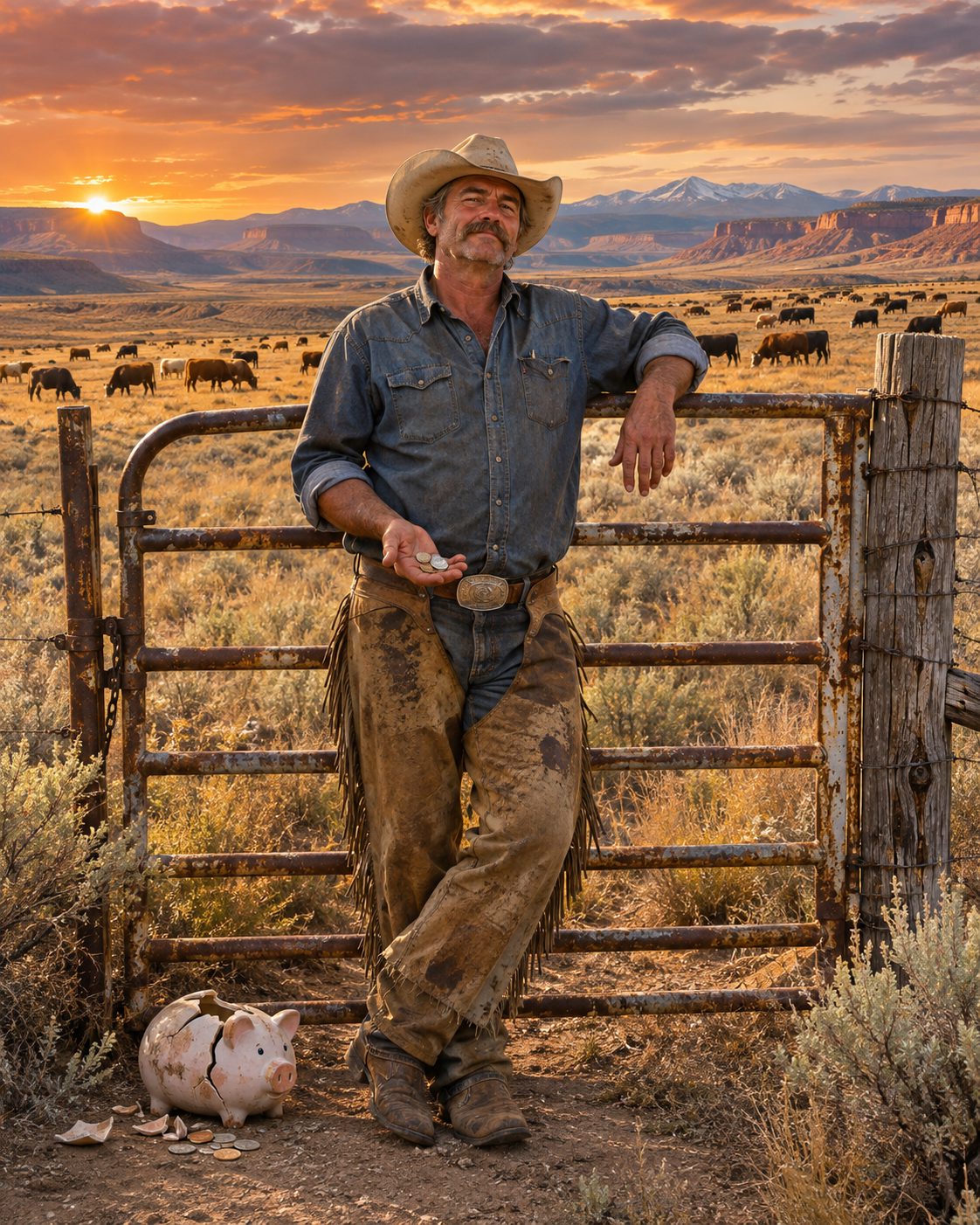
Wendover Productions' October 2024 video argues that the Bureau of Land Management (BLM) is trapped between incompatible demands: conservation, ranching, recreation, mining, energy development and military use. Its central explanation is that an agency expected to satisfy everyone inevitably disappoints everyone.
But that explanation leaves out an important distinction. Federal grazing is not simply another interest competing for access to public land. Existing ranchers receive preferential treatment under federal law, grazing fees are deliberately structured to protect the livestock industry, and permits carry economic value into private property transactions. The system has a built-in advantage for its existing users.
The video identifies the cheap grazing fee and valuable permits. It never properly investigates the economic and institutional arrangements behind them.
The $23 comparison is real, but incomplete
The narrator compares the federal grazing fee of $1.35 per animal unit month (AUM) with approximately $23 on private land.
The comparison is broadly credible. USDA's National Agricultural Statistics Service reported 2024 average private, non-irrigated grazing rates of $22.80 across the 11 western states used in the federal fee formula and $23.40 across 17 western states.
However, these are not necessarily equivalent products. A 2005 Government Accountability Office (GAO) investigation explained that private grazing land often offers better forage and water resources, alongside services such as fencing, watering, feeding, veterinary care and maintenance of livestock infrastructure. Public land also generally remains accessible to other visitors.
Consequently, the difference between $1.35 and $23 cannot simply be treated as the amount of money ranchers receive as a subsidy.
But there is something more important the video misses: the federal fee is deliberately designed not to capture ordinary market value.
The Public Rangelands Improvement Act of 1978 established a formula incorporating private forage values, cattle prices and production costs. It also established a policy explicitly intended to prevent economic disruption and harm to the western livestock industry.
The formula has a $1.35 minimum and limits annual increases or decreases to 25%. The 2025 fee was $1.35; it increased to $1.69 in 2026.
The GAO explicitly concluded that the formula's primary purpose was not to achieve fair-market pricing. It was designed to reflect private grazing rates while adjusting for ranching costs and producers' ability to pay.
That is a political and economic decision, not simply an administrative failure.
The video never explains this distinction. It presents the price difference without properly explaining the policy that produces it.
Sources: USDA grazing-rate survey · GAO investigation · Public Rangelands Improvement Act.
Grazing permits create private economic value
The narrator correctly observes that ranches can sell for substantially more when they include federal grazing privileges.
But this deserves considerably more investigation.
The BLM requires applicants to own or control qualifying private property known as base property, which carries preference for associated public grazing privileges. That preference can be transferred through an approved change of base property.
Permits generally cover ten years and are renewable when the permittee satisfies the applicable conditions.
The GAO identified an important consequence: although federal agencies do not recognize grazing permits as legal property rights, the real-estate market incorporates their value into private ranch prices.
In other words, the federal government does not necessarily receive the full economic value associated with granting access to its land. Some of that value is captured through private property transactions.
Wendover acknowledges that grazing rights increase ranch values, but never investigates the scale of this market or who benefits.
There is historical evidence that the distribution deserves attention.
A GAO examination of BLM permits in 2004 found that approximately 16.8% of permits, those authorizing more than 1,000 AUMs, accounted for roughly 76% of approved grazing use.
This is permit-level concentration, not proof that the same percentage of ranchers controlled that forage. The GAO specifically warned that one operator could hold multiple permits and multiple operators could share one permit.
Importantly, the BLM's public Rangeland Administration System contains operator names, authorization numbers, allotments, livestock numbers and authorized forage amounts.
An updated operator-level analysis is therefore possible.
The video gives readers the figure of approximately 18,000 permits but never establishes how the associated economic benefits are distributed.
That is a substantial omission.
Sources: BLM permit requirements · GAO permit distribution and property-value analysis · BLM Rangeland Administration System.
The law gives existing grazing operations a powerful advantage
The video's central framing makes the BLM appear to be a referee caught between competing groups.
Federal grazing law complicates that picture.
Under 43 U.S.C. §1752, an existing permittee who complies with the applicable requirements and accepts the new conditions receives first priority for renewal when the land remains available for grazing.
More importantly, a 2014 amendment provides for existing permit terms to continue under a new permit when the agency has not completed the required environmental analysis before expiration.
The BLM's 2015 implementation instructions describe this continuation as mandatory.
This means that when environmental reviews fall behind, existing grazing arrangements do not simply disappear. They continue while the agency works through its obligations.
That is a structural advantage for the status quo.
A subsequent investigation by ProPublica and High Country News, published in December 2025, found that approximately 75% of BLM acreage open to livestock grazing was authorized without an environmental review in 2023, compared with 47% in 2013.
Even more troubling, 82% of acreage previously identified as degraded because of livestock grazing was reauthorized without review.
The investigation also found that BLM rangeland management staffing declined 39% between 2020 and 2024. Ten current and former employees told the journalists they had felt pressure to go easy on ranchers when conducting environmental assessments and permit reviews.
The BLM responded that it remains committed to transparency, sound science and public participation.
These findings do not establish that every grazing operation is harmful. They demonstrate that the agency's ability to independently evaluate existing operations has serious weaknesses.
The video discusses the BLM's limited staffing and its confrontations with ranchers, but does not investigate this statutory continuation mechanism.
That is where its explanation becomes too comfortable.
The environmental evidence deserved equal attention
One of the video's most detailed sections explains Burning Man's environmental inspection.
Readers learn that federal inspectors randomly select 120 locations, collect remaining rubbish, photograph it against a green background and calculate the remaining square footage.
The procedure is explained with impressive precision.
Yet the video offers no comparable examination of contemporary livestock grazing outcomes.
This is particularly significant because Congress explicitly recognized the problem in the Public Rangelands Improvement Act of 1978. Its findings described vast areas of public rangeland as being in unsatisfactory condition and warned that existing management and funding levels could allow conditions to deteriorate further.
The law also requires the government to maintain an inventory of public rangeland conditions and trends and make it available to the public.
A May 2024 analysis by Public Employees for Environmental Responsibility (PEER), published before Wendover's video, examined BLM records covering 1997–2023.
It reported approximately 37.9 million acres failing land-health standards with livestock identified as a significant cause, alongside approximately 36.6 million acres without completed assessments.
These figures require qualification. PEER's own documentation acknowledges that the underlying BLM records contained substantial inconsistencies and had not been checked against agency data-quality standards. Its reconciliation sometimes carried forward livestock-related findings from older records when newer records omitted them. The figures should therefore be treated as a warning, not a definitive measurement of current livestock-caused damage.
Nevertheless, the absence of a centralized, consistently maintained electronic inventory is itself an important institutional problem.
The subsequent ProPublica investigation provided additional evidence through field visits in Arizona, Colorado, Montana and Nevada. Reporters documented livestock in restricted waterways and habitat affected by grazing.
There are legitimate counterarguments. Some range ecologists and ranchers maintain that properly managed grazing can support ecosystem functions, reduce wildfire fuel and maintain working landscapes.
That makes reliable monitoring more important, not less.
The video spends considerable time explaining how the BLM measures a temporary festival's environmental footprint. It never gives readers an equivalent understanding of how effectively the agency measures and responds to livestock impacts across 155 million acres.
Sources: PEER's May 2024 report · PEER's data methodology and limitations · 43 U.S.C. §1903 · ProPublica investigation.
Who pays to maintain the arrangement?
The financial picture is more complicated than the annual grazing fee.
According to the BLM, its FY2025 rangeland management allocation was $106.3 million, with approximately 43% spent on livestock grazing administration. That implies roughly $45.7 million in administrative spending.
The agency collects approximately $13 million in grazing fees, with receipts shared with state and local governments.
This is not a complete calculation of the net taxpayer subsidy. The wider budget also supports weed management, soil management, monitoring, water development, restoration and habitat improvements. The fee receipts are distributed rather than retained entirely by the BLM.
The economic benefits also matter. The BLM estimates that its grazing program supports $2.9 billion in annual economic output, 36,200 jobs and $557.3 million in labor income.
But economic output is not the same as net public benefit, government revenue or environmental value.
A 2024 study published in Rangeland Ecology & Management offers another important qualification. Using 2018 cost records from randomly selected producers in Wyoming, Idaho and California, researchers found a $3.09-per-AUM difference in nonfee grazing costs, but no statistically significant difference in overall costs between federal and privately leased grazing.
The study was supported by the Public Lands Council's Endowment Trust. The Trust's own guidelines identify the Public Lands Council as its primary beneficiary and describe its purpose as protecting public lands and the public-land livestock grazing industry.
That funding does not invalidate the research. It is relevant context when evaluating a study that challenges the claim that federal grazing is automatically cheaper for producers.
The video supplies neither a complete public-cost accounting nor a serious examination of these competing economic findings.
Sources: BLM financial and economic figures · Dollerschell et al., 2024 · Public Lands Council funding guidelines.
The verdict: An impossible mandate does not mean an equal contest
Wendover correctly identifies the BLM's extraordinary responsibilities and the contradictions built into American public-land management.
But its explanation leaves readers with an incomplete understanding of the power relationships within that system.
Existing grazing permittees receive renewal priority. Their grazing privileges can add value to privately owned ranches. Federal policy deliberately protects the livestock industry's economic interests through the fee formula. When environmental reviews fall behind, existing grazing terms can continue.
Meanwhile, taxpayers finance the agency's administration, and the environmental condition of extensive grazing areas remains a serious oversight challenge.
None of this proves that every rancher is exploiting the system, that every grazing permit is improperly issued, or that livestock has no legitimate place on public land.
It does establish that the BLM's multiple-use dilemma is not simply a story of everyone fighting for an equal share.
Wendover explains why the BLM is controversial. It does not adequately explain who benefits from the existing arrangements, who pays to maintain them, or what happens to the land when oversight fails.
The $1.35 grazing fee is not the end of that story. It is where the investigation should have started.
References
- The Gov Agency That Manages America's Worst Land — Wendover Productions, October 31, 2024. The original video and primary source for the claims being examined.
- Livestock Grazing on Public Lands — Bureau of Land Management. Current permit requirements, grazing fees, economic contributions and FY2025 program spending.
- Grazing Fee Rates for Cattle, 2023–2024 — USDA National Agricultural Statistics Service, 2025. Provides the private non-irrigated grazing rates used to test the video's $23 comparison.
- Livestock Grazing: Federal Expenditures and Receipts Vary — Government Accountability Office, September 30, 2005. Examines the fee formula, public costs, permit values, private-land comparisons and historical distribution of grazing privileges.
- Public Rangelands Improvement Act, 43 U.S.C. §1901 and 43 U.S.C. §1752 — United States Code. Establishes the economic objectives of grazing-fee policy and the statutory rules governing permit renewal and continuation.
- Implementing Amended Section 402(c)(2) of FLPMA — Bureau of Land Management, 2015. Explains the agency's mandatory continuation of grazing terms when environmental reviews remain incomplete.
- Evaluating Trends in Rangeland Health on BLM Lands — Public Employees for Environmental Responsibility, May 14, 2024. Aggregates BLM land-health records and identifies livestock-related failures and unassessed acreage; its accompanying metadata documents important data-quality limitations.
- A Loophole Allows Ranchers to Renew Grazing Permits With Little Scrutiny of the Environmental Impact — ProPublica and High Country News, December 1, 2025. Investigates automatic permit continuation, declining environmental reviews, staffing reductions and field evidence of grazing impacts.
- Evaluating Nonfee Grazing Permit Costs on Federal and Private Lands — Kasey Dollerschell and colleagues, Rangeland Ecology & Management, January 2024. Tests whether additional operating costs eliminate the apparent price difference between federal and private grazing.
- Public Lands Council Guidelines for Distribution, FY2025 — Public Lands Council. Discloses the purpose and beneficiary structure of the Endowment Trust that supported the 2024 grazing-cost study.
- Rangeland Administration System Reports — Bureau of Land Management. Provides public operator, authorization, allotment and forage-use records that can support further analysis of who receives federal grazing privileges.
Make the investigation’s thesis more preciseSeparate evidence from implied conclusions