Harris Did Not Inherit a $240 Million Campaign Account. Wendover Misses the Difference.
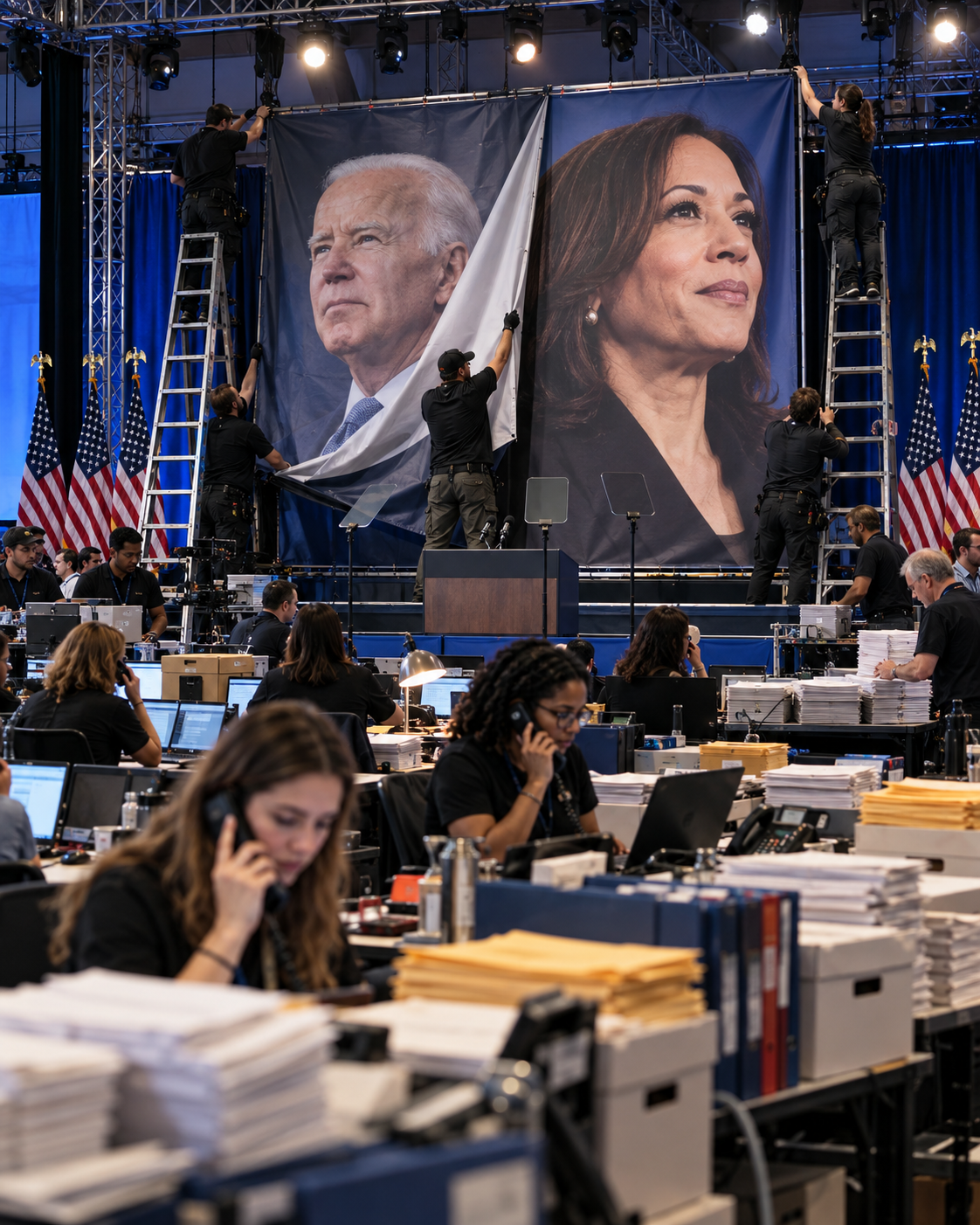
Wendover Productions gets the central story right: Kamala Harris did not have to build a presidential campaign from nothing. But its explanation of how she inherited Biden's organization turns a complicated legal and financial arrangement into a remarkably simple administrative trick.
The video describes a campaign name change, an inherited organization and a $500 million fundraising surge. What it leaves out is more revealing: Harris was already listed on Biden's campaign committee, most of the Democratic war chest was held outside that committee, and the widely reported $500 million represented a broader fundraising operation rather than one campaign account.
These are not minor accounting details. They determine who controlled the money, what Harris was legally entitled to use, and what the campaign actually inherited.
The $96 million was not a gift from Biden to Harris
The video says that transferring Biden's campaign was legally possible because of Harris's unique position as his vice president. That explanation is directionally correct, but it misses the most important piece of evidence.
On September 5, 2023, Biden for President filed an FEC Statement of Organization listing both Joseph Biden and Kamala Harris as candidates. The committee already existed as a joint Biden-Harris campaign organization under FEC identification number C00703975.
On July 21, 2024, that same committee amended its registration to become Harris for President. It retained its FEC identification number, treasurer Keana Spencer, mailing address and listed banking depository, Amalgamated Bank. This was not a newly created Harris committee receiving a $96 million contribution from Biden. It was the existing registered committee changing its name and candidate information.
The original 2023 FEC filing and the July 21, 2024 amendment establish this continuity directly.
There is a legal explanation too. Federal regulation 11 CFR §103.4 provides that the campaign depository designated by a presidential candidate's principal campaign committee also serves as the depository for that party's vice-presidential candidate.
The Federal Election Commission had also recognized the joint presidential and vice-presidential committee arrangement in its 2010 Advisory Opinion 2010-27, concerning Barack Obama and Joe Biden.
The regulation and the FEC advisory opinion explain the legal foundation.
There was, however, a genuine qualification. Federal law did not explicitly address the precise situation of an incumbent vice president becoming the presidential candidate before formal renomination at the party convention. The Brennan Center for Justice examined that gap in July 2024 and concluded that most campaign-finance experts believed Harris had a clear legal path because of the existing joint committee and established FEC practice.
The Trump campaign challenged the arrangement before the FEC, arguing that Harris could not simply take control of Biden's remaining campaign funds. Citizens United and Republican state parties also filed a complaint. The FEC was unlikely to resolve the dispute before the November election.
The Brennan Center's legal analysis explains both the supporting precedent and the unresolved legal question.【turn158007news18】
I would not describe the transfer as an established campaign-finance violation. The available evidence supports Harris's position. But Wendover presents the legal shortcut without explaining either its actual foundation or the controversy surrounding it.
The $240 million war chest was not one account
Here is where the financial explanation becomes particularly inadequate.
When Biden withdrew, the Democratic campaign operation had approximately $240 million in its combined war chest. But more than $90 million was held by Biden's principal campaign committee. A significant portion of the remainder was already controlled by the Democratic National Committee and other party committees.
The principal committee's June 30 FEC financial report showed approximately $95.95 million in cash on hand.
These are different financial arrangements. Money held by the DNC is not automatically money sitting in a presidential candidate's campaign account.
The distinction matters because the legal continuity gave Harris access to the existing principal committee's funds, not unrestricted ownership of every dollar associated with the Democratic election operation.
The Brennan Center's analysis identifies the distinction, while the committee's June 2024 FEC filing documents its actual cash position.
There was another financial consequence that the video overlooks: shared contribution limits.
Because Biden and Harris operated as one presidential ticket, their donors were subject to a shared contribution limit. Wealthy donors who had already contributed the maximum to the Biden-Harris committee could not simply be approached for another maximum contribution to a separate Harris campaign.
Had Harris established a genuinely separate campaign, she could potentially have solicited another contribution from those donors.
The existing arrangement therefore provided immediate access to campaign money and infrastructure, but it did not automatically create a fresh fundraising limit. The Brennan Center also explained that money could potentially have been redirected to the DNC to support the new ticket if the original committee could not continue using it.
That is a much more interesting financial trade-off than simply saying Harris inherited Biden's money.
The $500 million comparison confuses fundraising with corporate revenue
The video states that the Harris campaign brought in $500 million during its first month and compares that figure with Lyft's monthly revenue.
The comparison sounds impressive. The problem is what the $500 million actually represents.
Reuters reported approximately $500 million raised by Harris's wider election effort during the four weeks following July 21, based on information from four unnamed sources.
A few days later, The Washington Post reported a $540 million fundraising figure from the campaign. Crucially, it explained that this figure combined fundraising across three different structures:
- Harris for President.
- The Democratic National Committee.
- Joint fundraising committees.
The newspaper also noted that the campaign's figure could not yet be independently confirmed through subsequent financial filings.
Reuters's original report and The Washington Post's subsequent reporting make the distinction clear.
The principal campaign committee itself reported approximately $204.49 million in July receipts and $219.72 million in cash on hand at July 31. Those figures cover a different reporting period from Reuters's four-week fundraising estimate, but they demonstrate why the aggregate $500 million should not be presented as the receipts of one legal committee.
There was another organization involved.
Biden Victory Fund also became Harris Victory Fund on July 21. It retained its own FEC identification number, C00744946, and continued as a separate joint fundraising committee involving the DNC and numerous state Democratic parties.
Its FEC records show approximately $1.314 billion in gross receipts during 2023–2024, alongside approximately $899.4 million in transfers to affiliated committees.
That is a fundraising and distribution network, not $1.314 billion sitting in Harris's presidential campaign account.
The FEC's Harris Victory Fund records document this separate financial structure.
The comparison with Lyft also needs qualification. Lyft reported $1.436 billion in revenue for the second quarter of 2024, approximately $479 million per month on a simple average.
But corporate revenue and political contributions are different financial measures. One represents income from commercial operations; the other represents donations collected across political committees with different legal responsibilities and spending arrangements.
The comparison communicates scale, but it does not establish that one campaign organization generated the equivalent of a company's monthly business revenue.
Lyft's official second-quarter financial results provide the underlying corporate figure.
The name change affected actual donors, too
There is a smaller but revealing consequence of keeping the same committee.
A Texas donor named Jason Kaar had established a recurring monthly contribution through ActBlue, specifically earmarked for Biden for President. After Biden withdrew and the committee became Harris for President, another installment was processed on August 6.
Kaar objected. He said he had intended to support Biden, not Harris.
ActBlue's response to the FEC explained that the contribution had been forwarded to the same registered committee and bank account. The organization refunded the disputed $1 contribution on August 14 and cancelled future recurring payments.
The FEC subsequently dismissed the complaint in February 2025 under its enforcement-priority discretion, citing the small amount involved and ActBlue's remedial actions.
Importantly, that dismissal was not a ruling on the legality of the larger Biden-Harris campaign transition.
The FEC's MUR 8299 records document the donor's complaint and ActBlue's explanation; the dismissal report explains the Commission's decision.
One donor's experience does not establish widespread unauthorized fundraising. But it demonstrates something the video never considers: legal continuity preserved existing payment arrangements, not merely office infrastructure and staff.
The committee's identity mattered to people who had authorized payments to it.
An inherited organization is not an inventory of inherited assets
Wendover describes the operational benefits of retaining Biden's existing staff, headquarters, payroll, lawyers, technology and other infrastructure.
It also describes Harris keeping the Wilmington headquarters rather than relocating.
These are reasonable explanations for how the transition could happen so quickly. But the video does not document which individual employment agreements, leases, vendor contracts, software licences or intellectual-property arrangements continued unchanged.
The FEC filings establish continuity of the registered committees, their treasurers and their banking arrangements. They do not provide an inventory of every contract or asset used by the campaign.
That distinction matters. An existing organization can retain substantial operational continuity without every agreement or asset automatically becoming part of a new candidate's personal property.
The stronger explanation is that Harris inherited the benefit of an existing organizational structure because the underlying campaign committee continued operating. That is different from demonstrating that every part of the organization was transferred intact.
The verdict: The real story is the legal and financial machinery
Wendover's central explanation survives scrutiny. Harris had an enormous organizational advantage because she was already part of Biden's presidential ticket and its existing campaign committee.
But the video stops at the dramatic moment of the name change.
It does not adequately explain that the approximately $96 million in the principal committee was already held by a joint Biden-Harris organization, that much of the wider $240 million war chest sat elsewhere, or that the $500 million fundraising figure described a broader network of political committees.
It also overlooks the shared donor limits, the separate joint fundraising operation, the legal challenge and the consequences of maintaining the same committee for existing recurring contributions.
I am not accusing Harris of stealing Biden's campaign. The evidence does not justify that accusation.
I am criticizing an explanation that makes a complex financial and legal succession look like a simple corporate rebranding exercise.
The real story is not that Harris magically created a half-billion-dollar presidential operation in a month. It is that an existing political network, already containing her as an authorized candidate, could be redirected with extraordinary speed because its legal and financial infrastructure was already in place.
That is the story worth telling. And it is considerably more revealing than a new logo and a new website.
References
- The Logistics of a Presidential Campaign — Wendover Productions, YouTube. Original video and transcript reviewed. Watch the original episode.
- Biden for President — Statement of Organization — Federal Election Commission, September 5, 2023. The filing establishes that Biden and Harris were already listed together on committee C00703975. Original FEC filing.
- Harris for President — Amended Statement of Organization — Federal Election Commission, July 21, 2024. Documents the committee's renaming, retained identification number, treasurer and banking arrangements. Original FEC filing.
- 11 CFR §103.4 — Vice Presidential Candidate Campaign Depositories — Electronic Code of Federal Regulations. Establishes the shared presidential and vice-presidential campaign depository rule. Read the regulation.
- Advisory Opinion 2010-27 — Federal Election Commission, November 18, 2010. Explains the legal framework for joint presidential and vice-presidential campaign committees through the Obama-Biden example. Read the advisory opinion.
- Can Harris Use Biden's Campaign Money? — Brennan Center for Justice, July 29, 2024. Explains the $240 million war chest, the shared committee, the unresolved legal question and the implications for contribution limits. Read the analysis.
- Harris' Election Effort Raises Around $500 Million in a Month, Sources Say — Reuters, August 21, 2024. Establishes the original reported fundraising figure and its attribution to the wider election effort. Read the report.
- Harris's Campaign Has Raised $540 Million Since Launch, Democrats Say — The Washington Post, August 25, 2024. Identifies the separate committees included in the fundraising figure and its verification limitations. Read the report.
- Harris Victory Fund — Committee Overview — Federal Election Commission. Documents the separate joint fundraising committee, its participants, receipts and transfers. Inspect FEC records.
- MUR 8299 — ActBlue Response and Dismissal — Federal Election Commission, February 7, 2025. Documents the recurring donation complaint, refund and the limited grounds for dismissal. ActBlue response · FEC dismissal report.
- Lyft Announces Q2 2024 Results — Lyft Investor Relations, August 7, 2024. Provides the company's reported quarterly revenue used in the comparison. Read the financial release.
Tighten the argument around the headlineSeparate verified facts from reported claims