Wendover’s Fruit Story Mistakes Logistics for Appetite
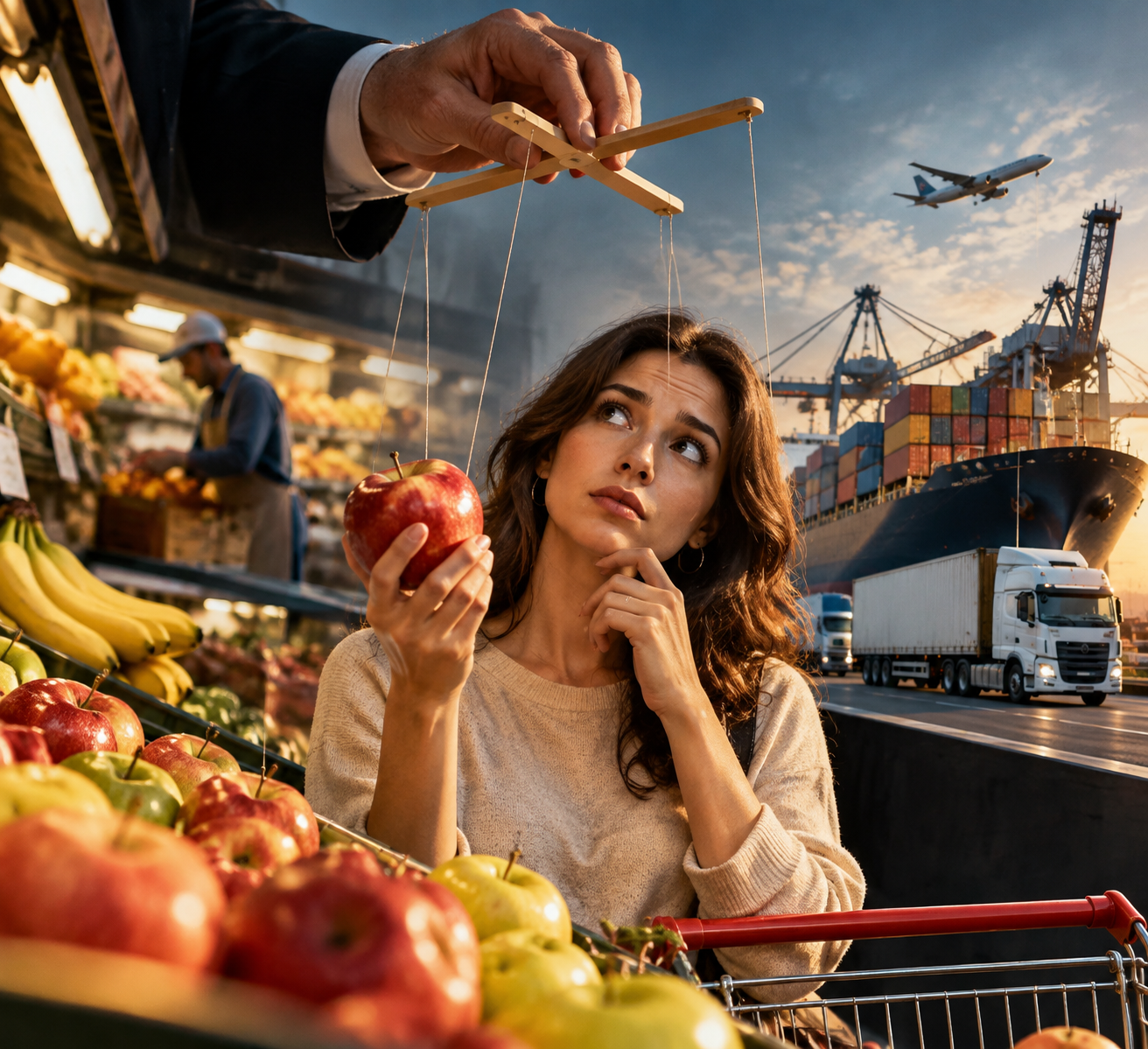
Wendover Productions’ The Logistics of Fruit follows bananas from Ecuador, apples through Washington’s enormous storage facilities, and grapes across the Pacific. It ends with a sweeping declaration: “You eat what you eat because the logistics make you.”
That conclusion is considerably stronger than the evidence supporting it.
The film demonstrates how sophisticated supply chains make fruit available throughout the year. It does not establish that logistics determine what Americans prefer, why they purchase particular varieties, or why some fruits command premium prices while others lose customers. Those decisions also involve marketing, consumer psychology, pricing, agricultural economics and commercial incentives.
Most revealingly, the film's own Cosmic Crisp example demonstrates how much of that story it leaves out.
Cosmic Crisp: The university was selling a market, not just an apple
Wendover describes how Washington State University developed Cosmic Crisp by combining desirable characteristics of Honeycrisp and Enterprise apples. It explains the licensing arrangement, the restricted nurseries and the requirement to distribute fruit under the Cosmic Crisp brand.
But the commercial operation behind that apple was considerably larger than a collection of stickers, boxes and licensing fees.
Washington State University's September 2022 Board of Regents materials reveal the financial machinery.
By that time:
- Approximately 19.3 million Cosmic Crisp trees had been planted over five years.
- Production was expected to reach 4 million boxes in 2022 and 5 million in 2023.
- The US market contained approximately 37 competing apple varieties.
- Only 27% of surveyed premium apple buyers recognized Cosmic Crisp.
- Just 14% had actually purchased it.
The university explicitly recognized that the growing supply required a corresponding increase in consumer demand.
Its board materials stated that it was “highly advantageous to the University to partner in increasing customer awareness and demand.”
That sentence deserves considerably more attention than the video gives it.
WSU had signed a four-year marketing agreement with Proprietary Variety Management worth approximately $10.4 million. By September 2022, the university reported collecting $16.7 million in gross royalties. It was also seeking authorization for another three-year marketing agreement capped at $7.5 million.
The university's royalty arrangement gave it a financial interest in the commercial success of the apple: fruit royalties applied when wholesale prices reached at least $20 per 40-pound box.
These are not incidental details. WSU owns the intellectual property and receives royalties from commercial production. It therefore has a direct financial incentive to establish consumer recognition, maintain demand and support premium pricing.
The video mentions the marketing partnership but never explains its financial scale or the university's incentive to create demand.
Cosmic Crisp was not simply an excellent apple waiting for better transportation. It was an agricultural product supported by a deliberately constructed commercial brand and a multimillion-dollar marketing operation.
That is a rather different explanation of consumer preference.
Source: Washington State University Board of Regents, September 2022.
Peaches: The trust explanation is incomplete
Wendover argues that Americans have turned away from peaches largely because consumers cannot trust their quality. A peach can be wonderful or disappointing, while apples offer a more predictable experience.
There is genuine research supporting the quality problem. The weakness is treating it as the dominant explanation without examining the other reasons consumers give.
A University of Florida IFAS online survey conducted in 2016 examined people who did not purchase fresh peaches.
Among 522 non-purchasers:
- 38% preferred other fresh fruit.
- 29% cited price.
- 17% cited poor quality.
- 17% preferred canned peaches.
- 11% said they simply did not like peaches.
Half of respondents also identified insufficient availability as a reason they did not purchase fresh peaches more frequently.
This is an older survey, not a current national measurement, but it demonstrates that the market has several distinct obstacles. Quality is one of them, not the entire explanation.
A separate peer-reviewed 2018 study in HortScience, involving 800 US consumers, found three distinct consumer groups:
- 48.8% prioritized actual fruit quality.
- 33.7% prioritized appearance.
- 17.5% considered both groups of attributes relatively equally.
The study also documented a substantial long-term decline in fresh peach consumption, from approximately six pounds per person in the 1980s to less than three pounds in 2016.
It identified short shelf life, difficult handling and inconsistent quality as genuine problems.
But it did not establish that consumer distrust was the principal cause of declining consumption.
There is a difference between identifying a problem and proving its relative importance.
The video could have investigated how much peach consumption is affected by price, availability, appearance, ripeness, competing fruit and retail merchandising. Instead, it settles on a convenient explanation and moves on.
The consumer is more complicated than that.
Sources: University of Florida IFAS and Zhou et al., HortScience, 2018.
The grape supply chain has a missing country
The grape section presents a relatively straightforward sequence: Chile supplies the American market during its off-season, Mexico bridges the gap, and California takes over during summer.
There is a significant omission: Peru.
This is not a country that emerged unexpectedly after the video was published.
A USDA Economic Research Service report published on July 25, 2024, documented that Peru had already overtaken Chile as the leading source of fresh table grapes imported into the United States during the 2022/23 season. Chile regained the leading position in 2023/24.
The same report established that:
- US fresh table-grape imports reached approximately 1.75 billion pounds in 2023/24.
- Imports accounted for 63% of American fresh table-grape availability.
- Imported grapes exceeded domestic production for the first time.
- Peru was becoming an increasingly important supplier to the American market.
These figures materially change the story.
The video spends considerable time describing Chilean production and transportation, followed by Mexican shipments and California's domestic harvest. Yet a major competing supplier is absent from its account.
A supply chain representing 63% of the American grape market cannot be adequately explained through a narrative that leaves out one of its leading suppliers.
Nor should California's share of domestic production be confused with its share of total American grape availability.
The video gives viewers an attractive seasonal sequence. USDA's figures reveal a more competitive international market in which the relative importance of suppliers changes over time.
Source: USDA Economic Research Service, Fruit and Tree Nuts Outlook, July 25, 2024.
The apple warehouse is not a time machine
The apple-storage explanation is another place where the presentation is cleaner than the underlying science.
The video describes controlled-atmosphere storage as reducing both oxygen and carbon dioxide concentrations to below approximately 3%.
That description is technically misleading.
According to the University of Maryland Extension, conventional controlled-atmosphere storage generally reduces oxygen from approximately 21% to 1–3%, while increasing carbon dioxide from atmospheric levels of approximately 0.04% to around 0.5–2.5%, depending on the variety.
The distinction matters because the gases have different roles in slowing respiration and preserving fruit.
There is also a quality trade-off that the video does not adequately explain.
Controlled-atmosphere storage can gradually reduce an apple's flavor profile, particularly its aroma, when storage extends beyond six months. Incorrect atmospheric conditions can also produce physiological disorders that damage the fruit.
The technology is extraordinary, but it does not freeze an apple in its original condition.
It extends marketability. That is not quite the same thing as preserving every aspect of freshly harvested quality.
There is another problem with the film's claim that apples are effectively the only fresh fruit available throughout the year from American production.
USDA research documents year-round domestic strawberry availability, with California supplying most of the season and Florida filling the winter months. The claim that apples are uniquely capable of year-round domestic availability is therefore too broad.
Sources: University of Maryland Extension and USDA Economic Research Service, The Changing Landscape of U.S. Strawberry and Blueberry Markets.
Logistics also changes prices, not just availability
There is a larger economic omission running through the entire presentation.
The video concentrates on getting fruit from farms to supermarkets. But transportation, storage and international trade also affect the prices consumers face.
A December 2013 USDA Economic Research Service study examined how imports influence American fresh-fruit availability and retail prices.
Using a model based on 1999–2010 data, researchers estimated that eliminating fresh-fruit imports would increase the average real retail price index from 153.4 to 225.4, while price volatility would rise from 3.86% to 12.02%.
These were simulated outcomes, not observed current prices, but they demonstrate an important mechanism: international supply affects affordability as well as availability.
The report also compared fruit consumption between 1990–92 and 2010–12.
Some results were far from uniform:
- Apple consumption fell from 18.9 to 15.6 pounds per person, even as the import share increased.
- Banana consumption remained at 25.5 pounds, with imports accounting for 99.8% of supply in both periods.
- Grape consumption increased only modestly, from 7.4 to 7.9 pounds, while the import share increased from 37.7% to 50.1%.
These historical figures are not a causal experiment. They do, however, show why the relationship between availability and consumption deserves proper investigation.
A fruit can become easier to obtain without consumers necessarily eating more of it.
And when prices change, purchasing decisions change too.
Source: USDA ERS, Imports Contribute to Year-Round Fresh Fruit Availability, December 2013.
Even Dole's infrastructure story has moved on
The banana section describes Dole's dedicated Guayaquil port operation as part of its carefully controlled transportation network.
There has since been an important commercial development.
In December 2025, Dole announced an agreement to sell its Guayaquil port business to Terminal Investment Limited. The transaction was completed on July 1, 2026, generating approximately $75 million in net cash proceeds.
Importantly, Dole had arranged to continue using the facility under a terminal-services agreement.
This does not invalidate the route described in the original video. It does, however, illustrate a distinction the presentation does not explore: controlling access to critical infrastructure does not necessarily require owning it.
The physical supply chain can remain in place while the ownership of its assets changes.
That is an important part of the economics of logistics, not merely a corporate footnote.
Sources: Dole's December 2025 announcement and July 2026 completion announcement.
The verdict: Supply chains deliver preference; they do not explain all of it
Wendover has built its argument around something real: sophisticated logistics determine which fruits can reach American supermarkets reliably, at what time of year, and in what condition.
But the video repeatedly moves from that observation to a much larger conclusion without doing the work.
Cosmic Crisp demonstrates that consumer demand can be deliberately cultivated through intellectual property, marketing expenditure, brand recognition and financial incentives.
Peach research demonstrates that price, availability, competing products, appearance and actual eating quality all influence purchasing decisions.
The grape market demonstrates that a seemingly straightforward international supply chain can omit major suppliers and conceal changing market shares.
Apple storage demonstrates that technological preservation comes with quality trade-offs that deserve to be acknowledged.
I do not dispute that logistics shape the American fruit market. I dispute the suggestion that logistics alone explain the American palate.
A shipping vessel can bring a banana to San Diego. A warehouse can preserve an apple for months. A refrigerated container can bring grapes across an ocean.
None of those things, by themselves, explains why a consumer chooses one fruit, pays more for one variety, rejects another, or develops a lasting preference.
That requires understanding the businesses creating demand, the prices consumers face, the growers making investment decisions and the retailers deciding what deserves shelf space.
Wendover explains how fruit gets to the supermarket. It mistakes that achievement for an explanation of why people want it.
The distinction is the entire story.
Tighten the opening thesisSeparate the six investigations more clearly