Wendover's Natural Gas Blind Spot: Electrifying Homes Does Not Make a Global Industry Disappear
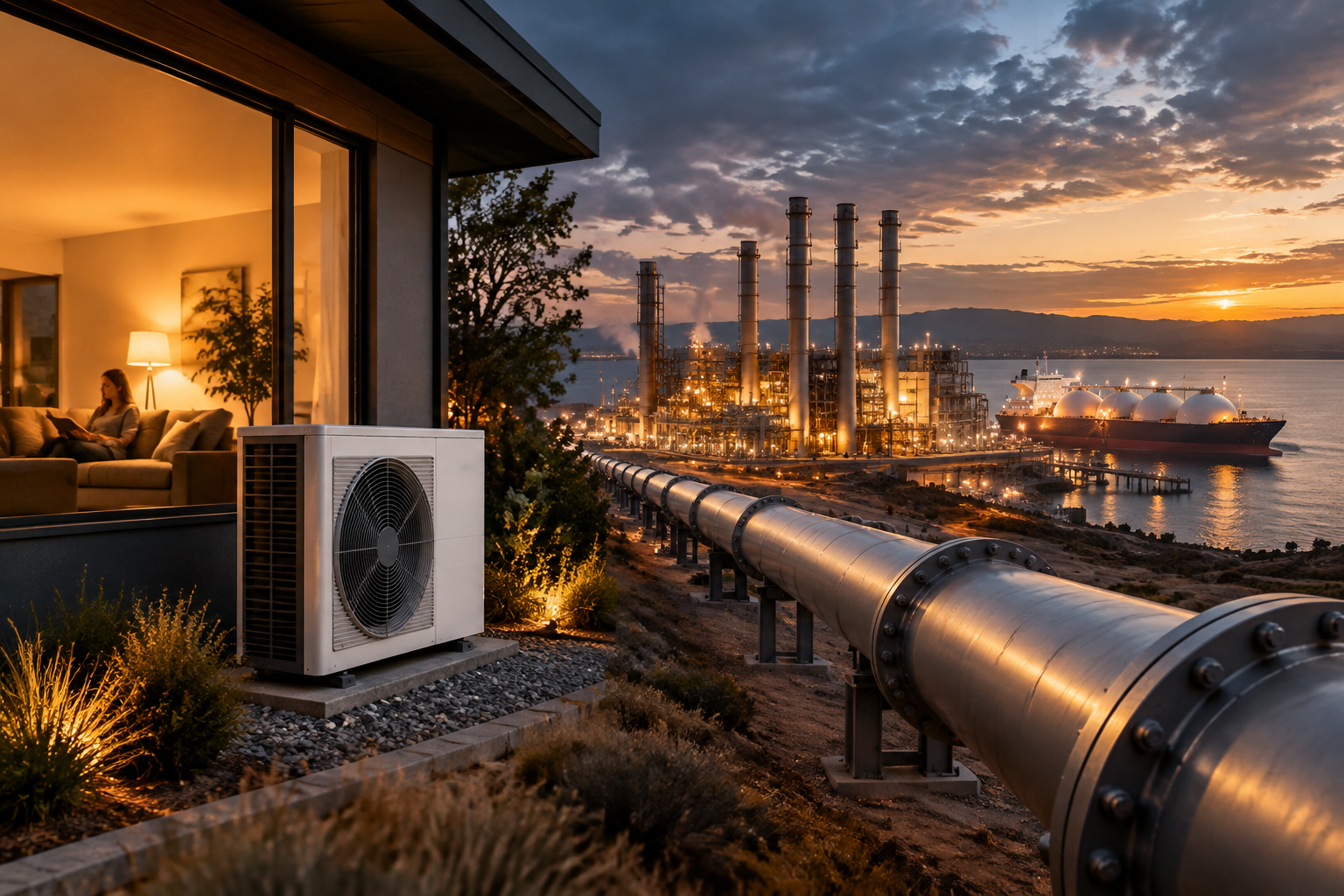
Wendover Productions has produced an excellent explanation of how natural gas travels across continents. Then, near the end, it makes a much less convincing leap: because buildings are becoming more electric, the enormous infrastructure carrying natural gas will become increasingly irrelevant.
That conclusion confuses one part of the energy transition with the future of the entire industry. Natural gas is not simply a household heating product. It is an industrial feedstock, a power-generation fuel, a source of flexibility for electricity grids, and an internationally traded commodity. A decline in one category of consumption does not establish the decline of all the others.
The problem is not that Wendover predicts a changing energy system. It is that the video offers a sweeping forecast without doing the sector-by-sector investigation necessary to support it.
The peak forecast was a scenario, not a settled fact
There is an important qualification. Wendover did not invent the idea of an approaching gas-demand peak. The International Energy Agency's World Energy Outlook 2024, published before the video, projected that natural gas demand would peak before 2030 under its Stated Policies Scenario, largely because of renewable energy, heat pumps and efficiency improvements. That gives Wendover's statement a legitimate foundation.
IEA Blob+1
But the same report contained a warning that the video left out. The IEA calculated that if gas consumption continued growing at its preceding five-year rate, global demand could reach approximately 5,200 billion cubic metres by 2040—about 850 billion cubic metres above its central scenario. Higher electricity demand, greater industrial consumption and slower heat-pump adoption were among the factors that could produce that outcome.
IEA Blob+1
That is not a minor footnote. It means the predicted peak depended on assumptions about how quickly countries electrify, how much electricity they consume, how rapidly renewables expand and what happens to industrial demand. Wendover presents the destination without explaining how conditional the journey is.
The uncertainty became even more apparent in the IEA's 2025 outlook. Its Stated Policies Scenario now has gas demand continuing to grow into the 2030s, while its Current Policies Scenario projects growth through 2050. The agency explicitly cautions that its scenarios are not forecasts of a single inevitable future.
IEA+1
The video was published in January 2025, so the later revision cannot fairly be used to accuse its creators of ignoring information that did not yet exist. But the earlier IEA report already contained the alternative scenarios and sensitivity analysis. The omission was not a failure to predict the future; it was a failure to communicate the uncertainty already visible at the time.
The biggest demand drivers are not household stoves
The IEA's actual consumption figures make the missing context difficult to dismiss. Global natural gas demand increased by approximately 2.8% in 2024, reaching another record, and industry and electricity generation accounted for roughly 75% of the additional consumption.
IEA+1
The American figures are equally instructive. In 2023, electricity generation consumed 40% of US natural gas, industry consumed 32%, residential buildings 14%, and commercial buildings 10%. Even eliminating residential and commercial consumption entirely would leave three-quarters of the American gas market represented by other uses.
U.S. Energy Information Administration (EIA)
Wendover actually encounters this reality during its journey. Near Eagle, Colorado, the video describes a gypsum-to-drywall factory operating its own six-megawatt natural gas power plant. That industrial customer is not an incidental curiosity: it illustrates a category of demand that cannot be understood simply by counting household heating systems.
Natural gas also serves as an industrial raw material, not merely a fuel. The US Energy Information Administration explicitly identifies its use as feedstock in manufacturing, alongside industrial electricity generation and other processes.
U.S. Energy Information Administration (EIA)
Electrification does not automatically eliminate gas-fired electricity
There is another missing connection in the video's closing argument. Replacing a gas furnace with a heat pump shifts energy consumption from a building's gas connection to the electricity grid; whether that reduces total gas consumption depends partly on how the additional electricity is generated.
Natural gas remains the world's second-largest source of electricity, supplying more than one-fifth of global generation. In 2024, gas-fired electricity generation increased by approximately 2.8%, even as renewable generation expanded.
IEA+1
The US illustrates why this matters. Natural gas supplied approximately 43% of American electricity generation in 2024. Its power stations are also valuable because they can be dispatched when required, with certain turbine designs able to ramp up quickly to meet peak demand and compensate for variable renewable generation.
American Public Power Association+1
This does not mean gas must remain the dominant source of electricity. Renewable generation, nuclear power, batteries, efficiency improvements and stronger transmission networks can all reduce its role. But electrification alone cannot establish how quickly that happens.
Wendover identifies the appliances changing inside buildings without examining the generation mix that must supply their replacement electricity.
New York City is not a global energy forecast
The New York example is genuine, but its scope matters. Local Law 154 prohibits on-site combustion of high-emission fuels in covered new construction, with requirements phased in between 2024 and 2027 according to building type and application date. Exceptions include manufacturing, hospitals, laboratories, commercial kitchens and emergency power. It is not a blanket prohibition on natural gas throughout the city's existing buildings.
Buildings+1
More importantly, the IEA's 2025 medium-term outlook expects residential and commercial natural gas consumption to increase by close to 50 billion cubic metres annually by 2030, driven by demand in Asia, Eurasia and the Middle East. The same outlook expects Europe to reduce its gas consumption by 8%.
IEA
That is the geographical distinction missing from Wendover's conclusion. Some wealthy cities are deliberately removing gas from new buildings while other regions are extending gas networks and increasing consumption. A building policy in New York cannot establish what will happen in India, China, Saudi Arabia or Southeast Asia.
The infrastructure is changing, not simply disappearing
The International Energy Agency's Gas 2025 report projects that global natural gas demand will increase approximately 9% between 2024 and 2030, adding around 380 billion cubic metres annually. Industry and energy use, including refining, account for approximately 45% of the expected increase, while electricity generation accounts for more than one-third. Asia-Pacific is expected to provide roughly half the growth.
IEA
The transportation picture is particularly revealing. The IEA expects approximately 300 billion cubic metres per year of new LNG export capacity to enter service by 2030, with the United States and Qatar accounting for around 70% of that expansion. Net global LNG supply could increase by approximately 250 billion cubic metres.
IEA
At the same time, long-distance pipeline gas trade is expected to decline by almost 55 billion cubic metres between 2024 and 2030, primarily because of reduced deliveries to Europe. This is an important distinction: some pipeline routes are losing business while LNG infrastructure is expanding. The global transportation system is being reorganised, not uniformly abandoned.
IEA
There is, however, a genuine risk that parts of this expansion will be uneconomic. The IEA estimates that available LNG supply could exceed demand by approximately 65 billion cubic metres in 2030 under its base-case price assumptions. If importing countries cannot absorb the additional volumes, some expensive terminals and associated infrastructure could operate below capacity.
IEA+1
That is a much more interesting infrastructure story than simply predicting obsolescence. A global market can continue consuming more gas while individual pipelines, terminals and investments become stranded.
Slower growth is not the same as declining demand
The latest consumption data deserve attention too. According to the IEA, global natural gas demand grew by 2.8% in 2024 and another 1% in 2025, adding approximately 40 billion cubic metres in the latter year. Growth slowed, but consumption did not decline.
IEA
The composition of that growth also changed. In 2025, colder weather in the United States and Europe drove almost 70% of incremental gas demand through the buildings sector, while industrial consumption remained broadly flat and gas-fired electricity generation grew only slightly.
IEA
That is precisely why a serious forecast needs more than a list of emerging technologies. Weather, energy prices, industrial activity, electricity demand, government policy and infrastructure availability all influence consumption. A slowing market can be approaching a peak, but a slowing growth rate is not itself proof that the peak has arrived.
A demand peak does not make an infrastructure network obsolete
Even the IEA's 2024 scenario that supported Wendover's argument did not predict the disappearance of natural gas infrastructure. Under its Stated Policies Scenario, demand reached a maximum around 2030 and then declined only very slightly through 2050. The report described a plateau, not a collapse.
IEA Blob
A commodity can reach peak consumption and remain indispensable to its customers for decades. Pipelines, compressor stations, storage facilities and LNG terminals do not become irrelevant simply because annual demand stops growing.
Their future depends on individual routes, customers, transportation costs, contract commitments, maintenance requirements and competing infrastructure. Some assets may become stranded; others may remain heavily used.
Wendover moves from a possible global demand peak to the declining relevance of an entire transportation system without examining those asset-level economics. That is a separate question, and the video does not answer it.
Verdict: The machinery is explained; the future is assumed
I do not dispute that natural gas demand could eventually peak. Electrification, efficiency, climate policy and renewable energy could produce substantial declines, particularly in advanced economies. Nor do I dispute that expensive infrastructure can become stranded when customers disappear.
What I dispute is the confidence of Wendover's conclusion.
The video takes a conditional forecast, illustrates it with a building regulation in one American city, and extends it to an international industry serving factories, electricity generators and entire national economies. It does not adequately distinguish between residential gas consumption, industrial demand, electricity generation, pipeline transportation and LNG shipping.
The distinction matters. A shrinking European pipeline market does not mean growing Asian LNG markets are disappearing. A heat pump replacing a gas furnace does not automatically eliminate gas from the electricity supply. A global demand peak does not mean the infrastructure supporting billions of cubic metres of consumption becomes obsolete.
Wendover's central weakness is not predicting that natural gas will eventually decline. It is presenting a complicated, geographically uneven industrial transition as though its destination were already settled.
The gas network may become smaller in some places, larger in others, and economically disastrous for particular investors. Those are three very different outcomes.
The video explains how natural gas moves. Its final argument never establishes where the industry is actually going.
References
1. The Logistics of Natural Gas — Wendover Productions, 30 January 2025. Original video. The primary work under examination, particularly its concluding prediction about building electrification and infrastructure obsolescence. Publication date verification.
2. World Energy Outlook 2024 — International Energy Agency, 2024. Full report. Establishes the forecast of a gas-demand peak before 2030 under the Stated Policies Scenario while documenting alternative pathways that could produce substantial additional demand.
3. Global Energy Review 2025: Natural Gas — International Energy Agency, 2025. Report. Documents record global consumption in 2024 and the importance of industrial and electricity-generation demand.
4. Global Energy Review 2025: Electricity — International Energy Agency, 2025. Report. Establishes the growth of global electricity consumption and natural gas's continuing position as a major electricity-generation fuel.
5. Use of Natural Gas — US Energy Information Administration. Official data and analysis. Provides the American consumption breakdown by sector and explains industry's use of natural gas as a manufacturing feedstock.
6. Use of Natural Gas-Fired Generation Differs in the United States by Technology and Region — US Energy Information Administration, 22 February 2024. Analysis. Explains the dispatchability and operational flexibility that make gas-fired power stations useful to electricity grids.
7. Local Law 154: Building Electrification — New York City Department of Buildings. Official guidance. Establishes the actual scope, implementation schedule and exceptions behind Wendover's New York example.
8. Gas 2025: Executive Summary — International Energy Agency, 27 October 2025. Report. Provides the medium-term global demand outlook, sectoral growth estimates, LNG expansion, declining pipeline trade and potential supply surplus.
9. World Energy Outlook 2025: Executive Summary — International Energy Agency, 2025. Report. Demonstrates how the IEA's updated scenarios differ from its 2024 outlook and documents the scale and uncertainty of planned LNG infrastructure.
10. Global Energy Review 2026: Natural Gas — International Energy Agency, 2026. Report. Provides the latest full-year consumption figures used here, including 2025 demand growth and the changing contributions of buildings, industry and electricity generation.